La Tomatina – Spain’s World-Famous Tomato Fight Festival
How a Banned Food Fight Outlasted a Dictatorship
On a Wednesday in late August 1945, something went wrong at a parade in Buñol, Spain — and it went so perfectly wrong that people are still doing it eighty years later.
The details of the original incident have acquired the soft edges of folk memory: a group of young men, a musicians' procession, a vegetable stall at the edge of the crowd. What is agreed upon is that tomatoes were grabbed and thrown, that a brawl broke out, that the police were called, that people were fined. What is remarkable is what happened the following year. The same young men — or men very much like them — returned to the same spot with tomatoes, apparently decided that the fines had been worth it, and did it again.
They did it again the year after that.
The town council of Buñol tried to stop them. The government of Francisco Franco, whose dictatorship governed Spain from 1939 to 1975 and which had strong opinions about public order, had participants arrested. In 1957, the festival was officially banned. People held a mock funeral for La Tomatina, carrying a coffin through the streets of Buñol in protest.
The ban did not hold. By 1959, the tomato fight was back. By the time Franco died and Spain transitioned to democracy, La Tomatina had already won — not through political argument or organized resistance, but through the simple, stubborn insistence of a community that had decided, collectively, that throwing tomatoes at strangers in August was something they were going to keep doing regardless of what any government said about it.
This is the actual origin story of La Tomatina. Not a spontaneous celebration that the authorities wisely embraced, but a spontaneous celebration that the authorities spent fourteen years trying to crush and failed. What survived is not just a festival but a demonstration of something that Francisco Franco, with all his apparatus of state control, could not suppress: the human appetite for sanctioned chaos.
Buñol and the Peculiar Geography of Excess
Buñol is a town of approximately 9,000 people in the Valencia region of eastern Spain, set in a river valley about 40 kilometers inland from the coast. It is not, by any conventional measure, a significant place. It has a castle. It has a river. It has an economy historically built on agriculture, paper manufacturing, and the cement industry.
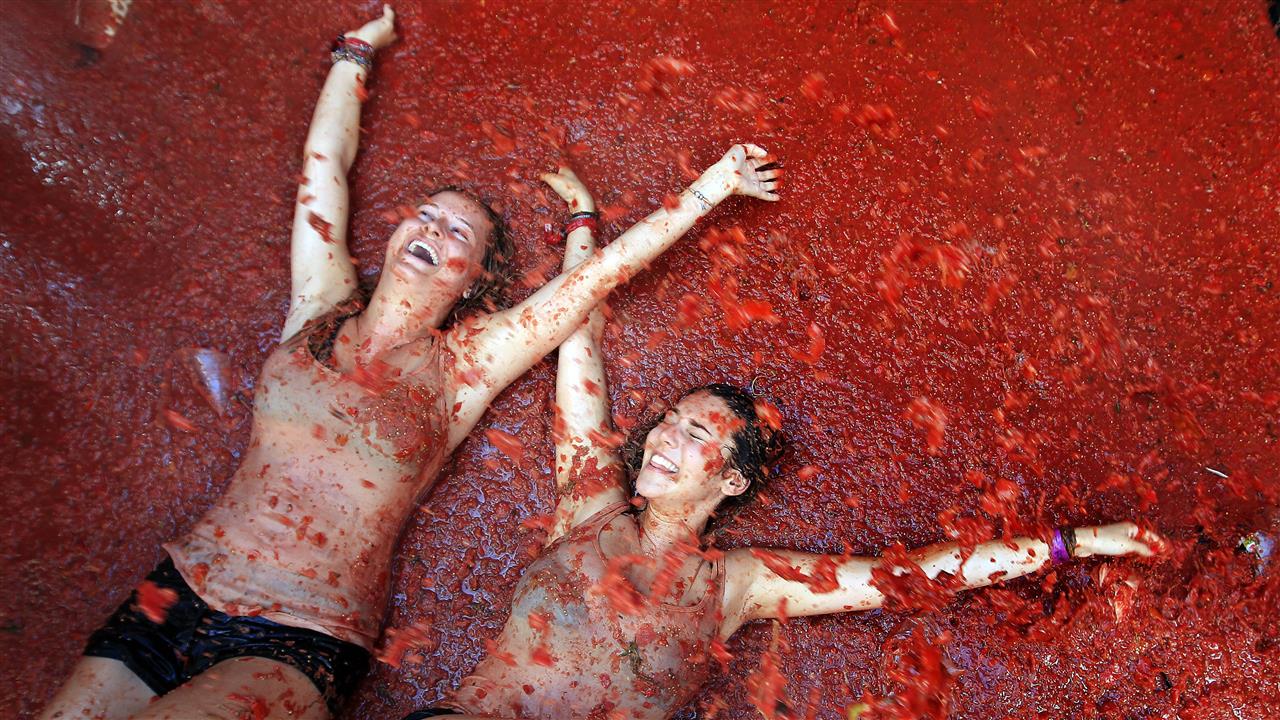
For 51 weeks of the year, it is unremarkable. On the last Wednesday of August, it receives somewhere between 15,000 and 22,000 people — more than twice its permanent population — who have traveled from across Spain and from dozens of countries specifically to stand in its streets and throw approximately 150,000 kilograms of tomatoes at each other for one hour.
The tomatoes are not ordinary tomatoes. They are sourced from the Extremadura region, specifically because Extremaduran tomatoes grown for industrial processing are cheaper, more abundant, and frankly better suited for throwing than the high-quality Valencia tomatoes grown for eating. They arrive in the days before the festival in large trucks, stored until the morning of the event, then loaded onto the five or six dump trucks that slowly move through the designated street — the Calle del Cid and surrounding area — dispensing tomatoes to the crowd.
By the time the hour is over, every surface in a several-block radius is coated in red pulp. The walls run with it. The cobblestones disappear under it. Participants are indistinguishable from each other — same red, same pulp, same grinning disbelief at what they have just participated in. The cleanup begins immediately, conducted by local workers with water hoses, assisted by the mild acidity of tomato juice, which does in fact function as a mild cleaning agent on stone surfaces. Within a few hours, the streets are clean. Within a day, Buñol is quiet again.
The Palo Jabón and the Logic of the Threshold
Before the tomato fight begins, there is a ritual that most accounts mention briefly and move past too quickly: the palo jabón, the greased pole.
A large wooden pole is erected in the main street, its surface coated in grease or soap. At the top, a cured ham — a jamón — is tied. Participants attempt to climb the pole and retrieve the ham. This is significantly harder than it sounds. The grease defeats almost everyone. The few who make genuine progress are immediately grabbed by other participants and used as climbing aids, which defeats them too. The crowd watches, shouts encouragement, laughs at failures.
The tomato fight officially begins either when someone reaches the ham or when festival organizers decide enough time has passed and fire the starting signal.
This ritual is not incidental decoration. It is a threshold — a period of collective absurdity that shifts the crowd's psychological state before the main event begins. Watching people fail to climb a greased pole in increasingly undignified ways is a social leveler: the athletic and the uncoordinated are equally defeated, the strong and the weak are equally ridiculous. By the time the tomatoes arrive, the crowd has already been transformed from a collection of individuals into something more unified — a group that has laughed together at the same spectacle, that has begun to shed the social self-consciousness that normally governs how strangers interact in public space.
The palo jabón is, in other words, the warm-up for social dissolution. La Tomatina itself is the dissolution.
What Actually Happens in the Hour
The trucks begin moving through the street. The tomatoes begin to fly. And here is what accounts of La Tomatina consistently fail to convey: the hour does not feel like chaos. It feels like total, overwhelming sensory immersion in a single collective act.
The smell arrives first — thousands of tomatoes crushed simultaneously produce a smell that is not unpleasant but is absolutely inescapable, a thick vegetable sweetness that coats the back of the throat. The sound is the crowd and the splatter, which are almost the same sound at sufficient volume. The vision narrows — you can see perhaps five meters in any direction before the red haze makes everything indistinct. You are, for the duration, nowhere except here.
The rules that participants are asked to follow exist not to diminish this but to make it survivable. Tomatoes must be squeezed before throwing — a whole tomato thrown at close range at a person's face is a projectile, not a festival element. No bottles, no hard objects, no tearing of clothing. If someone falls, the crowd around them creates space. The festival has a remarkably good safety record for an event where 20,000 people throw heavy objects at each other in a confined space, because the informal social contract of La Tomatina — that the point is shared joy, not individual victory — is genuinely understood and honored by most participants.
There are no sides. There is no winning. There is no point except the act itself.
When the ending signal fires, the throwing stops with a speed that surprises first-time participants. The social contract that governed the previous hour — everyone is a target, everything is permitted — ends as abruptly as it began. People look at each other, red-soaked, and start laughing. Strangers who spent an hour throwing tomatoes at each other shake hands, compare injuries that are always minor, pose for photographs in the red streets.
Spain, the Body, and the Fiesta
La Tomatina did not emerge from nowhere. It emerged from a culture with a highly developed philosophy of festive excess — a tradition of fiestas mayores (major festivals) in which ordinary social constraints are temporarily lifted, the body is permitted its pleasures, and the community reconstitutes itself through shared transgression.
The Spanish festival tradition includes events that make La Tomatina look restrained: the Running of the Bulls in Pamplona, where participants are chased through streets by animals capable of killing them. The Fiesta de San Juan celebrations in which bonfires are leaped and the night is treated as permanently available. The Carnival traditions of Cádiz, where political satire so savage it would be career-ending in normal circumstances is delivered in song by people in elaborate costumes, and everyone applauds.
These festivals share a structural feature: they are bounded. They have start times and end times. The chaos is real but it is contained within a frame that everyone understands. The Running of the Bulls begins and ends on a schedule. La Tomatina lasts exactly one hour. Carnival ends on a specific day. This boundedness is what makes the excess possible — because everyone knows the frame, they can fully inhabit the space inside it. The liberation is total precisely because it is temporary.
Mikhail Bakhtin, the Russian literary theorist, wrote extensively about what he called the "carnivalesque" — the tradition in medieval European culture of designated periods of licensed transgression, where hierarchies inverted, bodies celebrated, and the normal order was temporarily suspended. He argued that these periods were not threats to social order but necessary releases that ultimately reinforced it — that a society which never permitted excess would accumulate pressures that would eventually express themselves more destructively.
La Tomatina is a nearly perfect embodiment of the carnivalesque. The fact that Franco tried to ban it — that a dictatorship that suppressed political opposition, press freedom, and regional cultural expression felt threatened by people throwing tomatoes — suggests that he understood this on some level. Permitted transgression is, paradoxically, a form of social stability. Franco wanted no stability he did not control.
He lost.
The Ticket Question and What Tourism Does to Ritual
Until 2013, La Tomatina was free and open to anyone who showed up. Crowd sizes had grown to the point where safety was becoming a genuine concern — estimates suggested 50,000 or more people in streets designed to hold a fraction of that. The Buñol town council introduced ticketing, capping attendance at 20,000 and charging approximately €10 per person.
The response was divided. Local participants, many of whom had attended for decades, objected to paying for something that had always been free, that had survived a dictatorship without needing to monetize itself. Tourism advocates pointed out that controlled crowds were safer and that the revenue supported the infrastructure required to run the event. Both arguments are correct, and the tension between them is not resolvable — it is the permanent condition of any local festival that becomes a global attraction.
What ticketing unambiguously changed is the demographic composition of the crowd. La Tomatina today draws heavily from international tourism — British, American, Australian, German, Japanese participants who have added Buñol to itineraries that might include Barcelona and Madrid. The festival has become, for many of them, the kind of bucket-list experience that gets filmed on waterproofed phones and posted to social media before the tomato juice has dried.
This is not entirely a corruption. The international participants bring genuine enthusiasm. They follow the rules. They clean up after themselves. They spend money in Buñol's restaurants and hostels in ways that matter economically to a town of 9,000. And many of them leave having experienced something they cannot quite explain — the particular quality of an hour in which the normal rules do not apply and strangers are permitted, even encouraged, to cover each other in red.
What they carry home is an incomplete version of what La Tomatina is. They have the experience without the history — without knowing that people were arrested for this, that someone once carried a coffin through these streets to mourn its banning, that the stubborn insistence of a community on throwing tomatoes outlasted a dictatorship. The experience is real. The context, for most of them, is absent.
The context is what makes it more than a food fight.
The Last Wednesday in August
There is a specific quality to late August in Valencia that matters to understanding La Tomatina. The summer heat in this part of Spain peaks in July and August — dry, intense, the kind of heat that makes the shade feel like a physical object you can lean against. By the last Wednesday of August, people are ready for the heat to break, for the season to turn, for something to mark the end of summer before September's routines begin.
The tomato fight arrives at exactly this moment. It is messy, physical, loud, and cold — the tomatoes, stored in trucks, are considerably cooler than the August air, and being covered in them is, in the morning heat, not unpleasant. The festival is partly a harvest celebration — tomatoes ripening is August's agricultural fact in Valencia — and partly a seasonal threshold, the last transgression before the orderly world reasserts itself.
When the hour ends and the hoses come out and the red runs in the gutters toward the river, the people walking out of the Calle del Cid are not the same people who walked in. Not philosophically transformed. Not spiritually renewed. Just lighter, somehow — the particular lightness of having done something genuinely ridiculous in the company of strangers who were equally ridiculous, of having been, for exactly one hour, completely ungovernable.
Francisco Franco spent fourteen years trying to prevent this feeling. He failed. Every August, Buñol makes sure he keeps failing.
That is the festival. The tomatoes are just the medium.