Flamenco Dance – The Passionate Soul of Spanish Culture
The Art That Survived the Inquisition: How Flamenco Was Born from the Margins of Spain
There is a moment in flamenco that has no English name. The Spanish call it duende — a word that García Lorca, the great Andalusian poet, described in a 1933 lecture as "a power, not a work; a struggle, not a thought." It is the sensation that descends on a performance when something beyond technique takes over — when the dancer's feet are no longer stamping a rhythm but are arguing with fate, when the singer's voice cracks in a way that is not a mistake but a disclosure, when the audience stops watching and starts feeling the performance in the chest, behind the sternum, somewhere uncomfortably close to grief.
Duende cannot be taught. It cannot be rehearsed. But it can only arise from an art form that was built, over centuries, by people who had something real to grieve — and flamenco was built by exactly those people, in exactly that condition, in one of the most persecuted corners of early modern Europe.
To understand flamenco, you have to understand what Andalusia was, and what it lost.
The Wound That Made the Music
Southern Spain, in the centuries before flamenco emerged, was a place of extraordinary cultural density. Al-Andalus — the Muslim-ruled territory that at its peak covered most of the Iberian Peninsula — had sustained, for roughly seven centuries, a civilization in which Arab, Jewish, and Christian communities coexisted with a degree of intellectual and artistic cross-pollination that had no equivalent in medieval Europe. Córdoba in the 10th century was the largest city in Western Europe, its libraries holding more books than the rest of the continent combined. Music, poetry, philosophy, and mathematics flowed between traditions. The Andalusian musical scale — the mode that underlies flamenco's distinctive tonality, with its raised fourth degree and flattened seventh — is directly inherited from Arab-Andalusian musical theory.
Then the Reconquista completed. In 1492 — the same year Columbus sailed, in an accident of dates too neat to be coincidental — the last Moorish kingdom of Granada fell to Ferdinand and Isabella. That same year, the monarchs expelled the Jews from Spain: roughly 200,000 people, communities that had been on the Iberian Peninsula for a millennium, given four months to convert or leave. The Muslims of Andalusia were forced to convert in 1502, the converted communities — Moriscos — subsequently subjected to decades of Inquisition surveillance and eventually expelled entirely between 1609 and 1614. An estimated 300,000 people were driven out in those final expulsions, breaking the last living link to eight centuries of Islamic civilization on European soil.
Into this landscape of erasure came the Romani people — the Gitanos — moving westward through Europe from their origins in northwestern India, arriving in Andalusia in significant numbers in the 15th century. They encountered a world that had just lost two of its three major cultural pillars and that retained, in scattered communities of conversos (converted Jews) and hidden Moriscos, the musical memory of traditions that could no longer be practiced publicly. The Romani, themselves persecuted and marginalized by Spanish law — Gitanos were subjected to decrees requiring settlement, forbidding their language, banning their customs — absorbed what they found and added what they had brought.
Flamenco was the result. Not a single inventor, not a specific date, not a deliberate creation, but the gradual crystallization, over the 17th and 18th centuries, of something that could only have emerged from that specific convergence of the displaced, the silenced, and the surviving.
What Jondo Means
The oldest and most elemental form of flamenco song is called cante jondo — deep song. Lorca devoted the lecture series of his life to it, convinced that it was one of the great musical forms in human history, comparable in antiquity and emotional depth to the Hindu raga and the Byzantine melos. He was right, and he was not alone in thinking so. In 1922, Lorca and the composer Manuel de Falla organized the first Concurso de Cante Jondo in Granada, a festival specifically designed to rescue the deep forms from commercial dilution and restore them to serious artistic attention.
The deep forms — soleá, seguiriya, toná, debla — are the ones that contain duende most reliably. They are not songs about abstract emotion. They are songs about specific, named human conditions: incarceration (carceleras), the deaths of children (nanas in their minor keys), the experience of being hunted by authorities, the loss of home, the particular anguish of the seguiriya, which was historically associated with death, the road to execution, the unresolvable. The seguiriya is in a compound rhythm of twelve beats that cannot be simply counted — it must be felt in the body before it can be followed — and its text, when translated, tends toward images so compressed and brutal they read more like Lorca's own poetry than like folk song.
Cantaores — flamenco singers — are judged not by the beauty of their voices in any conventional sense, but by their capacity to transmit authentic emotional weight. A cracked voice, a voice that strains and breaks at the critical moment, is not a failure. It is evidence. The great cantaor Camarón de la Isla, widely considered the most important flamenco singer of the 20th century, had a voice that sounded simultaneously like a young man and a very old one, silken and rough in the same phrase. He died of lung cancer in 1992 at forty-one. His funeral in Cádiz drew 100,000 people — Romani and non-Romani alike — in one of the largest spontaneous public gatherings in Spain's postwar history.
The Grammar of the Body
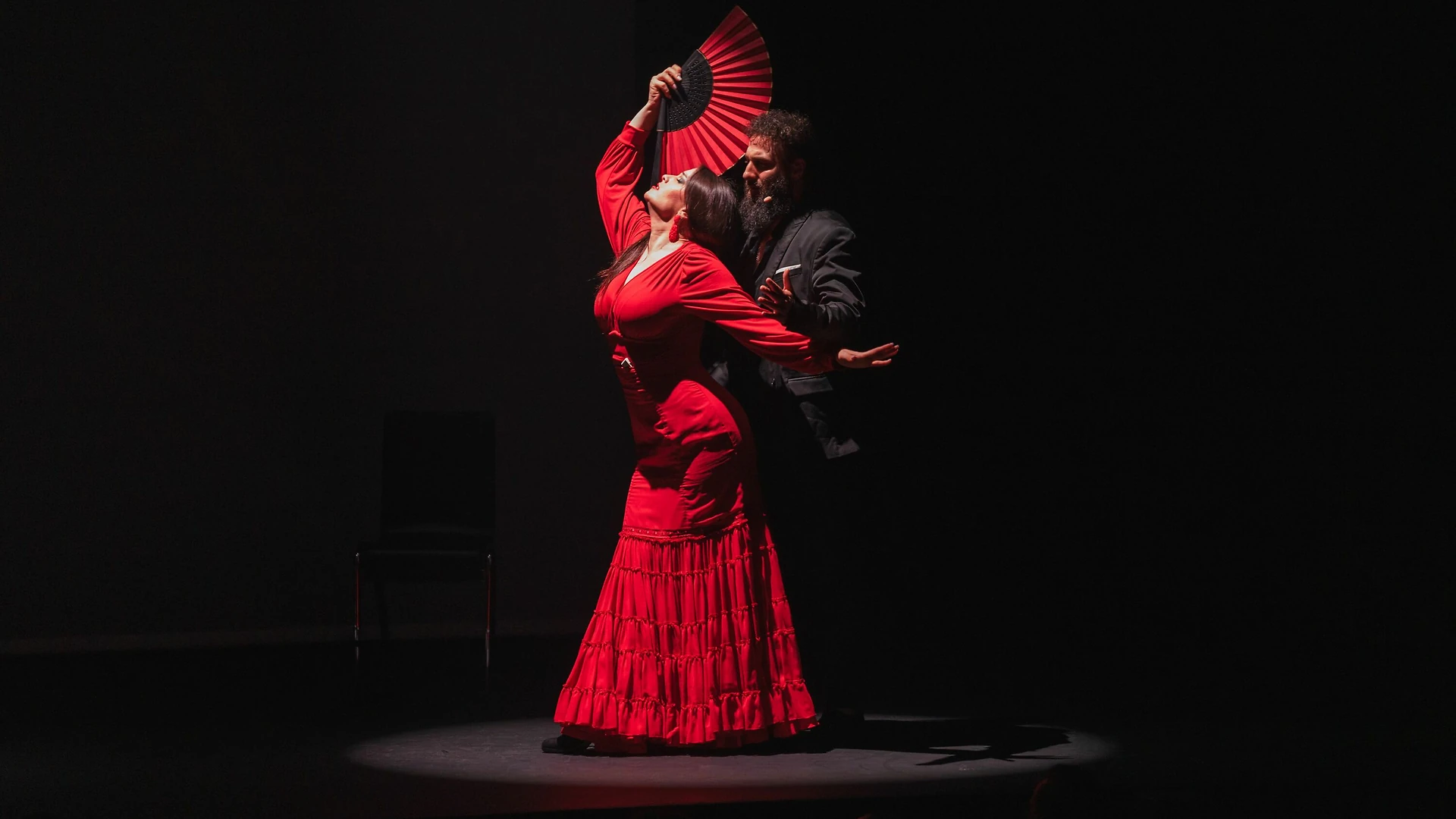
The baile — the dance — operates within a codified vocabulary that takes years of study to master and a lifetime to move beyond. The zapateado, the percussive footwork that defines flamenco dance to outside observers, is not simply stamping. It is a rhythmic language. The distinction between a golpe (full foot strike), a tacon (heel strike), a punta (toe strike), and a planta (ball-of-foot strike) creates a vocabulary of percussion capable of expressing nuance, argument, and counterpoint with the guitar. Advanced bailaores can produce polyrhythmic sequences of sixteen or more distinct strikes per second — a physical feat that requires the same combination of technical precision and emotional expressiveness as concert piano playing.
The arms and hands — floreos and braceo — are the part of flamenco that most clearly reveals its Moorish and possibly South Asian inheritance. The wrists rotate in continuous spiraling motions, the fingers rippling outward in a gesture that appears in miniature paintings from the Mughal courts of India and in the wall decorations of the Alhambra Palace in the same undulating form. The connection is not metaphorical; it is likely genealogical, carried in the body-memory of the Romani people who migrated from northwestern India across Persia and the Ottoman Empire before arriving in Andalusia.
The face in flamenco is not a mask of performed emotion. The great teachers insist that the emotion must be genuine, and that the technique exists to channel and control a feeling that the dancer actually has, not to simulate one they don't. This is why the same piece danced by the same dancer on two different nights can produce completely different performances — because the emotional raw material changes, and the dance responds to what is actually present. It is improvisation, but not of the anarchic kind. It is improvisation within strict formal constraints, the way a jazz musician improvises within a chord progression: freedom earned by deep knowledge of the structure.
The Guitar Arrives Late
The guitar is now so central to flamenco that it is impossible to imagine one without the other, but this association is historically recent. The oldest flamenco forms — cante jondo at its most archaic — were sung unaccompanied, or accompanied only by hand clapping (palmas) and box percussion (cajón, which entered the flamenco tradition from Afro-Peruvian music only in the 1970s, through the guitarist Paco de Lucía). The guitar entered the flamenco world gradually over the 19th century, initially as accompaniment and eventually as a solo art form with its own technical demands and expressive possibilities.
The flamenco guitar is a different instrument from the classical guitar. It is built lighter, with a thinner top, producing a brighter and more percussive sound that cuts through the noise of a tablao (a flamenco venue). The technique involves rasgueados — rapid, multi-finger strumming patterns that create rolling walls of sound — and picado — single-string runs of extreme speed and clarity — and a constant, rhythmic tapping of the body of the guitar with the ring finger, called the golpe, that adds a percussive dimension to what would otherwise be only a harmonic one.
Paco de Lucía, who died in 2014 and who is to the flamenco guitar what Charlie Parker was to jazz saxophone, spent forty years systematically expanding what the instrument could do while insisting that technical innovation without emotional truth was meaningless. His 1981 collaboration with John McLaughlin and Al Di Meola — recorded in an acoustic session that became one of the best-selling guitar albums in history — demonstrated that flamenco technique was not a regional curiosity but a universal musical language capable of meeting jazz and classical music as an equal.
What UNESCO Understood
In 2010, UNESCO inscribed flamenco on its Representative List of Intangible Cultural Heritage of Humanity. The citation noted flamenco's living transmission through apprenticeship and performance, its role in the cultural identity of Andalusian communities, and the ongoing risk of dilution through commercialization and decontextualization. The concern was not academic. The global spread of flamenco — now taught in studios from Tokyo to Toronto — has created a world in which millions of people perform a version of flamenco that is disconnected from the social and historical substrate from which it grew.
This is the tension that every living cultural tradition faces when it becomes globally desired, and flamenco faces it with particular acuity because its original community — the Romani people of Andalusia — remains among the most economically marginalized in Spain. The Gitano neighborhoods of Triana in Seville and Sacromonte in Granada, historically the incubators of flamenco's deepest forms, have been subjected to gentrification that has displaced the very communities whose presence gave those places their cultural meaning. The tourists who come to see flamenco in tablao shows in Seville's old city are often watching performers of genuine skill in venues whose economic model channels money toward the hospitality industry, not toward the Romani communities who preserved the art through centuries of persecution.
This does not mean that non-Romani flamenco is illegitimate. The tradition has always been permeable, and some of the greatest figures in its history — Niña de los Peines, Antonio Mairena, even Camarón in his later collaborations — worked across the Romani and non-Romani boundary. What it means is that the question of credit, of origin, and of economic benefit cannot be separated from the question of the art itself without losing something essential about what the art is and where it came from.
The Dark Sound, Still
There is a peña flamenca — a flamenco club — in almost every town of any size in Andalusia, and in many of them, on certain nights, something happens that has nothing to do with tourism, with UNESCO designations, with fusion experiments, or with the global market for Spanish cultural products. A cantaor stands up, the guitarist finds the compás, the room goes quiet in a particular way — not politely quiet but attentively quiet, the silence of people who know what might happen next and are holding themselves ready for it — and the song begins.
And sometimes, not always but sometimes, duende arrives.
Lorca said you cannot fight duende. You can only clear the way for it, by mastering the technique and then releasing the technique, by having something genuine at stake in the performance, by being willing to be exposed. The best flamenco is always an act of exposure — of emotion that is not safely performed but actually felt, in front of witnesses, at the edge of control.
This is what Kaldi's goats and the Starbucks trademark dispute and the tourist tablao cannot reach, and what five centuries of persecution, expulsion, and marginalization could not extinguish. Not the steps, not the costume, not the chord progression — but the specific quality of human vulnerability that the art makes possible, the willingness to stand in front of other people and mean it.
Spain didn't create that. The people Spain tried to erase did.