The Building That Grief Made: What the Taj Mahal Is Really Saying
The Building That Grief Made: What the Taj Mahal Is Really Saying
In June 1631, in the city of Burhanpur in the Deccan, the empress Arjumand Banu Begum — known to history by her court title, Mumtaz Mahal, "the Exalted One of the Palace" — died during the birth of her fourteenth child. She was thirty-seven years old. Her husband, the Mughal Emperor Shah Jahan, had been married to her for nineteen years and had, by all contemporary accounts, organized his emotional life around her with an intensity unusual even by the standards of a court where the emperor's personal attachments carried considerable political consequence. He had taken her on military campaigns. He had named her keeper of the imperial seal. He had made her the mother of the heir apparent and the figure around whom the court's social world revolved.
The accounts of his grief at her death are consistent across sources hostile and sympathetic: he did not leave his private chambers for eight days. When he emerged, his hair had gone white. For two years he wore only white, the Mughal color of mourning, and suspended all music and entertainment at court — a silence in the cultural life of an empire in which the emperor's aesthetic preferences were inseparable from state policy. He never remarried in any meaningful sense. And he began, within months of her death, the project that would consume the next twenty-two years of his reign, the labor of approximately 20,000 workers, and quantities of white marble, precious stone, and gold that no subsequent monument in the subcontinent has approached: the construction, on the southern bank of the Yamuna River at Agra, of a tomb so beautiful that it would make visible — in white stone and flowing water and the precise geometry of paradise — what he could not say in any other form.
The Taj Mahal is the world's most visited monument to grief. It is also, if you know how to look at it, one of the most sophisticated theological and cosmological statements ever made in architecture. The love story is real. The building is the argument.
The Commission and the Concept: Paradise as Blueprint
The design of the Taj Mahal was not a single architect's vision imposed on a compliant patron. It was the product of a design council that Shah Jahan convened and directed — the emperor himself a sophisticated architectural patron who had already overseen significant construction projects at Delhi and Lahore, and who had specific ideas about what the tomb was supposed to achieve. The primary architect credited in Mughal court records is Ustad Ahmad Lahauri, though the design process involved multiple specialists including calligraphers, garden designers, hydraulic engineers, and stone inlay craftsmen whose combined expertise was required to execute a conception of unusual complexity.
The conceptual framework of the Taj Mahal is drawn from the Quranic description of Jannat — paradise — and from the Persian garden tradition (chahar bagh, the "four-fold garden") that had provided Islamic architecture with its most important spatial metaphor for the divine realm since the earliest Islamic dynasty. The Quran's paradise is described in sensory terms: flowing water, lush gardens, pavilions of precious material, the presence of the divine translated into earthly abundance. The chahar bagh — a garden divided into four quadrants by water channels representing the four rivers of paradise — is the architectural translation of this description into a spatial form that could be built, walked through, and experienced.
At the Taj Mahal, this framework is executed at a scale and precision that no preceding Islamic garden tomb had attempted. The chahar bagh south of the tomb structure is a formal garden of approximately 300 meters square, divided into sixteen sunken parterres by raised walkways and water channels, with a central reflecting pool aligned to the tomb's central axis. The garden's planting — recorded in Mughal-period accounts as including cypress, fruit trees, and flowering species chosen for fragrance and seasonal succession — has not survived intact, but the spatial structure is preserved, and it is through that spatial structure that the garden does its theological work: the visitor who walks the central axis from the monumental gate to the tomb's plinth is walking the axis of paradise, approaching the divine presence through a landscape designed to be beautiful in the way that scripture says the beyond is beautiful.
The Gate and the Revelation: Architectural Sequence as Experience
The Taj Mahal is not experienced as a building you approach across open ground. It is experienced as a revelation — a spatial sequence designed to control when and how the monument becomes visible, so that the first full view arrives with maximum impact. The Darwaza-i-Rauza ("Gate of the Tomb") — the red sandstone entrance gateway at the southern end of the complex — is a two-story structure large enough to be a significant monument in its own right, and it is designed specifically to conceal the tomb until the visitor passes through its central arch.
The concealment is precise. Approaching the gateway from the outer forecourt, a visitor sees only the gate — imposing, beautifully detailed with white marble inlay and Quranic calligraphy, but opaque. Walking through the gateway's central arch produces the view that seven million visitors a year record on their phones and that no photograph has ever fully captured: the white marble tomb at the end of the axial water channel, perfectly reflected in the pool before it, framed by the gateway arch, with the four minarets rising at its corners and the sky behind it.
This revelation sequence is a deliberate theological staging: the transition from the outer world — represented by the red sandstone of the gate and the forecourt, materials of the terrestrial — to the inner world of the tomb complex, dominated by white marble, material of the celestial, enacts a passage from the profane to the sacred that the visitor experiences physically before understanding it conceptually. You walk through a gate and the world changes color. The red sandstone disappears. Everything ahead is white.
The Marble and Its Optical Intelligence
The white marble of the Taj Mahal is Makrana marble from the quarries of Makrana in Rajasthan — a stone of unusual purity and translucency selected, among other reasons, for its optical behavior in different light conditions. This reflects a deliberate decision to use a material whose appearance changes with the quality of light in ways that give the building a quality of aliveness that static materials do not possess.
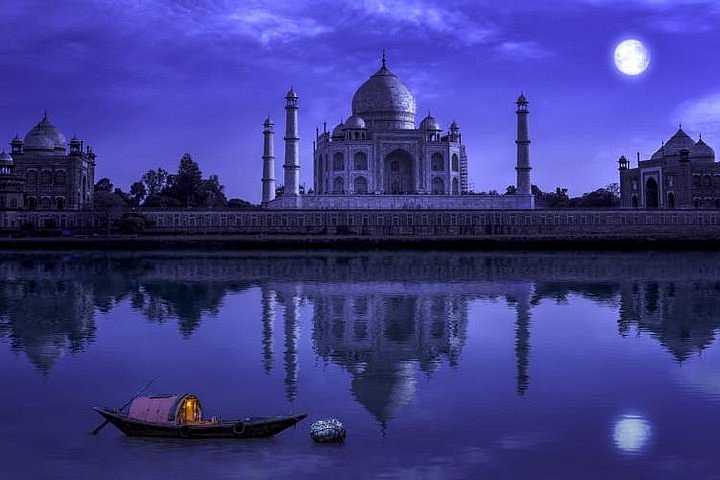
At dawn, Makrana marble reflects the pinks and golds of the rising sun, the tomb's white surface warming to a color close to the inside of a shell. At midday under direct sun, it achieves a blinding brightness that pushes the eye back from its surface, the building seeming to generate light rather than merely reflect it. In the late afternoon, it takes on blue-grey tones from the sky. In overcast conditions, it becomes a flat, luminous white with no shadows — almost immaterial, as if the building were made of compressed cloud. At full moon, historical accounts describe it as nearly translucent, appearing to glow from within. Shah Jahan is said to have visited the tomb on moonlit nights specifically to experience this effect.
The building also performs a series of optical corrections. The four minarets at the corners of the plinth are not vertical — they lean outward by approximately two degrees from the plinth's center. This is a deliberate correction: if the minarets were perfectly vertical, the visual effect of their height against the dome would create the appearance of inward lean. By building them slightly outward, the designers achieved the appearance of perfect verticality. The tomb's plinth itself is elevated approximately seven meters above the garden level — not only for visual drama but to ensure that the building appears to float above its surroundings when viewed from the garden, severed from the earth in a way appropriate for a structure meant to suggest the celestial.
The central dome rises approximately 74 meters above the plinth at its finial. Its proportions are carefully calculated to read correctly both from the garden — where distance compresses vertical elements — and from close approach, where the dome would otherwise appear to foreshorten. The four subsidiary domed pavilions at the dome's corners are positioned and scaled to create a visual hierarchy that the eye resolves as a single coherent composition from every approach angle — an achievement that required, before computer modeling was available, a geometric sophistication in three dimensions that the Mughal designers carried in mathematical training and spatial intuition.
The Calligraphy: A Building That Reads
One of the most intellectually demanding dimensions of the Taj Mahal is its calligraphic program — the Quranic verses and other inscriptions in black marble thuluth script inlaid into the white marble surfaces of the gateway, the tomb, and the interior cenotaph chamber. The calligraphy was designed by Amanat Khan Shirazi, whose name appears in the inscriptions themselves — a rare instance of a craftsman signing his work in the Mughal period, permitted here as a mark of exceptional royal favor.
The specific Quranic passages chosen for the inscriptions are not decorative; they are theologically precise selections whose content corresponds to the architectural and spiritual program of the tomb. The gate's exterior carries verses associated with the Day of Judgment and the entry of the righteous into paradise — appropriate for a threshold between the outer world and the inner. The tomb itself carries passages about the divine mercy, the soul's journey, and the peace of those who have found God's favor. The interior chamber carries the Throne Verse and the ninety-nine names of God.
Amanat Khan achieved a technical refinement that rewards close examination: the letters of inscriptions on the lower portions of the gateway, which are read from closer range, are proportionally smaller than the letters of inscriptions higher up, which must be read from further away. The size calibration is precise enough that all inscriptions appear to be the same size from the viewer's position — an optical correction applied to typography with the same sophistication applied to the minarets. The building is correcting for human perception at every scale.
The Interior: Darkness and the Cenotaph
The interior of the Taj Mahal is one of the greatest disappointments in world tourism — not because it is unworthy but because the scale of expectation the exterior creates cannot be met by any room. The octagonal central chamber, approximately 17 meters across, is dim even in daylight, lit by carved marble screens that filter the light into patterns on the walls and floor. The cenotaph of Mumtaz Mahal occupies the chamber's center; Shah Jahan's cenotaph, added after his death in 1666, is placed beside hers, slightly off the room's central axis — the only asymmetry in a building otherwise committed to perfect symmetry, and the detail that, for many visitors who know what they are looking at, is the most emotionally affecting element in the entire complex.
Shah Jahan had intended, according to multiple historical sources, to build a second tomb for himself across the Yamuna River — a black marble structure connected to the white by a bridge, the two tombs together completing a composition in which his death would mirror hers. This project, if it existed as a serious intention rather than a posthumous legend, was never built. He was deposed in 1658 by his son Aurangzeb, who imprisoned him in the Agra Fort for the last eight years of his life. From his window in the fort, Shah Jahan could see the Taj Mahal across the river. Contemporary accounts report that he spent the final years of his life in this position, looking at what he had built.
His body was brought to the Taj Mahal after his death and interred beside Mumtaz Mahal — the second tomb that disrupts the chamber's axis his only monument, the asymmetry that marks the end of the story.
The Pietra Dura: Flowers That Will Never Wilt
The decorative surface of the Taj Mahal repays close examination in ways that photographs at tourist scale do not permit. The exterior marble surfaces and interior chamber are covered with pietra dura — called parchin kari in Mughal craft vocabulary — the art of inlaying precisely cut slivers of semi-precious stone into marble to form patterns and images of extraordinary fineness.
The Taj Mahal's pietra dura work uses approximately thirty-five types of gemstone: carnelian, jasper, lapis lazuli, turquoise, malachite, onyx, coral, and others whose sources extended from Afghanistan to Tibet to the Indian Ocean trade routes. The floral motifs that cover the lower walls of the tomb and the interior surfaces are not repetitive patterns applied across a surface; each flower is individually designed, its petals cut from stones whose natural color variation is exploited to create internal gradation. The vine and leaf motifs that border the floral panels are executed with a fineness — some elements less than a millimeter wide — that contemporary craftsmen working in the parchin kari tradition describe as the most demanding technical challenge in the entire craft vocabulary.
The specific flowers chosen for the Taj Mahal's decorative program carry poetic associations in the Persian literary tradition — the narcissus, the iris, the lily, the tulip, the poppy — that a literate Mughal visitor in the seventeenth century would have read as fluently as we read text. The tomb is covered in flowers that will never wilt — an implicit argument about permanence, about the preservation in marble of what flesh cannot hold.
Construction: An Empire at Work
The white Makrana marble was quarried approximately 300 kilometers from Agra and transported by ox cart — a journey of six weeks for large blocks. The semi-precious stones for the pietra dura came from sources across the empire and from trade connections extending to Central Asia and the Indian Ocean world: lapis lazuli from Badakhshan, turquoise from Iran, carnelian from Gujarat, malachite from Central Asia, coral from the Arabian Sea. Approximately 20,000 workers were employed at the peak of construction, drawn from across the empire and from specialized craft centers in Lahore, Delhi, and Agra. One thousand elephants were employed in the transport of materials.
The foundation of the tomb presented an engineering challenge specific to its riverine location: the Yamuna River's bank is soft alluvial soil, incapable of supporting the weight of a massive marble structure without settlement. The Mughal engineers solved this through a system of deep wells sunk to the level of stable substrate, filled with rubble, mortar, and stone, creating an underground grid of foundations that has supported the structure without significant differential settlement for nearly four centuries. The engineering solution that keeps the Taj Mahal standing is the same solution that keeps timber pilings under Venice's canals standing: keep them permanently wet. The Agra riverfront's water table ensures that the wood elements of the foundation system remain permanently saturated, preserved from the rot that alternating wet-dry conditions would produce.
The Taj Mahal Under Threat
The Taj Mahal's current condition is a source of significant concern among conservators and environmental scientists. Air pollution from Agra's industrial zone has progressively stained the marble over decades — the white surface acquiring a yellow-brown patina that is removed periodically by the application of a traditional clay paste that draws pollutants out of the marble pores. The treatment is effective but is a maintenance response to ongoing contamination, not a solution, and the pollution sources have not been adequately controlled despite decades of judicial orders.
The Yamuna River's ecological degradation compounds the threat. The river Shah Jahan selected as the complex's northern boundary — specifically for its visual contribution to the composition — is now so severely polluted and reduced in flow by upstream diversions that it barely functions as a river through much of the year. The foundation system's preservation depends on adequate groundwater levels; the river's reduction has lowered the water table in ways that conservators monitor closely.
Seven million annual visitors produce physical wear on the marble surfaces and microclimatic changes in the interior chamber that affect the stone's condition. The Archaeological Survey of India has implemented visitor management measures, but the pressure of these numbers at a site of this scale is inherently difficult to manage without either restricting access — politically contentious — or accepting ongoing physical degradation.
A Monument That Outlived Its Maker
In 1658, Aurangzeb — Shah Jahan's third son — defeated his brothers in a succession war, imprisoned his father in the Agra Fort, and began the Mughal Empire's longest reign. He did not destroy the Taj Mahal, which speaks to the monument's established status as a work of genius even within the generation that produced it. But the empire he ruled began the slow contraction that ended the Mughal dynasty's effective power within a century.
The Taj Mahal survived the empire that built it. It survived the British colonial period, during which Lord Curzon ordered significant restoration work. It survived Indian independence and the subsequent decades of uneven maintenance. It is UNESCO World Heritage listed, one of the New Seven Wonders of the World by popular vote, reproduced on an uncountable number of objects, and simultaneously, in the physical original at Agra, among the most affecting experiences available to a human being who can get there.
What Shah Jahan built was a theological proposition: that love, properly expressed in stone, could defeat time. The proposition has not been fully tested yet — the building is less than four centuries old, which is young for ambitious architecture. But it has so far done better than he did. He was deposed and imprisoned. She died in childbirth. The building stands, white and precise and mathematically overwhelming, every morning catching the light in a new way, every dusk changing color as the sun descends, and every night — when the tourists have gone and the garden is quiet — reflecting the moon in its pool, doing exactly what grief