Classical Dances of India – The Grace and Legacy of Bharatanatyam
The Dance the Colonizers Tried to Ban: How Bharatanatyam Was Saved and What It Almost Lost
In 1910, the government of Madras Presidency passed the Madras Devadasi (Prevention of Dedication) Act, a piece of legislation whose stated purpose was the protection of women. What it actually did was criminalize one of the oldest continuous performance traditions in human history.
The devadasis — women dedicated to temple service, trained from childhood in dance, music, and Sanskrit literature, who had performed in South Indian temples for at least a thousand years — were declared by the colonial administration and its Indian reformist allies to be little better than prostitutes. Their art was characterized as immoral, their social position as degrading, and their dedication ceremonies as a form of exploitation masquerading as religious practice. The legislation that followed, completed in 1947, formally abolished the devadasi system and with it the institutional framework within which Bharatanatyam had existed, been transmitted, and been understood for more than a millennium.
The dance survived. Its survival is one of the most contested, complicated, and revealing stories in the history of any art form — a story about colonialism, caste, gender, nationalism, and the question of who gets to decide what a tradition means and who it belongs to.
The Temple as Theater
To understand what was lost and what was preserved, it is necessary to understand what Bharatanatyam originally was — not in the version that appears on concert stages in Chennai and London and New York today, but in its temple context.
The devadasis — the word means literally "servant of god" — were women who underwent a formal dedication ceremony, pottukattu, typically in childhood or early adolescence, in which they were ritually married to the temple deity. This dedication meant that they could never be widowed, unlike ordinary married women, because their divine husband could not die. It also meant that their social position was categorically different from both married and unmarried women in the caste-stratified world of South India: outside the rules governing ordinary female life, literate in an age when most women were not, financially independent through the land grants and income that accompanied their temple position, and trained to the highest standards in the arts that served the deity.
Their performance — called sadir or dasi attam before the 20th century, and later renamed Bharatanatyam in the revival period — was not entertainment. It was liturgy. The specific dances performed at specific times in the temple ritual calendar were understood as offerings to the deity as real as the flowers, incense, and food that constituted other forms of worship. When a devadasi danced the alarippu — the opening invocatory dance — at the start of a temple ceremony, she was not performing a pretty sequence of movements. She was enacting an invitation to the divine presence to descend into the ritual space.
The theological framework within which this made sense is bhakti: the devotional tradition in Hinduism that holds that the highest form of worship is not ritual correctness but the intensity of personal love between the devotee and the deity. The bhakti poets of Tamil Nadu — the Alvars and Nayanmars of the 7th through 10th centuries CE — composed the songs that devadasis danced, and many of those songs were erotic in their imagery, describing the devotee's longing for union with the god in the language of romantic love. Within the bhakti framework, this was not inappropriate. It was theologically precise: the soul's relationship to the divine was understood through the most intense human relationship available, which was romantic and erotic love. The dance enacted that relationship in the deity's own house.
What the Natya Shastra Built
The technical vocabulary of Bharatanatyam is codified in the Natya Shastra, a Sanskrit treatise on the performing arts attributed to the sage Bharata Muni and dated by scholars to somewhere between 200 BCE and 200 CE — making it roughly contemporaneous with Aristotle's Poetics and serving a comparable function as the foundational theoretical text of an entire performance tradition. The Natya Shastra is 6,000 verses long. It covers dramatic theory, staging, music, dance, costuming, makeup, the psychology of audience response, and the metaphysics of aesthetic experience with a comprehensiveness that has no real equivalent in any other ancient tradition.
The Natya Shastra's description of abhinaya — the art of expression — establishes the framework within which Bharatanatyam's expressive vocabulary operates. Abhinaya is categorized into four types: angika (expression through body and gesture), vachika (expression through speech and song), aharya (expression through costume and makeup), and sattvika (expression arising from genuine emotional truth rather than technical simulation). The sattvika category is the most important and the most difficult: it describes the condition in which a performer genuinely experiences the emotion they are depicting — bhava — and transmits it to the audience as rasa, aesthetic emotion, rather than merely displaying its external signs.
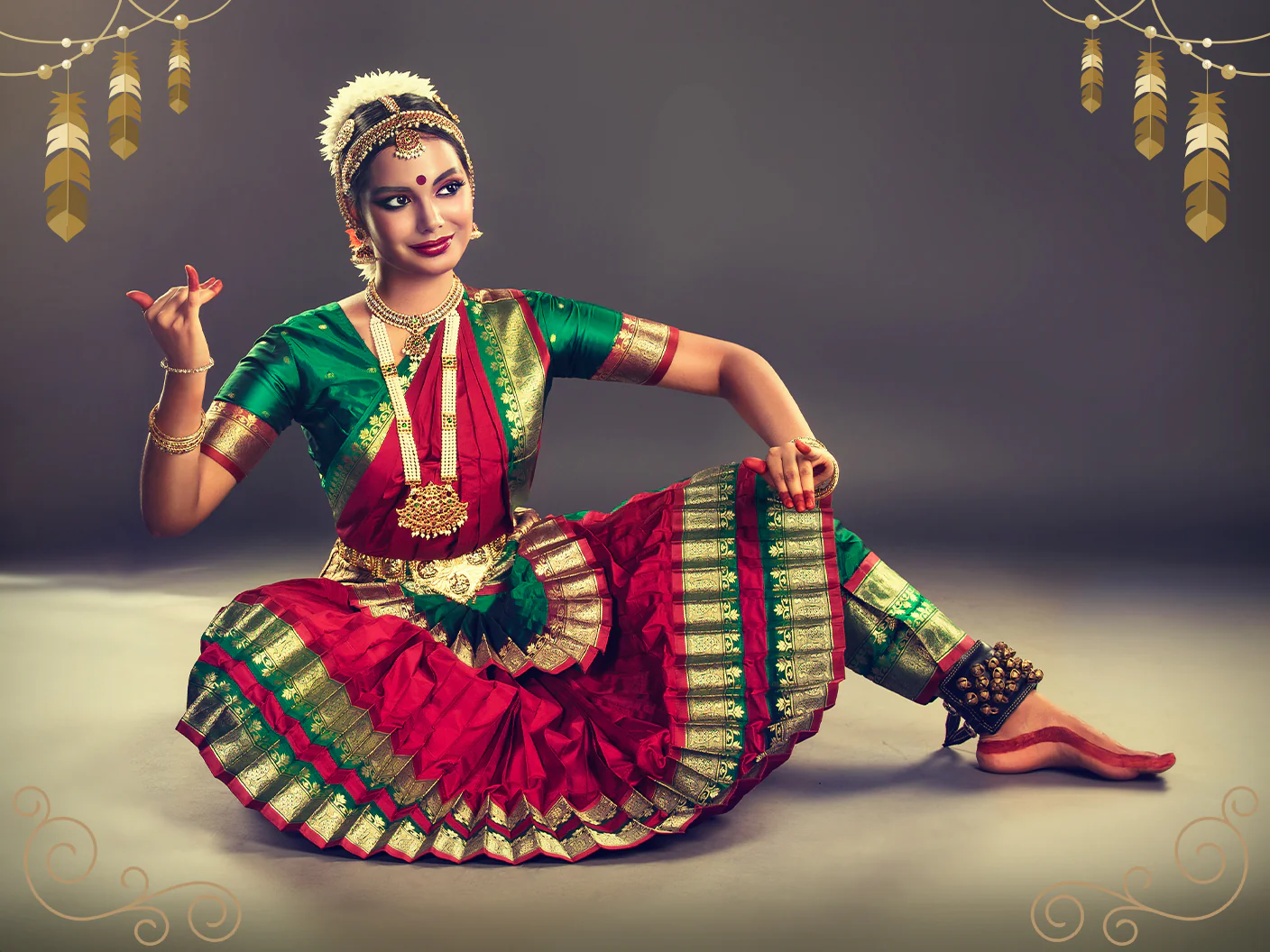
The hastas — the hand gestures that outsiders most immediately associate with classical Indian dance — number 108 in the Natya Shastra's primary classification, each with a name, a specific configuration of fingers and palm, and a range of assigned meanings. A single hasta can signify different things depending on context: the tripataka gesture (three fingers extended, ring finger folded) can mean a crown, a tree, the number three, lightning, a sword, or a particular ritual object depending on how it is deployed in the narrative and what the accompanying facial expression and body position indicate. The system is a language with a grammar — not a collection of symbols but a combinatorial vocabulary capable of expressing almost unlimited nuance.
Equally codified is the adavu system — the foundational units of footwork from which Bharatanatyam's choreography is constructed. There are approximately 120 basic adavus, organized into thematic families (the tattadavu group for pure rhythmic stamping, the nattadavu group for extended leg positions, the kudittamettu group for jumping movements) each of which is practiced in isolation before being combined into the choreographic sequences that constitute a performance. A student of Bharatanatyam spends years, typically beginning at age five or six, learning adavus before dancing any expressive piece. The discipline required is comparable to the finger and scale exercises that precede a concert pianist's ability to interpret music — the technique must become unconscious before expression can begin.
The Guru-Shishya Chain
For most of its history, Bharatanatyam was transmitted through a guru-shishya relationship — the direct, personal transmission of knowledge from master to student in an intimate and long-term pedagogical relationship that has no precise Western equivalent. The nattuvanars — the male hereditary teachers of the devadasi tradition, who provided the rhythmic instruction, composed the choreography, and conducted the performance — held their knowledge as family property, transmitted from father to son across generations. Their relationship with the devadasi students they trained was one of absolute authority over artistic matters and deep personal investment in the student's development.
This system produced dancers of extraordinary caliber. The training was intensive, continuous, and holistic: a student in the devadasi tradition was not learning dance as an after-school activity but as the entire substance of her education and social formation. She was learning Sanskrit, Tamil literature, music theory, astronomy (required for understanding the ritual calendar), the iconography of the deities whose stories she would enact, and the complete social world of the temple within which her art made sense.
When the colonial administration dismantled this system, it did not merely ban a set of dance practices. It severed a transmission chain that had been unbroken for centuries. The specific knowledge held by the nattuvanars — the full choreographic repertoire, the relationship between specific compositions and their correct performance styles, the oral commentary tradition that explained what individual sequences meant within the larger theological framework — began to leak away as the institutional context that had sustained it was destroyed.
The Revival and Its Contradictions
The revival of Bharatanatyam in the 1930s is most commonly associated with Rukmini Devi Arundale, a Brahmin woman with no family connection to the devadasi tradition who encountered the art through a chance meeting with the Russian ballerina Anna Pavlova in 1928, became fascinated, sought training from a nattuvanar named Meenakshisundaram Pillai, and began performing publicly in 1935. Her 1935 performance at the Diamond Jubilee of the Theosophical Society in Adyar, near Madras, is often cited as the beginning of Bharatanatyam's modern life as a concert stage art.
Rukmini Devi's contribution was immense and her intentions were sincere. She founded the Kalakshetra institution in 1936, which became one of the most important centers for Bharatanatyam training and has produced generations of distinguished performers. She systematized and codified a training curriculum that made the art transmissible outside the specific hereditary and institutional context of the devadasi tradition. She brought the art to concert stages and international audiences, securing for it the respect and recognition that colonial contempt had denied it.
She also, in ways that remain contested, transformed it. The explicit erotic imagery of many devadasi compositions — the sringar rasa (erotic aesthetic) that the bhakti tradition had placed at the center of devotional expression — was toned down or reinterpreted in Rukmini Devi's versions. The padams and javalis (lyrical compositions expressing the nayika's, the heroine's, longing for her lover/deity) were given more spiritualized, less physically immediate interpretations. The bare-midriff costume of the devadasis was modified to cover the torso more completely. The performance context shifted from temple ritual to concert auditorium. The art became more legible to Brahmin upper-class sensibilities and to international audiences.
The hereditary community whose art was being revived largely did not benefit from the revival. The nattuvanars who provided the foundational training — without whose knowledge the revival would have had nothing to revive — were employed as instructors at institutions like Kalakshetra but rarely received the institutional recognition given to the Brahmin women who became the revival's public face. The devadasi community, already impoverished by the abolition of their hereditary rights and temple income, found themselves watching their ancestral art transformed into a respectable middle-class accomplishment from which they themselves were largely excluded by caste and economic circumstance.
This history is not generally discussed in introductory articles about Bharatanatyam. It is extensively discussed by Indian feminist scholars, Dalit activists, and scholars of performance studies, and it is the subject of ongoing and genuine disagreement about what was saved and what was lost in the revival, who owns the tradition, and what acknowledgment is owed to the community who preserved it through the centuries of its greatest difficulty.
What the Dancer's Body Knows
To watch a Bharatanatyam performance without the theoretical background is to encounter something beautiful and partially opaque. To watch it with the background is to see a performance of extraordinary information density in which every element is simultaneously functional and symbolic.
The arangetram — the debut performance that marks a student's completion of foundational training, typically occurring after seven to ten years of intensive study — follows a structure established centuries ago. It begins with alarippu, the invocatory piece in which the dancer's body is literally assembled before the audience: the piece introduces the face, then the arms, then the torso, then the feet, integrating the body into readiness for performance in a sequence that mirrors the deity's entering of a ritual vessel. It proceeds through jatiswaram (pure rhythmic dance), shabdam (first introduction of expressive gesture), varnam (the central and most demanding piece, combining pure dance with extended expressive sequences), and concludes with tillana (a finale of rhythmic celebration) and a closing devotional piece.
Each piece in this structure serves a specific pedagogical and aesthetic function, and the entire sequence — which typically lasts two to three hours in a full performance — is designed to introduce the audience to every dimension of the art in a deliberately sequenced progression. An arangetram is a student's most important day. It is also, within the tradition's own framework, an offering: to the teacher whose knowledge has been transferred, to the lineage of teachers behind them, and to the deity in whose honor the art was originally created.
The anklets — ghungroo, strings of small bells tied around both ankles — are not decorative. Each contact of the foot with the floor rings them, and the specific pattern of rings produced by a sequence of footwork is a rhythmic statement legible to any musician in the accompanying ensemble. The dialogue between the dancer's feet and the mridangam (double-headed drum) player — each responding to and anticipating the other, both working from the same tala (rhythmic cycle) but expressing it differently — is a conversation conducted through the body, sustained across an entire performance, that trained listeners follow with the same attention a jazz audience gives to improvisational exchange between players.
The Art That Arrived Everywhere
Bharatanatyam is now taught in cities on six continents. The Indian diaspora carried it wherever it went, and in many diaspora communities it became a primary vehicle for transmitting cultural identity to children growing up outside India — a function the art was never designed for but has adapted to serve with considerable effectiveness. A Tamil child in Toronto or Singapore or Johannesburg who trains in Bharatanatyam is not simply learning a dance form. She is learning Tamil poetic and religious tradition, the iconography of South Indian Hinduism, a physical discipline requiring years of commitment, and a connection to a lineage of women whose bodies carried this knowledge when it had nowhere else to live.
The global spread has also produced genuine artistic expansion. Choreographers like Chandralekha, who worked in Chennai from the 1970s until her death in 2006, used the technical vocabulary of Bharatanatyam as the foundation for work that engaged with feminist politics, Indian philosophy, and contemporary movement aesthetics in ways that the tradition's orthodox practitioners found challenging and that international audiences found revelatory. Her 1988 work Angika — a meditation on the body as the primary site of knowledge, performed to the sound of Bharatanatyam footwork alone, without melodic accompaniment — demonstrated that the technical vocabulary could generate meaning in contexts entirely outside the temple or classical stage.
What Chandralekha's work made visible was something that the tradition had always contained: the idea that the body is not the medium through which the art is transmitted, but the art itself. The Natya Shastra's concept of sattvika abhinaya — expression arising from genuine emotional truth rather than technical display — was always pointing toward a form of knowledge that is not transferable through notation or description but only through the body's own experience of itself. The devadasis knew this. The nattuvanars knew this. The tradition survived, through all the disruptions of the last two centuries, because enough people refused to let a knowledge that lives only in bodies disappear from bodies entirely.
The Offering, Continued
The alarippu is still performed. The feet still ring against the floor, and the bells answer, and the hands move through their ancient configurations in front of faces trained over years to feel what they are expressing rather than merely to approximate it. In temples in Tamil Nadu where the tradition was nearly extinguished, devadasi descendants are beginning to reclaim the right to perform that their grandmothers had when the colonial legislation took it away. In diaspora community centers in Auckland and Birmingham and Houston, children who have never seen the Chidambaram temple are learning to embody the stories of Shiva's dance in the same technical language that has encoded those stories for two thousand years.
The art moved from the temple to the concert stage and lost some things in the movement. It gained others. It is now trying, in various ways, to understand what it lost and whether any of it can be recovered — and to go on being itself in the meantime, which it does every time a dancer steps onto the stage and the first bars of the alarippu begin and the body assembles itself, piece by piece, into something ready to offer.
The offering, as it has always been, is the act itself. The dance is the devotion. The devotion is the dance.
It is still going.