Woven Into Identity: The Carpet Heritage That Defines Turkmenistan
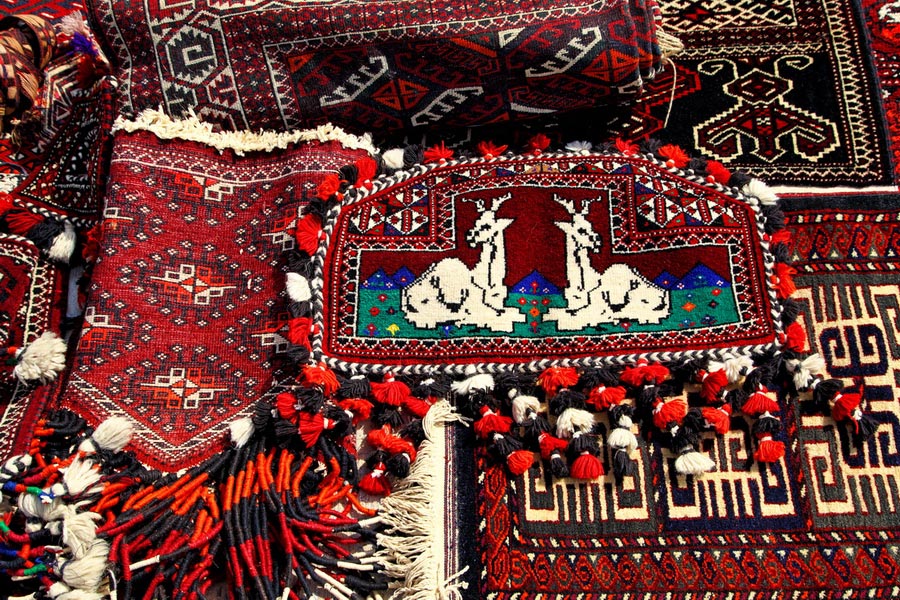
Woven Into Identity: The Carpet Heritage That Defines Turkmenistan
Look closely at the flag of Turkmenistan. Down its left edge runs a vertical stripe of deep red, and embedded within that stripe are five geometric medallions, each one distinct from the others, each one a compressed visual vocabulary that a Turkmen weaver could spend a month producing in wool. These are **guls** — the tribal medallions that identify the five major Turkmen tribal confederations and that have appeared on Turkmen carpets for at least a thousand years. Most nations put eagles on their flags, or stars, or the silhouette of a geographic form. Turkmenistan put carpet patterns. This is not a stylistic choice. It is an accurate statement about what holds the country together.
Carpet weaving in Turkmenistan is not a craft tradition. It is an epistemological system — a way of encoding, transmitting, and claiming knowledge about identity, kinship, and cosmology that long predates the written forms that scholars privileged. Before the Turkmen people had a widely shared alphabet (the Cyrillic script imposed during the Soviet period; the current Latin-based alphabet adopted in 1993), Turkmen women were producing carpets whose pattern vocabulary could communicate tribal affiliation, marital status, spiritual protection, and geographic origin to anyone who knew how to read the knots.
That knowledge — how to read a carpet — is not widely held outside Turkmenistan, and increasingly it is under pressure within it. Understanding what is at stake in Turkmen carpet culture requires reading the knots themselves.
The Gul: A Motif as Identity Document
The word **gul** means "flower" in Persian, but the guls of Turkmen carpet design are not floral in any botanical sense. They are geometric medallions — octagonal, cross-sectional, or polygonal forms — whose internal details vary by tribal origin with a precision that ethnographers and carpet scholars have spent two centuries trying to fully decode.
Each of the major Turkmen tribal groups — **Tekke**, **Yomut**, **Ersari**, **Saryk**, **Choudor**, and others — has its own primary gul, and the appearance of that gul on a carpet is a declaration of tribal membership as unambiguous as a surname. The Tekke gul, perhaps the most recognizable to Western eyes (it dominated the Central Asian carpet trade in the nineteenth century), is an octagonal form with internal cross-structures and hooked appendages, usually executed in crimson and white with dark blue accents. The Yomut gul is more diamond-shaped, with characteristic internal diagonal fills. The Ersari, the largest tribal grouping and the one occupying the Amu Darya river basin, produces a wider range of gul variants reflecting the group's own internal diversity.
But the gul's function goes beyond identification. Carpet scholars including Orientalist Johannes Kalter and textile historian Marla Mallett have argued that gul forms encode cosmological information — that the repeated medallion structure of a Turkmen carpet maps a worldview in which ordered, bounded forms repeat across a field in a pattern that suggests both the structure of the universe and the structure of the tribe within it. The main gul, repeated across the carpet field, asserts presence and identity. The secondary gul (*dyrnak gul* or "minor gul"), interspersed between the main medallions, completes the pattern while acknowledging the subsidiary clans and families within the larger tribal structure. Even the border — the series of geometric bands that frame the central field — has its own vocabulary of protective symbols, many of them identifiable as pre-Islamic amulet forms absorbed into carpet grammar over centuries of Zoroastrian, then Islamic, cultural layering.
Red as Spiritual Technology
Turkmen carpets are defined by a red so specific and so consistent that it functions almost as a trademark: a deep, saturated crimson that ranges from the color of arterial blood to something close to pomegranate. This is not aesthetic preference. It is ancient dye technology meeting spiritual intention.
Traditional Turkmen carpet red was achieved using **madder** (*Rubia tinctorum*), a root plant cultivated across Central Asia whose dye molecules bond with wool fiber through a mordanting process — typically alum — that fixes the color with remarkable permanence. Madder-dyed wool from Turkmen carpets produced a century ago retains a richness that synthetic dyes manufactured fifty years later have already begun to lose. The dye chemistry is partly responsible, but so is the wool itself: Turkmen sheep, particularly the Karakul breeds of the desert and semi-desert zones, produce a lanolin-rich fleece with a fiber structure that takes natural dyes with unusual depth.
The spiritual dimension of Turkmen red is harder to document but consistently reported by ethnographers working with Turkmen weavers. Red is the color of protection in Central Asian folk cosmology — it deflects the evil eye (*göz*), which is a tangible threat rather than a metaphor in the worldview of many Turkmen women. The small amulet pendants (*tumar*) that Turkmen women have traditionally worn and attached to children's clothing are often crimson or red-ochre. The tent-bands (*yolami*) woven to decorate the interior and exterior of yurts are red-dominant. The bridal trousseau — the collection of woven items a young woman prepares for marriage, sometimes over years — is centered on the carpet she weaves as evidence of her skill and the depth of her family's craft tradition.
Red on a Turkmen carpet is therefore not primarily decorative. It is protective infrastructure.
The Loom as Women's Domain and Women's Power
Turkmen carpet weaving is, almost entirely, women's work — and understanding the culture requires sitting with the full implications of that statement rather than passing through it on the way to discussing pattern. In a traditional nomadic or semi-nomadic Turkmen household, the vertical loom was among the most important pieces of property the family owned. The carpets produced on it were economic assets — they functioned as currency in trade, as dowry in marriage negotiations, and as portable wealth that could be packed onto camels and moved across the landscape without losing value.
This gave Turkmen women a form of economic agency that their role in other domains didn't always mirror. A skilled weaver was a productive member of the household in the most direct possible sense: her labor produced something that could be exchanged for goods, services, and social standing. The quality of a young woman's carpet work was directly legible to the families who might consider her for marriage. Carpet skill was not one accomplishment among many; it was the primary technical credential by which a Turkmen woman was evaluated.
Girls typically began learning carpet weaving between the ages of five and seven, sitting beside mothers and grandmothers at the loom, initially just watching, then beginning with simple border rows before advancing to the complex field patterns that required years of pattern memory to execute without a drawn plan. Turkmen carpet designs — including patterns containing tens of thousands of individual knots per square meter — were traditionally not drawn out before weaving began. They were held in the weaver's memory, transmitted through years of apprenticeship at the household loom, and produced by a kind of embodied knowledge that cognitive scientists would now describe as procedural memory: skill that lives in the hands as much as the mind.
The absence of written patterns was not a limitation. It was a feature of a knowledge system that kept design ownership within the tribal and family lineage. A Tekke woman could not weave a convincing Yomut carpet not because she lacked technical skill but because she had not been apprenticed into the Yomut pattern tradition. The carpet was therefore evidence not just of individual skill but of belonging — proof of membership in a specific community of knowledge.
Imperial Eyes and the Market That Changed Everything
The first systematic Western encounter with Turkmen carpets came through the expansion of the Russian Empire into Central Asia during the nineteenth century, a military campaign that brought Transcaspia under Russian control between the 1850s and 1880s. Russian officers and merchants who arrived in the wake of the military campaigns brought carpets back to Europe, where they entered the antique market and the collections of Orientalist scholars. The pieces created immediate demand.
What followed was a market transformation that had consequences still visible in contemporary Turkmen carpet culture. European and Russian buyers wanted Turkmen carpets — specifically, they wanted the Tekke carpets that dominated the market passing through Ashgabat and the Caspian port cities. Tekke weavers, responding to demand, increased production. Increased production required shortcuts. Chemical synthetic dyes, introduced in the 1870s and 1880s, offered faster and cheaper coloring than madder and the other natural dye sources that traditional carpets required. The transition to synthetic dyes happened rapidly across most commercial production in the 1880s and 1890s, and the result was immediately visible: carpets with harsh, flat tones that faded or shifted color unpredictably compared to the warm, light-stable madder reds of the older tradition.
Carpet scholars date the beginning of the decline in Turkmen carpet quality precisely to this period — not because the weavers became less skilled, but because the market pressure that rewarded volume over quality disrupted the slow, labor-intensive traditions that produced the finest work. The Tekke name became so associated with a particular commercial carpet type in Western markets that "Tekke" in antique carpet dealing effectively became a style designation rather than a tribal attribution — obscuring the enormous range of quality within what the Tekke tribal confederation actually produced over centuries.
Soviet Factories and the Industrialization of a Sacred Craft
The Soviet period brought a different kind of disruption. From the 1920s onward, the Turkmen Soviet Socialist Republic systematized carpet production through state-controlled workshops and factories that employed hundreds of weavers working on commission-designed pieces produced according to centrally specified patterns. The **Turkmen State Carpet Factory** in Ashgabat, established in the 1930s, became one of the largest carpet-producing operations in the Soviet Union.
What the factory system did efficiently, it did at the cost of what it did not prioritize. Pattern standardization meant that weavers who might have produced carpets in their specific tribal idiom were instead executing designs approved by a central artistic committee — designs that often hybridized tribal patterns into a generic "Turkmen style" that flattened the distinctions between Tekke, Yomut, and Ersari vocabularies. The economic structure of the factory meant that weavers were paid by the piece, which incentivized speed over the patient, dense knotting of fine work. And the displacement of home-based production into factory settings severed the intergenerational transmission chain through which pattern knowledge had always moved — from grandmother's hands to granddaughter's hands at the household loom.
Yet the Soviet period also produced some remarkable objects. The factory system enabled the creation of carpet pieces on a scale that household looms could not accommodate, and in the 1980s Turkmenistan produced what it claimed was the world's largest handmade carpet — approximately 301 square meters, recorded in the Guinness Book of World Records. The record has been broken and reclaimed multiple times since independence; a carpet produced in 2001 for the presidential palace in Ashgabat measured over 301 square meters, and subsequent pieces have pushed the dimensions further. These are, in terms of craft tradition, complicated objects: technically prodigious, symbolically charged with nationalist pride, but produced under conditions (large factory teams, standardized patterns, political commissioning) that have little connection to the household loom tradition that gave Turkmen carpet culture its depth.
Ashgabat's Carpet Museum: Monument to a Living Art
Independent Turkmenistan (from 1991 onward) under both President Niyazov and his successor Gurbanguly Berdimuhamedow treated carpet culture as a key pillar of national identity — sometimes to the point of political theater. The **Turkmen Carpet Museum** in Ashgabat is the most concentrated expression of this investment: housing over 2,000 carpets spanning tribal, regional, and historical categories, including antique pieces of extraordinary quality and some of the largest single-piece carpets ever produced. The building itself, redesigned in the 2000s into a form meant to evoke a rolled carpet, is a statement about national priorities rendered in architecture.
Less symbolically freighted but more practically significant is the continued functioning of carpet workshops throughout the country, particularly in the **Mary**, **Lebap**, and **Balkan** regions where specific tribal weaving traditions have deeper roots. These workshops — some connected to the state carpet enterprise, some operating as cooperatives or family businesses — represent the live edge of the tradition: the places where the question of what Turkmen carpet weaving will look like in a generation is actually being answered, in the specific decisions individual weavers make about materials, patterns, and whether to teach their daughters.
The Return to Natural Dyes and the Question of Continuity
One of the most significant developments in Turkmen carpet culture over the past two decades is the revival of natural dye traditions. Driven partly by the international antique and collector market's consistent preference for natural-dyed pieces, and partly by a genuine cultural impulse to recover what synthetic dyes displaced, a number of Turkmen workshops and individual weavers have returned to madder, pomegranate rind, walnut hull, and indigo as dye sources.
The recovery is not straightforward. The specific knowledge of mordanting ratios, dye bath temperatures, and plant sourcing that produced the finest natural-dyed carpets of the pre-industrial period was disrupted by decades of synthetic dye use, and reconstructing it has required both oral history collection from elderly weavers who remember pre-synthetic production and experimental archaeology — testing combinations until the results approach what survives in old pieces. Several international textile heritage organizations have contributed technical documentation to this process.
What this recovery reveals is a broader truth about the carpet tradition's resilience: the knowledge did not entirely disappear. It went underground — into the memories of women who were old in the 1990s, into the physical evidence of antique carpets, into the visual archive that Turkmen families maintained even when production conditions changed. The patterns held. The tribal guls persisted on carpets produced under Soviet factory conditions, sometimes simplified, sometimes hybridized, but never fully erased. The red was always there, even when it was synthetic red rather than madder red, because the color's symbolic function was too embedded to abandon.
What Survives in the Knot
A Turkmen carpet of the highest quality — asymmetrically knotted (*Persian knot*, in the trade terminology that tells you something about how Western scholarship organized its categories), with wool pile on a wool foundation, naturally dyed, produced on a vertical loom by a weaver working from memory — contains between 800,000 and 1,500,000 individual knots per square meter. Each knot is tied separately, cut to pile height, and beaten down with a comb (*darak*) after each row. A carpet of roughly two by three meters, at that knot density, represents somewhere between 4 and 10 million individual manual operations, executed over months or years of work.
This is not inefficiency that technology will eventually solve. It is the point. A carpet made this way carries within it the accumulated hours of a specific person's attention — the particular decisions, the small variations in tension and color that distinguish her work from anyone else's, the pattern knowledge she received from her mother and will transmit to her daughter. Machine-woven and even semi-mechanical copies of Turkmen patterns exist in abundance, and they reproduce the visual surface with increasing fidelity. What they cannot reproduce is the record of human presence embedded in a hand-knotted piece, the evidence that a specific woman's intelligence and skill moved across this surface for months, encoding not just pattern but history.
Turkmenistan's carpet heritage has survived imperial conquest, Soviet collectivization, synthetic chemistry, and the flattening pressures of a global market that has never fully understood what it was buying. It survived because it was never just beautiful. It was necessary — for identity, for dowry, for protection, for economic security, for the transmission of knowledge between generations of women who had no other reliable archive. The carpet was the archive.
The archive is still being written. In workshops in Mary and in households in the Karakum's edge villages, women are at looms right now, tying knots that will outlast every political system that has claimed sovereignty over this land. The gul on the flag is not nostalgic symbolism. It is a reminder of what was here before the state, and what will likely be here after it — the same red, the same geometry, the same patient human intelligence recorded in wool.