Woven in Gold and Meaning: Kente Cloth and the Language of African Identity
Woven in Gold and Meaning: Kente Cloth and the Language of African Identity
In the royal court of the Asante kingdom, in the city of Kumasi in what is now Ghana, there is a protocol for kente that predates the written records that document it. The Asantehene — the paramount chief of the Asante people, one of West Africa's most powerful traditional rulers — wears kente at ceremonies whose significance is measured in the specific cloth chosen for the occasion: the pattern, the colors, the proverb encoded in the weave that communicates to every knowledgeable observer exactly what the occasion means, what historical precedent it invokes, what spiritual forces have been acknowledged. The cloth is not worn. The cloth is read.
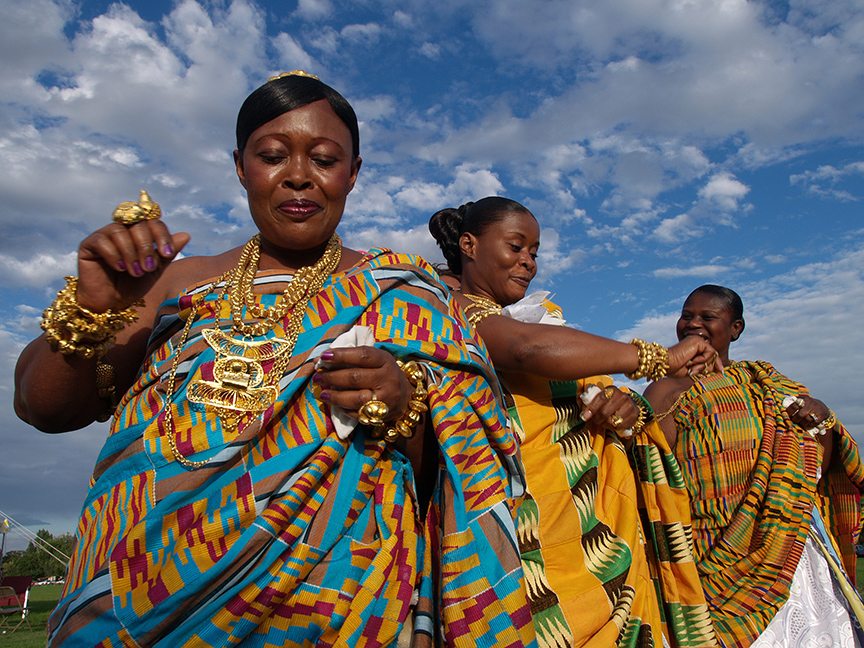
Kente is a handwoven textile produced in narrow strips — typically four inches wide — on a horizontal strip loom, then cut and sewn together to form the large cloth that drapes over the body in the style of a toga. It is made primarily in the Asante region of Ghana and by the Ewe people of the Volta region, with traditions that overlap and diverge in ways that both groups will tell you about at length. It is produced in silk and cotton, in colors of extraordinary richness, in patterns whose names reference Asante proverbs, historical events, royal prerogatives, and philosophical propositions. It has been worn by African leaders, by Martin Luther King Jr. and Malcolm X, by American presidents receiving African heads of state, by graduates of historically Black universities, by athletes at international competitions, by the Ghanaian Olympic team, and by the United States Congressional Black Caucus at the impeachment hearing of Donald Trump. It has been reproduced in polyester at a fraction of the cost and sold at markets across the world to people who have no idea what the patterns mean.
Kente is simultaneously one of the most recognized textile traditions on earth and one of the most misread. The recognition is wide and the understanding is narrow, and the distance between them is where the cloth's most important stories live.
The Origin Story the Spiders Tell
The founding narrative of Asante kente weaving involves a spider. According to the tradition recorded by Asante oral historians and documented by ethnographers including Doran Ross and Venice Lamb, two hunters from the village of Bonwire — Ota Kraban and Kwaku Ameyaw — observed a spider weaving its web in the forest near Kumasi and were inspired by the structure and beauty of what they saw to attempt a similar production in fiber. They returned to their village and began experimenting with the looping and interlacing of plant fibers, eventually producing the first kente cloth from the black and white fibers of the raffia palm.
The spider origin story is widespread in West African textile traditions — it appears in variants from multiple Ghanaian and Ivorian weaving cultures — and it encodes something true about the structural logic of weaving even if it is not intended as literal history. A spider's web is a structure of remarkable tensile efficiency: the radial and spiral elements interact to create a fabric stronger than steel by weight, and the principle of interlaced perpendicular elements that gives a web its strength is precisely the principle of plain-weave textile construction. The hunters who "learned from the spider" were, in the oral tradition's shorthand, describing the discovery of weave structure itself — the foundational technology of all cloth-making.
What the Asante weavers of Bonwire developed from this foundation was a specific strip-weaving tradition that is distinct from the broad-loom weaving of many other textile cultures. The **kente loom** (*ntamakesie*) is a horizontal frame set close to the ground, with the warp threads extending forward from the weaver over a long distance — traditionally across a compound, sometimes up to thirty meters — weighted at the far end to maintain tension. The weaver sits at the loom and works from a seated position, passing the weft shuttle through the warp shed with one hand and advancing the cloth with the other, building the strip incrementally from the near end while the weighted warp threads trail behind. The resulting strip is narrow — four to five inches — and the cloth that will eventually be assembled from it requires many strips, each woven in sequence and cut to consistent length before assembly.
This narrow-strip production method is not a limitation of Asante textile technology. It is a deliberate structural choice that serves both practical and aesthetic purposes. The strip loom is portable and inexpensive to construct, requiring no permanent installation. The narrow strips allow for the production of complex pattern sequences that would be prohibitively difficult to execute across a broad loom. And the seams that join strips in the finished cloth create their own visual rhythm — a grid of joining lines that the weaver can incorporate into the design rather than conceal.
The Color Grammar of Kente
Kente's color system is the element most frequently discussed in popular accounts of the cloth, and the one most often oversimplified. The common shorthand — gold for wealth, red for blood and sacrifice, green for growth, blue for peace, black for spiritual power — is real as far as it goes, but it is the equivalent of describing English grammar as "nouns are things and verbs are actions": accurate at the coarsest level and progressively inadequate as the actual complexity of usage becomes visible.
The color meanings in Asante kente are contextual, historically layered, and sometimes contradictory across different weavers and communities. **Gold** (*sika dwa*) does encode royalty and wealth — the Asante kingdom was built on gold, the Asante Golden Stool (*Sika Dwa Kofi*) is the most sacred object in the Asante political tradition, and gold's cultural primacy reflects a material reality that shaped the kingdom's history. But gold in kente can also reference the dry season, the maturity of crops, the quality of luminosity associated with the sun's power, and in some weavers' accounts, the spiritual force that animates the universe.
**Red** carries specific associations with death, sacrifice, and the blood of those who fought for Asante sovereignty — it appears in funeral cloths and in cloths honoring those who died in battle. But red is also the color of political authority in contexts not associated with mourning, and its meaning shifts based on the pattern in which it appears and the occasion for which the cloth is worn. **White** is associated with purification and the ancestors, and appears in cloths worn for funerary and cleansing ceremonies. **Blue** has associations with peace, harmony, and the sky — but also, in some Asante chromatic traditions, with feminine spiritual power. **Black**, despite associations with mourning in European color symbolism, carries in Asante kente a stronger association with maturity, spiritual intensity, and the power of aged things — including aged wisdom.
The Ewe kente tradition, developed independently in the Volta region, has its own color grammar that overlaps with Asante conventions in some areas and diverges significantly in others. Ewe kente tends toward more figurative imagery — representations of animals, tools, and human figures woven into the cloth alongside the geometric patterns that dominate Asante weaving — and its color conventions reflect a different set of historical and spiritual references. The two traditions are related but distinct, and the tendency of external observers to treat all Ghanaian kente as a single unified tradition is itself a form of categorical flattening that the weavers of both traditions resist.
Pattern as Philosophy: The Proverb Cloths
The most intellectually dense dimension of kente is the naming system that connects individual patterns to the Asante philosophical tradition of *mmebusem* — proverbs. The names given to kente patterns — and there are hundreds of named patterns, each with its own history and associations — frequently reference Asante proverbs that encode specific moral, philosophical, or historical content. Wearing a particular named pattern is therefore not merely an aesthetic choice. It is a statement that a knowledgeable observer can decode.
**Sika Futuro** ("Gold Dust") is a pattern associated with wealth and the Asante gold trade; wearing it communicates something about the wearer's economic status or aspirations, or their acknowledgment of the wealth that has flowed through Asante history. **Emaa Da** ("It Has Not Happened Before") commemorates an unprecedented event or achievement, and is worn when something genuinely new has occurred — a first, an innovation, a departure from precedent. **Woforo Dua Pa A** ("When You Climb a Good Tree, You Are Helped") references the Asante proverb about the importance of associating with excellence, and is appropriate for occasions that celebrate accomplished mentors, teachers, or institutions.
This naming system is not fixed or closed. New patterns are created, named, and added to the vocabulary by working weavers — a process that has continued throughout the tradition's history and that reflects the living, evolving character of kente as a cultural system rather than a static museum object. The Asante court historically had a role in certifying patterns that could be associated with royalty, but the broader pattern vocabulary has always been produced and maintained by the weaving community itself.
The philosophical sophistication of the proverb cloth tradition reflects a broader Asante intellectual culture in which proverbs (*ebe*) are the primary vehicle for ethical and philosophical instruction. The Akan saying *"Obi nkyere akwadaa Nyame"* — "No one teaches a child about God" — suggests that certain forms of knowledge are so fundamental that they are transmitted through experience rather than instruction. Kente pattern knowledge is the opposite: it is explicitly taught, carefully transmitted, and deliberately encoded in objects designed to carry meaning across time and social distance. The cloth is the instruction.
The Weavers of Bonwire: Craft as Hereditary Vocation
The village of **Bonwire**, approximately twenty-five kilometers northeast of Kumasi, is the acknowledged center of Asante kente weaving — the village whose weavers supply the Asantehene's court, whose production history stretches back to the tradition's origins, and whose weavers carry a social status within Asante culture that reflects both the spiritual importance of cloth and the economic value of a skill that required years of apprenticeship to develop.
Kente weaving in the Asante tradition is a hereditary craft. Boys from weaving families enter apprenticeship in childhood, typically between the ages of eight and twelve, and spend years learning first to manage the loom mechanics and then, progressively, to execute increasingly complex patterns. The full pattern vocabulary of an accomplished kente weaver — the ability to produce dozens of named patterns from memory, to calculate the warp threading required for each pattern variation, to advise clients on appropriate patterns for specific occasions — represents a knowledge base that takes a minimum of a decade to acquire.
The gender dimension of Asante kente weaving is consistently noted and not always accurately reported. In the Asante tradition, weaving is male-coded: men and boys do the strip-weaving on the horizontal loom, while women traditionally do the sewing that assembles the strips into finished cloth. This division is not universal across Ghanaian weaving traditions — in some Ewe weaving communities, women weave — but within the Asante tradition it is maintained consistently enough to be structurally significant. It means that kente production is one of the domains in which Asante men's craft labor is publicly valued and transmitted in the way that women's craft labor is valued in many other textile traditions.
The economic position of Bonwire weavers has changed significantly over the past century, from a craft that supplied a specific royal and aristocratic clientele under the Asante political system to a production base that serves domestic demand, tourist markets, diplomatic gifts, and export to the Ghanaian diaspora. This market expansion has had predictable effects on both the quality range and the price range of available kente: the finest hand-woven silk kente produced for royal occasions and for connoisseur buyers represents a category of quality and price entirely separate from the machine-imitation kente available at tourist markets, and everything between these poles exists in a quality spectrum that reflects the relationship between time invested and market price available.
Colonial Encounter and the Politics of the Cloth
The encounter between kente cloth and European colonialism produced a set of dynamics that shaped the cloth's current global significance in ways that its pre-colonial history did not anticipate. The British colonial administration of the Gold Coast (now Ghana) brought with it the evaluative frameworks of the European textile industry, which classified indigenous African textiles as craft production rather than art and assessed them by standards of commercial utility rather than cultural meaning. Kente was noted, collected, and displayed — the British Museum holds historical Asante kente pieces — but understood primarily as ethnographic specimen rather than as the philosophical and political document it actually was.
The Asante kingdom's relationship with colonial authority was never one of passive accommodation. The Asante fought multiple wars against British forces between the 1820s and 1900, and the Gold Coast was not fully incorporated into the British colonial system until 1901. Throughout this period, kente continued to function within the Asante political system as it had before colonial contact — a medium of royal communication, a marker of authority, a language spoken by cloth that the colonial administration could observe but not easily read. The British seizure of the Golden Stool in 1900 — or rather the attempt to seize it, which precipitated the War of the Golden Stool and the final defeat of Asante sovereignty — was partly a failure to understand that the Golden Stool was not a piece of furniture but the physical embodiment of the Asante nation's soul. The colonial administrators who ordered its surrender did not know how to read what they were looking at.
Ghanaian independence in 1957 — the first sub-Saharan African nation to achieve independence from colonial rule — gave kente a new political register. Kwame Nkrumah, Ghana's first president, wore kente at the independence ceremony and at his subsequent appearances on the international stage, explicitly deploying the cloth as a symbol of African sovereignty, dignity, and the refusal to be culturally defined by European standards. The photograph of Nkrumah in kente at the moment of independence is one of the most politically charged images in the history of African textiles: the cloth doing the political work that had always been available to it, now in a global arena rather than a regional one.
Kente in the Diaspora: Claimed Across an Ocean
The journey of kente into African American cultural life is one of the most significant episodes in the cloth's history, and it is inseparable from the political and cultural movements of the 1960s and 1970s. The Black Power and Black Arts movements of that era generated a deep investment in African cultural forms as resources for African American identity construction — resources that the Middle Passage had interrupted and that required deliberate effort to recover and reimagine. Kente was among the most accessible and visually powerful of these resources.
The specific political charge of kente for African Americans relates to the nature of the transatlantic slave trade and its relationship to the Asante kingdom. The Asante, like many West African polities, participated in the slave trade — including selling enslaved people to European traders. This history is known and grappled with by contemporary Ghanaians and diaspora communities in ways that complicate but do not dissolve the cloth's meaning for African Americans. What kente offered to diaspora communities seeking African cultural connection was not a perfect genealogical link — the specific ethnic origins of most African Americans cannot be precisely determined — but a visual and material point of contact with the African cultural world that slavery had severed. The cloth became a sign of that connection: imprecise, partly symbolic, and genuinely felt.
By the 1980s and 1990s, kente stoles — narrow strips of kente-patterned fabric worn over academic robes at graduation — had become established in historically Black colleges and universities (HBCUs) as a marker of African heritage and Black academic achievement. The practice spread to mainstream universities with significant Black student populations and is now widespread enough to have become a recognizable convention. The kente stole at graduation is simultaneously a fashion item, a political statement, a cultural affiliation marker, and — for those who know the cloth's history — an extremely compressed act of meaning-making: the wearing of a cloth that encodes royalty, achievement, and the philosophical tradition of a West African people by a graduate whose ancestors were removed from that tradition by force and who is reclaiming it through a ceremony that celebrates exactly the kind of achievement the tradition always honored.
The Mass Market, the Machine Loom, and the Authenticity Question
The global recognition of kente has produced a mass market that bears a complicated relationship to the tradition that gave the cloth its value. Machine-woven kente-pattern fabric — produced on power looms in Ghana, in China, and in other manufacturing centers — reproduces the visual appearance of kente at a fraction of the cost of handwoven production. These fabrics are widely available, widely purchased, and widely worn by people who appreciate their appearance and their cultural associations without being in a position to evaluate their relationship to the handwoven tradition.
The question of authenticity this raises is genuine and not easily resolved. Ghanaian textile scholars and weavers make a clear distinction between *genuine kente* — handwoven in strips on the traditional loom, with the structural characteristics that distinguish handweaving from machine pr