Worn on the Head, Held in the Heart: The Ei Katu and the Living Floral Culture of the Cook Islands
Worn on the Head, Held in the Heart: The Ei Katu and the Living Floral Culture of the Cook Islands
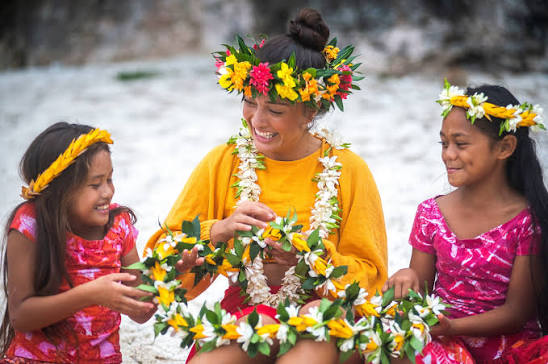
There is a greeting in the Cook Islands that has no adequate translation into any language that does not already have flowers in it. When a visitor arrives — at the airport, at a village gathering, at a family home where a celebration is in progress — they are often met with an **ei katu**: a crown of fresh flowers, woven into a circle and placed on the head with both hands, accompanied by a look that says something specific: *you are here, you are seen, you are welcome in the most complete sense of that word*. The visitor might wear this crown for an hour before the flowers begin to lose their freshness. They will remember being given it for considerably longer.
The **ei katu** — *ei* meaning garland or wreath, *katu* meaning head in Cook Islands Māori — is one of the most visually immediate expressions of a cultural practice that runs through Cook Islands life the way water runs through the reef: everywhere, organizing things, giving the landscape its character. Fresh flowers in the Cook Islands are not decoration in the sense that implies something added to an occasion already complete without it. They are part of the occasion's grammar — the medium through which welcome, affection, respect, celebration, and mourning are expressed with the body's most immediate participation: smell, touch, the weight of petals on the crown of the head.
To understand the ei katu is to understand something about how Cook Islands culture holds its relationships — with people, with land, with the living world that the fifteen islands of the archipelago are embedded in so completely that separating the culture from the ecology is like separating the reef from the ocean it inhabits.
The Islands That Grow the Crowns
The Cook Islands are among the Pacific's most geographically scattered nations: fifteen islands spread across approximately 2.2 million square kilometers of ocean, ranging from the volcanic, mountainous peaks of the southern group — Rarotonga, Aitutaki, Mangaia, Atiu — to the low coral atolls of the northern group — Penrhyn, Manihiki, Rakahanga — where the land barely rises above the water line and the flowers available to the ei katu maker are those that can survive the specific conditions of an atoll: salt-tolerant, hardy, adapted to thin coral soil and the constant presence of ocean wind.
This geographic diversity produces diversity in ei katu tradition. Rarotonga — the largest island, the seat of government, and the hub of most external contact — has access to the broadest range of flowering plants, including both the native species that have grown there since the island's volcanic emergence and the introduced species that successive waves of contact have added to the archipelago's botanical palette. Mangaia, the oldest geologically of the Cook Islands, has its own distinct flora including endemic species found nowhere else. The northern atolls work with what the atoll environment provides, and the creativity their ei katu weavers demonstrate within those constraints is itself a kind of cultural argument: that the tradition is not dependent on abundance but on attention, and that attention applied to a limited palette can produce results as beautiful as any produced from a richer one.
The floral foundation of Cook Islands ei katu culture is the **tiare māori** — *Gardenia taitensis*, the Polynesian gardenia, a small white flower with a fragrance so distinctive and so associated with the Pacific islands that its smell functions, for Cook Islanders living abroad, as one of the most powerful available triggers of home. The tiare māori is not showy — it is modest in size, white in color, unassuming in form — and its primacy in Cook Islands floral culture is not about visual spectacle. It is about fragrance and meaning. The flower is worn close to the skin, tucked behind an ear or woven into the ei katu near the face, so that its scent is continuously present rather than intermittently encountered. This proximity is the point: the tiare māori at the ear is not a fashion statement. It is a small, continuous olfactory connection to the living world, maintained throughout the day.
Other flowers appear in ei katu according to availability, occasion, and the weaver's aesthetic judgment: **frangipani** (*pua*) in white, yellow, and pink, valued for both fragrance and the waxy durability of its petals; **hibiscus** (*purau*) whose large blooms add color and visual drama but wilt more quickly; **bougainvillea** whose papery bracts hold their color after the flowers themselves have faded; **croton** leaves whose variegated patterns provide contrast and structure; **orchids** for formal occasions where the additional preparation time and expense are appropriate. The selection is not arbitrary — different flowers carry different registers of meaning and appropriateness, and an experienced ei katu maker reads the occasion and assembles accordingly.
The Hands That Weave: Transmission and Technique
Ei katu making is learned by watching and doing rather than by instruction in the explicit sense. A girl in the Cook Islands — and ei katu weaving has been predominantly, though not exclusively, women's work — begins her relationship with the craft by sitting beside her mother, grandmother, or aunt while they weave. She watches how the flowers are selected from the morning garden: which ones are fully open, which still closed enough to last the day, which have the structural integrity to survive being worked with hands, which will wilt before the occasion ends. She watches the assessment of freshness, the discarding of imperfect specimens, the selection process that is so rapid in experienced hands as to look like instinct.
The technical process of ei katu construction varies by regional tradition and individual weaver, but the basic principle involves threading or binding flowers and foliage into a circular form sized to the recipient's head. Some makers use a length of split vine or a cord of plaited fiber as the base structure, binding flower stems to it in overlapping sequence. Others work without a base structure, threading flower stems through each other in a technique that produces a denser, more integrated result. The most accomplished ei katu weavers can produce a crown in fifteen to twenty minutes; the work of their hands is so practiced that the cognitive load of it has been redistributed — like any deeply learned physical skill — from the attention-demanding foreground of awareness to the smoother background of embodied knowledge.
What cannot be learned quickly is the aesthetic judgment that makes a beautiful ei katu rather than merely a technically correct one: the sense of proportion, the management of color and fragrance in combination, the reading of the recipient's coloring and the occasion's tone in selecting the combination that will work for this specific person at this specific moment. This judgment takes years to develop and is explicitly valued within the community — the woman known for her exceptional ei katu is a recognized artisan, her skill a form of social capital that the community acknowledges and seeks out for significant occasions.
The intergenerational transmission of this knowledge is simultaneously the tradition's greatest strength and its most vulnerable point. When the transmission chain is intact — when grandmothers teach daughters who teach granddaughters, in the household context where the occasion for making ei katu arises naturally and frequently — the knowledge moves forward without requiring any institutional support. When migration interrupts the chain, when Cook Islanders move to New Zealand or Australia (where a diaspora population of over 80,000 now significantly exceeds the islands' resident population of approximately 17,000), the transmission becomes more deliberate and more fragile. Communities in Auckland and Sydney maintain ei katu making through organized workshops and community gatherings, but the conditions of diaspora — the different botanical environment, the different daily rhythm, the absence of the family garden whose morning harvest provides the fresh flowers — mean that the practice is maintained with effort rather than simply lived.
Occasions and Meanings: The Social Life of the Crown
The ei katu appears across the full range of Cook Islands social occasions, and its presence is not decorative in the sense of optional. To arrive at a wedding, a graduation, a church celebration, or a community gathering in the Cook Islands without flowers — whether worn on the head or carried as an ei (garland) around the neck — is to arrive not quite correctly, in the same way that specific dress codes in other cultures define what fully appropriate presence at an occasion requires.
**Church** is the occasion where the ei katu's formal social weight is most consistently visible. The Cook Islands is a deeply Christian society — the London Missionary Society's arrival in 1823 produced a conversion that was rapid and thorough, and the country's church attendance rates remain among the highest in the Pacific — and Sunday church service is the social occasion of the week, the gathering at which the community presents itself to itself and to God in its best possible form. Women and girls arrive at church in their finest clothes and their most carefully made ei katu, the combination of dress and flowers constituting the full formal presentation that the occasion demands. The church interior fills with fragrance as much as it fills with voice, and the visual effect of the congregation in full floral presentation — the ei katu of the women and girls creating a garden effect throughout the pews — is one of the most distinctive aesthetic experiences the Cook Islands offers.
**Welcomes and departures** are perhaps the ei katu's most socially resonant context. The giving of an ei katu to an arriving visitor is one of the most genuine forms of welcome the culture has — it requires the giver to have prepared for the arrival, to have assessed the occasion and selected appropriate flowers, to have invested time and care in the weaving. The receipt of an ei katu is therefore not merely pleasant. It is evidence of being thought about, of mattering enough to someone that they spent part of their morning making something specifically for you. When Cook Islanders depart from the islands — for study, for work, for the increasingly common pattern of transnational life between Rarotonga and Auckland — they are often sent off with ei katu, the flowers a physical continuity between the living world of the islands and the person carrying it into distance. The flowers die en route. The meaning they carried does not.
**Funerals and mourning** incorporate the ei katu in ways that resist the Western assumption that flowers at funerals are purely consolatory decoration. In Cook Islands funerary tradition, flowers placed on or around the deceased and worn by those mourning serve a function closer to accompaniment: the living world, present at the departure of someone who was part of it, sending its most immediate and fragrant representatives along with the person leaving. The specific flowers chosen for mourning contexts often differ from those used in celebratory contexts — white predominates, fragrance is prioritized over visual drama — but the act of making and wearing ei katu at a funeral is not a mitigation of grief. It is grief expressed in the culture's most immediate material language.
The Ei and the Katu: Distinctions That Matter
The ei katu is the most culturally prominent of a broader family of floral garlands that Cook Islands tradition maintains, and the distinctions between the forms carry meaning that the English word "garland" obscures.
The **ei** in its broadest sense refers to any garland — worn around the neck, draped over the shoulders, placed on an object or a grave. The neck ei is the most common form for casual gifting and communal occasions; it is made on a longer base than the ei katu and can incorporate a wider range of materials, including shells, seeds, and non-floral plant material, in combinations that vary by island and occasion. The neck ei given to an arriving dignitary, a sports team returning from a competition, a teacher at the end of the school year — each carries its register of meaning in its materials, its scale, and its presentation.
The **ei katu** specifically — the head garland — occupies a more elevated register than the neck garland, partly because the head holds a significance in Polynesian cultural thinking that is different from its significance in Western conventions. In traditional Polynesian understanding, the head is the most sacred part of the body — the seat of the spirit, the location of the *mana* (spiritual power and authority) that a person carries. To place something on the head is to make a statement about the person's status and spiritual condition. The ei katu placed on a child's head at a christening, on a bride's head at her wedding, on a dancer's head at a performance, or on a visitor's head in welcome — each of these placements carries the full cultural weight of the head's sacred significance.
This is why the ei katu is given rather than worn for one's own pleasure — it is placed by another person's hands, on another person's head, as an act that the giver performs for the recipient. The unilateral self-crowning with an ei katu would miss the point of the object entirely, because the point is not the crown. The point is the relationship enacted in the giving.
Flowers and Land: The Ecological Dimension
The ei katu's existence depends on a relationship with land that urbanization and demographic change are gradually altering. The traditional Cook Islands household garden — the *māra* — maintained flowering plants specifically for ei making alongside the food plants that were the garden's primary economic purpose. The tiare māori growing beside the taro, the frangipani near the breadfruit, the hibiscus at the fence line — these were not ornamental choices in the Western sense of garden ornament as optional beauty added to functional space. They were part of the household's functional ecology, their flowering cycles known and anticipated, their peak harvest times aligned with the social occasions that would require them.
As Cook Islands households have changed — more apartment-style housing in Rarotonga's urban center, smaller land parcels, the shift toward a more consumption-oriented relationship with goods — the household garden's ei-producing function has diminished for some families. Flowers are now also commercially available at Rarotonga's market, where vendors sell pre-made ei katu alongside fresh-cut flowers for those who do not make their own. This commercial dimension has both expanded access to ei katu for people who lack the botanical knowledge or garden to make their own and introduced a transactional layer to a practice whose meaning has always been precisely in its non-transactional character — the time, care, and attention that making an ei katu represents, given freely rather than purchased.
The tension between the hand-made and the commercially produced ei katu is acknowledged within the community without being fully resolved — as similar tensions in any living tradition rarely are. What remains consistent is the evaluation criterion: the ei katu that a knowledgeable recipient most values is still the one made by specific hands that chose specific flowers with specific knowledge of the recipient and the occasion. The commercial ei katu serves a function. The made-with-attention ei katu carries the tradition's actual meaning.
Dance, Performance, and the Ei Katu's Ceremonial Peak
The **ura** — traditional Cook Islands dance — is the performative context in which the ei katu reaches its most elaborate and most visually spectacular form. Cook Islands dance is among the most celebrated in Polynesia, distinguished by hip movements of extraordinary speed and precision and by costumes that integrate natural materials — woven pandanus, shells, feathers, and flowers — into a total aesthetic effect that the performers' weeks of preparation make possible.
The **ei katu** worn in ura performance is not the casual garland of a welcome or a church attendance. It is a crafted object whose construction can take an experienced maker an hour or more, incorporating flower varieties chosen for visual impact under performance lighting, structural materials that allow the crown to survive vigorous movement without disintegrating, and a scale that reads from a distance. The combination of the dancer's movement with the ei katu's fragrance creates a sensory envelope — the audience smells as well as sees the performance — that is specific to this tradition and that recorded or filmed ura can never fully convey.
The **Te Maeva Nui** — the Cook Islands' annual cultural festival, held around Constitution Day in late July — is the occasion at which ura performance and ei katu making reach their peak of public visibility, with groups from across the islands competing in dance categories judged partly on the quality and elaborateness of the costuming, which includes the floral elements. The competition is serious and the judging nuanced; experienced observers can evaluate the ei katu construction quality, the flower selection's appropriateness, and the relationship between the floral elements and the other costume components with the same precision that judges in other traditions evaluate more conventionally technical performances.
The Diaspora Garden: Ei Katu Beyond the Islands
More than 80,000 Cook Islanders live in New Zealand, primarily in Auckland, in a diaspora community that has maintained Cook Islands cultural practice with a consistency and vitality that reflects both the strength of the original cultural attachment and the active community infrastructure — churches, cultural organizations, family networks — that sustains it. Ei katu making in Auckland is an activity that happens in suburban New Zealand backyards where tiare māori plants are tended in pots or sheltered garden beds, in community halls where workshops teach the technique to second-generation Cook Islanders whose connection to the islands is mediated by family rather than direct experience, and at the Cook Islands cultural events in Auckland that function as both community cohesion occasions and as deliberate exercises in cultural transmission.
The botanical challenge of making ei katu in Auckland is real. The tiare māori grows in New Zealand, but reluctantly — it requires sheltered conditions and careful management to survive the temperate climate, and the abundance that allows a Rarotonga morning harvest to fill a basket does not replicate in a Auckland winter. Diaspora ei katu makers adapt: the tiare is supplemented with locally available flowers, the ei katu becomes more eclectic in its materials while maintaining its form and its function, and the practice continues with the modifications that any transplanted tradition makes to survive in new conditions.
What the diaspora ei katu carries that the botanical adaptation cannot fully compensate for is the context — the specific social world of the Cook Islands in which the ei katu's meaning is immediately legible to everyone present. In Auckland, the ei katu worn at a Cook Islands community event is understood by the Cook Islanders in the room and may or may not register to the broader New Zealand context surrounding the event. This legibility gap is one of the losses that diaspora life produces, and it is one of the reasons that Cook Islands diaspora communities invest so consistently in maintaining cultural events where the context is present in full — where the ei katu on the head means to everyone in the room exactly what it means.
What the Flowers Know
There is a temporality built into the ei katu that is unusual among cultural objects: it is made to be beautiful for a few hours. The flowers that compose it are at their peak when they are placed on the head; by evening they will have wilted; by morning, if they were not already given back to the earth, they will be past their beauty and ready to compost. The ei katu is among the most deliberately ephemeral of cultural objects, in a world that increasingly prefers the durable, the reproducible, and the storable.
This temporality is not a limitation of the tradition's material options. Cook Islands weavers know how to make lasting things — the woven pandanus work, the carved wood, the shell jewelry that Cook Islands artisans produce are durable objects that travel, last, and hold their beauty through decades. The choice to make the head garland from fresh flowers — flowers that will die, flowers whose beauty is inseparable from their aliveness — is a choice about what the object should be and what making it should mean.
An ei katu that lasted forever would be a different object with a different meaning. The meaning of the ei katu is partly in its freshness — the evidence it carries that someone was in a garden this morning, thinking of you, selecting these specific petals from these specific plants with your specific head in mind. The flowers chosen this morning for this occasion by these hands: that is what is placed on the head, and that is what is felt there. The crown dies because the morning dies. The gesture made in the morning remains.
The tiare māori behind the ear loses its fragrance by mid-afternoon. Before it does, it gives everything it has.
That, perhaps, is what the Cook Islands ei katu tradition knows that longer-lasting things do not: that the most meaningful gifts are the ones given without reservation, the ones that hold nothing back, the ones that offer their full beauty in full knowledge that the beauty is brief. The flowers know how to do this. The hands that weave them have been learning from the flowers for a very long time.