Wood, Faith, and Memory: Lithuania's Cross-Crafting Tradition and the Sacred Art That Survived Everything
Wood, Faith, and Memory: Lithuania's Cross-Crafting Tradition and the Sacred Art That Survived Everything
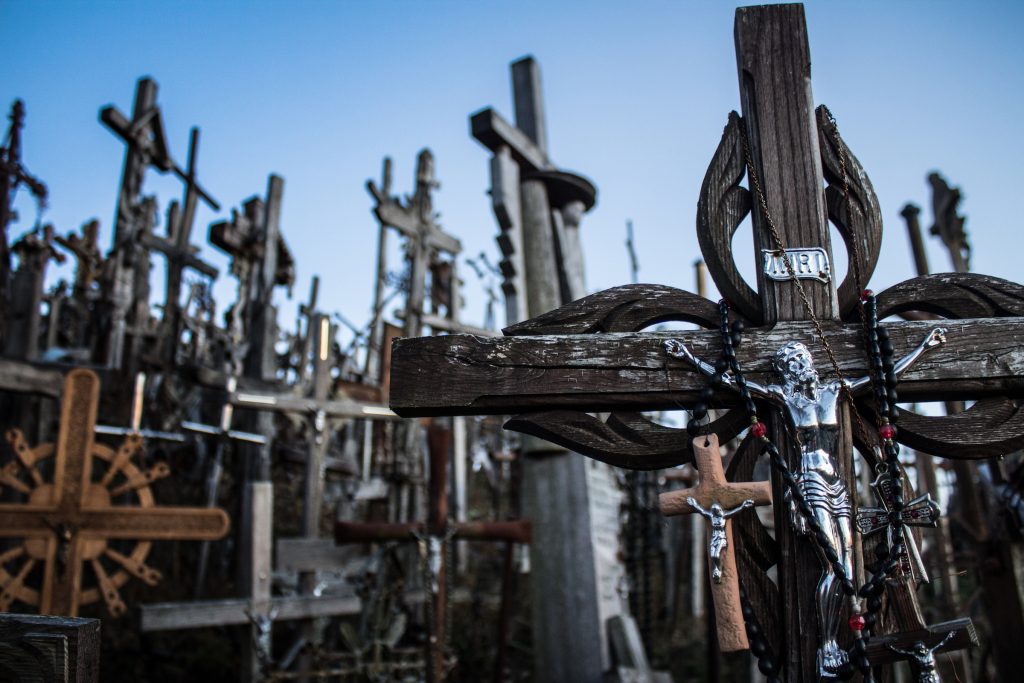
In 1961, Soviet authorities bulldozed the Hill of Crosses — a low rise near the northern Lithuanian city of Šiauliai that had been accumulating hand-carved wooden crosses for at least a century, possibly much longer, placed there by pilgrims, by families mourning the dead, by prisoners returning from Siberian labor camps, by ordinary Lithuanians expressing the particular mixture of Catholic faith and national identity that the Soviet state was committed to eliminating. The bulldozers came, the crosses were destroyed, the site was leveled. A guard was posted.
By the following year, new crosses had appeared. The Soviet authorities demolished the hill again. And again. And again. The official count of demolitions between the early 1960s and 1985 ranges from three to five, depending on the source, and each demolition was followed by reconstruction — crosses arriving at night, brought by Lithuanians who understood perfectly what they were doing and what the consequences of being caught would be. The Hill of Crosses was not simply a religious site. It was a statement, renewed with every cross placed upon it, that a people existed who could not be made to stop remembering themselves.
Today the Hill of Crosses contains an estimated 200,000 crosses, crucifixes, statues, and rosaries — a density of sacred objects that has no precise parallel anywhere on earth. John Paul II visited in 1993, calling it a place of hope, peace, and love. It is now one of the most visited pilgrimage sites in Eastern Europe and one of the most photographed landscapes in the Baltic region. And it is the most concentrated expression of a craft tradition — **kryždirbystė**, Lithuanian cross-crafting — that UNESCO inscribed on its Representative List of Intangible Cultural Heritage of Humanity in 2008, calling it a living expression of national and religious identity that has survived, through its own accumulated weight, every attempt to suppress it.
The Last Pagan Country and What Paganism Left Behind
Lithuania's religious history is unlike any other country in Europe. The Lithuanian Grand Duchy maintained its pre-Christian polytheistic tradition — a Baltic religion whose pantheon included Perkūnas (god of thunder), Laima (goddess of fate), Žemyna (earth goddess), and dozens of nature spirits and ancestral forces — until 1387, when Grand Duke Jogaila's political marriage to the Polish queen Jadwiga brought official Christianization as part of the dynastic union. This makes Lithuania the last country in Europe to officially convert to Christianity, a distinction that comes with a specific cultural consequence: the pagan tradition was not centuries old and largely forgotten when Christianity arrived. It was a living, practiced, socially embedded system that an entire population had to renegotiate with a new faith.
What the Lithuanians did — not through any conscious program but through the organic syncretism of a population navigating between two cosmological systems — was fold their pre-Christian sacred practices into the new Christian framework without fully dissolving them. The roofed wooden poles (*stogastulpiai*) and carved sacred pillars (*krikštai*) that had marked the sacred spaces of Baltic paganism — forest clearings, water sources, the boundaries of village territory, the graves of the honored dead — became the structural templates for Christian cross-crafting. The cross-shaped top was added to the pagan pillar. The Christian iconography — Christ, the Virgin, the saints — was placed within the architectural vocabulary of the older sacred object. The result was not Christianity displacing paganism but a synthesis in which each transformed the other.
This synthesis is visible in the specific vocabulary of Lithuanian cross forms. The traditional **saulutė** — a sun wheel motif that appears as a central decorative element in many Lithuanian crosses — is not a Christian symbol. It is a Baltic solar symbol, associated with Saulė (the sun goddess) in the pre-Christian tradition, incorporated into the cross design because the craftsmen who moved from carving pagan sacred poles to carving Christian crosses brought their decorative vocabulary with them. The sun-wheels, serpents, and stylized plant forms that appear alongside explicitly Christian imagery in Lithuanian folk crosses are the visible evidence of a tradition that remained continuous across the religious transition.
The Craft: What Kryždirbystė Actually Involves
Lithuanian cross-crafting is a woodworking tradition of considerable technical complexity that encompasses several distinct object types, each with its own formal vocabulary and functional purpose. Understanding what the craft produces requires moving beyond the simple image of a cross to the full range of objects that kryždirbystė encompasses.
The **kryžius** (cross) in its simplest form is a shaped wooden cross, but in the Lithuanian tradition this simple form quickly expands into elaboration: decorative surface carving in geometric, floral, and figurative motifs; painted polychrome surfaces in the specific palette — red, black, and natural wood tones with occasional blue and green — that characterizes Lithuanian folk art; and the addition of subsidiary elements — sun wheels, small roofed shrines containing sacred images, cast iron or tinwork elements, sometimes entire narrative reliefs carved into the cross arms.
The **stogastulpis** (roofed pillar) is the form most directly continuous with pre-Christian sacred pole tradition: a tall wooden pillar topped with a small roof structure sheltering a sacred image (Christ, the Virgin, or a saint), the pillar's surface elaborately carved and sometimes featuring multiple tiers of decoration. Stogastulpiai are placed at roadsides, at crossroads, in cemeteries, and at the boundaries of villages and farm properties — liminal locations that in both pagan and Christian tradition are understood as places where the visible and invisible worlds are in closer contact.
The **krikštas** (grave marker cross) is the cross-crafting tradition's application to the specifically funerary context. Lithuanian grave crosses range from simple painted wooden crosses to elaborate structures several meters tall that function simultaneously as grave markers, as memorials in the narrative sense (often bearing carved or painted imagery specific to the deceased's life), and as permanent sacred objects that maintain a connection between the living community and the dead. The krikštas tradition reflects the Baltic understanding of the dead as continuing presences whose relationship with the living community must be maintained through appropriate material and ritual attention.
The craftsmen who produce these objects — cross-crafters (*kryždirbiai*) — are not a separate artisan caste but members of farming and village communities for whom cross-crafting is one skill among many. The tradition has historically been transmitted within families and within village apprenticeship networks, with the knowledge of woodworking technique, decorative vocabulary, and appropriate placement and commissioning protocols passing from experienced craftsmen to apprentices through the direct observation and practice that woodworking knowledge requires.
The specific techniques involved — the use of specific chisels and gouges for particular carving operations, the preparation of wood (air-dried oak, lime, or ash, chosen for specific qualities), the application of natural pigments in traditional palette, the construction of the small roofed structures that top many cross forms — require years of practice to develop to the standard that the community's aesthetic expectations impose. A cross-crafter whose work does not meet the community's standards faces the same social judgment as any craftsman in a tradition-embedded community: the quality of the work is a statement about the quality of the person.
The Hill of Crosses: A Place Made by Grief and Resistance
The Hill of Crosses (*Kryžių kalnas*) near Šiauliai is the most famous site of Lithuanian cross-crafting expression, but its fame should not obscure its specific history, which is more complex and more tragic than the pilgrimage-site presentation typically conveys.
The site's origins are debated among historians, but the most widely accepted account places the first crosses there in the aftermath of the 1831 and 1863 uprisings against Russian Imperial rule — both of which resulted in mass executions, deportations to Siberia, and the suppression of Lithuanian cultural and religious expression. Families who could not bury their dead (many were killed or deported without the possibility of proper burial) placed crosses on the hill as memorial markers — a practice that the tradition of grave-marking crosses made immediately available as a form of mourning expression.
The Russian Imperial authorities who ruled Lithuania from 1795 to 1918 found the Hill of Crosses problematic for the same reason the Soviet authorities later would: it was a site of national memory that refused to be erased and that communicated, through its accumulation of crosses, the existence of a community that remembered its own suffering and refused to accept the political authority that had caused it. The Russian prohibition of Lithuanian-language printing (1864–1904) and the broader Russification policies of the late nineteenth century gave cross-placing at the Hill of Crosses an additional political register: each cross was simultaneously a religious act and a national affirmation in a period when national affirmation was prosecuted.
The Soviet demolitions of the 1960s and 1980s — which used heavy machinery to physically remove the accumulated crosses and bulldoze the site — were the most violent suppression the Hill had experienced, and they produced the most determined resistance. The Lithuanians who brought new crosses to the site under cover of darkness, who concealed small crosses under clothing to be placed when guards were absent, who organized nighttime cross-planting expeditions that required the same qualities of commitment and mutual trust as other forms of underground resistance — were not simply performing religious observance. They were performing national existence: the assertion that Lithuania and its memory continued despite every institutional effort to eliminate both.
The 1991 restoration of Lithuanian independence did not end the Hill's significance as a site of resistance memory; it transformed that significance into something more complex. The Hill is now a site of pilgrimage, of tourism, of continued cross-placing that ranges from deeply personal memorial acts (a cross placed for a recently dead family member) to political and social statements (crosses bearing inscriptions referencing contemporary events, contemporary grievances, contemporary assertions of faith and national identity). The 200,000 crosses that now cover the site are not a uniform monument but an accumulation of individual voices — each cross a specific person's or family's statement — that together constitute one of the most intensive concentrations of human memorial expression in the world.
The Cross in the Landscape: Roadside Shrines and Territorial Marking
Beyond the Hill of Crosses, the Lithuanian landscape is marked by a density of wayside crosses, roadside shrines, and small cross-topped pillars that surprises visitors from countries whose religious landscape is organized around permanent stone or brick structures. Lithuania's sacred landscape is primarily wooden, and therefore impermanent, and therefore continuously renewed.
The placement of crosses at roadsides — particularly at crossroads, at the boundaries between village territories, at sites where accidents or violence have occurred, and at points where travel routes are dangerous — reflects the Baltic understanding of these liminal locations as places where protective spiritual presence is both most necessary and most available. A cross placed at a crossroads is not simply a religious marker; it is a claim of sacred protection over a dangerous place, maintained by the community through the periodic renewal of the wooden structure as it weathers and decays.
The Catholic Church's relationship to this landscape practice has been complex throughout Lithuanian history. The Church accepted the cross-placing tradition as an expression of lay piety — the building and maintenance of wayside shrines is a recognized form of Catholic devotional practice — while periodically expressing concern about the pre-Christian elements embedded in the forms (the sun wheels, the serpents, the fertility symbols) and the lay-controlled character of a religious landscape that was not built or maintained by clerical authority. The tradition's persistence and its deep embeddedness in popular devotion have generally meant that the Church accommodated itself to the tradition rather than successfully reforming it.
The craftsmen who produce roadside crosses and wayside shrines are commissioned by individuals, families, and village communities for specific purposes: memorial crosses for the dead, votive crosses fulfilling promises made in moments of crisis, protective crosses placed at dangerous locations, and the periodic renewal of existing crosses as they weather. The commissioning process involves the cross-crafter in understanding the specific purpose the object will serve and the specific aesthetic preferences of the commissioner, within the tradition's overall formal vocabulary. The result is that each cross is simultaneously a product of the tradition's collective formal knowledge and a specific individual or community's particular expression within that tradition.
The Soviet Chapter: Suppression and the Persistence of Wood
The Soviet occupation of Lithuania (1940–1941, 1944–1990) subjected the cross-crafting tradition to systematic suppression as part of the broader campaign against religious expression and national culture. The practical instruments of suppression included: the prohibition of public religious displays (which made the placement of new crosses and the maintenance of existing ones legally problematic); the confiscation of church property and the closure of many churches (which reduced the institutional support for religious folk art); the replacement of religious holidays with Soviet equivalents (which disrupted the ceremonial calendar in which cross-placing often participated); and the specific demolitions of the Hill of Crosses already described.
What the Soviet authorities underestimated was the domestic and private character of much of the cross-crafting tradition. Crosses placed in cemeteries, maintained in family farmyards, carved and kept within homes — all of these were harder to confiscate and destroy than the public Hill of Crosses, and the tradition continued in these private contexts throughout the Soviet period. Cross-crafters who could not publicly sell or commission religious objects maintained their knowledge privately, passing it within families, sometimes disguising it as general woodworking practice.
The tradition also benefited from the peculiar position of Lithuanian folk art within the Soviet cultural framework. The Soviet ethnographic and cultural heritage apparatus had a complex relationship to pre-Soviet folk traditions: on one hand, they were associated with the religious and nationalist cultures that socialism was replacing; on the other hand, they could be presented as evidence of the peasant cultural creativity that Marxist cultural theory valued as the authentic expression of the working class before bourgeois cultural forms corrupted it. Lithuanian folk crosses, presented as peasant folk art rather than religious objects, occupied an ambiguous position in this framework that sometimes protected cross-crafters who could frame their work in acceptable terms.
This ambiguity was precisely the kind of cultural navigation that Lithuanians became skilled at during the Soviet period — maintaining national and religious tradition within the semantic frames that the occupying power's cultural framework made available, using the approved vocabulary of folk art and cultural heritage to protect what was actually religious and national expression. The cross-crafter who described their work to Soviet authorities as "traditional folk woodworking" was not lying; they were selecting the most survivable available description of a practice whose full meaning far exceeded that description.
UNESCO Recognition and the Contemporary Practice
The 2008 UNESCO inscription of kryždirbystė — Lithuanian cross-crafting — as Intangible Cultural Heritage of Humanity represented the international recognition of a tradition that had survived, through its own remarkable persistence, the most sustained suppression campaign of any folk art tradition in European history. The inscription came eighteen years after Lithuanian independence and forty-seven years after the first Soviet demolition of the Hill of Crosses: a recognition that arrived, if not late, then with full awareness of the tradition's survival against significant odds.
The contemporary practice of kryždirbystė is maintained by approximately 100 to 200 active cross-crafters in Lithuania, distributed across the country with particular concentrations in the northern and northeastern regions where the tradition has deepest historical roots. The cross-crafters' community is organized through several voluntary associations that coordinate training, exhibitions, and the documentation of the tradition's formal vocabulary — activities that have become more important as the traditional apprenticeship networks within family and village contexts have weakened under the pressures of urbanization and the general decline of craft apprenticeship as a transmission mechanism.
The contemporary cross-crafter works within the inherited formal tradition while also engaging with the contemporary contexts in which crosses are commissioned and placed. Memorial crosses for the recently dead are still made in the traditional idiom; crosses commemorating historical events now sometimes incorporate inscriptions and imagery specific to those events; decorative crosses for instit