Where the Chiefs Still Rule: The Living Chiefdom Traditions of Wallis and Futuna
Where the Chiefs Still Rule: The Living Chiefdom Traditions of Wallis and Futuna
There are three kings in Wallis and Futuna. This is not a tourist brochure's romantic exaggeration, not a ceremonial title preserved in amber for the benefit of visiting dignitaries, and not a constitutional fiction maintained as a concession to indigenous culture. The three kings — the **Lavelua** of Uvea (Wallis Island), the **Tuigaifo** of Alo, and the **Keletaona** of Sigave (the latter two ruling the twin island of Futuna) — are the primary governing authorities of their respective territories. They adjudicate land disputes. They regulate customary ceremony. They determine who belongs to the community and on what terms. They hold, in the language of French territorial law, a *coutumier* authority that the French administrative framework explicitly recognizes as parallel to and in many domains superior to the formal state apparatus.
When the Lavelua of Uvea makes a decision about land allocation or communal resource management, that decision carries weight that a prefectural order from Mata-Utu — the territorial capital — cannot simply override. When the traditional councils (*fono*) convene to address a community matter, they are not advisory bodies making recommendations to a French administrator. They are the government, operating in the domain that the colonial and postcolonial settlement has, with the particular pragmatism that French Overseas collectivities sometimes display, acknowledged as theirs.
This arrangement is extraordinary in the contemporary world. It is also, from inside Wallis and Futuna, entirely ordinary. The chiefdoms are not a governance experiment or a cultural compromise. They are the shape that authority has taken in these islands for a millennium, and they have proven sufficiently durable and sufficiently legitimate to the communities that live within them to survive everything that has arrived from outside.
Three Islands, Three Kingdoms, One Territory
Wallis and Futuna is a French collectivity (*collectivité d'outre-mer*) in the central South Pacific, consisting of three main islands: Uvea (commonly called Wallis Island), and the twin islands of Futuna and Alofi, approximately 230 kilometers to the southwest. The total land area is roughly 274 square kilometers, and the population is approximately 11,000 people — a number that has been declining for decades as emigration to New Caledonia and metropolitan France offers economic opportunities unavailable at home.
Despite their administrative grouping as a single French territory, Wallis and Futuna are not culturally or historically unified. **Uvea** and **Futuna** are distinct Polynesian cultures with separate languages (Wallisian and Futunan are related but distinct tongues), separate social structures, separate oral histories, and separate chiefly traditions that developed largely independently across centuries of island isolation. The French colonial period — beginning formally in 1887 with the protectorate agreement, consolidated through the 1961 referendum that made the islands an overseas territory — imposed a single administrative framework over this cultural diversity without erasing it, and the chiefdom traditions have maintained their distinct character on each island in the decades since.
**Uvea** (Wallis) has one paramount kingdom — the *royaume de Uvea* — headed by the Lavelua, a title meaning roughly "king" or "paramount chief" that derives from the Samoan influence that is detectable throughout Wallisian social organization. Uvean chiefly tradition was significantly shaped by periods of Tongan expansion and Samoan influence across the historical period, and the social hierarchy it developed — with the Lavelua at its apex, beneath whom district chiefs (*faipule*) and village chiefs (*aliki*) operate in a descending structure of customary authority — reflects this regional entanglement.
**Futuna** is divided between two kingdoms: **Alo** in the east, ruled by the Tuigaifo, and **Sigave** in the west, ruled by the Keletaona. This division reflects a persistent political reality of the island — two independent chiefdom systems that have coexisted, competed, intermarried, and occasionally fought across Futuna's entire documented history, and that continue to maintain distinct ceremonial, political, and social identities that the single French administrative designation "Futuna" papers over without penetrating.
The Structure of Chiefly Authority: Title, Land, and Person
Polynesian chiefly authority is fundamentally different from the European monarchical model that the word "king" might suggest to outside readers, and the difference matters for understanding how authority actually operates in Wallis and Futuna.
In European hereditary monarchy, authority is transmitted through bloodline — the king's child inherits the throne, the biological line determines succession. In Polynesian chiefdom tradition — including that of Uvea and Futuna — authority is more accurately understood as residing in the **title** rather than the person, and the title's transmission involves a council selection process that can draw from a range of eligible candidates across the chiefly lineages rather than automatically passing to a biological heir. The Lavelua is the person who holds the title of Lavelua; when that person dies or is deposed, the title's continuation is determined by the relevant traditional councils, who evaluate candidates from the eligible noble families (*aliki*) according to criteria that include genealogical standing, personal qualities, community relationships, and political consensus.
This distinction has significant practical consequences. A paramount chief who loses the support of the district chiefs and their councils can be removed — deposed through the same consensual process by which authority was conferred. This possibility — that chiefly authority is conditional on sustained legitimacy rather than simply inherited — gives the Polynesian chiefdom a built-in accountability mechanism that European hereditary monarchy lacked until constitutional arrangements imposed external constraints. The chief governs by consent in a meaningful sense: the consent of the noble families whose recognition underwrites his authority, and more broadly the consent of the community whose willingness to participate in the ceremonial and economic obligations that chiefdom structures requires maintains the system's practical functionality.
**Land** is the material foundation of chiefly authority in both Uvea and Futuna, and the relationship between title-holding and land management is intimate and non-separable. In the customary land system that the French administration has formally recognized, land in Wallis and Futuna is not privately owned in the Western property-rights sense. It belongs to the community under chiefly custodianship — the chief manages land allocation, arbitrates competing claims, regulates land use, and represents the community's collective interests in the territory that the community inhabits. Individual families have customary use rights to specific parcels, transmitted across generations and recognized by the chiefly structure, but these rights are not the same as freehold ownership and cannot be unilaterally alienated.
This land system is one of the chiefdoms' most practically significant domains of authority in the contemporary period, because it governs a resource — land — over which tension between customary and introduced legal frameworks is globally common. In Wallis and Futuna, the 1961 territorial statute and subsequent legal arrangements have maintained the customary land system rather than replacing it with French property law, which means that land disputes are still primarily resolved through customary process — the chief's council hearing competing claims, weighing genealogical and use-history evidence, and rendering judgments that carry community legitimacy in a way that formal legal proceedings could not easily replicate.
Kava and the Ceremony of Governance
**Kava** — the ceremonial drink prepared from the root of *Piper methysticum*, consumed across the Pacific in social and ritual contexts — occupies a position at the center of Wallisian and Futunan political culture that requires sustained attention to appreciate. In both islands, kava ceremony (*kavakava* in Wallisian, *kava* in Futunan) is not social drinking with a ritual framework. It is the primary medium through which chiefly authority is enacted, political relationships are established, and community decisions are legitimized.
When the Lavelua receives a visiting dignitary — a French official, a delegation from another Pacific nation, a researcher — the reception takes the form of a kava ceremony. The preparation of the kava, the order in which it is served, the specific bowls used, the speeches (*fakatapu*) that accompany each serving — all of these elements encode political and social information with a precision that the uninformed observer misses entirely. Who prepares the kava for whom, who sits where in the ceremonial space, who speaks in what order and with what formulas — these are not decorative customs but operational political communications, readable to participants according to a grammar that traditional knowledge maintains.
The kava ceremony functions as both the setting and the medium for political decision-making in a way that has no direct Western equivalent. The communal consumption of a mildly psychoactive substance in a ritually structured setting creates a social atmosphere — a quality of shared attention and lowered defensiveness — that traditional political philosophy apparently found conducive to the kind of honest deliberation that governance requires. The ceremony's pacing — slow, deliberate, with long silences between serving rounds and speeches — enforces a temporal register incompatible with the adversarial urgency of formal debate. You cannot rush a kava ceremony. You can only proceed through it.
This quality of enforced temporal deliberateness is, from the perspective of the communities that maintain the tradition, a feature rather than a limitation. The chiefdom's political culture values consensus over majority decision, and consensus requires time — the time for each voice to be heard in its proper order, for objections to be expressed obliquely before they harden into direct confrontation, for the group's sense of the appropriate outcome to emerge through the ceremonial process rather than being imposed by a vote count. Kava ceremony provides the temporal and ritual container within which this consensus process can unfold.
Catholicism and Chiefdom: A Complex Cohabitation
The Marist missionaries who arrived in Wallis in 1837 and in Futuna in 1837 (where one of them, Pierre Chanel, was killed in 1841 and subsequently canonized as the first martyr of Oceania) transformed the religious landscape of both islands with a thoroughness that is now essentially complete: Wallis and Futuna is today one of the most consistently Catholic populations in the Pacific, with church attendance rates and religious affiliation that few European Catholic communities can match.
This transformation might have been expected to displace the chiefdom traditions, or at minimum to create the kind of deep tension between indigenous authority and introduced religious authority that has characterized relations between Catholicism and traditional governance in many Pacific contexts. In Wallis and Futuna, the relationship developed differently — through a process of accommodation that has produced something neither purely Catholic nor purely traditional but genuinely both.
The critical historical moment was the conversion of the Lavelua of Uvea, **Lavelua Soane Patita Vaimua Aloisia**, in 1842 — the paramount chief's adoption of Catholicism brought the majority of the Wallisian nobility into the faith rapidly, reframing the relationship between chiefly authority and Christian practice from potential conflict to mutual reinforcement. Chiefs who were also practicing Catholics could present Christianity not as a foreign imposition but as compatible with — and in important ways supportive of — the social hierarchy and communal values that chiefdom structures embodied.
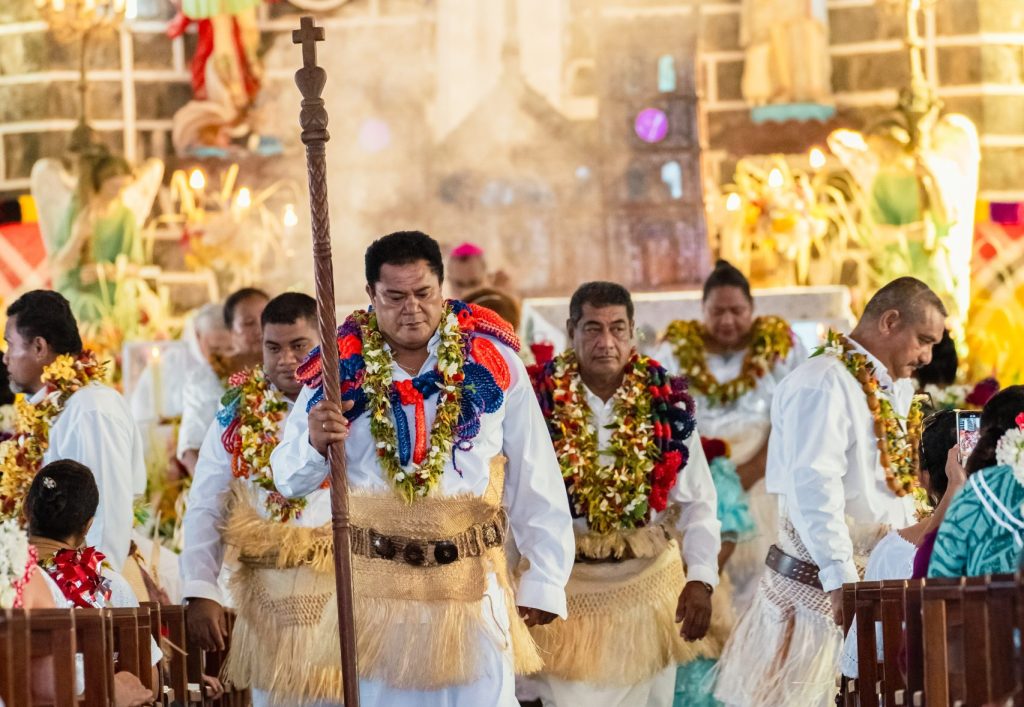
The result, persisting into the present, is a religious-political synthesis in which the Bishop of Wallis and Futuna is one of the territory's most influential figures, Catholic liturgical occasions are simultaneously civil ceremonies attended by the chiefly apparatus in full formal regalia, and Christian and customary values are articulated as continuous rather than competing. The funeral of a paramount chief is a Catholic mass conducted with full traditional ceremonial complement. The installation of a new chief involves priestly blessing alongside customary ritual. The religious and political calendars are so intertwined that separating them analytically is possible but separating them practically in the lived reality of either island would be unrecognizable to the communities that have maintained the synthesis across seven generations.
This synthesis is not without its tensions — theologians and anthropologists have both noted the places where Catholic doctrine and customary practice sit in uncomfortable proximity — but its durability is significant evidence of both traditions' adaptability and the community's capacity to hold complexity without requiring resolution.
The Fono : Council as the Engine of Customary Governance
The **fono** — the traditional council that operates at multiple levels of the chiefly hierarchy — is the institution through which customary governance is actually conducted, and understanding it is essential to understanding how chiefdom authority functions in practice rather than in principle.
The fono brings together the appropriate chiefs, noble title-holders, and community representatives to deliberate on matters within their customary jurisdiction. Land disputes, ceremonial obligations, community labor coordination, resolution of interpersonal conflicts that have risen to the level requiring chiefly intervention — these are the fono's typical business. The council's proceedings follow customary protocol: seating arrangements reflect hierarchical standing, speaking order is determined by title seniority, decisions are reached by the consensus process that kava ceremony accompanies and supports rather than by formal vote.
The fono's authority is not merely symbolic. When the fono determines that a family's land use rights have been violated, the determination has practical consequences that French administrative law cannot easily override — because the community's recognition of the fono's judgment underwrites its implementation in a way that external legal enforcement could not substitute. A neighbor who ignores a fono land determination faces not a legal sanction but social consequences of considerable weight: the withdrawal of community cooperation, the withholding of reciprocal labor for ceremonies and construction, the accumulated disapproval of the community that the customary system's social fabric makes very difficult to evade.
This informal enforcement mechanism is one of the customary governance system's most effective features in a small, face-to-face community context. With a total population of 11,000 across three islands, Wallis and Futuna has the social scale at which the kind of sustained community disapproval that non-compliance with customary decisions produces is genuinely costly. The anonymity that makes defiance of social norms relatively low-cost in large urban societies does not exist in a community where everyone knows everyone and social reputation has direct material consequences in every dimension of daily life.
The French Framework: Parallel Authority in Practice
The formal structure of Wallis and Futuna's governance allocates authority between the French state apparatus and the customary chiefdom institutions in ways that are partly specified in the 1961 organic law and its subsequent modifications, and partly determined by the accumulated practice of coexistence that seven decades of parallel governance have produced.
The French state, represented by a prefect (*administrateur supérieur*) appointed from Paris, holds formal authority over taxation, immigration, defense, and the domains that French administrative law covers across all overseas collectivities. The territorial assembly, elected by universal suffrage, handles matters of territorial administration and budget. These are real powers with real consequences — the French state provides approximately 80% of the territory's budget, which means the relationship is one of significant financial dependency alongside formal political recognition of customary authority.
Within this framework, the three kings hold customary authority over the domains the 1961 statute and subsequent practice have recognized as theirs: land management, customary ceremony, social organization within the chiefly system, and the resolution of disputes through customary process. In practice, the boundary between these domains and those of the French administrative framework is negotiated continuously, with specific disputes and questions requiring improvised case-by-case determination of which authority applies.
The relationship is not without friction. French administrators and territorial elected officials sometimes find customary authority an obstacle to planned development or administrative efficiency; chiefs and traditional councils sometimes find French administrative requirements an interference with customary process. But the friction operates within a framework of mutual recognition that both sides have maintained across seven decades, and the fundamental proposition — that the chiefdoms are legitimate governing authorities within their domains, not subordinate cultural institutions to be tolerated at the French state's discretion — has not been seriously challenged by either Paris or the local population.
The most recent significant test of this arrangement came with the deposition of the Lavelua Tomasi Kulimoetoke II in 2005 — a complex episode involving conflict between the territorial assembly, the French administration, and the traditional council over a matter of chiefly succession — which demonstrated both the real authority that customary institutions hold and the genuine complexity that arises when customary and formal legal authorities reach incompatible conclusions about the same situation. The resolution — negotiated over an extended period through channels that were neither purely customary nor purely French administrative — illustrated the pragmatic flexibility that both systems have developed for navigating their coexistence.
Customary Obligations: The Economy of Reciprocity
Life within the chiefdom system is not merely governed by customary authority. It is organized by it, in the sense that the customary framework structures the economic, ceremonial, and social obligations that daily life generates and requires.
The most significant of these obligations cluster around the kainaga — the extended kinship group that is the fundamental social unit above the household in both Wallisian and Futunan social organization. The kainaga coordinates its members' participation in the communal labor (gaue fakafonua, "work for the land/community") that maintains the physical infrastructure of chiefly ceremonial life: the construction and maintenance of meeting houses (fale), the preparation of feast foods for ceremonies, the provision of labor for community projects that chiefly decision has initiated.
Inasi — the first-fruits ceremony in which the community presents the season's agricultural products to the paramount chief before distributing them within the community — is one of the clearest expressions of the reciprocal economy that chiefdom structures manage. The ceremony is not taxation in the conventional sense, despite its surface resemblance to tribute systems. The chief who receives the inasi is not enriching himself at the community's expense; he is performing the redistributive function that chiefship entails, accepting the community's agricultural surplus in trust and ensuring its redistribution through the feasting and ceremonial occasions that chiefly authority organizes. The chief who fails to redistribute — who accumulates rather than circulates — violates the implicit contract that legitimate chiefship requires, and his authority accordingly weakens.
This redistributive economy — production flowing toward chiefly centers and then circulating back outward through ceremonially organized feasting and gift-giving — is the material mechanism through which chiefly authority maintains its practical legitimacy. The community participates in the obligations of the customary system because participation in the obligations brings participation in the benefits: the feasting, the ceremonial occasions, the social belonging that chiefdom structures provide, and the practical support of a community-based mutual assistance network that has no formal insurance or welfare analogue.
Language, Memory, and the Oral Transmission of Authority
The chiefdom traditions of Wallis and Futuna are maintained not through written archives or legal codification but through the oral transmission of genealogical knowledge, ceremonial protocol, chiefly history, and customary law that the traditional specialists — the matāpule (ceremonial attendants and orators) of Uvea, the soa and other title-holders of Futuna — have maintained across generations.
This oral tradition is both the chiefdom's most essential resource and its most vulnerable one. The knowledge of genealogical connections that determines chiefly eligibility, the ceremonial protocols that give specific rituals their legitimacy and their meaning, the historical accounts that establish the precedents on which contemporary customary determinations draw — all of this exists in the memory and practice of living people rather than in documents that can be consulted when the people who hold the knowledge are no longer present.
The demographic pressure of emigration — which has taken a significant portion of the working-age population from both islands to New Caledonia and metropolitan France — creates real risk of knowledge discontinuity. The young people who leave for economic opportunity are generally not the ones who sit with elders learning the genealogies and ceremonial protocols that the customary system requires. The elders who hold the deepest knowledge are aging. The transmission chain that has sustained the tradition across a thousand years of island history is under pressure from a migration pattern that the territory's economic structure makes difficult to reverse.
The response to this pressure has included some documentation efforts — recordings of oral history, compilation of genealogical records, the archiving of ceremonial knowledge in forms that can persist beyond individual memory — but the community is acutely aware that documentation is not the same as living transmission, and that a customary tradition maintained primarily through written and recorded archives rather than through active practice and intergenerational apprenticeship has already lost something essential.
What Survives and Why
The chiefdom traditions of Wallis and Futuna have survived a sequence of external pressures that has extinguished comparable institutions across much of the Pacific: French protectorate governance, Catholic missionary transformation, colonial administrative incorporation, economic dependency on metropolitan subsidy, and the demographic drain of emigration to wealthier territories. Their survival — as living governance institutions rather than ceremonial remnants — requires explanation.
The most important factor is the particular form of the 1961 territorial statute, which chose to recognize rather than replace customary authority, creating a parallel governance framework that gave the chiefdoms institutional room to maintain their practical functions. This choice was pragmatic as much as principled — a small territory with 11,000 people and minimal French administrative presence would have been difficult to govern without the customary institutions' legitimacy — but its consequences have been significant. Chiefdoms that retained real governance functions retained the practical necessity of their own knowledge transmission.
The second factor is the community's own sustained investment in the tradition — the willingness of Wallisian and Futunan communities, across generations and in the face of significant economic pressure toward assimilation, to maintain the ceremonial obligations, the kava protocols, the participation in fono processes that the system requires. This investment is not passive cultural inertia. It is an active choice, renewed with each generation, to maintain a form of social organization that the community evidently finds more adequate to its values and its conditions than the alternatives the modern world has offered.
The third factor — rarely discussed explicitly but deeply embedded in the situation — is the particular character of the Catholic-chiefdom synthesis that Wallis and Futuna developed. By making peace between the two most powerful authority structures in the community's life, and by embedding the chiefs within the Catholic ceremonial calendar and the church within the chiefly ceremonial system, the synthesis created a mutually reinforcing dual authority that neither institution could easily undermine without damaging itself. The chiefdom tradition has the church's blessing, quite literally. The church has the chiefdom's ceremonial support. Both are stronger for the arrangement than either would be without it.
The Morning After the Fono
On a morning in Mata-Utu, the capital of Uvea, the Lavelua has received the French prefect. The kava ceremony that preceded the meeting lasted an hour and a half. The speeches moved in their customary sequence: the ceremonial greeting, the presentation of gifts, the formal expression of the purpose of the visit, the chief's response, the closing formulas that acknowledge the relationship between the two authorities and leave both intact. By the time the meeting itself began, both parties had been sitting together long enough that something had changed — the ambient social temperature, the quality of attention, the degree to which each man was present to the other rather than to his position.
This is what the kava ceremony accomplishes that no amount of administrative protocol can substitute for. It makes time — the specific, unhurried time of ceremonial procedure — and in that time it makes a different kind of conversation possible than the one that would otherwise happen between a French official and a Polynesian king in a French overseas collectivity whose formal constitutional status places one definitively above the other.
Outside the meeting house, the fale's open sides admit a breeze from the lagoon. Children cross the yard without looking at the building where the Lavelua and the prefect are meeting, because this is ordinary — the chiefs and the French authorities have been meeting in this building, or buildings like it, for decades, and the outcome of the meeting will be determined partly by what was said inside and partly by what was established in the kava ceremony that preceded it, and partly by the accumulated weight of a thousand years of chiefly authority that the French state formally recognized in 1961 and has been working alongside ever since.
The authority is real. The kings are present. The tradition holds.