What the River Remembers: The Ngondo Festival and the Ancestral Water Traditions of Cameroon's Sawa People
What the River Remembers: The Ngondo Festival and the Ancestral Water Traditions of Cameroon's Sawa People
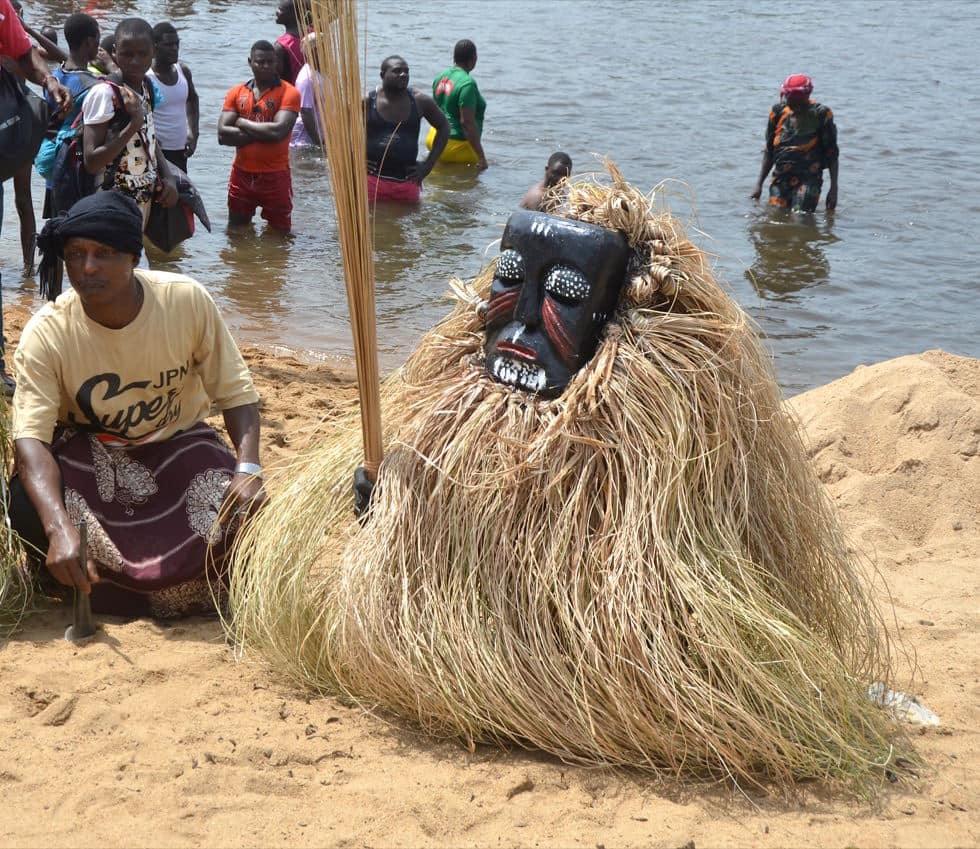
The Wouri River at Douala does not look like a threshold. It looks like what it is: a wide, brown, industrious estuary carrying the commercial weight of Cameroon's largest port city to the Atlantic Ocean, flanked by container terminals and fishing pirogues, busy with the practical traffic of a West African economic hub. But once a year, in the first week of December, the Wouri becomes something else. The canoes that move across its surface are not carrying cargo. The men and women assembled on its banks are not waiting for a ferry. The drummer whose rhythm carries across the water is not providing entertainment. The Ngondo festival has begun, and the river is open.
Open to what, exactly, requires some explanation — explanation that the Sawa people of Cameroon's coastal littoral have been providing to each other across generations for at least several centuries, and that they now provide, with varying degrees of patience, to the researchers, journalists, tourists, and government officials who arrive each December to witness a ceremony whose surface spectacle — the canoe races, the crowning of the festival queen, the traditional dances on the riverbank — is visually dramatic and spiritually the least important part of what is happening.
The most important part happens underwater. Or rather: it involves the underwater, the domain of the *Jengu* (water spirits), the ancestral dead who inhabit the river's depths, and the specific human intermediaries — male divers trained and ritually prepared for the purpose — who descend into the Wouri to consult with those ancestors and return with messages for the living. This is the Ngondo's theological core: not a celebration of the river but a conversation with it, mediated by those willing to make the crossing between the world of the breathing and the world of those who have finished breathing.
The Sawa: A Civilization Built at the Water's Edge
The **Sawa** people are not a single ethnic group in the sense that term is usually applied. They are a confederation of coastal and riverside communities — the Duala, Bassa, Bakweri, Bamileke coastal groups, Mungo, and others — whose shared identity is organized around their relationship to the water that defines their geography. *Sawa* means, roughly, "people of the water" or "coastal people" in the languages of the littoral zone, and it describes a cultural identity formed by residence along the rivers, estuaries, and coastal waters of what is now the Littoral and South West regions of Cameroon.
This water-based identity goes deeper than geography. The Sawa worldview is organized around the understanding that the river and the sea are not simply resources or obstacles but inhabited realms — domains of the *Jengu* (also spelled *Nyungu* in some communities), the water spirits who are simultaneously the ancestors of the living Sawa and the supernatural custodians of the aquatic world. The relationship between the Sawa people and the *Jengu* is not one of supplication to distant deities but of ongoing kinship with beings who were once human and who retain both knowledge of the living and concern for their welfare.
This cosmological framework shaped Sawa civilization in practical ways. The Duala — the largest and most economically dominant Sawa group, who gave their name to Cameroon's largest city — built their commercial empire on water-based trade networks, using their intimate knowledge of the estuary and its currents to position themselves as irreplaceable middlemen between the European trading ships that arrived from the fifteenth century onward and the interior communities whose goods those ships sought. Their relationship with the water was simultaneously spiritual, economic, and political — a relationship so integrated that separating its components is an analytical convenience that the tradition itself does not recognize.
The Jengu: Spirit World as Extended Community
The *Jengu* (singular: *jengu*) are the animating spiritual reality of the Ngondo festival and the reason the river is the appropriate site for a ceremony concerned with the community's future. They are typically described in ethnographic literature as "water spirits" or "merfolk" — descriptions that are technically accurate and culturally inadequate in the same way that describing the Catholic saints as "dead people believed to have influence" is technically accurate and culturally inadequate.
In Sawa understanding, the *Jengu* are the ancestors of the living community who have transitioned to the aquatic realm. They retain their social relationships — their kinship ties, their particular knowledge of individuals and families, their capacity for both assistance and displeasure. They are interested in the Sawa community's wellbeing not abstractly but specifically: they know which families have honored them and which have been negligent, which community decisions are wise and which invite disaster, what the coming year holds and what the living could do differently to improve its outcome.
The *Jengu* are understood to be physically present in the Wouri and the other waterways of the Sawa world. Encounters with them are not metaphorical — divers who descend deep enough, in the right state of ritual preparation, genuinely expect to make contact with beings who will communicate with them. Sawa fishermen operating on the river operate within a set of behavioral protocols designed to maintain respectful relationship with the *Jengu*: certain activities are prohibited in or near the water at certain times, certain offerings must be made before fishing seasons begin, certain stretches of the river are understood to be particularly active sites of *Jengu* presence and must be approached accordingly.
This ongoing relationship makes the Ngondo not an annual aberration in a normally secular social life but the climactic expression of a relationship that the community maintains continuously. The December festival is the formal consultation; the rest of the year is the ongoing reciprocal maintenance that makes the consultation meaningful.
Origins and History: When the River Called a Meeting
The Ngondo's origin traditions locate its founding in a moment of collective crisis. The oral histories most widely transmitted within the Sawa community describe the festival's establishment in the seventeenth or eighteenth century — accounts vary — when the Sawa peoples were facing threats of sufficient severity that the community's elders determined a collective consultation with the *Jengu* was necessary to receive guidance and seek protection.
The original Ngondo was, by these accounts, an emergency council — a *parlement* in the oldest sense, a gathering for speaking and listening across the boundary between the living and the ancestral, convened at the water's edge because the water is the domain in which that boundary is crossable. The *Jengu* were consulted about the nature of the threat, the appropriate response, and the community's prospects. The consultation produced guidance. The guidance was followed. The crisis passed, or at least was navigated. The council became an annual tradition.
This founding narrative is significant for what it reveals about the Ngondo's fundamental nature: it is not a harvest festival, a seasonal celebration, or a commemoration of a historical event. It is an institution of governance — the mechanism through which the Sawa community submits its situation to ancestral review, receives direction from those with the longer view that death provides, and renews the compact between the living and the dead that sustains the community's integrity across time.
The colonial period — German colonization from 1884, then French and British mandate after World War One — placed the Ngondo under pressure without eliminating it. Colonial administrators viewed the festival with the combination of suspicion and ethnographic curiosity typical of the era: suspicious because a large gathering organized around indigenous spiritual authority was politically difficult to control; curious because its spectacle was compelling and its social coherence was evident. German and later French attempts to either suppress or co-opt the Ngondo met with the resistance that the Duala and other Sawa groups mounted against colonial cultural imposition generally — a resistance that included the famous protest figure **Rudolph Duala Manga Bell**, the Duala king who was executed by German colonial authorities in 1914 for his resistance to forced land expropriation, and whose legacy the Ngondo subsequently incorporated as a symbol of Sawa dignity under colonial pressure.
The festival's post-colonial history is one of formal institutionalization: the independent Cameroonian state recognized the Ngondo as a significant cultural event, and it is now officially listed among Cameroon's major national festivals, attracting government participation, media coverage, and tourism promotion alongside its continued function as a living spiritual and governance institution.
The Emissary Who Descends: Ritual Diving as Diplomatic Act
The Ngondo festival's most distinctive and least-understood practice — the one that most decisively separates it from the category of cultural performance — is the ritual diving by which the community's designated intermediaries enter the Wouri to consult with the *Jengu*.
The diver — *le plongeur sacré* in the French terminology that Cameroonian media typically uses — is not self-selected. He is identified through a process of ritual selection that involves the elders, the existing *Jengu* cult leadership, and the *Jengu* themselves, who are understood to call their chosen intermediaries through dreams, visions, and signs recognized by the initiated. Once selected, the diver undergoes a period of ritual preparation that involves dietary restrictions, abstinence from sexual activity, specific herbal treatments, and extended time in the company of senior members of the *Jengu* cult who transmit the prayers, songs, and protocols that govern underwater communication.
The descent itself occurs at the festival's spiritual climax, typically in the early morning hours, in a section of the river designated for the purpose. The diver enters the water carrying offerings — items selected by the elders as appropriate gifts for the *Jengu* — and descends to a depth at which, in the tradition's understanding, the *Jengu* are accessible. The consultation is understood to be a genuine exchange: the diver presents the community's situation and questions, and the *Jengu* respond with messages, warnings, prescriptions, and prophecies.
What the diver returns with — whatever he brings from the depth, whether an object, a message transmitted in the *Jengu*'s own language and interpreted by specialists, or simply a quality of presence that the assembled community recognizes as bearing news from the other side — is then processed by the Ngondo's leadership council. The *Jengu*'s response is interpreted, deliberated over, and ultimately communicated to the assembled Sawa community as the ancestral guidance for the coming year.
From the perspective of empirical skepticism, the underwater consultation is obviously not what the tradition claims it is. From the perspective of the tradition's own epistemology, empirical skepticism is applying the wrong evaluative framework to a form of knowledge acquisition that does not operate through the methods empiricism values. The Sawa have not been consulting their ancestral dead for three centuries because the practice has failed to produce useful guidance. They have continued because, within their understanding of how knowledge flows between the living and the dead, the practice works.
The Ngondo Parliament: Governance Dressed as Festival
Alongside its spiritual functions, the Ngondo has historically operated as a political institution — a *parlement* in the etymological sense of a gathering for speaking, at which the Sawa community deliberates on matters of collective concern and reaches consensus through processes that the festival's ritual framework both enables and constrains.
The **Supreme Council of the Ngondo** — the governing body that oversees the festival and through which the ancestral guidance is processed and enacted — is composed of representatives of the various Sawa communities, elders recognized for their spiritual authority and their knowledge of tradition, and the *Jengu* cult leadership whose ritual expertise manages the festival's theological dimensions. This council functions year-round, not only during the December festival, and its decisions carry the authority that ancestral backing confers: positions taken by the Ngondo council on community matters — land disputes, marriage protocols, relations with outside powers, responses to government policy — are understood as carrying the *Jengu*'s implicit endorsement, which gives them a weight that purely political institutions lack.
This governance function was tested severely during the colonial period, when the Ngondo became a site of Sawa political organization that colonial authorities found difficult to penetrate or disrupt precisely because its spiritual character gave it a legitimacy that purely secular organizations could not claim. The chiefs and elders who met under the Ngondo's auspices were not simply political organizers who could be arrested and replaced; they were ritual officeholders whose authority derived from sources that the colonial state could not control.
In the postcolonial context, the Ngondo's governance role has evolved without disappearing. The Cameroonian state has, at various points, engaged with the Ngondo council on matters ranging from the recognition of Sawa territorial rights to questions of cultural policy. The festival's status as a formally recognized national cultural event gives its leadership access to official processes while the festival's spiritual authority gives it a constituency that official recognition alone cannot create. The Ngondo council navigates this dual position — simultaneously a heritage institution within the national cultural framework and an autonomous spiritual authority within the Sawa community's own governance structure — with the pragmatic adaptability that the tradition has demonstrated across centuries of political change.
Canoes, Queens, and the Spectacular Surface
For the thousands of visitors who attend the Ngondo each December — including Cameroonians from outside the Sawa community, diaspora members returning from France, the United States, and other migration destinations, and an increasing number of international cultural tourists — the festival's most immediately accessible dimension is its spectacle: the canoe races on the Wouri, the installation of the festival queen, the traditional dances performed by community groups in full ceremonial dress, and the general festive atmosphere of a celebration that draws the Sawa diaspora home and gives the riverbank the quality of a reunion organized on the largest possible scale.
The **canoe races** are among the festival's most technically demanding elements. The Duala and other Sawa groups maintain a tradition of wooden pirogue construction whose quality and navigational tradition reflects centuries of river-based life, and the racing pirogues — long, narrow, paddled by teams of up to thirty people in coordinated synchrony — are objects of considerable local pride. The races are competitive in the genuine sense: communities invest in their boats and their paddling teams, training specifically for the Ngondo races in the months before the festival, and the results carry social prestige that persists through the year. Victory in the Ngondo canoe races is not simply an athletic achievement; it is evidence of a community's vitality and coherence, its ability to organize collective effort toward a common goal.
The **Ngondo queen** — selected through a process that varies in its specific mechanics between different Sawa communities but generally involves a combination of lineage, character assessment by elders, and in some accounts the *Jengu*'s own indication of preference — is not a beauty queen in the Western pageant sense. She is a ritual officeholder whose role combines ceremonial representation of the community with specific responsibilities within the festival's spiritual program. The queen's installation ceremony involves protocols — specific garments, specific songs, specific sequences of ritual action — that connect her role to the Ngondo's theological framework rather than its entertainment dimension.
The traditional dances performed at the Ngondo — particularly the *ngoso* and *mboa* dances of the Duala, performed by groups in elaborately constructed costumes — are likewise not primarily entertainment, even though they are entertaining. They are enactments of specific relationships — between communities, between the living and the ancestral dead, between the human world and the *Jengu*'s domain — whose meaning is fully available only to those who know the choreographic and musical vocabulary in which those relationships are encoded.
The Oral Archive: What the Festival Preserves
One of the Ngondo's least-discussed but most consequential functions is its role as an archive — a living repository of Sawa historical knowledge, genealogical memory, legal precedent, and cosmological understanding that the festival's annual performance keeps active rather than allowing to calcify into text.
The *griot* tradition of West and Central Africa — the specialized oral historians whose memory holds what written records cannot capture — is present in the Ngondo through the elders and ritual specialists who know the specific songs, prayers, genealogies, and historical accounts that the festival requires. These are not passive repositories. They are active interpreters, adapting the tradition's vocabulary to new circumstances while maintaining the core knowledge that gives the adaptation its authority.
The genealogical memory preserved through the Ngondo is particularly significant because Sawa kinship organization — which connects living families to specific *Jengu* ancestors and through them to specific territories and rights — is not recorded in any external archive. It exists in the community's oral tradition, maintained by specialists whose knowledge is the community's title to its own history. When that knowledge is recited at the Ngondo — when an elder traces a lineage back through the named ancestors to the Jengu from whom the line derives — he is not merely performing a ritual. He is establishing a record that has legal, social, and spiritual force within the Sawa community's own governance system.
The Ngondo therefore preserves what colonialism's documentary infrastructure deliberately excluded: the Sawa community's own account of its history, its land relationships, its kinship structures, and its spiritual compact with the ancestral world. This preservation work is not nostalgic. It is urgent — particularly in a context where urban development pressure, resource extraction, and the demographic disruptions of migration are actively threatening the continuity of the knowledge transmission chains that the festival maintains.
Ngondo in the Twenty-First Century: Continuity Under Pressure
The contemporary Ngondo operates in conditions that the festival's founders could not have anticipated: a Sawa diaspora scattered across multiple continents; a Douala whose urban growth has transformed the Wouri's banks from the riverine landscape of traditional life into a port-industrial zone; a generation of young Sawa whose primary language may be French rather than Duala; and a global media environment that can broadcast images of the underwater consultation before the elders have finished interpreting what the divers returned.
These pressures are real, and the people responsible for the Ngondo's continuity speak about them with the specificity of practitioners who are managing a living situation rather than a heritage object. The transmission of the Jengu cult's ritual knowledge — the prayers, the protocols, the herbal preparations, the specific competencies that make the underwater consultation possible — requires apprenticeship structures that work best in communities of dense, continuous social contact. Urban life, migration, and the diversification of livelihood paths all make those structures harder to maintain.
The Ngondo's response to these pressures has been characteristically pragmatic: incorporating the diaspora back into the festival's social life rather than treating departure as departure; using the festival's formal recognition and media coverage to create documentation of elements of the tradition that can be archived even if the ideal form of transmission is oral and embodied; and allowing the festival's spectacular surface — the canoe races, the music, the dance — to do the work of keeping the diaspora community emotionally connected to a tradition whose theological depth they may not fully inherit but whose social and cultural meaning they continue to claim.
Whether these adaptations are sufficient to maintain the Ngondo's core function — the genuine consultation between the living and the Jengu, conducted by people who know what they are doing and believe fully in what they are doing it for — is a question that the Sawa community is living rather than answering in the abstract. The festival continues. The divers descend. The river holds whatever the river holds.
What the Water Carries
There is a quality to the Wouri River in the early morning of Ngondo's spiritual climax that visitors consistently struggle to articulate. The water looks the same as it always looks: wide, brown, opaque with the silt of the Congo Basin's drainage. The container ships are visible in the distance, loading and unloading in the port whose economic logic has nothing to do with Jengu or ancestral consultation. The city's noise is already present, because Douala is always already noisy.
And yet the assembled community on the bank is not performing attention to something absent. They are attending to something they understand to be genuinely present in the water — a presence that the festival's centuries of practice have been organized around, that the diver prepares for months to approach, that the elders' songs address by name. The Jengu are there, in the river, in whatever sense the tradition means when it says they are there. The question of what that sense is — whether it maps onto any external ontology, whether it requires one — may be less important than the question of what the community does with the guidance it receives.
It plans. It deliberates. It cautions itself against specific dangers, orients itself toward specific opportunities, reaffirms specific values. It buries the past year's conflicts in the ritual acknowledgment that the Jengu see what the living have done and are not finished with them yet. It renews the compact between the generations — the living, the recently dead, the long dead who are now Jengu — that the festival has been renewing for centuries.
The water carries what the community brings to it: its fear about the future, its grief about the past, its questions about what it should do next. It returns something — whatever the tradition means by the Jengu's response — that the community translates into the only thing a community ever really needs from an oracle: not prophecy, but orientation. The sense of where it stands, what it faces, and what those who came before it would recognize as the right way forward.
The river does not answer in words. The community has been listening long enough to know how to hear it anyway.