The Yurt and the Sky: Inside Kyrgyzstan's Living Nomadic Culture
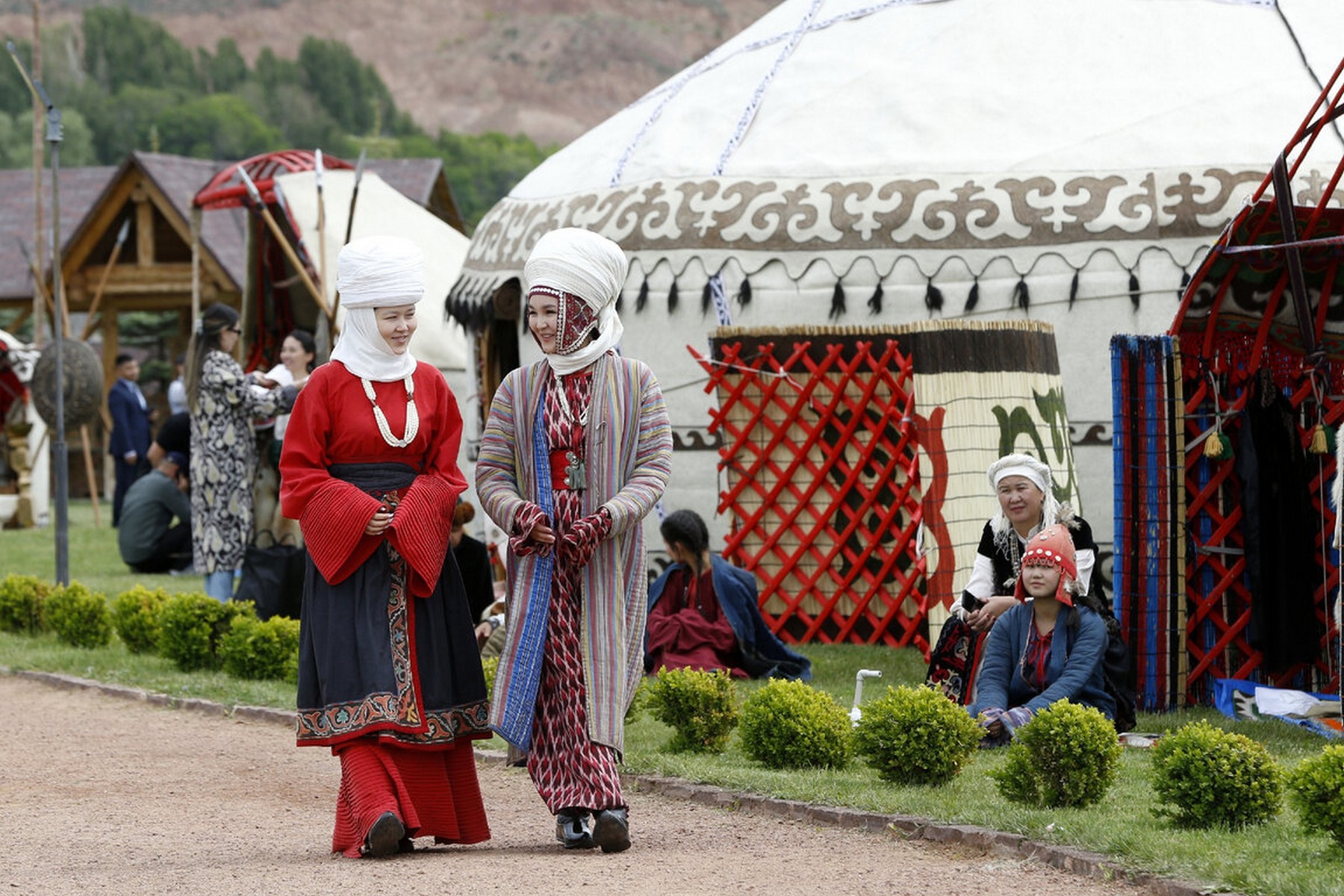
The Yurt and the Sky: Inside Kyrgyzstan's Living Nomadic Culture
Picture this: a family of four packs up their entire home — walls, roof, floor, furniture, cooking equipment — loads it onto two horses and three yaks, and relocates sixty kilometers into the mountains. The move takes a day. The new home is assembled in under two hours. By evening, a fire burns inside, bread bakes in a cast-iron pot, and children sleep under felt blankets stitched by their grandmother's hands. This is not a scene from the twelfth century. This is Kyrgyzstan in the present tense.
The **yurt** — called *boz üy* (grey house) in Kyrgyz, for the natural undyed felt that covers it — is the central artifact of one of Central Asia's most enduring nomadic civilizations. But to call it an artifact is already to misunderstand it. The yurt is not a relic. It is a living technology, a cosmological diagram, a social institution, and increasingly, a quiet declaration of identity in a country that spent seven decades under Soviet rule being told that nomadism was a primitive stage humanity was meant to outgrow.
Kyrgyzstan never fully believed that. And the yurt is the evidence.
Engineering That Took a Millennium to Perfect
The yurt's genius is not immediately obvious. It looks simple — a circular latticed wall, a domed roof of converging wooden poles, a felt skin stretched over the frame. But the engineering logic embedded in that simplicity took centuries of iteration on the high-altitude steppes of Central Asia to perfect, and it solves problems that modern architecture still struggles with.
The circular floor plan eliminates corners, which are structurally weak points and aerodynamic liabilities in the high winds that rake Kyrgyzstan's mountain passes at elevations above 3,000 meters. The dome shape sheds snow, deflects wind, and creates convective airflow: heat rises through the central opening (*tunduk*), drawing cold air in along the ground and cycling it upward, keeping the interior surprisingly comfortable in both summer heat and winter cold. The felt covering — made from compressed sheep's wool — is a near-perfect natural insulator, warm in cold and cool in warmth, and water-resistant without being waterproof in the suffocating way synthetic materials are.
The latticed wall sections (*kerege*) fold flat for transport, the roof poles (*uuk*) bundle into tight cylinders, and the entire structure weighs roughly 400–500 kilograms — manageable for the pack animals that Kyrgyz herders have worked alongside for generations. No nails are used in assembly. No glue. The structure is held together by tension, leverage, and a series of hand-knotted ropes. It can be dismantled just as fast as it goes up.
Modern architects studying yurt construction have noted that the structural principles — distributed load-bearing, tensile integrity, modular assembly — anticipate concepts that Western architecture wouldn't formally theorize until the twentieth century. Buckminster Fuller, who invented the geodesic dome in the 1940s, was working toward something the Kyrgyz had already perfected.
The Tunduk: A Circle That Holds the Universe
Every yurt contains a single element that elevates it from shelter to symbol: the **tunduk**, the circular crown piece at the apex of the dome through which wooden roof poles radiate outward and downward like spokes of a wheel. The tunduk serves a practical purpose — it is the chimney, the window, the vent. But its cultural significance dwarfs its utility.
The tunduk is reproduced on the flag of Kyrgyzstan. This is not an aesthetic choice. It encodes a worldview. The circle represents unity, completeness, the cyclical nature of the seasons and human life. The radiating spokes represent the community, extending outward from a common center. Looking up through the tunduk from inside a yurt, you see a ring of sky, framed by wood and rope, moving through its arc across the day. The Kyrgyz have looked at that circle of sky for over a thousand years and seen in it not emptiness but order.
The tunduk's position as both a cosmological symbol and a domestic fixture illustrates something essential about Kyrgyz culture: the sacred and the everyday are not separated here. There is no cathedral to visit on Sundays and then return to secular life. The home itself is the temple. Cooking, sleeping, weaving, receiving guests — all of it happens inside a structure that is simultaneously a house and a diagram of the cosmos.
Felt: The Material Memory of the Kyrgyz People
The felt that covers a yurt — and fills it — is not bought at a market. Or rather, it wasn't, for most of Kyrgyz history, and in many rural communities it still isn't. Felt-making (*kiyiz*) is a communal practice, a labor-intensive process in which wool is cleaned, carded, layered on reed mats, soaked with boiling water, and then rolled and pressed repeatedly until the fibers lock together into a dense, durable fabric. It takes a team of women the better part of a day to make enough felt for a single yurt panel.
This communal dimension is the point. Felt-making events — *kiyiz tuu* — are social occasions in which neighbors gather, work alongside each other, share food, and transmit knowledge across generations. The patterns pressed or appliquéd into the felt are not decorative in a casual sense: they are a visual vocabulary. The **yin-yang-like curved ram's horns** (*qochqor müyüz*) represent strength and masculinity. Stylized flowers and birds signal prosperity. Geometric borders encode territorial and clan affiliations that a knowledgeable Kyrgyz person can read as easily as text.
UNESCO recognized Kyrgyz felt-making traditions — specifically the art of *ala-kiyiz* (patterned felt made by pressing colored wool into designs before felting) and *shyrdak* (appliquéd felt carpet made from two contrasting-color layers cut and stitched together) — with Intangible Cultural Heritage status in 2012. The recognition matters less for the prestige than for what it signals: these are not dying crafts kept alive in museums. They remain in active production, taught mother to daughter, used in homes, carried to markets, and increasingly exported to a global audience that recognizes their quality without fully grasping their depth.
Hospitality as Moral Obligation
Enter a Kyrgyz yurt unannounced — a stranger, even a foreigner — and you will be offered a seat, a bowl of **kumiss** (fermented mare's milk), and whatever food the family has. This is not tourist performance. It is *konokashy*, the Kyrgyz code of hospitality so deeply embedded in social life that refusing a guest is considered a moral failure, not just a breach of etiquette.
The seating arrangement inside a yurt encodes social hierarchy with the precision of a formal diagram. The *tor* — the innermost section of the yurt, directly opposite the entrance — is the seat of honor, reserved for the eldest male, the most respected guest, or the *aksakal* (white beard: the community elder). Women traditionally occupy the left side of the yurt; men, the right. Guests are seated according to age and status, and the order in which they are served reflects their position. A Kyrgyz host who gets this wrong is not simply impolite — they have disrupted a social grammar that everyone in the room can read.
The bowl of kumiss offered to a guest is the most loaded item in this grammar. Accepting it fully — drinking it down — communicates respect and ease. Refusing it is an insult. Leaving too much is awkward. The bowl itself, if it is a decorated wooden one (*piala* of lacquered wood), may carry clan markings. The guest who pays attention to what they're holding is receiving a message.
The Jailoo: Summer Migration and the Rhythms of Pastoral Life
The yurt's full meaning only becomes legible when you understand the **jailoo** — the high-altitude summer pastures, typically between 2,500 and 4,000 meters in Kyrgyzstan's Tian Shan and Pamir-Alay mountain ranges, where herders drive their flocks each spring and remain until autumn. This vertical migration — from valley winter quarters to mountain summer grazing grounds — is the organizing rhythm of traditional Kyrgyz life, and the yurt is what makes it possible.
The jailoo is not just an economic strategy (though it is an efficient one: high pastures recover in winter while valley land rests in summer, preventing overgrazing through seasonal rotation). It is an experience that Kyrgyz people speak of with a quality of feeling that approaches the sacred. The air at 3,500 meters is cold and absolutely clear. Wildflowers — edelweiss, gentian, alpine poppy — cover slopes that no plow has touched. Eagles hunt above glaciers. The silence is the kind that makes city-dwellers realize how much noise they live inside of.
Many urban Kyrgyz who have never herded livestock in their lives still return to the jailoo for a few weeks each summer, to relatives who maintain the old patterns. The experience anchors something. Children who grow up spending summers in yurts at altitude come back to Bishkek knowing something about scale — the scale of mountains, of seasons, of a way of life that predates the city by a thousand years.
Soviet Pressure, Cultural Survival, and the Yurt's Comeback
The Soviet period (1917–1991) treated nomadism as an ideological problem. Collectivization policies in the 1920s and 1930s forced Kyrgyz herders into collective farms (*kolkhozy*), disrupting the seasonal migration patterns that pastoral ecology depended on. Hundreds of thousands of animals were slaughtered when herders resisted collectivization rather than surrender their livestock to state ownership. A famine followed. Estimates of Kyrgyz deaths in the early collectivization period range from 30% to 40% of the pastoral population.
The yurt was not banned outright, but it was marginalized — associated with backwardness, with pre-socialist life, with a past that Soviet ideology insisted was being transcended. Permanent housing was the future. Factories, schools, and apartment blocks were the future. The nomad was an embarrassment to the modernizing project.
Yet the yurt survived. It survived in part because it was practically necessary — rural herders continued to use yurts on pastures even under Soviet oversight, because there was no practical substitute. And it survived as memory and meaning, passed through families who kept the knowledge of construction, felt-making, and interior arrangement alive even when the structures weren't being built.
After independence in 1991, the yurt experienced a cultural resurgence that has only intensified in the decades since. It now appears at every major national celebration, anchors the country's growing community-based tourism industry, and occupies a place of deliberate prominence in Kyrgyz national identity — the tunduk on the flag is one of the world's more honest national symbols, because it represents something the country actually has.
The Yurt Economy: Tradition as Livelihood
Kyrgyzstan's yurt culture has become one of the country's most compelling tourism propositions, and the model being developed — community-based, low-infrastructure, environmentally appropriate — is more sophisticated than the "glamping" tag sometimes attached to it suggests.
Organizations like the Community Based Tourism (CBT) network, established in the late 1990s with Swiss development support, have helped hundreds of rural families offer yurt stays to travelers in a way that keeps economic benefit local. The traveler sleeps in a working yurt on an active jailoo, eats food from the family's herd, helps with daily tasks if they choose, and pays directly to the family. No intermediary hotel chain extracts the margin. The felt on the walls was made by the grandmother. The kumiss in the bowl was fermented that morning.
This model works partly because Kyrgyzstan's tourism infrastructure constraints — poor road access in many mountain areas, limited hotel capacity outside Bishkek — push visitors toward exactly the kind of immersive, community-embedded experience that mass tourism economies struggle to manufacture. The constraint became a feature.
Felt crafts have followed a parallel trajectory. The Kyrgyz cooperative Altyn Kol ("Golden Hands"), along with numerous smaller women's cooperatives in the Issyk-Kul and Naryn regions, now produce shyrdak and ala-kiyiz goods for international markets. A large shyrdak carpet — representing dozens of hours of skilled labor — sells for prices that reflect actual craft value rather than the discounted rates of commodity manufacturing. The market is small but real, and it sustains techniques that might otherwise exist only in ethnographic archives.
What the Yurt Knows That We've Forgotten
There is a recurring temptation, when writing about nomadic cultures, to frame them as instructive parables for a sedentary world that has lost its way. The yurt-as-sustainability-lesson. The nomad-as-environmental-sage. This framing, however well-intentioned, is its own kind of condescension — it turns a living culture into a metaphor for someone else's anxieties.
The Kyrgyz yurt tradition is not a parable. It is a working system developed by specific people in a specific landscape over a specific period of history, and it is being actively maintained, adapted, and transmitted by people who have decided it is worth keeping — not because the world needs to learn from it, but because it is theirs.
That said: a home you can build in two hours, pack onto two horses, and move without leaving a mark on the land does encode a relationship to place and resource that the permanent structures of industrial civilization have structurally abandoned. The tunduk open to the sky keeps the inhabitant connected to weather, light, and season in a way that thermostat-controlled apartments do not. The communal labor of felt-making creates social bonds that individualized consumer markets cannot replicate.
These are not arguments for returning to nomadic life. They are observations about what is lost when a way of life disappears — and what is protected when a culture decides, as the Kyrgyz have, that some things are worth the effort of keeping alive.
Stand inside a yurt at dusk, when the tunduk frames the first stars and the felt walls hold the warmth of the day's fire, and you understand something that no architectural theory fully captures: that a home can be both temporary and permanent, both humble and complete. The Kyrgyz have known this for a thousand years. The knowledge is still there, woven into wool, carved into wood, carried across the mountains on horseback, and offered — with kumiss and unhurried grace — to anyone willing to accept it.