The Spin That Seeks God: What the Whirling Dervish Dance Actually Means
The Spin That Seeks God: What the Whirling Dervish Dance Actually Means
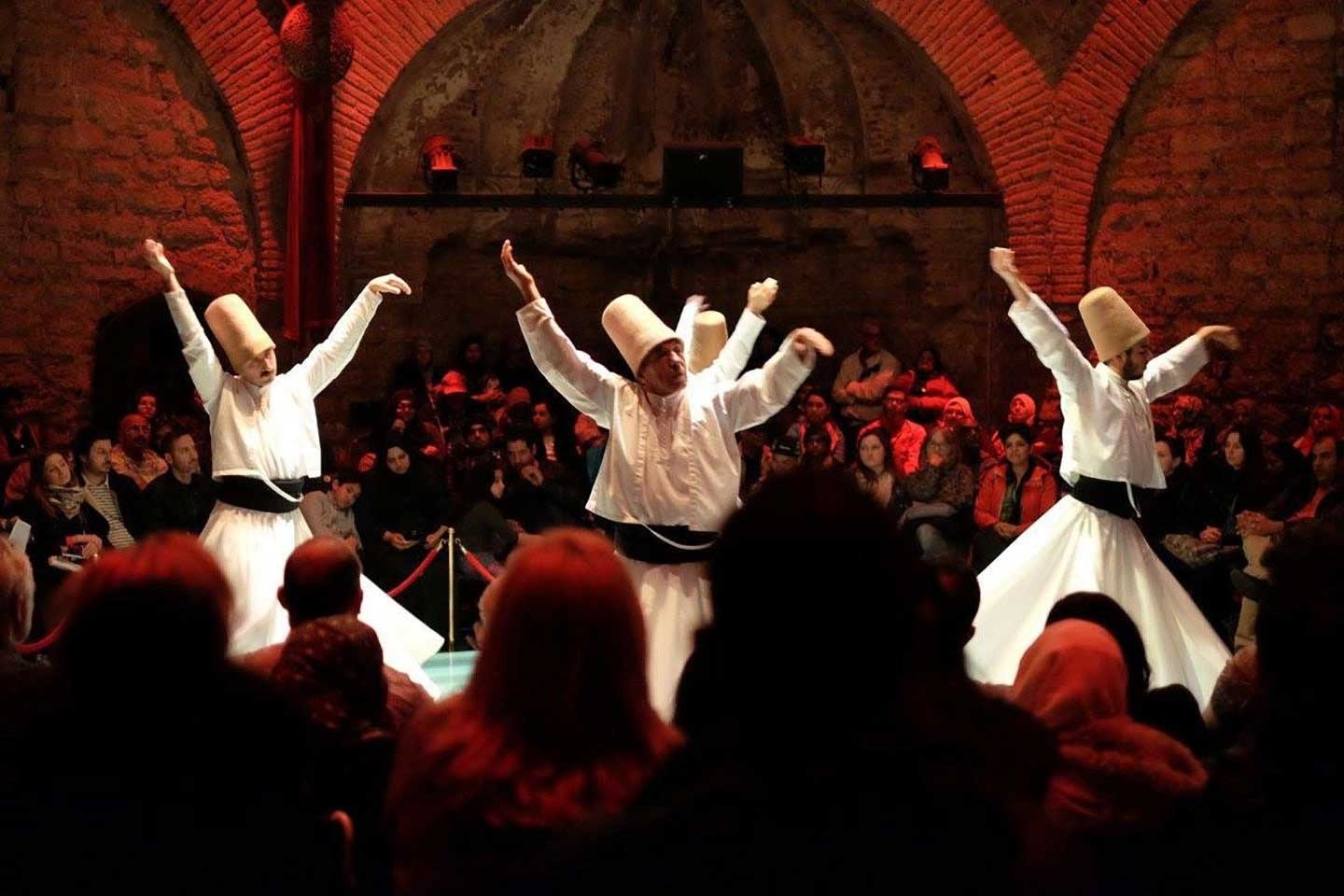
There is a moment in the Sema ceremony — the whirling practice of the Mevlevi Sufi order — that photographers never capture, because it happens before anything visually interesting occurs. The dervishes stand motionless in their camel-hair cloaks and tall conical felt hats, arms crossed over their chests, heads slightly bowed. The musicians have not yet begun. The posture is deliberate: arms crossed over the chest represent the number one in Arabic numeric form, a zero wrapped upon itself — the declaration that there is no reality but the One. The bowed head is the ego acknowledging its submission. The dervish standing in that posture is, before a single rotation has been made, already in the ceremony. The turning, when it begins, is not the beginning. It is the continuation of something that started in stillness.
This gap between what the whirling dervish looks like and what it is runs through almost every encounter between the practice and the world outside it. The white skirts, the spinning, the serene expression — these produce an image that the tourism industry, the wellness market, and the Instagram algorithm have each processed in their own way, turning a precise theological practice into a visual shorthand for mystical experience in general. The actual practice is stranger, more demanding, and more philosophically radical than any of these appropriations suggests. To understand what a dervish does when they turn requires understanding what Jalal ad-Din Rumi believed about the nature of the soul, the structure of the universe, and what the human being is doing here at all.
Rumi and the Foundation of the Turn
**Jalal ad-Din Muhammad Rumi** was born in 1207 in Balkh, in the Khorasan region of the Persian-speaking world that is now Afghanistan — a fact that complicates the Turkish national claim on him but does not diminish the depth of his association with Konya, the Anatolian city where he spent most of his adult life and where he died in 1273. His full name identifies him as a jurist, a theologian, and a scholar before he became the ecstatic poet the world knows him as. The transformation happened through friendship.
In 1244, Rumi met a wandering Sufi mystic named **Shams-i-Tabrizi** — Shams of Tabriz — whose theological intensity and disregard for conventional religious decorum produced in Rumi something close to complete transformation. The two formed a friendship of such consuming intensity that Rumi's existing students grew alarmed and resentful. Shams disappeared twice — murdered in the second disappearance, almost certainly by members of Rumi's own circle. Rumi's grief at the loss was the fuel that generated his greatest poetry: the *Masnavi*, a six-volume epic of spiritual instruction in verse, and the *Divan-i Shams-i-Tabrizi*, a collection of lyric poems addressed to the absent beloved friend who had become, in the mystical logic Rumi inhabited, inseparable from the divine.
The whirling practice emerged from within this grief and this ecstasy. Tradition holds that Rumi began turning spontaneously — in the marketplace, at the goldsmith's, in response to the rhythmic hammering of metal — as a physical response to states of spiritual intensity that his body needed to express and his mind could not contain. Whether or not the specific origin stories are literally accurate, they describe something real about the relationship between the physical turn and the theological state it enacts: the spin is not a technique applied to produce an experience. It is the experience finding its form.
After Rumi's death, his son Sultan Walad organized the *sohbet* (spiritual conversations) and practices that Rumi had transmitted into a formal order — the **Mevlevi Order**, named from Rumi's honorific *Mevlana* (Our Master). The Sema ceremony was systematized, its movements codified, its musical accompaniment specified. What had begun as spontaneous ecstatic expression became a transmitted tradition with a precise curriculum — though the tradition maintained, and continues to maintain, that the precision of the form is in service of the spontaneity of the state, not a replacement for it.
The Theology of Annihilation: What the Spin Means
To understand why dervishes turn, it is necessary to understand the Sufi concept of **fana** — annihilation, or the dissolution of the individual self in the divine reality. Fana is not metaphor in Sufi theology. It is the description of a specific experiential state in which the ordinary sense of a bounded, separate self temporarily dissolves, and what remains is awareness without the usual subject-object structure — no observer separate from the observed, no self distinct from the divine ground in which the self is held.
The Sema ceremony is designed to induce and support this state, not through psychological manipulation but through a set of physical and sensory conditions that the tradition has determined, over eight centuries of practice, to be conducive to it. The turning itself is the primary mechanism. When a body rotates continuously, the vestibular system — the inner ear's mechanism for detecting rotation and maintaining orientation — undergoes changes that alter sensory processing in ways that meditators and psychologists have both noted, though from different frameworks. Sustained rotation produces an altered relationship to the sense of a fixed, located self; the body in continuous turning is not anchored to a point in space the way a stationary body is. The ground beneath the feet is moving. The room moves. The distinction between mover and moved becomes experientially blurry.
This is not vertigo in the pathological sense; trained dervishes do not experience the nausea and disorientation that untrained people feel when they spin because they have developed, through years of practice, the physical and attentional skills that allow turning to be sustained without the vestibular dysregulation that makes spinning distressing. What they develop instead is a capacity to turn from a center — to find, within the continuous rotation, a stillness that the turning surrounds rather than eliminates. The metaphor the tradition uses is astronomical: the dervish turns as the planets turn, as the electrons turn, as the entire cosmos turns around the divine center. The turn is not an aberration from the natural order. It is a participation in it.
The theological meaning of the dervish's specific posture during the Sema deepens this: the right hand is raised, palm facing up, receiving divine grace from above; the left hand is lowered, palm facing down, transmitting that grace to the earth. The dervish in this posture is functioning as a conduit — a channel through which the divine flows into the world, with the turning body as the mechanism of transmission. The white skirt (*tennure*) that spreads outward as rotation accelerates maps the soul's expansion as the ego contracts: the more completely the self releases its ordinary boundaries, the wider the grace transmitted.
The Sema Ceremony: A Liturgy in Four Movements
The Mevlevi Sema is not improvised. It is a liturgy, structured in four sections (*selams*), each corresponding to a stage of the soul's journey toward and within the divine presence.
The ceremony opens with the **Naat-i Sharif**, a eulogy for the Prophet Muhammad composed by Rumi himself and sung by a solo vocalist (*neyzen*). The *ney* — the end-blown reed flute that is the Mevlevi order's sacred instrument — then plays an improvised solo introduction (*taksim*). Rumi's opening verses of the *Masnavi* begin: *"Listen to the reed, how it tells a tale of separation / Lamenting the pain of exile."* The reed was cut from the reed bed; its music is the sound of that separation. The ney is the instrument of Sufi longing precisely because its sound is produced by breath moving through a wound — the cut end of a reed that was once whole, now made resonant by the breath of the player who becomes, in this metaphor, the divine breath animating the separated soul.
The first selam represents the human being's birth into awareness — the recognition of one's own existence and of the divine reality that both grounds and exceeds it. The dervishes emerge from their black cloaks (symbolizing the ego's tomb, the material world's limitations) into their white *tennure*, executing three circumambulations of the space — representing the three stages of knowing: knowledge itself, the thing known, and the knower, collapsing toward unity.
The second selam enacts the rapture of witnessing divine grandeur — the soul's astonishment before the vastness of what it encounters as it releases its ordinary limitations. The turning accelerates. The *tennure* spreads fully. The selam ends not with a climax but with a return to stillness — the selam structure consistently returning the dervish to the moment before beginning, as if demonstrating that the ecstatic state has a before and after even if the state itself knows neither.
The third selam is the ecstatic union — fana itself, or as close as the ceremony brings the participants to it. The music intensifies; the verses shift to a register of explicit love poetry. This is the selam most associated with the ceremony's visual peak, and it is the selam during which experienced observers most often report witnessing something in the dervishes' faces and bodies that goes beyond technique — a quality of absence, of the person being somewhere other than the room, that is distinct from concentration or performance.
The fourth selam represents the soul's return — from the station of union back to the world of time and human existence, now carrying what the union disclosed. The dervishes slow. The posture of transmission — right hand up, left hand down — is resumed. The ceremony closes with the sheikh's recitation of Quranic verses and the Fatiha, and the dervishes resume their black cloaks: having touched the eternal, they return to the temporal.
The Ney and the Sama': Music as Theological Argument
The musical framework of the Sema is not incidental to its function. Sufi musical theory — elaborated most fully in the works of al-Ghazali, Ibn Arabi, and Rumi himself — holds that **sama'** (audition, or spiritual listening) is a form of knowledge-acquisition that bypasses the ordinary discursive mind and operates directly on the heart, which Sufi philosophy identifies as the seat of spiritual perception rather than emotion in the Western psychological sense.
The *ney*'s primacy in this context is theological rather than aesthetic. The flute's sound is produced entirely by breath — the player's breath passing through a hollow reed, shaped by the specific cavity of the instrument into tones. In Sufi symbolism, breath is the divine animating principle — the breath by which God, in the Quranic account, brought Adam to life — and a musical instrument that produces sound through breath alone is therefore a particularly direct metaphor for the soul, which is itself animated by a breath of the divine. When the *ney* plays, it is, in the Mevlevi understanding, the sound of the soul's longing made audible — a demonstration, in sound, of the very separation and yearning that the ceremony enacts.
The **kudüm** (small kettledrums) provide the rhythmic foundation; the **rebab** (bowed lute) contributes the melodic line most associated with Rumi's era. But it is the ney that opens and centers the ceremony, and it is the ney's improvised *taksim* that establishes the modal and emotional territory in which the Sema will unfold. A skilled *neyzen* does not merely play the ceremony's music; they participate in its spiritual work, using improvisational decisions to read the state of the room and respond to it — not unlike the way a skilled sheikh might adjust a spiritual discourse based on what he perceives in his students.
The Mevlevi Curriculum: Years Before the First Turn
The image of dervishes spinning has circulated so widely that it has almost entirely displaced awareness of the training that precedes the spinning — a curriculum so demanding that its duration was traditionally measured in years of service (the *çile*, a 1,001-day novitiate) before a student would be permitted to participate in the Sema at all.
The Mevlevi *çile* was not primarily about learning to turn. It was about learning to be turned — about the character transformation that Sufi education has always been directed at producing, in which the ego's habitual patterns are progressively identified, weakened, and eventually offered up. The novice (*can*) in a Mevlevi tekke (lodge) spent the first period of training performing the most humble service functions of the community: cleaning, cooking, caring for guests. This was not hazing or mere institutional hierarchy. It was deliberate character education: the person who has genuinely served without resentment for three years is a different person — less defended, less insistent on their own importance, more porous to experience — than the person who arrived.
Physical training in turning came later, and it was itself a form of character work. The specific technique of Mevlevi turning — rotating on the left foot, using the right foot to push and sustain the turn, maintaining the head at a slight angle that allows a fixed-gaze technique to prevent disorientation — takes months to acquire at basic competence and years to refine. Instructors in the classical tradition evaluated not just whether students could sustain the turn but whether they could sustain it in the specific interior state the turning was meant to support: genuine release of self-consciousness, not its performance.
The Ottoman suppression of Sufi orders in 1925 — when Mustafa Kemal Atatürk, as part of his secularization program, closed all tekkes and formally banned Sufi practice — disrupted this curriculum severely. The orders went underground or into diaspora; the transmission chains frayed. When the Mevlevi Sema was revived in Konya in the 1950s as a cultural event (the secularist state permitted it as folklore once it had been stripped of explicit religious status), the revival was working with compromised transmission — practitioners who had learned from masters whose own training had been interrupted, reconstructing a living practice from partial memory and documentary sources.
This history of suppression and reconstruction is important context for understanding both the Sema's current forms and its current controversies. The ceremony that UNESCO added to its Intangible Cultural Heritage list in 2008 is simultaneously an authentic continuation of a tradition and a partially reconstructed approximation of it — the two conditions coexisting in the same practice, as they do in every living tradition that has survived historical rupture.
Tourism, Appropriation, and the Question of Access
Every Thursday and Sunday evening in Konya, at the cultural center near the Mevlana Museum that houses Rumi's tomb, a Sema ceremony is performed for an audience that includes tourists from forty countries, regional pilgrims, curious secular Turks, and Sufi practitioners from international Mevlevi communities. The performance is open, free, and photographed continuously.
The tension this produces is real and has no clean resolution. On one hand, Mevlevi tradition has always held that the Sema is not esoteric — that it is a gift to the world, not a secret held from it, and that witnessing the ceremony, even without full understanding, can produce genuine effect in receptive observers. Rumi's poetry is addressed to humanity, not to initiates; the tradition has no membership requirement for the experience of longing that the ceremony enacts. On this reading, the tourist in the audience is not an intruder; they are a recipient, however partial, of something freely given.
On the other hand, the conditions of a tourist performance — the photographic equipment, the schedule dictated by the tourism calendar, the audience whose attention is partially directed at the visual spectacle rather than the interior experience — are not conducive to the specific interior work the ceremony is designed to support. Experienced practitioners describe a qualitative difference between a Sema performed within a functioning spiritual community and one performed for an audience, even when the external form is identical. What is lost, they suggest, is not the form but the field — the collective interior orientation that the community brings to the ceremony and that the ceremony, in turn, amplifies.
The commercialization of dervish imagery compounds this. Whirling dervish figures appear on Turkish tourist merchandise, restaurant logos, hotel wallpaper, and wellness retreat branding in a quantity and variety that would be difficult to justify as cultural appreciation and easier to read as cultural extraction — the image circulating far beyond the practice it depicts, stripped of its theological content and functioning as an aesthetic marker of exotic spirituality. The dervish on the tea towel is not a Sufi criticism; it is simply evidence that an image powerful enough to circulate this widely will eventually circulate beyond the context that gave it its power.
The Living Orders: Mevlevi Communities Today
Despite the Ottoman suppression and the subsequent complicated history of revival, Mevlevi communities continue to function in Turkey, in the Arab world, in Europe, and in North America — transmitting the practice in conditions that vary enormously from the classical tekke model but maintain the essential curriculum of character work and turning practice.
In Istanbul, several active Mevlevi communities operate outside the tourism circuit, conducting Sema in contexts oriented toward practitioners rather than audiences. In Konya, beyond the public ceremony, a community of serious students maintains contact with surviving elements of the traditional curriculum, working with the partial but genuine transmission that the post-1925 recovery has produced. International communities — in the United States, Germany, the Netherlands, South Africa — practice in forms adapted to their contexts, sometimes with Turkish sheikhs visiting to provide direct transmission, sometimes developing their own lineages under teachers who themselves trained in Turkey or the Levant.
The question of what makes a Mevlevi practice authentic — in the absence of the classical tekke, in the presence of cultural discontinuity, across multiple languages and contexts — is one that the living communities navigate with varying degrees of sophistication. What they share is the orientatio