The Religion the World Misnamed: Vodun's Living Heritage in Benin
The Religion the World Misnamed: Vodun's Living Heritage in Benin
On January 10 each year, the streets of Ouidah fill with a sound that has no precise Western analog — a layered percussion of sacred drums, the voices of initiates in trance, the clatter of iron ceremonial objects, and beneath all of it, something that visitors consistently describe as a vibration rather than a sound, something felt in the sternum before it is heard in the ear. The Vodun Festival has begun. A million people or more have gathered in this coastal Beninese city — pilgrims, practitioners, tourists, scholars, diaspora members returned from Haiti and Brazil and Louisiana — to participate in or witness the public face of a religious tradition that is simultaneously one of the world's oldest continuous spiritual systems and one of its most systematically misrepresented.
**Vodun** — the word means "spirit" or "deity" in the Fon and Ewe languages of the region that is now the Republic of Benin and neighboring Togo — is the source from which the Haitian *Vodou*, the Louisiana *Voodoo*, and the Brazilian *Candomblé* and *Umbanda* all descend, carried across the Atlantic in the minds and bodies of enslaved West Africans who refused, under conditions of total dispossession, to relinquish the spiritual architecture that gave their world its structure. What arrived in the Americas was transformed by the encounter with Christianity, with Indigenous American traditions, and with the specific conditions of enslavement into new forms that diverged from the Beninese source over three centuries. But the source remains — in Ouidah, in Abomey, in the sacred forests and coastal temples and royal compounds of what was once the Kingdom of Dahomey — and it is older, more philosophically complex, and more internally diverse than anything the term "voodoo" in its popular usage manages to suggest.
The Kingdom That Made the Religion: Dahomey and Vodun
Vodun's development as a complex, systematized religious tradition is inseparable from the history of the **Kingdom of Dahomey**, the powerful West African state that dominated the region between roughly 1600 and 1894, when French colonial forces defeated the last Dahomean king and absorbed the kingdom into French West Africa. Dahomey was, by the standards of its time and region, an extraordinarily sophisticated political entity: it maintained a standing army that included a renowned corps of female warriors (the *Agojie*, whom European observers called the Dahomey Amazons and whom the popular imagination has recently rediscovered through film), kept detailed oral and artistic historical records through an elaborate system of royal commemorative arts, and organized its religious life through a relationship between the royal lineage and the vodun spirits that gave the monarchy both its legitimacy and its cosmological authority.
The Fon-speaking people of Dahomey conceptualized the universe as populated by **401 vodun** — spirits or divine forces that govern every domain of natural and human experience. The number 401 is understood not as a precise count but as an expression of totality: the vodun are as numerous as reality's aspects, and reality has more aspects than can be finally enumerated. Each vodun has its own personality, domain, preferences, rituals, colors, symbols, and modes of communication with the human world. **Legba** guards crossroads and thresholds, mediates between humans and the other vodun, and must be propitiated before any serious ritual work can proceed — his image, typically a small clay figure with exaggerated phallic form, stands at the entrance to compounds throughout Benin, receiving the first offerings. **Mawu-Lisa**, the creator deity, is understood as a paired male-female principle, the sky and the light, present in everything that exists. **Sakpata** governs the earth, smallpox, and all diseases of the skin — terrible in power, essential to propitiate, capable of affliction but also of healing. **Ogou** (called *Ogou* in Haitian Vodou and *Ogum* in Brazilian Candomblé) is the vodun of iron, warfare, and technology, his rituals involving the forging and the metal and the specific heat of the blacksmith's work.
The relationship between Dahomey's kings and the vodun was not merely ceremonial. The royal lineage was understood to be descended from specific vodun, and the king's authority depended on maintaining the proper ritual relationships with the spirits that had granted sovereignty to his ancestors. The **royal palaces of Abomey**, now a UNESCO World Heritage Site, were religious spaces as much as political ones: the bas-relief murals that cover their walls depict not only military victories and royal portraits but cosmological narratives, the relationships between kings and their vodun patrons encoded in visual language that required initiatory knowledge to fully read.
Ouidah: The Sacred City and the Route of Slaves
**Ouidah** — a coastal city of roughly 100,000 people, an hour's drive west of Cotonou — occupies a position in Vodun heritage that has no precise parallel in other religious traditions' sacred geographies. It is simultaneously the religion's most important living center, the site of one of the Atlantic slave trade's most active ports, and the city from which the Vodun tradition was most intensively exported across the ocean to the Americas. These three functions are inseparable from each other and from the city's contemporary character.
The **Python Temple** — the *Temple des Pythons* — is among Ouidah's most visited sacred sites, housing several dozen royal pythons (*Python regius*) that are venerated as sacred animals associated with the vodun **Dangbé**, the serpent deity whose cult is centered in Ouidah and whose symbol appears throughout the city's visual culture. The pythons move freely within the temple compound, are handled by priests and worshippers during ceremonies, and are treated with the specific care appropriate to sacred beings whose wellbeing is understood to be connected to the community's wellbeing. When a sacred python is found dead — or, occasionally, when one wanders into the city streets — it receives burial rites.
The **Route of Slaves** — *La Route des Esclaves* — is the most emotionally charged geography in Ouidah's sacred landscape. The three-kilometer procession route follows the path that enslaved people walked from the market at the city's center to the **Point of No Return**, the arch on the beach from which they were loaded onto slave ships. This route, restored in the 1990s as a memorial and UNESCO-recognized historical itinerary, passes several sacred sites whose existence predates the slave trade: trees associated with protective vodun that captives were marched around in rituals intended to erase their memory of home and make them compliant; a sacred grove where the vodun of the sea was propitiated before the crossing; the beach itself, where the ocean meets the land and where, in Vodun cosmology, the world of the living meets the world of the dead.
The Vodun Festival's largest procession follows this route, which means that the annual celebration of the living religion simultaneously traverses the path of its most catastrophic dispersal. This coincidence — the festival route as memorial route, the celebration as acknowledgment of the wound — is not accidental. Beninese Vodun practitioners are clear that the religion's survival in the Americas, its transformation into Haitian Vodou and Brazilian Candomblé, is understood as part of the vodun's own power: the spirits that could not be transported in chains were somehow transported anyway, arriving in the Americas in the memories and practices of the enslaved, reconstituting themselves under different names and in different conditions, and persisting there for three centuries until the moment of reconnection became possible.
The Vodun Cosmology: How the Spirit World Is Organized
To understand Vodun's theological sophistication requires engaging with its cosmological structure, which is considerably more philosophically developed than popular representations suggest. Vodun is not animism in the dismissive sense that nineteenth-century European anthropologists used the term — the attribution of spiritual significance to random natural objects without systematic theological structure. It is a coherent theological system with its own metaphysics, ethics, and eschatology.
At its foundation, Vodun posits that the universe contains multiple layers of reality — the visible world of human experience (*gbeto*) and the invisible world of spiritual forces (*vodun*) — and that these layers are constantly interactive. The vodun are not distant deities who intervene occasionally in human affairs; they are present, immanent forces whose presence is felt in every aspect of natural and human life. A thunderstorm is not merely a meteorological event; it is the vodun **Hevioso** — the deity of thunder, lightning, and justice — making his presence felt, and the quality of the storm, its direction and intensity, can be read by those with the knowledge to read it as communication from Hevioso about the moral state of the community.
The **Fa** divination system — known as *Ifá* in the Yoruba tradition with which Vodun shares significant historical connections — is Vodun's most complex intellectual system, a binary divination method using palm nuts or a divining chain (*aklaka*) to generate one of 256 possible configurations (*du*), each associated with a vast body of oral literature encoding guidance, warnings, and the terms under which specific vodun have agreed to interact with specific human situations. A skilled **Fa diviner** (*bokonon*) must memorize the oral literature associated with all 256 configurations — a training process that takes many years — and can consult Fa on behalf of clients seeking guidance on questions ranging from the agricultural to the personal to the political. Dahomey's kings consulted Fa before military campaigns; contemporary Beninese consult Fa before major life decisions.
The concept of **Kpoli** — the individual's personal destiny, chosen before birth in the invisible world and brought into the visible world at birth — is fundamental to Vodun's ethical framework. A person's Kpoli is not deterministic in the Western fatalistic sense; it is more like a contract, setting out the terms and possibilities of a specific life. Through Fa divination, a person can learn aspects of their Kpoli, understand what vodun are particularly relevant to their path, and identify what ritual obligations will keep their relationship with those vodun productive. The ethical life, in Vodun, involves honoring these relationships — performing the rituals, making the offerings, maintaining the practices — that keep the human and spiritual worlds in proper alignment.
Initiation, Priests, and the Sacred Convents
Vodun's institutional structure is organized around a system of initiation that takes individuals progressively deeper into the tradition's knowledge and practice. The general population participates in Vodun through public ceremonies, household shrines, the observance of specific vodun's sacred days, and the ethical conduct that the tradition requires. But the deeper knowledge — the initiatory secrets that allow direct mediation between human and spiritual worlds — belongs to initiated priests and priestesses (*vodunon*, *vodunsi*) who have undergone training in the **convents** (*couvents*) that are among Vodun's most distinctive and most architecturally significant institutions.
A Vodun convent is not a monastery in the Christian sense — it is not a place of permanent residence for those who have withdrawn from the world. It is a training institution, a ritual space, and a place of ongoing ceremony, in which initiates spend extended periods (sometimes months, sometimes years in the most serious initiations) learning the songs, dances, ritual protocols, and esoteric knowledge appropriate to the specific vodun whose cult the convent serves. The initiation process involves ritual death and rebirth: the initiate, entering the convent, is understood to die to their former self and to be reborn as a person in specific relationship with a vodun, carrying a new name, a new set of obligations, and new capacities for spiritual work.
The **sacred groves** (*bois sacré*) associated with Vodun convents and shrines are among Benin's most important ecosystems as well as its most important sacred spaces. In a country that has experienced significant deforestation, the sacred groves — maintained as inviolable by religious prohibition, their trees never cut, their animals never hunted — have preserved patches of original forest that have been cleared from the surrounding landscape for agricultural use. The biodiversity value of these sacred groves is measurable: surveys have consistently found higher plant species diversity within sacred grove boundaries than in adjacent managed land. The spiritual and ecological functions of the sacred grove are not separate in Vodun's understanding; the grove is preserved because it is sacred, and its sacredness is expressed in the specific vitality that intact forest contains.
The Annual Vodun Festival: When the Invisible Becomes Visible
The **Fête du Vodoun** — officially established as a national holiday on January 10 by the Republic of Benin in 1996, restoring a celebration that had been suppressed during the Marxist-Leninist government of President Mathieu Kérékou — is the most concentrated public expression of Vodun's living presence in Beninese culture and the most accessible entry point for outside observers who want to encounter the tradition in something approaching its full complexity.
The festival's central ceremonies involve **spirit possession** — the process by which a vodun enters the body of an initiated priest or priestess, communicating directly with the human community through that person's voice, gestures, and behavior. Possession in Vodun is not the dramatic, violent spectacle that popular representation tends toward; experienced possession, in the presence of knowledgeable practitioners, is more often described as a quality of altered presence — the person's normal personality receding and something other, older, and differently configured taking its place. The possessed individual may speak in languages they do not normally know, demonstrate physical capacities they do not normally have, or communicate specific information about community members' situations that they could not have known in their ordinary state.
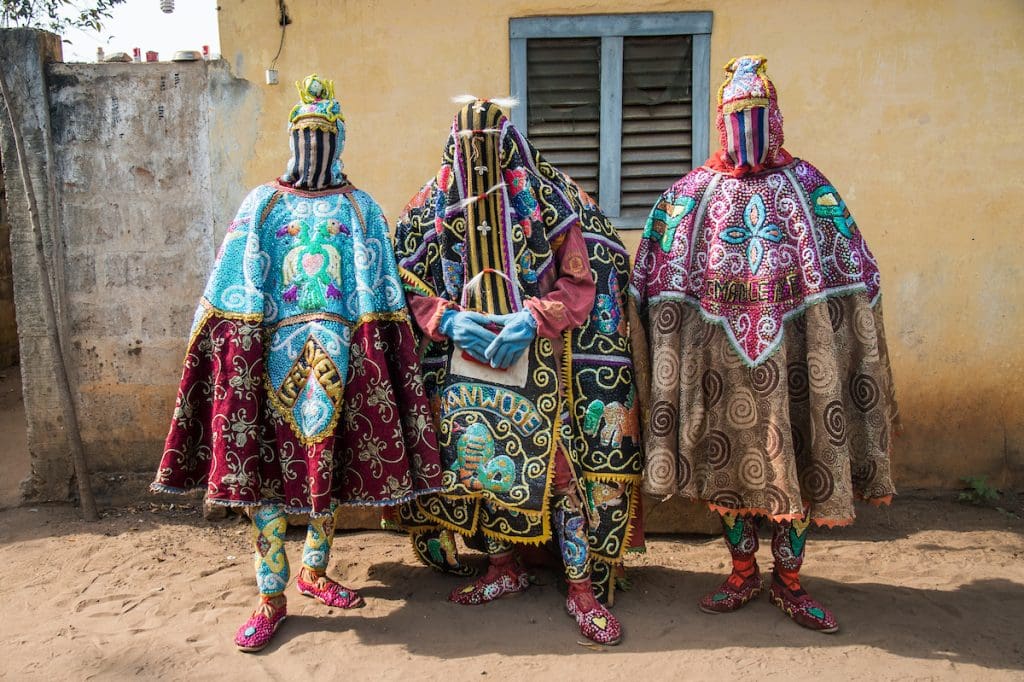
The visual language of the festival — the **zangbeto** (night watchmen) costumes that appear as tall spinning haystacks of raffia, moving through crowds with no visible human agency; the **egungun** masquerades (shared with Yoruba tradition) in which ancestral spirits return in elaborate costumed form; the ceremonial colors, animal sacrifices, libations, and iron objects associated with specific vodun — constitutes a complex aesthetic system that rewards sustained attention and knowledge. For visitors who encounter it without context, the festival can appear spectacular and cryptic simultaneously. For practitioners and knowledgeable observers, it is a seasonal report on the state of the relationship between the human and spiritual communities — a negotiation conducted in public, with full ceremony, about the terms under which life will proceed in the coming year.
The Atlantic Crossing: How Vodun Became Vodou, Voodoo, and Candomblé
The transformation of Beninese Vodun into the diaspora religions of the Americas is one of the most remarkable stories in the history of religion — and one of the most incompletely told. Between the sixteenth and nineteenth centuries, an estimated 12 million enslaved people were transported from West and Central Africa to the Americas. The Ouidah port and its surrounding territory was one of the Atlantic slave trade's most active points of embarkation, which means that the people most thoroughly embedded in the Vodun tradition — Fon, Ewe, and Yoruba speakers from the Dahomey region — were among the most intensively transported.
What enslaved people carried in their minds was more durable than anything that could be confiscated. The cosmological structure, the names and personalities of the vodun, the ritual protocols, the divination system, the songs and drum rhythms associated with specific ceremonies — all of this survived the Middle Passage in the only container available: human memory and community practice, maintained in the specific conditions of enslavement through a combination of covert observance, strategic syncretism with Catholic saints (the vodun Legba syncretized with Saint Peter, Ogou with Saint James, Mawu-Lisa with the Virgin Mary), and the internal solidarity of communities that shared a religious framework even when they could no longer practice it openly.
**Haitian Vodou** is the diaspora religion most directly descended from Beninese Vodun, maintaining the *lwa* (cognate with *vodun*) pantheon, the Fa-derived divination system (called *wanga* in Haiti), the initiation structure, and the core ritual protocols in forms that specialists can trace point by point to their Beninese sources. The contemporary reconnection between Haitian Vodou practitioners and Beninese Vodun practitioners — facilitated by the Ouidah festival, by academic exchange, and by diaspora return travel — has produced genuinely moving encounters in which practitioners from both sides recognize, across three centuries of separation and transformation, the shared tradition that connects them.
**Candomblé** in Brazil and **Santería** in Cuba represent parallel processes of African religious preservation and transformation, drawing on Yoruba and Fon traditions in varying proportions and blending them with Catholic and Indigenous elements to produce new religious forms that are distinct from their African sources while remaining connected to them. The reconnection efforts between Brazilian Candomblé communities and Beninese Vodun practitioners have been sustained over decades, including the establishment of formal religious exchange programs and the controversial question of whether diaspora traditions require "reafricanization" — return to African source materials — or whether their transformations represent legitimate and equally valid developments of the tradition.
Vodun Under Pressure: Colonialism, Marxism, and Pentecostalism
Vodun has survived several concerted attempts to eliminate it, each reflecting the specific ideology of its historical moment. French colonial suppression treated Vodun as primitive superstition incompatible with the civilizing mission of colonial governance, banning public ceremonies, destroying shrines, and prosecuting practitioners — a campaign whose main effect was to drive the tradition underground while intensifying its association with resistance to colonial authority. The independence movements that swept Francophone West Africa in the 1950s and 1960s were frequently energized by religious nationalism, and Vodun's persistence was a political as much as a spiritual statement.
President Kérékou's Marxist-Leninist government (1972–1990) pursued a secularist suppression of Vodun that was ideologically distinct from colonial suppression but equally damaging in practice: religion generally, and traditional religion specifically, was classified as backward cultural practice incompatible with socialist modernity. The 1996 establishment of the Vodun Festival as a national holiday by the democratically elected government that followed was therefore not merely cultural celebration but explicit reversal — a formal state acknowledgment that what the previous government had suppressed was in fact a national heritage worth celebrating.
The current pressure on Vodun comes primarily from Pentecostal and evangelical Christianity, which has expanded dramatically in Benin as throughout sub-Saharan Africa over the past three decades. Pentecostalism's specific theological stance toward traditional religion — classifying vodun spirits as demonic entities and demanding that converts destroy their household shrines and sever their initiation obligations — puts it in direct conflict with Vodun in a way that earlier forms of Christianity, which in many cases accommodated or syncretized with traditional religion, did not. The rate of conversion to Pentecostalism among younger Beninese is a genuine concern within Vodun communities, whose knowledge transmission depends on each generation's willingness to undergo initiation and learn the oral traditions that the convents preserve.
What Vodun Knows That the World Needs
There is a risk in discussing Vodun's philosophical sophistication and ecological wisdom that mirrors the risk in discussing SAPE's elegance or the Kyrgyz yurt's sustainability: the risk of instrumentalizing a living culture as a resource for someone else's concerns, reducing a complex religious tradition to a set of lessons available for extraction by the secular West. Vodun is not a spiritual technology kit. It is a comprehensive account of reality developed by specific communities over millennia, maintained at significant cost through historical conditions that included the deliberate destruction of the tradition's practitioners and contexts, and belonging to those communities in a sense that demands more than academic or touristic appreciation.
That said — and with that caution held — it is accurate that Vodun's sacred grove system has preserved forest that would otherwise have been cleared, and that this preservation is a function of the religion's cosmological structure rather than a fortunate byproduct. It is accurate that the Fa divination system represents one of the world's most sophisticated binary information processing traditions, whose 256-position structure bears suggestive relationships to binary computing logic that scholars have noted without fully explaining. It is accurate that the tradition's understanding of the relationship between human health and spiritual relationship — the idea that physical and social dysfunction is frequently a function of disrupted relationships with the vodun, requiring ritual restoration rather than purely physical intervention — anticipates aspects of what contemporary psychology calls social determinants of health.
These observations are worth making. They do not constitute Vodun's claim to respect and protection. That claim rests on simpler ground: the tradition is real, it is old, it is lived by millions of people whose relationship to it is not quaint or primitive but contemporary and chosen, and it has survived everything that has been thrown at it — the Middle Passage, colonial suppression, Marxist secularism, Pentecostal pressure — with enough vitality to fill a million people into the streets of Ouidah every January.
On the beach at the Point of No Return, where the Route of Slaves ends and the Atlantic begins, the festival's procession arrives at dusk. Drums are playing. The ocean is the same ocean that carried the enslaved away and carried the tradition with them. Someone pours libation into the water — rum, or palm wine, or water itself — in the direction of Haiti, of Brazil, of all the places where what left this shore three hundred years ago arrived changed but recognizable, and has been waiting to come home.
The vodun do not forget. Neither, it turns out, does anyone who carries them.