The People the Conquistadors Could Not Break: Mapuche Culture and the Soul of Southern Chile
The People the Conquistadors Could Not Break: Mapuche Culture and the Soul of Southern Chile
The Arauco War — the conflict between the Spanish Empire and the Mapuche people of southern Chile — lasted, depending on how you count, approximately 300 years. It began in the 1540s when Pedro de Valdivia's forces pushed south from the conquered Inca territories and encountered a people who did not behave like any adversary the Spanish had faced in the Americas. It did not end until 1883, when the Chilean state completed the military campaign it called the *Pacificación de la Araucanía* — Pacification of Araucanía — which sounds, in Spanish, like the conclusion of a bureaucratic process and was, in practice, the conquest of a people who had held out against every empire that tried to subdue them for three centuries and who surrendered not to Spanish force but to the 19th-century combination of breech-loading rifles, repeating carbines, and the systematic theft of territory that the word "pacification" was designed to make sound benign.
Three centuries of military resistance is not the most remarkable fact about the Mapuche. The most remarkable fact is what they were defending: not a state, not a centralized political structure, not an emperor's throne or a capital city. They were defending a way of being in the world — a relationship with land, with spirits, with community and language and the specific knowledge systems that made the forests and rivers of southern Chile legible to the people who had lived there for at least two thousand years. They did not have the political architecture that empires typically destroy first. They had something harder to erase: culture so thoroughly distributed through daily practice that there was no single center of gravity to defeat.
They are still here. Approximately 1.8 million people in Chile identify as Mapuche — roughly 10% of the Chilean population, the country's largest indigenous group by a considerable margin. Another 100,000 or more live in Argentina, primarily in the Neuquén and Río Negro provinces where the Mapuche presence predates the border that the two states drew between them. In the metropolitan region of Santiago, hundreds of thousands of Mapuche live urban lives while maintaining community connections to their *lof* (community territory) in the south. The Mapuche are not a memory. They are a contemporary political, cultural, and demographic reality, and the conflict over their land and rights is among Chile's most persistent and unresolved national questions.
Che: Being People in a Specific Place
The word **Mapuche** means, in Mapudungun, "people of the land" — *mapu* (land, earth, territory) and *che* (people). The name is simultaneously a self-identification and a philosophical statement: the Mapuche understand their identity as inseparable from their relationship to the specific territory they inhabit. This is not metaphor. It is an ontological position — the claim that what a person is cannot be separated from where they are, that the *mapu* shapes the *che* in ways that cannot be replicated in a different landscape.
This understanding of identity is the key to comprehending Mapuche political positions that often seem, to outside observers trained in individual rights frameworks, to be about land as property. They are not about land as property. They are about land as constitutive of personhood — the Mapuche relationship to *Wallmapu* (the entire Mapuche territorial world, spanning what is now southern Chile and Argentina) is a relationship to the medium through which Mapuche identity exists. Displacement from Wallmapu is not the loss of an asset. It is the disruption of the conditions under which being Mapuche is possible.
The political theology of *ñuke mapu* — mother earth — deepens this. The land is not owned by people in the Mapuche cosmological framework; it is a being that people exist in relationship with, a being with its own agency and rights that human communities must attend to and reciprocate through ceremony and respectful use. This cosmological position, which shares structural features with Andean Pachamama traditions and with many other indigenous land philosophies worldwide, is not a poetic attitude toward the environment. It is an operational worldview that shapes how Mapuche communities relate to forests, rivers, and agricultural land in ways that have produced, over millennia, sustainable use patterns that the industrial agriculture that has replaced them on most of their former territory has not.
Mapudungun: The Language of the Earth
**Mapudungun** — *mapu* (land) + *dungun* (speech, language) — is the Mapuche language, spoken today by approximately 200,000 to 400,000 people with varying degrees of fluency, depending on how fluency is defined and which survey one accepts. It is a language isolate: it has no demonstrated relationship to any other language family, which means it developed independently and encodes a way of organizing the world into concepts that have no ready-made equivalents in Spanish, English, or Quechua.
Mapudungun's grammatical structure is radically different from Spanish and from the Indo-European languages that most of its academic describers have as their native frame. It is a **polysynthetic** language — meaning that what Spanish or English would express in multiple words, Mapudungun often combines into a single morphologically complex word. The verb system is especially elaborate: verb forms encode not just tense and subject but also the direction of action relative to the speaker, the evidential basis for the speaker's knowledge (did they witness it directly, hear about it, or infer it?), and the degree of certainty attached to the proposition. A language with a sophisticated evidential system is a language whose speakers have built into the grammar itself the obligation to disclose the epistemic basis of their claims — a form of intellectual honesty encoded at the structural level.
The language has been under sustained pressure since the colonial period, when Spanish missionaries produced the first Mapudungun grammars as tools for evangelization. The 20th-century Chilean state's educational policies — which suppressed indigenous language instruction in schools and associated Spanish monolingualism with social mobility — produced a generation of Mapuche parents who did not transmit Mapudungun to their children in urban contexts, creating a significant gap in intergenerational transmission. The contemporary language revitalization movement has produced bilingual education programs, digital Mapudungun resources, and community language nests (*jardines interculturales*) in both Chile and Argentina. The effort is urgent: the number of fully fluent elder speakers is declining, and the specific register of ceremonial Mapudungun — used in *nguillatun* and other ritual contexts — is significantly more endangered than everyday speech.
What is at stake in Mapudungun's survival goes beyond linguistic diversity as an abstract good. The language carries a knowledge system — ecological, spiritual, relational — that does not translate fully into Spanish. The names for plants, for weather phenomena, for the specific qualities of different Andean and coastal environments in the Mapuche world are not translation equivalents for Spanish terms; they encode relationships and distinctions that the Spanish vocabulary was not built to hold. When a language dies, its knowledge dies with it in a form that cannot be fully recovered through translation.
The Machi: Medicine, Prophecy, and the Permeable World
At the center of Mapuche spiritual and medical life stands the **machi** — a ritual specialist, healer, and spiritual intermediary who is one of the most complex religious figures in South American indigenous tradition. The machi is typically female, though male machi exist and carry their own specific spiritual significance; in some Mapuche communities the male machi (*weye*) occupies a gender-liminal social position analogous to *two-spirit* figures in North American indigenous traditions. The machi's authority derives not from hereditary lineage or political appointment but from spiritual selection: the machi is called to the role through recurring dreams, illness that conventional healing cannot address, and a series of initiatory experiences that the community recognizes as signs of spiritual vocation.
The machi's healing practice — *machitun* — integrates what biomedical categories would separate into pharmacology, psychiatry, and spiritual intervention. The machi works with *lawen* — medicinal plants, primarily from the forests of southern Chile, whose pharmacological properties have been progressively documented by ethnobotanical researchers and some of whose active compounds have been confirmed to have the effects that Mapuche healers have attributed to them for centuries. The *canelo* tree (*Drimys winteri*) — sacred in Mapuche cosmology, its white branches present at every major ceremony — contains compounds with anti-inflammatory and antimicrobial properties. The *boldo* (*Peumus boldus*), *maqui* (*Aristotelia chilensis*), and dozens of other plants in the machi's pharmacological vocabulary represent a pharmaceutical knowledge base accumulated through generations of clinical observation that formal medicine has only begun to assess.
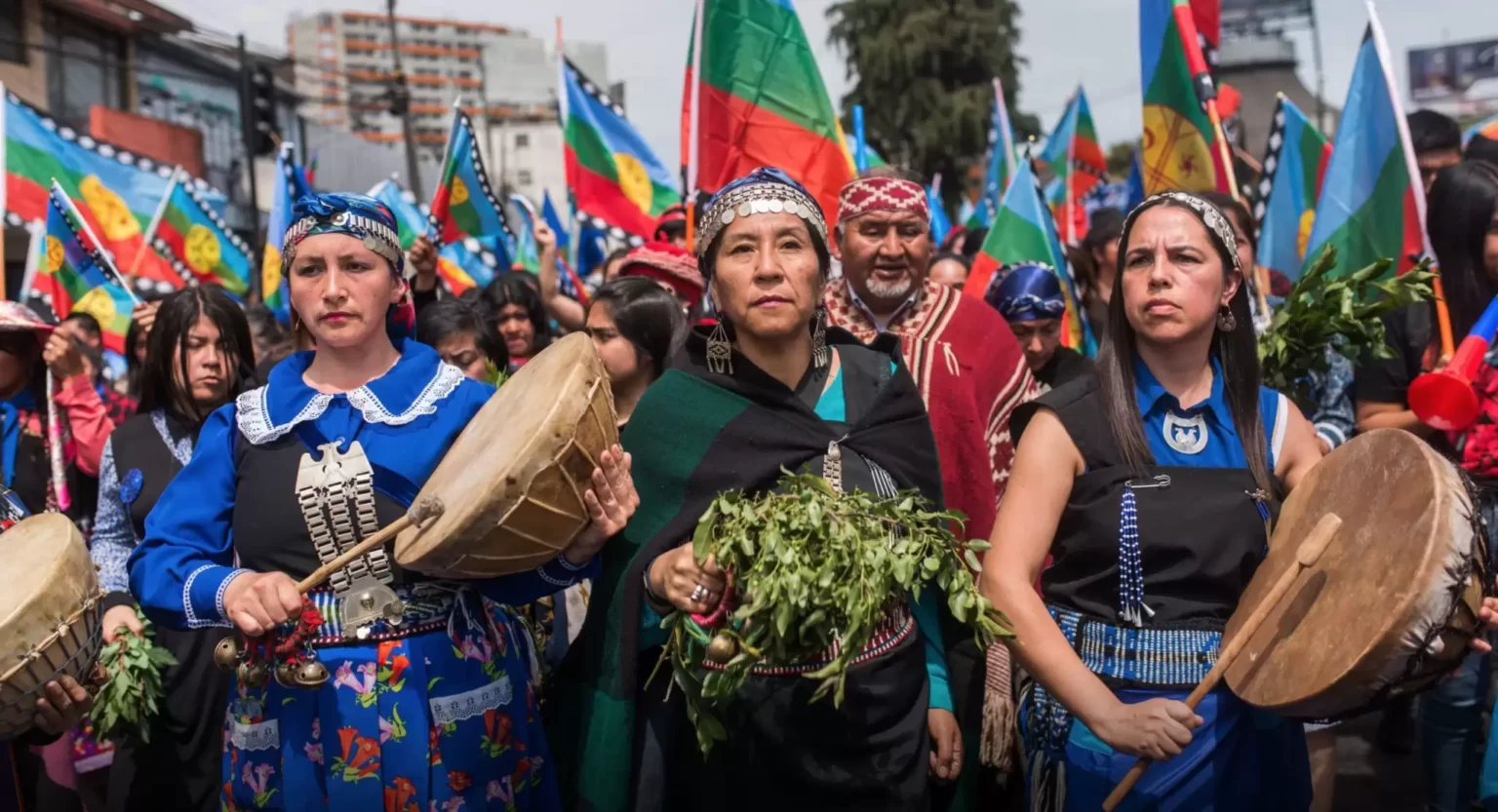
But the machi's work is not reducible to herbal pharmacology. The *machitun* ceremony involves the diagnosis and treatment of illness understood as spiritual disruption — the loss of *püllü* (soul force), the intrusion of *wekufü* (malevolent spirit forces), or the consequence of broken relationships with the spiritual world. The machi enters altered states through rhythmic drumming on the *kultrun* — a small ceremonial drum whose painted surface encodes a cosmological map of the Mapuche universe — and through the use of plant preparations that may include psychoactive compounds. In this altered state, the machi travels between the visible and invisible dimensions of the world to identify the spiritual cause of illness and negotiate its resolution.
The *kultrun*'s painted surface deserves particular attention. The circular drum face is divided into four quadrants representing the cardinal directions and the four seasons, with symbols encoding the Mapuche cosmological geography — the arrangement of worlds (*mapu* as a layered cosmos of visible and invisible dimensions) and the forces that move between them. The machi's kultrun is a personal cosmological instrument, its specific design reflecting the machi's own spiritual history and the particular cosmological knowledge they carry. Each kultrun is unique. Each is sacred. Each is buried with its machi at death, because the instrument and its owner share a spiritual identity that cannot be transferred.
Nguillatun: The Great Ceremony of Renewal
The **nguillatun** is the most important collective ceremony of Mapuche religious life — a multi-day gathering of a *lof* (community) or several communities for the purpose of collective prayer, spiritual renewal, and the maintenance of right relationship with *Ngenechen* (the supreme Mapuche deity, understood as the sustaining force of life) and with the spiritual forces that inhabit and govern the natural world.
A nguillatun is held every one to four years, depending on community tradition, and lasts two to four days. Its preparation begins months in advance: the *lonko* (community leader) and the machi coordinate the organization, the community contributes food and animals for collective feasting and sacrifice, and the *rewe* — the sacred carved pole that is the ceremony's spiritual center and the machi's axis mundi — is erected in the ceremonial ground (*nguillantun mapu*). The rewe is a notched wooden ladder, typically of canelo wood, whose steps represent the levels of the Mapuche cosmos; the machi climbs it during the ceremony as a physical enactment of spiritual ascent.
The ceremony itself moves through phases of prayer, music (*pifilca* flutes, *trutruca* horns, *kultrun* drums), ritual procession, animal sacrifice, and collective feasting — a structure that resembles, in its integration of spiritual, social, and alimentary dimensions, the ceremonial forms of other indigenous Andean traditions and that reflects a common underlying philosophy: that community renewal requires the full participation of the community's physical and spiritual dimensions simultaneously. The nguillatun is not a religious service that the community attends; it is a social-spiritual act that the community performs, and the distinction matters because the performance is constitutive of the community itself. Communities that cannot perform nguillatun together are communities that have lost something essential about their coherence.
The Chilean state's policies toward Mapuche ceremonial land have historically made nguillatun difficult in communities where the *nguillantun mapu* (ceremonial ground) was appropriated during the 19th-century land seizures. The recovery of ceremonial land — distinct from agricultural land, in the Mapuche land rights framework — is a specific and often underreported dimension of Mapuche territorial claims that is not primarily about agricultural production but about the spatial conditions that collective spiritual life requires.
Textile as Text: The Language of Mapuche Weaving
Mapuche women's weaving tradition — producing the distinctive patterned cloth called **makuñ** (poncho) and **ñimin** (the patterned weaving technique itself) — is among the most sophisticated textile traditions in South America and one of the most fully decoded in terms of its symbolic vocabulary. Unlike kente, whose pattern names reference proverbs, or Turkmen carpet guls, which identify tribal affiliation, Mapuche textile patterns encode cosmological and spiritual information in a visual vocabulary that the weaver produces from memory, learned through years of apprenticeship at the upright loom (*witral*).
The primary colors of traditional Mapuche textiles — dark blue-black (*karü*), deep red (*kelü*), and the natural white and brown of undyed Araucanian sheep wool — are achieved through natural dyeing with plants from the southern Chilean forest and wetland environments. The indigo blues came from native dye plants; the reds from *relbún* root (*Galium hypocarpium*) or from cochineal obtained through trade. The color vocabulary, like the pattern vocabulary, is not decorative: specific color combinations reference specific spiritual forces, seasons, cosmological directions, and the social position of the wearer.
The **weavers** of Mapuche tradition are women, and their role in transmitting both the technical and the cosmological knowledge embedded in textile production has made women central to Mapuche cultural continuity in ways that the political focus on male *lonko* leadership has tended to obscure. The grandmother who teaches a granddaughter to weave the specific pattern sequence of a *ñimin* is transmitting the same knowledge as the machi who teaches a student the names and properties of lawen — knowledge that is simultaneously practical, spiritual, and political, in the sense that its maintenance is an act of cultural resistance against the forces that have historically attempted to assimilate or erase Mapuche distinctiveness.
Contemporary Mapuche weavers work within this tradition while also navigating the contemporary market for indigenous crafts — a navigation that requires constant decisions about what to preserve, what to adapt, and what is not for sale. The finest traditional makuñ, produced in the full pattern vocabulary with natural dyes on the traditional witral loom, represent months of labor and a depth of technical and cosmological knowledge that the craft market's prices do not adequately reflect. The cooperatives of Mapuche weavers in the Araucanía region and in the urban context of Santiago have been working for decades to change this — to position Mapuche textiles not as ethnic handicrafts but as what they actually are: works of art produced within a living intellectual tradition of extraordinary depth.
The Land Conflict: History and Present
The **Mapuche land question** in Chile is not a historical grievance in the sense of something that happened in the past and whose consequences are now primarily symbolic. It is a present-tense conflict with material stakes, involving territory, water rights, legal systems, forestry corporations, and a cycle of state violence and community resistance that has produced deaths, imprisonments, and a political impasse that Chilean governments across the ideological spectrum have failed to resolve.
The historical dimension is essential context. Before the 1883 *Pacificación de la Araucanía*, Mapuche communities controlled approximately 10 million hectares of territory in southern Chile. The military campaign, the subsequent land grant system (*reducciones*) that confined Mapuche families to small reservations, and the waves of European colonization that the Chilean state promoted in the Araucanía region through the late 19th and early 20th centuries reduced Mapuche landholding to approximately 500,000 hectares by the 1920s. The Pinochet dictatorship's 1979 land law, which subdivided communal Mapuche lands into individual parcels that could then be sold, accelerated the loss further.
The current conflict centers on a paradox that would be almost comical if its consequences were not lethal: the territory from which Mapuche communities were expelled in the 19th century is now covered in eucalyptus and pine plantations owned by two of Chile's largest forestry corporations — Arauco (owned by the Angelini group) and CMPC (owned by the Matte group). These exotic monoculture plantations, which replaced the native *bosque valdiviano* (Valdivian temperate rainforest) that Mapuche communities had managed for millennia, now account for a significant portion of Chile's export economy. Mapuche communities demanding the return of their territorial lands are, in practice, demanding that these plantation forests be removed from corporate control — a demand that the Chilean state has consistently been unwilling to enforce through legal mechanisms, producing a situation in which some Mapuche activists have resorted to arson of forestry equipment and plantation land as the only form of pressure available to them.
The Chilean state's response to this activism — labeling it terrorism and applying the *Ley Antiterrorista* (Anti-Terrorism Law), a statute inherited from the Pinochet period — h