The Paste That Knows Your Face: Thanaka and the Cultural Soul of Myanmar
The Paste That Knows Your Face: Thanaka and the Cultural Soul of Myanmar
Shortly after dawn in Mandalay, a woman sits at a low table in her kitchen, a small cylinder of pale wood resting on a circular stone slate — the *kyauk pyin* — beside a cup of water. She dribbles a few drops onto the slate, presses the flat end of the wood against it, and begins to grind. The motion is practiced and unhurried: the wood rotates slowly, the friction releasing a pale cream-colored paste that collects in the slate's central depression. When the paste is thick enough, she lifts her fingers to her face and applies it — spreading it across both cheeks in smooth arcs, drawing a precise circle on her nose, leaving her forehead bare today. Her daughter, five years old and sitting beside her, holds up her own face to receive a circle on each cheek. The daughter is already practicing the grinding herself, small hands working the wood against the slate with a seriousness that makes the act look like what it is: a lesson in being Burmese.
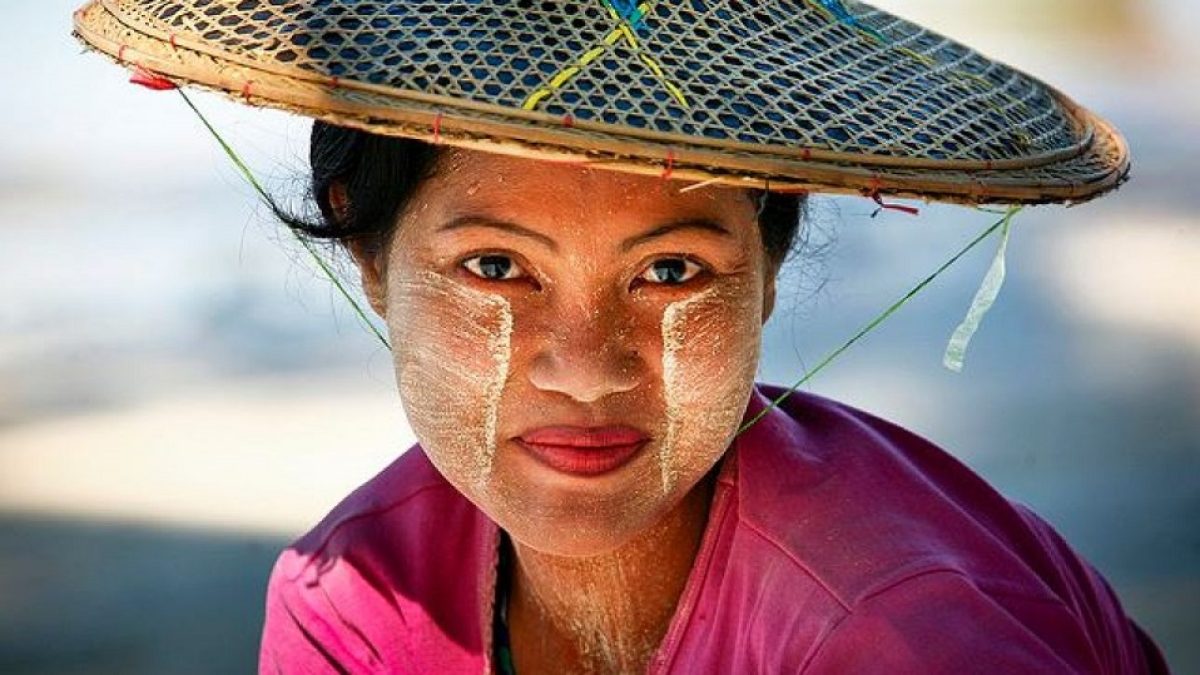
This is **thanaka** — a cosmetic paste ground from the bark, wood, and roots of the *Hesperethusa crenulata* tree and several related species, applied to the face and sometimes arms and legs of millions of people across Myanmar every day. It has been applied in this way for at least 2,000 years, possibly considerably longer. It is worn by women and children, and less commonly but genuinely by men. It protects the skin from sunburn, controls oil, and carries a fragrance — faintly woody, faintly floral — that Myanmar nationals living abroad consistently identify as one of the most powerful olfactory triggers of homesickness available to them. Thanaka is not merely a cosmetic product. It is, as much as any single material object can be, Myanmar.
A History Ground Into Stone
The earliest textual references to thanaka appear in Burmese chronicles from the Bagan period — the era between the ninth and thirteenth centuries CE when the first Burmese empire consolidated its power along the Irrawaddy Valley and built the temple complex that still defines the Myanmar landscape today. But the practice almost certainly predates these records. Archaeological evidence from the Pyu city-states that preceded Bagan — urban centers like Beikthano, Halin, and Sri Ksetra that flourished between roughly 200 BCE and 900 CE — includes grinding stones of the type used for thanaka preparation, suggesting that the practice was already established when the Burmese polity was still forming.
The tree species most prized for thanaka — *Hesperethusa crenulata*, known in Burmese as *thanakha* — grows primarily in the dry zones of central Myanmar, the arid interior regions around Mandalay, Magway, and Sagaing where annual rainfall is low enough to produce the stress conditions that concentrate the tree's aromatic compounds in its bark and heartwood. The best thanaka, according to connoisseurs, comes from trees that have grown slowly in poor soil under dry conditions: the wood is denser, the paste finer, the fragrance more complex. A mature thanaka tree — typically harvested after fifteen to twenty years of growth — is a significant economic asset for the farming communities that cultivate or harvest it, and the regional trade in thanaka logs and cylinders has been a feature of Burmese commerce for centuries.
The Burmese kings recognized thanaka's economic and cultural centrality early. The chronicles record royal interest in regulating and taxing the thanaka trade, and the gift of fine thanaka wood was a recognized form of tribute. At the royal court, the quality of thanaka used by courtiers was a marker of status: the finest, most fragrant wood was reserved for those closest to the throne, while coarser grades served the general population. This hierarchy of quality persists in the contemporary market, where premium aged thanaka from specific growing regions commands prices that reflect both scarcity and reputation.
The Chemistry Beneath the Ritual
Thanaka's endurance as a daily practice is not purely cultural. The paste works — and the specific ways in which it works have been progressively confirmed by dermatological research conducted over the past three decades, adding a scientific vocabulary to what Burmese users already knew from generations of embodied experience.
The active compounds in thanaka bark include **coumarin** and its derivatives, particularly **marmesin**, which has documented UV-absorbing properties. This gives thanaka a genuine, if modest, sun protection factor — consistent with its traditional reputation as a shield against the tropical sun that beats down on the farming communities, market workers, and schoolchildren who form its primary user base. Studies conducted at Yangon medical institutions and by international dermatology researchers have placed thanaka's sun protection factor in the SPF 8–30 range depending on preparation method and application thickness — not equivalent to commercial high-SPF sunscreens but meaningful for daily, partial-exposure protection.
Beyond UV absorption, thanaka contains compounds with documented antimicrobial and anti-inflammatory properties. **Alkaloids** and **flavonoids** present in the bark inhibit certain bacterial species associated with acne and skin infection, which explains thanaka's traditional reputation as a treatment for skin eruptions and blemishes. The paste also has mild astringent properties — it tightens pores and reduces oiliness, which is functionally valuable in Myanmar's tropical climate where humidity and heat make oil control a daily concern.
Perhaps most relevant to thanaka's reputation as a skin-brightening agent is the compound **tetrahydrodermichrome**, identified in some thanaka species, which inhibits melanin synthesis to a degree. Myanmar's cultural aesthetic around skin tone is complex and not reducible to simple analysis, but thanaka's role in it is real: the pale paste, applied daily, does measurably affect the skin tone of regular users over time, particularly in reducing the hyperpigmentation that tropical sun exposure produces.
What makes this chemistry remarkable from a cultural perspective is that it was discovered empirically — through generations of use and observation — and systematized into practice at least two millennia before the compounds responsible were identified and named. Thanaka is a case study in ethnobotanical knowledge that reached functional conclusions the scientific method would not confirm until the twentieth century.
The Grammar of Application: Reading a Face
Thanaka is not applied uniformly. The specific patterns in which it is worn constitute a visual language that varies by region, age, gender, occasion, and individual taste — a grammar of the face that a Burmese person reads automatically and a foreigner typically misses entirely.
The most common application is a smooth oval or circular patch on each cheek, occasionally extended across the nose bridge. This basic pattern is practical: it places the UV-absorbing paste on the skin areas most exposed to overhead sun. But within and beyond this baseline, the variations are expressive. Elaborate floral patterns — lotus flowers, jasmine sprigs, fern fronds — are painted onto the cheeks using the paste as a medium, sometimes with a small implement for fine lines, producing what are effectively cosmetic paintings on the face. These decorative applications are more common at festivals, ceremonies, and occasions where beauty is being consciously performed rather than simply maintained.
Regional variation in thanaka application is significant enough that experienced observers can make reasonable guesses about a person's geographic origin from their application pattern. Women from the Irrawaddy Delta region tend toward fuller coverage, spreading the paste across forehead and cheeks in a near-complete mask. Women from Shan State, where the Shan ethnic minority has its own thanaka traditions overlapping with but distinct from lowland Burmese practice, often apply in smaller, more precisely located patches. Urban Yangon patterns have shifted over the past two decades toward lighter, more cosmetically sophisticated application that reflects engagement with broader Asian beauty trends — the influence of Korean beauty culture is visible in the way some younger Yangon women use thanaka as a targeted treatment rather than a full coverage paste.
Children's application patterns are their own category. Young children — babies through primary school age — are typically given large, clearly defined circles on each cheek applied by a parent, the circles generous enough to ensure adequate sun protection and distinctive enough to be immediately visible. This application style has an aesthetic of its own: the chunky circles on a child's face are widely considered adorable by Burmese adults in a way that is culturally specific and consistent. Photographs of Burmese children with thanaka circles have circulated extensively in international travel photography, often presented as charming exotica — a framing that misses the degree to which the parent applying that circle is doing exactly what any parent applying sunscreen to a child's face is doing, with the added dimension of cultural transmission.
Gender, Identity, and the Thanaka Body
Thanaka is primarily identified as a women's and children's practice, and this identification is accurate as far as it goes. The daily application of thanaka is a female-coded ritual in Myanmar — the grinding stone in the kitchen, the morning application before school or work, the aesthetic judgment about pattern and thickness — all of this belongs primarily to the world of women and girls.
But the association is not exclusive, and the exceptions are culturally revealing. Men in rural and agricultural contexts have traditionally worn thanaka — farmers working under direct sun, boatmen, market workers — as a functional sun protection measure, without the application's female-coded aesthetics creating social friction. The functional justification provides what anthropologists would call a gender exemption: the paste is permitted because it is working, not because it is beautiful. In these contexts, application is typically minimal and unapologetic — a rough smear across the nose and cheeks rather than a crafted oval, the difference between using sunscreen and wearing makeup.
More interesting is the role of thanaka in the cosmetic practice of *acault* — the Burmese category of male individuals who adopt feminine social roles, dress, and behavior, associated with the *nat* spirit medium tradition and its shamanic functions. *Acault* practitioners wear thanaka as part of their feminine cosmetic presentation, and the quality of their application is evaluated according to the same aesthetic standards applied to women. Within this context, thanaka is a gender marker — a cosmetic technology through which femininity is performed and recognized — in a tradition that predates modern Western frameworks of gender identity by centuries.
The contemporary moment has brought new pressures to thanaka's gender politics. Myanmar's urban younger generation, navigating between traditional practice and global beauty culture, has produced a generation of young men who wear thanaka in contexts that would have read as gender-transgressive a generation earlier — not as *acault* identification but as fashion, cultural pride, and practical skincare. The K-beauty influenced skincare market that has penetrated urban Myanmar presents thanaka as a premium natural ingredient with scientifically validated benefits, reframing the paste from ethnic marker to global skincare commodity and, in doing so, making male use more legible in contemporary terms.
Thanaka and the Market: Between Heritage and Commodity
The thanaka market in Myanmar operates across a range of scales that reflects the practice's deep embeddedness in everyday life. At its most basic, thanaka is purchased as raw wood cylinders at markets across the country — logs of varying quality, some already turned into convenient grinding-sized sticks, others sold as larger pieces to be cut at home. The quality gradient is wide: fresh young wood from commonly available trees costs next to nothing; premium aged heartwood from the most prized growing regions, sold by specialist vendors who can speak at length about provenance and fragrance, commands prices that put it firmly in the luxury tier.
Above the raw material market, a commercial processed thanaka product has existed for decades — powders, creams, and lotions that incorporate thanaka extract alongside conventional cosmetic bases. These products serve urban consumers who want thanaka's benefits and associations without the time investment of daily grinding, and they have expanded significantly in the past decade as the Yangon middle class has grown and as beauty product consumption has intensified.
The most recent development is the international commodity pivot. Thanaka extract — standardized for its active compounds and positioned as a premium botanical ingredient — has entered the global cosmetics ingredient market, appearing in Korean-formulated skincare products, European natural beauty lines, and a growing category of "Myanmar heritage" cosmetics sold for export. This internationalization of thanaka as an ingredient creates both opportunity and risk for the cultural tradition it derives from. The opportunity is economic: demand for thanaka wood and extract creates income for the farming communities that grow the trees. The risk is the same one that attends the commodification of any living cultural practice: the ingredient travels without the context, the product is consumed without the meaning, and the culture that produced the knowledge receives a fraction of the value its knowledge generates.
Burmese government and cultural institutions have begun to engage with the intellectual property dimensions of thanaka's international marketability, but the frameworks for protecting traditional knowledge within global trade regimes remain inadequate to the task. Thanaka is not patentable — it is far too old and too widely known for any claim of novelty — but the specific knowledge systems around cultivation, preparation, and application that constitute its living cultural dimension are not protected by any mechanism that functions at the market's scale.
Thanaka in the Diaspora: Carrying the Morning Ritual Abroad
The Myanmar diaspora — scattered across Thailand, Malaysia, the United States, Australia, and Europe by waves of political displacement beginning in 1988 and intensifying after the 2021 military coup — carries thanaka as one of the most portable and emotionally loaded cultural artifacts available. A small cylinder of thanaka wood weighs almost nothing in a refugee's luggage. The grinding stone can be left behind; a flat rock or the back of a porcelain bowl will substitute. The tree itself does not grow in Minnesota or Melbourne, but the wood keeps indefinitely and can be shipped.
In diaspora communities, thanaka application takes on a weight it does not need to carry at home in Myanmar, where its presence is so constant as to be unremarkable. In a Burmese community center in Fort Worth, Texas, or at a New Year celebration in Canberra, the paste on the face is a flag — a declaration of continued identity in an environment that cannot decode it, directed not outward at non-Burmese observers but inward, at the community itself. Parents applying thanaka to their children in diaspora contexts are doing something categorically different from parents doing the same thing in Mandalay: they are teaching the child that this practice belongs to them even here, even now, even when the kyauk pyin grinding stone has been replaced by a smooth kitchen tile.
The political dimension of this identity claim has sharpened since the February 2021 coup, after which thanaka — already a cultural marker — became for some members of the diaspora a visible statement of solidarity with a Myanmar that predates and refuses the military junta. Cultural performance, always political at some level, becomes explicitly so when the culture is under threat. The morning ritual of grinding wood against stone and applying the result to a face is, in these contexts, an act of cultural insistence.
What the Wood Remembers

There is a quality that thanaka has, as a cultural object, that manufactured cosmetics cannot replicate regardless of their formulation sophistication: it is made fresh, every morning, from a material that has its own history. The wood on the grinding stone came from a tree that grew for fifteen years in the dry zone's thin soil. The water added to the slate comes from the morning. The paste is ground by the specific pressure of specific hands on a specific day. The result is not a product pulled from a tube with a standardized formulation; it is something made, right now, by the person who will wear it.
This freshness is not incidental to thanaka's meaning. It is the difference between wearing a symbol and performing one. The two minutes of grinding before application are not an inconvenient delivery mechanism for active compounds. They are the practice — the daily repetition of a gesture that connects the person grinding to the millions who have ground before them and the many who are grinding at the same moment across the same landscape. The paste on the face lasts until it wears off or is washed away, which means it must be made again tomorrow. There is no applying thanaka once and being done. The commitment is daily, which is also to say: the identity is daily.
Myanmar's thanaka tradition has survived the Bagan empire's fall, colonial prohibition attempts by British administrators who found it unhygienic, decades of military dictatorship that suppressed much of the country's cultural expression, and the pressures of global beauty culture that have displaced traditional cosmetic practices across much of Southeast Asia. It survived because it is not merely traditional — it is useful, effective, and beautiful. And because the knowledge of how to make it lives not in a factory or a laboratory but in the hands of every Burmese mother who has ever sat with her child at a grinding stone in the morning and shown her how the wood moves against the stone, how the paste collects, how you lift it to the face and spread it there, in the same pattern your grandmother used, in the same motion that will carry this thing — whatever this thing is, this paste, this practice, this morning — forward into another day.