The Night the Ferns Bloom: Latvia's Jāņi and the Pagan Fire Festival That Never Stopped
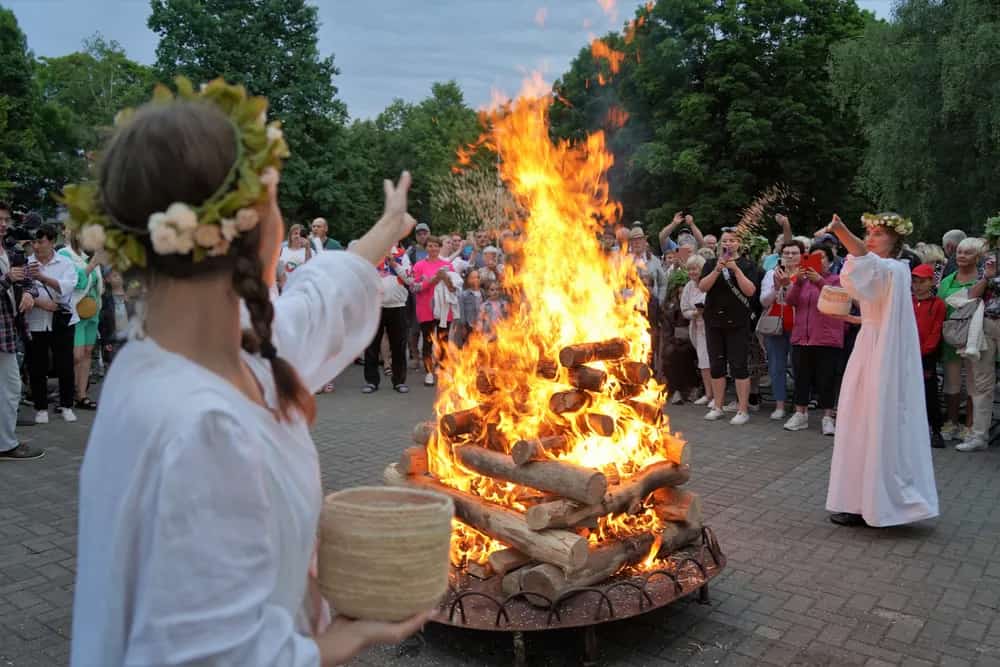
The Night the Ferns Bloom: Latvia's Jāņi and the Pagan Fire Festival That Never Stopped
Latvia was Christianized — forcibly, by the German crusading orders of the Teutonic Knights and the Livonian Brothers of the Sword — in the thirteenth century. The Latvian peasant population was converted at sword-point over a period of decades, their sacred groves destroyed, their priests killed or fled, and their polytheistic religion officially replaced by the Catholicism of their conquerors. The conversion was thorough in the institutional sense: churches replaced sacred sites, the Christian calendar replaced the Baltic pagan calendar, and the Latin Mass replaced the chanted ritual songs of Latvian folk religion.
What the knights could not convert was the solstice. The summer solstice — the longest day, the night of maximum fire, the night when the boundary between the visible and invisible world thins to its annual minimum — was too deeply embedded in the Latvian agricultural calendar, too thoroughly woven into the social and emotional fabric of the community, and too cosmologically important to the Baltic worldview to be simply crossed off the calendar and replaced with a saint's day. What the church provided instead was a saint: John the Baptist, whose feast day on June 24 aligned conveniently with the solstice celebration, allowing the Latvian population to observe **Jāņi** (the Latvian form of John) while technically celebrating a Christian occasion.
The saints' day was nominal. What the Latvians celebrated — and what, seven hundred years later, they still celebrate with an enthusiasm that makes Jāņi the most anticipated and most emotionally significant holiday in the Latvian calendar — was the solstice, with its fires and its oak wreaths and its all-night singing and its fire-jumping and its search for the fern flower that blooms only on this night and grants the finder access to the hidden knowledge of the earth. The Christianity was a frame. The celebration was Baltic pagan religion, maintained in near-complete form, wearing a borrowed name.
The Baltic Religion That Nearly Survived
Latvia and Lithuania share a distinction unique in European religious history: they are the remnants of the Baltic linguistic and cultural zone that maintained pre-Christian polytheistic religion more completely and more persistently than any other European culture. While the Germanic, Slavic, and Celtic peoples of northern and western Europe were Christianized between the fourth and tenth centuries, the Baltic peoples held out — militarily and culturally — until the late thirteenth and early fourteenth centuries, making them the last large European cultural group to officially convert.
The extra centuries of pre-Christian religious practice left an imprint that has never been fully overwritten. Latvian folk religion — **Dievturība**, the indigenous Baltic spirituality that was partially revived as a formal movement in the early twentieth century — centers on a pantheon of deities and spiritual forces whose names and characteristics are preserved in the thousands of traditional folk songs (*dainas*) that Latvian farmers sang at agricultural and seasonal occasions across the centuries. The chief deity **Dievs** (God, from the Proto-Indo-European root for "sky deity" shared by the Latin *deus* and the Sanskrit *deva*) governs the cosmic order; **Laima** (goddess of fate, literally "luck") determines the fate of humans at their birth; **Māra** (earth goddess, later partially merged with the Virgin Mary) governs the material world and fertility; **Pērkons** (thunder deity, cognate with the Lithuanian *Perkūnas* and the Slavic *Perun*) rules storms and is the adversary of evil forces.
The summer solstice in this theological framework is the night when the solar force is at its maximum and the protective power of Pērkons is most available — the moment in the annual cycle when the evil forces that threaten crops, animals, and human health are most vulnerable to ritual suppression. The fires of Jāņi are not decorative bonfires; they are instruments of the cosmic battle between solar order and chthonic disorder that the Baltic worldview understood as the fundamental structure of the universe.
The Oak: Sacred Wood of the Highest Forces
The most distinctive visual element of Latvian Jāņi — and the one that most clearly marks its distinction from other European midsummer traditions — is the **oak wreath** (*ozola vainags*). On Jāņi night, Latvians wear crowns made from fresh oak branches: men and married women wear oak-leaf wreaths, unmarried women wear wreaths of flowers (typically mixed with oak, clover, and specific midsummer wildflowers), and the cattle are decorated with oak branches tied to their horns and stalls. Oak branches are placed over doorways, woven into the structures of gates and fences, and incorporated into the bonfire construction.
The oak's sacred status in Baltic religion is connected to the same Indo-European theological tradition that made the oak sacred in Greek religion (sacred to Zeus), Roman religion (sacred to Jupiter), Norse religion (sacred to Thor), and Celtic religion (the Druids' sacred tree). In Baltic religion specifically, the oak is the tree of Pērkons — the thunder deity strikes oaks preferentially, and the oak struck by lightning was understood not as a destroyed tree but as a consecrated one, marked by the direct contact of divine force. The oak's extraordinary resistance to lightning — an actual physical property: the oak's high water content makes it a better lightning conductor than most other species, and therefore genuinely does attract strikes at higher rates — was read as evidence of its special relationship with the thunder deity rather than its electrical conductance.
Wearing an oak wreath at Jāņi is therefore not simply a folk custom of uncertain origin. It is the continuation of a theological practice: placing oneself under the protection of the maximum solar and divine force available on the solstice night, using the material associated with that force. The oak wreath is protective technology in the same functional sense as the nazar boncuğu: a material object that encodes a specific protective relationship between the wearer and the spiritual forces that the tradition understands as real.
The tradition of calling each person by a specific name on Jāņi is connected to the oak's sacred character: every Latvian named **Jānis** (a common Latvian men's name, the most common, in fact — approximately 1 in 7 Latvian men is named Jānis) is specifically honored on Jāņi night. The convergence of the Baltic solstice tradition with the Christian feast of John the Baptist produced a naming convention that has made Jānis the dominant Latvian male name — Latvian parents naming their sons with an awareness, conscious or not, that the name connects the boy to the most important night of the Latvian calendar. On Jāņi, every Jānis receives their own oak wreath, their own songs sung specifically for them, and the community's acknowledgment of their connection to the festival's patronal force.
The Dainas: Songs That Held a Religion Alive
The most extraordinary cultural achievement of Latvian midsummer tradition — and the element that distinguishes the Latvian celebration from all other European midsummer practices — is the **daina**: the traditional Latvian folk song, the vehicle through which Baltic religious knowledge, agricultural wisdom, ecological observation, and social values were transmitted across generations during the centuries when institutional expression of the old religion was prohibited.
The Latvian daina is a short lyric poem, typically four lines, in a specific trochaic meter that is among the oldest documented metrical forms in Indo-European poetry — the same meter appears in ancient Sanskrit hymns, suggesting a common Proto-Indo-European origin. The dainas' content covers the full range of Latvian life and cosmology: love songs, laments, work songs (for plowing, sowing, harvesting, spinning, weaving), wedding songs, death songs, and the specifically seasonal songs — the **Jāņu dainas** — that belong to the Jāņi festival and that encode its theological and practical dimensions in compressed lyric form.
The Jāņu dainas are sung throughout the night of Jāņi, typically in antiphonal form: groups calling to each other across the bonfire, the singing continuing through the short midsummer night until dawn. The songs address Jānis (John) directly, describe the cosmic events of the solstice night, give instruction for the specific practices of the festival (the fire-building, the fern-flower search, the cattle decoration), and encode in their specific imagery the Baltic theological understanding of what the solstice means. A scholar of Baltic religion can read the Jāņu dainas as a theological text; an ordinary Latvian singer absorbs their content as aesthetic experience and cultural practice without necessarily engaging with the theology explicitly.
The collector of the dainas — and therefore their primary preserver — was **Krišjānis Barons**, the nineteenth-century Latvian folklorist whose life project of systematically collecting traditional folk songs across Latvia produced the **Latvju dainas** (Latvian Dainas) — a collection of approximately 218,000 distinct song texts (with multiple melodic variants of many) that represents one of the largest collections of oral poetry ever assembled from a single language tradition. Barons understood what he was doing: preserving the primary medium through which Latvian cultural identity and folk religious knowledge had survived the centuries of German, Swedish, Polish, and Russian rule that had made institutional expression of that identity difficult or impossible.
The 218,000 dainas that Barons collected are the evidence that the Latvian peasant tradition had maintained a living oral literature of extraordinary richness despite — or perhaps because of — the conditions of political and cultural subordination that made written culture largely inaccessible. The dainas survived because they were so thoroughly embedded in daily and seasonal practice that suppressing them would have required suppressing every singing voice in every field, kitchen, and gathering across the country. The German landowners who controlled Latvia for centuries could not prohibit their serfs from singing.
The Fire: Purification, Protection, and the Physics of the Sacred
The bonfire (*ugunskurs*) of Jāņi is the ceremony's organizational center — its most dramatic visual element, its primary functional instrument, and the object around which the night's activities are organized. Jāņi bonfires are built in the days before the festival from specific materials: oak wood is preferred (the oak's connection to Pērkons already established), birch branches contribute their specific fragrance, and the structure is built to burn long and hot through the shortest night of the year.
The placement of the bonfire is significant: traditionally on a hilltop or elevated position from which the fire's light is visible across the surrounding landscape. The visibility was not incidental to the fire's function. In the pre-modern Baltic world, the bonfire was a communication technology as well as a ritual instrument — its light communicated across the landscape the information that the solstice celebration was underway, that this community was maintaining the tradition, that the fire's protective power was being activated across the territory the light reached.
The fire's protective function in Baltic religion is specific and operates through a theory of purification that is consistent across many different cultural traditions' use of fire for ritual purposes. Fire, in the Baltic understanding, consumes evil forces — the malevolent spirits, the disease-carrying entities, the forces that threaten crops and cattle and human health — while leaving the living participants purified by their passage through or near the flames. The cattle that are driven through the bonfire smoke, the humans who jump across the fire, the homes whose doorways are decorated with protective plants that have been passed through the fire's heat — all are undergoing a process of ritual purification that the fire's consumption of harmful forces provides.
**Fire-jumping** (*pārlēkšana pār uguni*) is the most physically dramatic element of Jāņi and the one that most directly enacts the purification logic. Pairs of young people — traditionally couples, though contemporary fire-jumping is more democratic — jump over the bonfire together, the tradition holding that a couple who successfully crosses the fire without breaking their handhold will have a happy and enduring relationship. The physical specifics are negotiated carefully: the bonfire burns down to its appropriate jumping height (enthusiastic fire-jumpers can be seen circling the bonfire assessing the flame height, waiting for the optimal moment), the approach is run rather than walked (for maximum clearance), and the landing is on firm ground prepared for the purpose.
The purification interpretation of fire-jumping does not require belief in the specific mechanism to produce real effects. The physical experience of running through fire with a partner, the heat and light and noise of the bonfire, the adrenaline of the approach and the exhilaration of the landing — these produce a shared physical experience of genuine intensity that does exactly what ritual is supposed to do: mark the occasion as different from ordinary time, create a memory whose visceral quality distinguishes it from other memories, and bind the participants through a shared physical ordeal that ordinary social occasions cannot replicate.
The Fern Flower: Sacred Botany and the Night of Hidden Knowledge
The search for the **fern flower** (*papardes zieds*) is Jāņi's most mythologically elaborate tradition — and its most botanically impossible one. Ferns reproduce by spore rather than flower; there is no such thing as a fern flower in the botanical sense. Yet the tradition holds that on Jāņi night alone, the fern produces a flower that blooms for a single instant at midnight, that the flower glows in the darkness of the forest floor, and that whoever finds it — the search requires going into the forest alone at midnight, leaving the safety of the bonfire's light — gains access to hidden knowledge: the ability to understand the speech of animals, to locate buried treasure, to know the secrets of the earth.
The impossible flower is the point. The search is conducted alone in the midsummer forest at midnight — a genuine physical experience of forest darkness (the midsummer night is short and never fully dark at Latvian latitude, but the forest at midnight is dark enough to be disorienting), of isolation from the communal safety of the bonfire's light, and of the specific quality of attention that searching for something that cannot exist requires. The person who goes into the forest searching for the fern flower and returns without finding it — which is all of them, always — has nevertheless undergone something: the experience of the forest at the solstice's most charged moment, alone, attentive to the quality of the darkness and the sounds of the night in a way that the bonfire's noise and company did not permit.
The fern flower tradition encodes a specific approach to knowledge: the understanding that the most important knowledge — the speech of animals, the secrets of the earth, the location of hidden things — is not accessible through ordinary means and in ordinary states of attention, but requires the specific quality of solitary attention in the dark that the fern flower search forces. The tradition doesn't promise that the flower will be found; it promises that the searching, done seriously, produces something.
In the contemporary Latvian celebration, the fern flower search has become a deliberately romantic tradition: couples disappear into the forest together under the pretext of searching for the flower, and the tradition accommodates this with characteristic Latvian folk humor — the Jāņu dainas contain numerous winking references to what the fern flower search actually occasions. The tradition evolved, as living traditions do, while maintaining the structural feature that makes it meaningful: the departure from the communal space, the private experience in the dark, the return.
The Soviet Interval and the Inextinguishable Fire
Latvia spent fifty years under Soviet occupation (1940–1941, 1944–1990), during which the expression of Latvian national identity was systematically suppressed and Latvian cultural institutions were subordinated to Soviet control. The experience of Soviet occupation during the critical years of Latvian national formation — the Singing Revolution that helped restore Latvian independence was named for the spontaneous mass singing of Latvian folk songs that became its primary form of resistance — gave the daina tradition and the Jāņi celebration dimensions of political weight that their Baltic religious origins had not previously carried.
The Soviet period's approach to Jāņi was characteristically contradictory. The official atheist state could not straightforwardly endorse a festival with explicit pre-Christian religious dimensions. But the festival was so thoroughly embedded in Latvian popular culture, and the banning of it would have been so politically counterproductive (the Soviet state needed Latvian popular acceptance of its authority), that the accommodation chosen was familiar from other contexts: the festival was permitted but reframed as a folk culture celebration rather than a religious one — a celebration of summer, of nature, of the collective spirit of the working people, stripped of its explicit theological content and presented as a cultural rather than spiritual practice.
The Latvians celebrated the folk culture version officially and maintained the spiritual practice underneath it. The dainas continued to be sung — the Soviet cultural apparatus, which supported folk song as authentic proletarian cultural expression, actually facilitated the institutional preservation of daina culture that independence has continued. The bonfires burned. The oak wreaths were woven. The fern flowers were searched for in the midnight forest. The fire-jumping continued. The theological language retreated to