The Night That Doesn't Darken: What Midsummer Really Celebrates Across the World
The Night That Doesn't Darken: What Midsummer Really Celebrates Across the World
On the twenty-first of June, at a latitude above the Arctic Circle, the sun does not set. It grazes the northern horizon sometime around midnight, bruises the sky a deep amber and rose, and then begins rising again — a forty-minute interlude of horizontal light before the full day resumes. People who experience this for the first time often describe a specific disorientation: the body expects darkness, the nervous system has organized itself around the approach of night, and then the darkness simply does not come. Something in the organism that has spent nine months oriented around the return of light finds itself, suddenly, in surplus. It does not know what to do with abundance.
What humanity has done with this abundance, for at least ten thousand years, is celebrate. The summer solstice — the astronomical moment when the Northern Hemisphere reaches maximum tilt toward the sun, producing the year's longest day and shortest night — is the most universally observed natural event in human cultural history. It has been marked by bonfires, by dancing, by flowers woven into crowns, by the lighting of water with floating lanterns, by the placement of offerings at sacred sites aligned to catch the solstice sunrise, by the drinking of mead in quantities that the subsequent morning regrets, and by a particular quality of communal feeling — generous, expansive, briefly freed from the usual social constraints — that is the holiday's most consistent cross-cultural product.
Midsummer is not one festival. It is a family of festivals that share a common astronomical trigger and a common emotional logic: that the longest day deserves to be met with the longest celebration, and that light — real, physical, solar light, after months of northern cold and dark — is cause for a gratitude so physical it must be enacted with the body rather than merely felt.
The Astronomy That Started Everything
The summer solstice is an astronomical event with measurable, predictable parameters: it occurs when the sun reaches its maximum northward declination of approximately 23.5 degrees, producing the longest day of the year for observers in the Northern Hemisphere. In 2026 this moment falls on June 21, as it typically does — the solstice wanders slightly from year to year due to the difference between the calendar year and the astronomical year, which is why it falls between June 20 and June 21 in modern times.
What is less often appreciated is the precision with which pre-modern human communities tracked this event. Stonehenge, constructed in phases between roughly 3000 and 1500 BCE on Salisbury Plain in southern England, is aligned so that the rising sun on the summer solstice shines directly through its central axis, illuminating the altar stone at the monument's center. Newgrange in Ireland, older than Stonehenge at roughly 3200 BCE, is aligned to the winter solstice sunrise — but its builders were clearly working within a tradition of solar observation that treated the solstices as the year's organizing moments. The Goseck Circle in Germany, a circular enclosure dated to approximately 4900 BCE, has gates aligned to the solstice sunrise and sunset, making it one of the earliest known solar observatories in Europe.
These monuments required generational investment in observation, engineering, and communal labor. Communities do not build stone circles aligned to astronomical events unless those events carry sufficient cultural and religious weight to justify the effort. The summer solstice's importance to Neolithic European communities was not sentimental. It was agricultural: knowing precisely when the year's longest day had passed meant knowing precisely how many growing days remained, when to expect the first frosts, how to organize the planting and harvest calendar that the community's survival depended on. The bonfire on the hilltop was also a signal — visible to neighboring communities across the landscape — that the turning point had been reached and that the agricultural clock was ticking.
Sweden's Midsommar: The Festival That Swallowed a Nation
If any single national tradition has come to define Midsummer in the global imagination, it is **Swedish Midsommar** — a holiday of such cultural intensity that the country effectively shuts down for it, most Swedes traveling to the countryside to spend the longest weekend of the year at summer houses, by lakes, in villages where the celebration still has the character of a genuine community event rather than a tourist performance.
The center of Midsommar is the **midsommarstång** — the maypole, raised on Midsummer Eve and decorated with birch leaves and wildflowers in a process that is itself a communal ritual: gathering the greenery, weaving the garlands, raising the pole with collective effort in a sequence that requires everyone to pull together at the right moment or the whole thing lists and falls. The pole is a solar symbol — its circular top wreath representing the sun, its vertical axis connecting earth and sky — though most contemporary Swedes raising one would describe it primarily as tradition rather than cosmology.
The dances around the midsommarstång are among the most visually distinctive features of Swedish Midsummer and among the most misunderstood by outside observers. **Små grodorna** — "The Little Frogs," a song in which participants hop in a circle imitating frogs — is genuinely, non-ironically danced by Swedish adults as part of Midsommar, because Midsommar is one of the few occasions in Swedish social life where dignity is explicitly suspended in favor of collective playfulness. The Swede who would be mortified to be seen hopping like a frog in any other context hops willingly at Midsommar, because the holiday's social permission structure is precisely the suspension of the ordinary rules of adult comportment. The playfulness is the point, not a byproduct.
**Herring** (*sill*) is the meal — pickled in multiple preparations, served with boiled new potatoes, sour cream, chives, and the particular Swedish crispbread that has no adequate substitute. The meal is followed by **jordgubbar** — strawberries, the first of the season, served with cream, whose arrival at Midsommar is timed closely enough that many Swedes associate the taste of fresh strawberries with the holiday as completely as they associate any other seasonal food with its occasion. The **aquavit** comes in multiple rounds, accompanied by the drinking songs (*snapsvisor*) that are another feature of Swedish Midsommar culture that combines a seemingly incongruous formality — the songs are often quite elaborate, requiring group participation and memorization — with the frank pursuit of collective inebriation.
The forecast for Swedish Midsommar is almost always rain. This is not a problem. It is, at this point, part of the tradition.
Finland's Juhannus: Fire, Water, and the Midsummer Soul
Finnish **Juhannus** — named for John the Baptist (*Johannes*), in the Christianization of a far older solstice observance — is organized around two elemental experiences: fire and water, specifically the sauna and the lake, the bonfire on the shore and the cold immersion that follows it.
The **kokko** — the Juhannus bonfire — is built on a lakeside or shoreline as a beacon that has its folk-astronomical origins in the signal fires that marked the solstice across the landscape, communicating to neighboring communities that the observation had been made and the turning point noted. Contemporary Juhannus bonfires can reach considerable size — competitive bonfire construction is documented in several Finnish municipalities — and the evening gathering around the kokko, with the sky's refusal to darken behind it, produces one of the most distinctive visual experiences available in northern Europe: a fire burning in what appears to be perpetual dusk, the reflections doubling on water that doesn't darken because the sky above it doesn't either.
The **sauna** sequence at Juhannus is the holiday's domestic core. The birch branches (*vihta*) — gathered fresh for the occasion, specifically for the Midsummer sauna — release a fragrance in the steam that is associated by Finns with the holiday so specifically that the smell of fresh birch in steam reliably triggers Juhannus memories for anyone who has spent childhood summers in Finland. The vihta is used to lightly beat the skin, stimulating circulation and releasing the birch's aromatic oils, in a practice whose health benefits (birch leaf contains salicylates, a natural anti-inflammatory) are backed by both traditional knowledge and contemporary phytochemical analysis.
Juhannus occupies a particular position in Finnish emotional life as the counterweight to the long winter — the compensatory surplus of light that repays, in one concentrated weekend, the nine months of darkness that Finnish winter requires. The intensity of feeling around the holiday is disproportionate to its formal content because it carries this compensatory weight: the sun that was so scarce is now, briefly, inescapable. For Finns who live abroad, Juhannus is among the most powerfully triggering of homesick occasions — the combination of light and lake and sauna and birch fragrance being simultaneously specific to the country and impossible to fully replicate anywhere else.
The Slavic Ivan Kupala: Magic, Fire, and Flowers on the Water
In the Slavic cultures of Eastern Europe — Russia, Ukraine, Belarus, Poland — the summer solstice is observed through **Ivan Kupala** (also called Ivana Kupala or simply Kupala Night), a festival that has preserved its pre-Christian character more completely than most European midsummer traditions, despite — or perhaps because of — centuries of official Christian disapproval.
The festival's name combines the Christian *Ivan* (John, for John the Baptist) with *Kupala*, a Slavic deity or spirit associated with water, fertility, and summer — a grammatical seam that perfectly illustrates how Christianity imposed its calendar on existing observances without fully overwriting their content. The Kupala Night tradition that survives in Ukrainian and Belarusian villages retains elements that would have been entirely legible to its pre-Christian practitioners: the jumping over bonfires as purification and divination (the couple that jumps together without releasing hands will marry), the floating of flower wreaths on rivers and streams as a form of romantic fortune-telling (the direction the wreath drifts, whether it sinks or reaches the opposite bank, determines the fate of the relationship), and the search at midnight for the **fern flower** — a bloom that appears, in Slavic folk belief, only at this one moment of the year and that grants the finder extraordinary powers: treasure-finding, the understanding of animal speech, protection from evil.
The fern flower does not exist botanically — ferns reproduce by spore, not flower — which is precisely what makes it the perfect magical object for a night that is itself defined by the suspension of ordinary reality. Kupala Night is structured as a threshold time: the boundary between the human world and the spirit world is understood to be unusually permeable at the solstice, and the rituals that characterize the festival are oriented around either protecting against this permeability (the bonfires as barriers to malevolent spirits, the wearing of protective herbs) or exploiting it (divination, love magic, the possibility of encounters with supernatural beings in the forest). The logic is consistent: when the solar year stands at its furthest extreme, time itself is understood to stand outside its usual rules.
The water immersion central to Kupala — mass bathing in rivers and lakes at the solstice, sometimes preceded by ritual undressing that has attracted considerable official anxiety over the centuries — connects the festival to a broader European tradition of midsummer water rites. The connection between water and solar festivals seems counterintuitive until you consider the agricultural calendar: the summer solstice marks the beginning of the growing season's second half, and in much of Eastern Europe, the adequacy of rainfall in the weeks following the solstice determines the harvest's quality. Propitiating water at the solstice is not metaphorical. It is petitioning the element whose behavior will determine whether the community eats adequately in the following winter.
The British Isles: Druids, Stonehenge, and a Contested Heritage
Every summer solstice dawn, several thousand people gather at Stonehenge — druids in white robes, neo-pagans with flower crowns, curious tourists, insomniacs from nearby Salisbury, and a rotating cast of festival-goers who have managed the logistics of sleeping nearby — to watch the sun rise over the Heel Stone and send its first light through the monument's central axis. The gathering is simultaneously authentic and complicated: authentic because the astronomical alignment is genuine and the site's importance to solstice observation is not in doubt; complicated because the "druids" performing ceremonies there bear a complex relationship to the actual Iron Age priests of the Celtic world, most of whom left no textual record and none of whom built Stonehenge, which predates the Celtic presence in Britain by approximately two thousand years.
This complexity does not make the contemporary Stonehenge solstice gathering meaningless. It makes it a different kind of meaning — a modern re-enchantment of a site whose original significance is imperfectly recoverable, performed by communities that find in the astronomical event and the ancient stones a genuine occasion for the kind of communal spiritual experience that contemporary secular life does not otherwise provide. The gathering's eclectic character — its mix of serious religious practitioners, curious visitors, and people who simply want to be somewhere extraordinary at dawn — is itself a kind of cultural document: evidence that the solstice retains its pulling power even for populations that have lost the theological frameworks within which that power was originally organized.
Elsewhere in the British Isles, midsummer is observed through traditions that vary by locality: **St. John's Eve** bonfires in Cornwall, the **Bonfire Night** traditions of Ireland that predate their November counterpart, and the **Up Helly Aa** fire festival in Shetland — though the latter falls in January and marks a different point in the Norse calendar, it belongs to the same cultural tradition of fire as communal midwinter and midsummer ritual that runs through the entire northern European cultural landscape.
Flowers, Crowns, and the Botanical Grammar of the Holiday
Across virtually every European midsummer tradition, flowers appear: woven into crowns, gathered into bundles and hung over doorways, cast onto water, placed under pillows for prophetic dreams, hung in barns to protect livestock, and burned in bonfires as offerings. This botanical preoccupation is not decorative. It reflects the solstice's position at the peak of the northern European flowering season, when the maximum number of plant species are simultaneously in bloom — and when the traditional knowledge systems of herbalism, which organized plant use by the calendar, prescribed the gathering of the most medicinally and magically potent plants.
**St. John's Wort** (*Hypericum perforatum*) — which flowers at midsummer and is named for the Midsummer Baptist — was gathered at the solstice across northern Europe for its protective and healing properties that herbalists have used for centuries and that contemporary pharmacology has confirmed contain compounds with antidepressant activity. **Mugwort**, **yarrow**, **elder flower**, **verbena**, and **fern** all appear in the midsummer botanical tradition across multiple European cultures, each with specific magical or medicinal attributions that the solstice timing was understood to maximize.
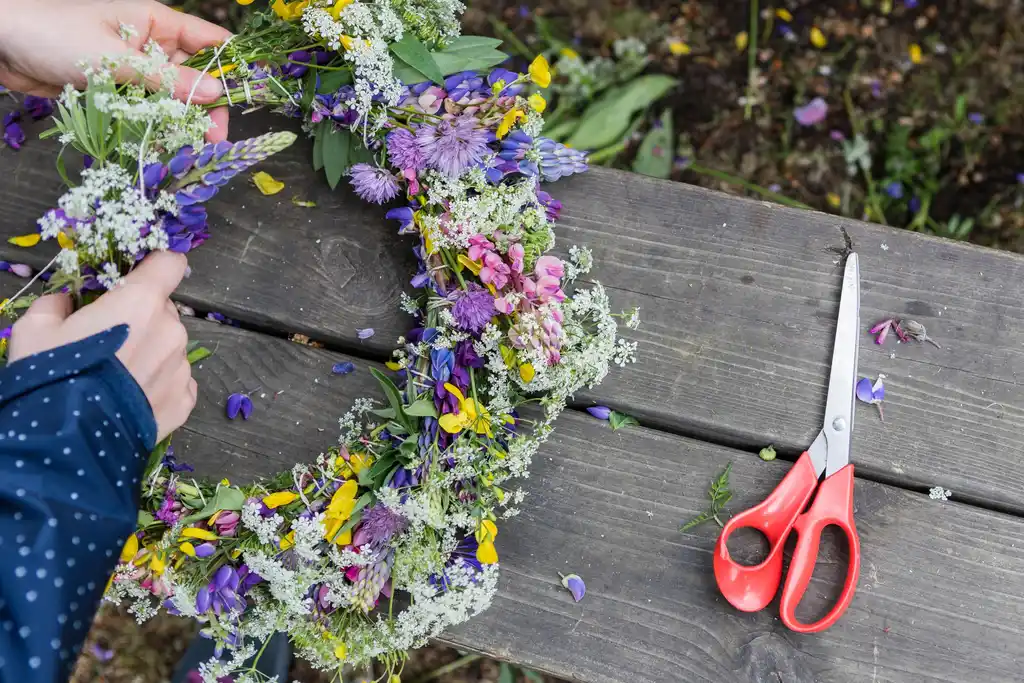
The **flower crown** (*blomsterkrans* in Swedish, *seppele* in Finnish, *vinok* in Ukrainian) is the botanical tradition's most visually persistent survival — worn by women and girls at Midsommar, Juhannus, and Kupala Night, it carries a symbolism that overlaps across all three traditions: the crown connects the wearer to the natural world at its peak moment, marks the liminal status of the holiday (crowns are worn at significant life transitions — weddings, coronations — and Midsummer is a transition in the solar year), and in many folk traditions provides the medium for love divination. The number of different flower species in the crown, the direction it faces when cast onto water, the dreams it produces when placed under the pillow on Midsummer Night — these are divination protocols that teenagers in Swedish villages were following in the nineteenth century for the same reason teenagers anywhere follow ritual practices that promise to answer the questions that concern them most: who will I love, and will they love me back?
What the Light Does to People
The psychological literature on the effects of extended daylight on human behavior is less developed than might be expected, partly because the most dramatic experiences of midsummer light are concentrated in populations small enough to complicate large-scale studies. But the anecdotal and ethnographic evidence is consistent enough to function as data: extended summer daylight in northern latitudes produces measurable changes in social behavior. People sleep less. They socialize more. They make decisions with less of the caution that shorter days and longer nights seem to induce. The phenomenon sometimes called "summer madness" in Scandinavian folk psychology — a quality of recklessness, generosity, and willingness to follow impulse that the light seems to license — is a real enough behavioral pattern to have generated its own vocabulary in multiple languages.
This is partly biological: extended light exposure suppresses melatonin production more thoroughly and for longer periods than standard day-night cycles, altering sleep architecture and affecting the hormonal systems that regulate mood and social motivation. But it is also cultural: communities that have organized a holiday around the longest day's excess have given their members formal permission to behave differently, to stay up past midnight, to dance around a pole singing frog songs, to jump bonfires and cast flowers on water and tell the person they have been meaning to tell all year that something significant is felt.