The Men Who Dance to Be Chosen: Wodaabe Beauty and the Gerewol Festival of Chad
The Men Who Dance to Be Chosen: Wodaabe Beauty and the Gerewol Festival of Chad
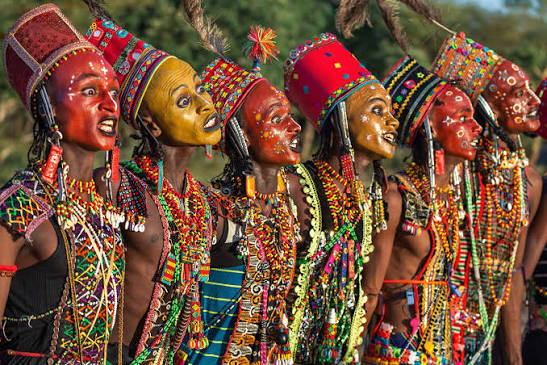
Somewhere in the Sahel, at a location determined by the convergence of seasonal pasture, the movements of cattle herds, and communication networks that function without phones or fixed addresses, several hundred men are standing in a line in the late afternoon heat. They have been preparing for this moment for hours. Their faces are painted in geometric patterns of ochre, black, and white — the teeth and the whites of the eyes emphasized to maximum contrast, because contrast is beautiful and contrast is what the judges will be looking for. The hair is braided and adorned. The turbans are wrapped with the precision of months of practice. The ostrich feathers are positioned. The men are smiling — a specific smile, held continuously, that requires muscular endurance as much as intention, because one of the things being judged today is the ability to display the teeth in a way that communicates both beauty and composure simultaneously. They have been practicing this smile since childhood.
The women walk slowly along the line, looking.
This is **Gerewol** — the annual beauty and courtship festival of the **Wodaabe** people, a subgroup of the Fulani ethnic complex scattered across the Sahel from Niger through Chad and into Cameroon and the Central African Republic. It is, in the simple structural description, a male beauty contest judged by women. But the simple structural description, accurate as far as it goes, misses almost everything that makes Gerewol one of the most philosophically dense and culturally rich festivals in West and Central Africa — a practice that encodes an entire worldview about beauty, identity, gender, cattle, the cosmos, and what it means to be Wodaabe in the contemporary Sahel.
Who the Wodaabe Are: Cattle, Movement, and the Fulani World
The Wodaabe — the name means "people of the taboo" in Fula, referring to the strict behavioral codes (*pulaaku*) that govern Wodaabe social life — are among the most thoroughly nomadic pastoralists surviving in contemporary Africa. Their livelihood is built entirely around the movement of large herds of **Bororo cattle** — the long-horned zebu-type cattle whose quality and quantity constitute wealth, identity, and the primary medium through which social relationships are negotiated. The Wodaabe follow pasture, moving with the rains across a territory that spans national boundaries with an indifference to those boundaries that predates the colonial cartography that drew them.
The Sahel — the semi-arid zone between the Sahara to the north and the more fertile savanna to the south — is the Wodaabe's ecological home, and it is an environment whose demands have shaped Wodaabe culture in specific and legible ways. Pastoral nomadism in the Sahel requires constant movement, constant risk assessment, and constant negotiation with other groups over access to water and pasture. It rewards the qualities that Wodaabe aesthetic culture most prizes: endurance, physical resilience, self-possession under stress, and the ability to maintain dignity and composure in conditions that continuously threaten both.
The relationship between Wodaabe aesthetics and Wodaabe cattle is not metaphorical. The same qualities evaluated in Gerewol — the length and straightness of the nose, the height and bearing of the body, the luminosity of the skin and eyes, the quality of the teeth — are the same qualities evaluated in Bororo cattle, which Wodaabe breeders have selectively developed over centuries for specific physical characteristics including the distinctive long-horned profile. The Wodaabe aesthetic sense was developed in relation to their animals, shaped by the same discerning eye that assesses cattle quality, and this parallel is acknowledged rather than denied within the culture. Beauty is beauty; the criteria for it apply consistently across the domains in which beauty matters.
Pulaaku: The Behavioral Code That Makes Gerewol Possible
Gerewol cannot be understood without understanding **pulaaku** — the Fulani concept of proper conduct that functions simultaneously as an ethical framework, an aesthetic standard, and a form of ethnic identity marker. Pulaaku is often translated as "Fulani-ness," but this translation flattens its behavioral specificity. Pulaaku prescribes four core virtues: *munyal* (patience, endurance, self-control), *semteende* (modesty, shame, reserve), *hakkiilo* (care, forethought, intelligence), and *tiinaaki* (fortitude, hardness). A Wodaabe person who exhibits these qualities is behaving in accordance with their deepest identity; a Wodaabe person who fails to exhibit them — who displays emotion too readily, who loses composure under stress, who acts without forethought — has violated something fundamental.
The relationship between pulaaku and Gerewol is paradoxical in a way that the Wodaabe navigate with practiced ease. Gerewol is, on the surface, an occasion of display — of beauty, of self-presentation, of competitive exhibition. Pulaaku, particularly *semteende*, might seem to prohibit exactly this kind of explicit self-promotion. The resolution is structural: Gerewol is a community ritual rather than individual vanity, the display is prescribed by tradition rather than initiated by the individual, and the composure required to perform well in Gerewol — the controlled smile, the steady gaze, the endurance of hours of standing and performing in intense heat — is itself a demonstration of *munyal* and *tiinaaki*, the endurance virtues that pulaaku most prizes.
The man who performs best at Gerewol is not, therefore, the most vain or the most self-promoting. He is the one who has most completely mastered the self-discipline that Wodaabe identity requires — who can maintain perfect composure, perfect beauty, and perfect performance simultaneously, for hours, without showing strain. The festival rewards not simply attractiveness but the specific form of attractiveness that Wodaabe culture has decided matters: attractiveness that is the outward expression of inward virtue.
The Gerewol Calendar: When the Rains End and the Clans Converge
Gerewol is not a single event with a fixed date but a period that typically occurs at the end of the rainy season — roughly August through September — when the Sahel's temporary grass cover has peaked, the cattle are at their best condition after the rains, and multiple Wodaabe lineage groups converge at locations that function as annual meeting points. The timing is agricultural and ecological rather than calendrical in the fixed sense: the festival happens when conditions are right, determined by the movement of the rains and the state of the pasture.
The convergence itself is a major social event. Extended family groups (*lewol*) who may not have seen each other since the previous Gerewol gather, marriages are negotiated, disputes are settled, information about pasture and water conditions is exchanged, and the social ties that bind a dispersed nomadic society together are renewed through the physical fact of being in the same place at the same time. Gerewol is the Wodaabe social calendar's most important node — the occasion around which the year's other social business organizes.
The festival typically runs for several days, with the most intense performances concentrated in the late afternoon when the light is angled in a way that the Wodaabe have identified as most flattering to the facial presentation. This is not casual — the specific quality of Sahelian light in the late afternoon, when it is golden and horizontal rather than bleaching and vertical, genuinely does affect the visibility of the makeup patterns and the quality of skin luminosity that the performance requires. The timing reflects millennia of practical aesthetic knowledge: the Wodaabe know when the light is right because they have been performing in it for as long as the performance has existed.
The Makeup and Its Meaning: A Face Painted for the Cosmos
The preparation of a Wodaabe man's face for Gerewol is not makeup application in the Western cosmetic sense. It is a process that takes several hours, involves multiple collaborators (lineage mates, friends, experienced elders who know the patterns), and produces a result that is simultaneously personal, traditional, and cosmological.
The foundation is **ochre** — iron oxide pigment that produces the deep red-orange tone applied across the face as the base of the presentation. Ochre is among the oldest cosmetic substances used by humans anywhere; ochre use at African archaeological sites dates back over 100,000 years, suggesting that the Wodaabe practice, whatever its specific historical age, participates in a cosmetic tradition of extraordinary antiquity. Over the ochre base, **kohl** (ground antimony or galena) is applied around the eyes and along the central line of the face — specifically along the nose bridge and down through the lips to the chin, a vertical black line that visually elongates the face and emphasizes the vertical aesthetic that Wodaabe beauty codes prize.
The white used to highlight the teeth and the eyes is **white clay** or **chalk powder**, applied with care to create the maximum contrast effect. The Wodaabe aesthetic places specific emphasis on two features that are highlighted by these contrasts: the **teeth** and the **eyes**. Long, white teeth are considered among the most beautiful physical features a Wodaabe man can possess, and the practiced display of the teeth — the Gerewol smile, held for hours — is simultaneously a beauty presentation and a demonstration of the dental quality that the culture prizes. The **whites of the eyes**, similarly, are considered beautiful to the degree they are large and white, and the kohl that surrounds them functions not just decoratively but practically, reducing glare in the intense Sahelian light in a way that keeps the gaze clear and the eyes visibly white rather than sun-reddened.
The vertical line down the center of the face is understood within Wodaabe aesthetic philosophy as a reference to the cosmic axis — the line connecting earth and sky that appears in various forms across the Fulani cultural complex — and the overall facial composition is meant to produce an impression of elongation, symmetry, and luminosity that reflects the ideal of Wodaabe physical beauty: tall, slender, long-featured, light-complexioned within the range of Wodaabe skin tones. These aesthetic preferences are specific to the culture and have developed within it over centuries; they are not standards borrowed from elsewhere.
The Yaake and the Gerewol: Two Dances, Two Competitions
Gerewol encompasses multiple performance events, of which the two most important are structurally distinct: the **Yaake** and the **Gerewol dance** proper.
The **Yaake** is performed primarily for male judges — experienced elders of other lineages who evaluate the performers' *charm* and *personal magnetism*, qualities associated with the power to attract and to affect others. The Yaake involves a specific performance of facial expression — the rolling of the eyes, the baring of the teeth, the animation of the face in ways that communicate intensity and personal power — that is more theatrical and less composed than the Gerewol proper. The men chant, sway, and compete to attract the judges' attention through the force of their personal presence, and the evaluation rewards something closer to charisma than the more formalized beauty standards of the main competition.
The **Gerewol dance** proper is the event that produces the iconic visual that has circulated internationally: the long line of men, faces painted, performing the controlled sway and smile that the judging requires, while the **woDaaBe** women — specifically selected female judges from outside the performers' lineage — walk slowly along the line, evaluating each man in turn with a directness that would be considered extraordinary in almost any other cultural context.
The female judges are looking for specific qualities: the straightness of the nose, the whiteness of the teeth and eyes, the height and bearing of the body, the symmetry of the face, and the quality of the *yaake* — the performer's ability to roll his eyes upward to display the whites, a gesture that both communicates the specific charm valued in Wodaabe men and displays the eye whites whose quality is being evaluated. The judgment process is unhurried and serious; the women examine each performer carefully, consult with each other, and eventually make their selections. A woman who is unmarried may select a man for courtship or marriage. A woman who is already married may select a man for a temporary liaison that Wodaabe social norms accommodate in specific ways within the festival's ritual frame.
Gender Inversion and the Radical Social Logic of Gerewol
The most immediately striking feature of Gerewol to outside observers — particularly those from cultures in which beauty display and the associated judgment have historically been organized around female performance for male evaluation — is the complete inversion of these roles. In Gerewol, men are beautiful for women's judgment. Men spend hours on their appearance. Men are evaluated, selected, and chosen. Women hold the evaluative authority.
This inversion is not coincidental or merely interesting; it reflects something structural about Wodaabe social organization and the specific way in which Wodaabe culture has organized gender, beauty, and selection. Wodaabe marriage operates through several parallel systems: the **koogal**, a first marriage arranged by parents according to lineage protocols, and the **teegal**, a love marriage chosen by the individuals themselves and potentially resulting from a Gerewol selection. The coexistence of these two marriage types means that Gerewol's female selection operates within a social structure that formally recognizes female choice as a legitimate basis for partnership — not a circumvention of social norms but an expression of a specifically Wodaabe norm.
The theoretical implications of this structure for understanding gender universals have attracted sustained anthropological attention since the first detailed accounts of Gerewol were published in the mid-twentieth century. The ethnographer Mette Bovin, who conducted extensive fieldwork with Wodaabe communities, documented the degree to which Wodaabe culture resists the assumption that female display for male evaluation is a cross-cultural constant rather than a culturally specific arrangement. Gerewol demonstrates the assumption's fragility by simply not sharing it — and by having maintained its contrary arrangement across at least several centuries of documented practice.
What this means for the men who participate is complex. The Gerewol performer is simultaneously in a position of display (typically associated in many cultures with vulnerability and potential objectification) and a position of active self-expression — the display is chosen, prepared, and executed according to standards that the performer has internalized and takes pride in meeting. The man who performs well at Gerewol has demonstrated mastery of his own cultural aesthetic tradition, has enacted the values that pulaaku demands, and has competed successfully in the domain that his society has identified as a primary arena for male excellence. This is not vulnerability. It is accomplishment.
The Cattle Connection: Bororo Aesthetics and the Unified Theory of Beauty
The parallel between the aesthetic criteria applied to Gerewol performers and those applied to Bororo cattle is documented in anthropological literature and acknowledged within the culture itself, and it requires engagement rather than embarrassment. The Wodaabe are not dehumanizing their men by using similar aesthetic criteria for men and cattle. They are doing something more philosophically interesting: they are applying a unified aesthetic theory across all the domains in which beauty matters to them.
The Bororo cattle that are the foundation of Wodaabe economic and social life have been selectively bred over generations for specific physical characteristics: long, sweeping horns; a distinctive hump profile; a coat of specific coloration patterns; particular proportions of body that indicate good health and efficient conversion of scarce Sahelian forage. The Wodaabe breeders who evaluate cattle quality with the discerning eye that centuries of pastoral expertise have developed are using an aesthetic sense that is simultaneously practical (a beautiful Bororo is also a productive Bororo, by Wodaabe breeding standards) and genuinely aesthetic — the pleasure taken in a fine animal is not purely economic.
The transfer of aesthetic criteria between cattle and human — the emphasis on height, straightness of feature, luminosity, and proportion — reflects a worldview in which beauty is a property of living beings in general, not a culturally arbitrary human category. Beautiful cattle and beautiful humans are both expressions of the same underlying order: health, genetic quality, the visible evidence of a lineage that has maintained its standards over generations. This is a coherent and internally consistent aesthetic philosophy, even if it is one that most cultures outside the pastoralist traditions of the Sahel have not developed in the same form.
Gerewol Under Pressure: Climate, Conflict, and Cultural Continuity
The Wodaabe pastoral system that Gerewol depends on — and that Gerewol helps to sustain by facilitating the social networks and marriage alliances that a dispersed nomadic society requires — is under pressure from multiple directions in the contemporary Sahel.
**Climate change** is compressing the Sahelian zone from the north, pushing the desert southward at rates that exceed the capacity of pastoral adaptation. The rains on which the Gerewol calendar depends arrive less reliably and with shorter duration than they did a generation ago, affecting both the availability of the festival's ecological preconditions (the post-rain pasture convergence that brings lineage groups together) and the overall viability of the pastoral system that gives the Wodaabe their economic independence and their cultural identity.
**Conflict** between pastoral and agricultural communities — a longstanding tension across the Sahel that has intensified dramatically in the twenty-first century — has displaced Wodaabe communities from traditional pastoral routes and gathering sites, disrupting the annual convergence patterns on which Gerewol depends. In parts of Niger, Mali, and Chad, violence between herders and farmers has reached levels that affect the festival's ability to occur safely in traditional locations.
Sedentarization pressure — from governments, development organizations, and the economic pull of urban employment — has drawn younger Wodaabe toward settled life in ways that weaken both the pastoral system and the cultural practices embedded in it. A Wodaabe man working in a city cannot participate in Gerewol in any meaningful sense; the festival requires the convergence of cattle, lineage groups, and the specific ecology of the Sahel that urban life has abandoned.
Despite these pressures, Gerewol persists — conducted at reduced scale in some years, in some regions, but maintaining the core practices with a fidelity that reflects how central they are to Wodaabe identity. The festival is not a performance that can be separated from its cultural context and maintained as a form while the content erodes. It survives to the degree that the pastoral lifestyle that generates it survives, and the Wodaabe awareness of this connection is explicit: among the arguments that Wodaabe community leaders make for pastoral rights, for access to traditional routes, for protection from agricultural encroachment, is the argument that the culture — Gerewol, pulaaku, the entire aesthetic and social tradition — depends on the cattle, and the cattle depend on the land.
What the Smile Holds
The Gerewol smile — held for hours, displayed continuously, muscles aching by the third hour — is not a natural smile. It is a constructed and sustained performance of an expression that communicates specific things: beauty, composure, confidence, the ability to maintain appearance under sustained physical stress. It is pulaaku made visible on a face.
But the Gerewol smile also holds something that no external description can fully access: the interior experience of the man performing it. The preparation that preceded it — the hours with the ochre and kohl, the collaboration with lineage mates who helped apply the makeup and arranged the hair, the long tradition of watching fathers and uncles perform and absorbing the aesthetic standards through years of observation. The specific quality of Sahelian late afternoon light that falls on the line of performers. The sound of the chanting that accompanies the performance. The awareness of the women walking along the line. The cattle nearby, the sound of their bells, the smell of them — the economic and social foundation of everything happening here.
The Gerewol is not a beauty contest in the way that phrase suggests to a Western audience — a competitive event peripheral to serious life, organized around vanity and judged by superficial standards. It is the Wodaabe social year's most significant gathering, a mechanism for marriage alliance and social cohesion, a demonstration of cultural values, a connection to ancestral practice, and a complex philosophical statement about beauty, gender, discipline, and identity — all compressed into the held smile of a man in ochre and kohl, standing in the desert, waiting to be seen.
The women are still walking slowly along the line. One of them stops. She looks at a specific man for a long moment, and something passes between them that has passed between Wodaabe men and women on this occasion for hundreds of years. Then she moves on, or doesn't. Either way, the cattle are grazing beyond the line of performers, and the light is turning gold, and the Sahel holds its breath for the moment before the choosing completes.
This is Gerewol. It has been happening for as long as anyone can remember, which is long enough that it seems like it always will.