The Men Who Dance to Be Chosen: Inside Niger's Gerewol Festival
The Men Who Dance to Be Chosen: Inside Niger's Gerewol Festival
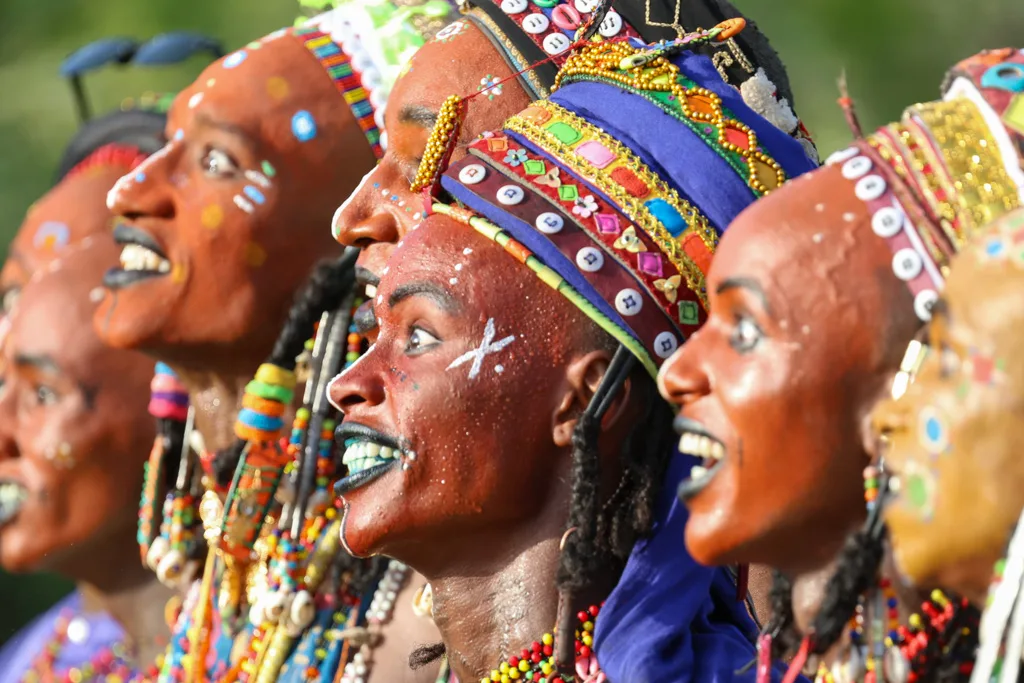
Somewhere in the Sahel, in the weeks following the end of the rainy season when the grass is still green enough to feed cattle and the air has not yet returned to its furnace temperatures, a man spends three hours on his face. He applies a base of red ochre powder mixed with fat, working it into his skin with patient fingertips. He lines his eyes with kohl, drawing the black outward to emphasize their whites, because white eyes are beauty and wide eyes are beauty and the contrast between the dark iris and the brightened surrounding is one of the things the judges will be looking for. He whitens his nose and lips with chalk or white clay powder, because a long, thin nose and white-highlighted lips read as refinement in the Wodaabe aesthetic vocabulary. He arranges ostrich feathers and beads in his hair, which has been braided or extended with additional strands to reach a length and elaboration appropriate to the occasion. He checks his work in a small pocket mirror — a practical tool, not a vanity — adjusting the symmetry, evaluating the line of the eye paint, deciding whether the ochre needs another layer. He has been preparing for this festival for months in some respects and for his entire adult life in others.
Tonight he will dance. He will dance in a line with other young men for hours, sustaining a specific facial expression — the **yaake** expression, which involves rolling the eyes to show the whites, baring and widening the teeth in a controlled, sustained display — while female judges circulate, evaluate, and eventually make selections. The women are the judges. The women hold the power of choice. The men are competing to be found beautiful.
This is **Gerewol** — the annual festival of the **Wodaabe** people, a subgroup of the Fulani (Fula) ethnic community who inhabit the arid Sahel zone stretching across Niger, Chad, Cameroon, and Nigeria — and it inverts nearly every assumption the contemporary world carries about gender, nomadic life, beauty, and what a competition is for.
Who the Wodaabe Are: A People the Desert Made
The Wodaabe number somewhere between 100,000 and 200,000 people — estimates vary because nomadic populations are difficult to census, and the Wodaabe have historically moved across national borders that they did not draw and do not particularly recognize. They are pastoralists: their economy, their social structure, their aesthetic values, and their spiritual world all rotate around the **zebu cattle** (*nagge*) that they herd across the Sahel's seasonal grazing circuits. The zebu is not simply livestock. It is wealth, status, spiritual indicator, and emotional object simultaneously. A man's herd is a measure of his worth. A man's relationship to his animals — the care with which he tends them, the knowledge he has of their individual characters and conditions — is a measure of his character.
The Wodaabe name means "people of the taboo" (*woɗa* = taboo, prohibition) — a name that identifies them not by territory or ancestry but by behavioral code. The central Wodaabe value system is organized around **pulaaku**, a complex concept that encompasses beauty (*hakkillo*), reserve (*semteende*), patience (*munyal*), and care (*nder*) — a code of conduct that prizes restraint, dignity, and composure under difficulty. The person who displays pulaaku does not cry out in pain, does not show anger publicly, does not eat or drink eagerly in the presence of others. Pulaaku is not coldness; it is a form of respect for the social fabric, an understanding that uncontrolled expression imposes costs on the community that must absorb it.
This value system, carried across one of the world's most challenging landscapes — the Sahel's annual cycle of adequate rainy season and brutal dry season requires continuous movement, resource calculation, and the management of animals whose health is the family's survival — produces a particular kind of human being: adaptable, observant, disciplined, and, paradoxically, given the harshness of the context, deeply invested in beauty. The Wodaabe do not treat beauty as a luxury that harsh conditions prohibit. They treat it as a necessity that harsh conditions make more essential.
The Calendar of Gerewol: What the Rains Make Possible
Gerewol is not a fixed-date festival. It is triggered by the end of the rainy season — typically in September or October in Niger — when the seasonal grazing circuits of multiple Wodaabe clans converge on the same temporary water and grass resources. The gathering is simultaneously practical and ceremonial: different clan groups that have spent the dry season separated across vast territories come together at the seasonal pastures, exchange news, conduct trade, arrange marriages, resolve disputes, and celebrate the fact that the rains came and the cattle survived.
The timing is not incidental to the festival's character. The end of the rainy season is the Wodaabe year's moment of maximum abundance — the cattle are well-fed, the grass is still green, the people have eaten adequately for several months. This abundance is the condition of celebration. A community in genuine resource stress does not hold a multi-day beauty competition. Gerewol is possible because the rains made it possible, which is why the festival is simultaneously a celebration and a thanksgiving — gratitude expressed through the most extravagant use of the abundance available: time, beauty, music, dance, and the ritual attention of one generation to the continuation of the next.
The festival lasts between one and seven days depending on the year and the specific clan gathering. The schedule, such as it is, follows the days' heat and the nights' cooling: daytime ceremonies, cattle displays, and social activities give way in the late afternoon and evening to the dances that are the festival's ceremonial core.
The Yaake Dance: Endurance as Aesthetic Practice
The most distinctive and demanding of the Gerewol ceremonies is the **yaake** — a dance in which lines of young men perform for hours while maintaining the specific facial display that the competition requires. The yaake expression — eyes rolled to show maximum white, teeth bared in a wide controlled smile, the whole face held in sustained, symmetrical display — is physically difficult to maintain for minutes, let alone the hours that the competitive context demands.
The challenge is deliberate. Endurance, in the Wodaabe aesthetic philosophy, is itself a form of beauty — or rather, it is the proof of the inner qualities that beauty is understood to express. A man who can sustain the yaake expression for hours without his face falling, without his body betraying fatigue, without the composure that pulaaku requires being broken by the effort, is demonstrating not just physical capacity but character. The beautiful face that can be maintained under difficulty is more beautiful than the beautiful face that can only be sustained in comfort. The competition is therefore simultaneously an aesthetic evaluation and a character assessment, which is why the women who judge it are evaluating something more complex than surface appearance.
The yaake performers move in place — small, rhythmic steps, a controlled swaying, the arms raised and the body held upright. The movement is not expressive in the Western dance sense; it does not tell a story or express an emotion through gesture. It holds a state: the sustained, concentrated presentation of a self at its most composed and most beautiful, offered for evaluation over time. The judges — young women, selected for the role and approaching it with serious attention — move along the line, looking closely at faces, sometimes bending to examine a feature more carefully, sometimes pausing with a dancer for a long moment of evaluation before moving on.
What they are looking for is specific and culturally codified. **White eyes** (*jawdi nde*) — the brighter the whites, the more beautiful. **White teeth** — the smile's maintenance and the quality of the teeth it reveals. **A long, thin nose** — considered the most refined facial feature in Wodaabe aesthetics. **Symmetry and regularity** of feature. And underneath all of these surface evaluations, something harder to specify but consistently described by observers and participants: **magnetism**, a quality of presence that makes one face compel attention among the many faces in the line. The Wodaabe have a word for this quality — *togu* — that might be translated as attractiveness or magnetism, but that specifically refers to the power one person has to draw another's eyes involuntarily.
The Ruume: When Women Choose
Beyond the yaake, Gerewol includes a second ceremony called the **ruume** — a dance and selection ritual in which the stakes are higher and the choices made are understood to have more lasting consequences. In the ruume, young women who are not yet married circulate among the male dancers and, through a gesture — touching a man's chin, taking his hand, approaching him with specific intentional eye contact — indicate their selection. The man who is chosen may accept or decline, though acceptance is the expected response. The selection made at Gerewol may formalize an existing relationship, initiate a new one, or — in the practice of **koobal**, a Wodaabe institution that permits women to leave existing marriages and take new partners at the festival — reconstitute existing domestic arrangements.
This last dimension of Gerewol is the one that most consistently confounds outside observers and has generated the most misrepresentation in Western journalism and documentary film about the festival. The koobal practice — by which a Wodaabe woman may, during Gerewol, exercise the right to leave her current husband and publicly choose a new partner — is real, but its frequency and significance are often overstated by observers for whom the novelty of female choice within an Islamic, nominally patriarchal cultural context makes it a more dramatic story than the full picture warrants.
The Wodaabe practice Islam — the Fulani conversion to Islam preceded and accompanied their expansion across the Sahel — but their Islam has always coexisted with pre-Islamic customary practices that Islamic jurisprudence would categorize as irregular. The Wodaabe have maintained these practices through the selective, pragmatic engagement with religious law that characterizes many pastoral communities whose mobility and resource constraints make strict textual observance impractical. The result is a religious culture that is genuinely Islamic in its cosmology and daily observance while maintaining a set of social practices — including the gender dynamics of Gerewol — that derive from an older pastoral customary framework.
Wodaabe women's power within this framework is real but contextual: the choice exercised at Gerewol is one of the few formal, public arenas in which female agency is structurally privileged. Outside this ceremonial context, Wodaabe social organization is organized around patrilineal descent and male household authority in ways broadly consistent with the wider West African Islamic context. The festival's inversion of the usual evaluative gaze — men displaying, women judging — is therefore not a description of the overall gender structure of Wodaabe society. It is a bounded ceremonial space within which a specific kind of power is temporarily reallocated, and that bounded character is part of what makes the festival function as a social valve: it provides a legitimate arena for choice and desire that would otherwise have no formal outlet.
Music and the Gerewol Soundscape
The sonic environment of Gerewol is inseparable from its experiential character. The festival's music is primarily vocal — the Wodaabe musical tradition is rich in **polyphonic chanting** that draws on call-and-response structures, the voices of the male performers weaving into complex harmonic patterns whose repetition over hours creates a hypnotic, meditative acoustic atmosphere that is part of the ceremony's psychological mechanism.
The chants (*tende*) performed during the yaake are competitive in their own right: a strong, clear voice that can sustain the chant without wavering, that can hold its part in the ensemble while maintaining the facial display, adds to the performance's overall assessment. The voice is not evaluated separately from the face; both are expressions of the same inner quality that beauty demonstrates. A man who sings well while looking beautiful is more beautiful than one who does only one.
The percussion that accompanies the dancing comes primarily from **gourd drums** and hand-clapping, the rhythm driving the sustained movement of the performers and providing the structural backbone around which the vocal parts circulate. Traditional musical instruments — the one-string fiddle (*nyanyeru*) and the transverse flute (*serdu*) — appear at Gerewol in contexts outside the main dance ceremonies, accompanying more intimate social occasions within the festival's extended social calendar.
The songs performed at Gerewol are not composed for the occasion. They belong to a repertoire transmitted across generations of Wodaabe men, whose memorization of the chant texts and mastery of the vocal technique is part of the same long preparation that the physical and cosmetic aspects of the festival require. A young man approaching his first Gerewol has been learning the songs since childhood, listening to older men perform them, gradually taking his own place in the ensemble as his voice and knowledge develop.
The Cosmetic Tradition: What the Face Is Made Of
The cosmetic practice of Gerewol — the elaborate preparation of the male face for competitive display — deserves examination not as exotic spectacle but as a knowledge system with its own material logic and aesthetic philosophy.

The primary colorant is **red ochre** (*laayre*) — iron oxide pigment that occurs naturally across the Sahel's geology, ground to a fine powder and mixed with animal fat or commercial cosmetic base to produce a workable paste. Ochre is one of the oldest cosmetic materials in human history: archaeological evidence of its use for body decoration extends back over 100,000 years, and its persistence in Gerewol practice connects the festival's cosmetic traditions to a human cultural past far older than the Wodaabe as a distinct cultural group.
**Kohl** (*tunjere*) — antimony sulfide ground fine and applied to the lash line with a pointed stick — creates the dark eye lining that emphasizes the white of the eye. The practice is common across the Islamic world as both cosmetic and protective tradition (kohl was understood to protect the eyes from desert glare, a claim that ophthalmological research has partially supported for certain formulations). In Gerewol, the kohl application is extensive — drawing the black beyond the lash line outward toward the temple, maximizing the contrast that makes the white of the eye most visible.
**White chalk or clay** (*ladde*) is applied to the nose ridge and lips in the specific pattern that the Wodaabe aesthetic vocabulary favors: a thin vertical strip emphasizing the nose's length and narrowness, and a horizontal highlighting of the lips that sets them apart from the surrounding ochre base. The effect — red-toned skin, dramatically dark-rimmed white eyes, chalk-white nose and lips — is visually striking precisely because it is not naturalistic. It is a transformation of the face into a display object, an aesthetic statement rather than an enhanced version of ordinary appearance.
The men who apply this cosmetic daily during Gerewol are not doing something that their culture marks as transgressive or gender-inappropriate. Within Wodaabe culture, the male investment in beauty — the care taken over appearance, the knowledge of cosmetic materials, the serious attention to one's physical presentation — is a component of *pulaaku*, the code of dignity and refinement that defines the admirable person. The association of beauty with femininity, and the consequent implication that male investment in appearance is a form of gender transgression, is a cultural artifact of other traditions rather than a universal — and Gerewol is one of the clearest available demonstrations of that fact.
Photography, Tourism, and the Ethics of the Gaze
Gerewol has attracted increasing attention from international photographers, documentary filmmakers, and tourists since the 1970s, when the festival's visual drama first reached a Western audience through photographic publications. The images that circulate most widely — the extraordinary faces in full ceremonial makeup, the eye-rolling yaake expression, the vivid colors against the Sahel landscape — are genuinely striking and difficult to contextualize briefly.
This circulation has produced a relationship between the festival and its outside observers that requires honest engagement. Gerewol has become, for a segment of the international photography and "adventure travel" market, an aesthetic destination — a place where extraordinary images are available. The Wodaabe themselves have developed a nuanced and not-always-welcoming relationship to this attention. Some participants accept payment for photographs; others decline contact with cameras entirely. The festival's coordinators and community elders have varying positions on outside access. The question of who benefits from the images that leave Gerewol — whose economic interests are served by the international market for photographs of the Wodaabe men's faces — is not resolved by the aesthetic quality of those photographs.
What the outside gaze consistently underrepresents is the festival's social and economic context: the cattle trading, the marriage negotiations, the clan diplomacy, the practical reunion functions that make Gerewol a working institution rather than a ceremonial set piece. The beauty competition is the most visually spectacular component of a multi-day social event that serves the pastoral community's real needs. Covering the festival as primarily or exclusively a beauty spectacle produces images that are accurate as far as they go and fundamentally incomplete in what they omit.
What Gerewol Knows That We Don't
There is something specific that Gerewol demonstrates that is difficult to find demonstrated anywhere else with such cultural clarity: that the association of beauty with women and competitive display with men is a cultural contingency, not a natural law. The Wodaabe built a tradition in which men display, men prepare, men invest enormous effort in their own appearance, and women choose — and built it within a broader Islamic, patriarchal social context, which means its existence is not evidence that the Wodaabe have an egalitarian gender structure, but that human cultures are capable of quarantining specific reversals within otherwise conventional arrangements, and that the reversal, in its bounded space, can be completely genuine.
The men at Gerewol are not performing femininity. They are performing Wodaabe masculinity, which includes beauty as one of its central components. The most beautiful man at Gerewol is not less masculine within the Wodaabe cultural framework. He is more of what a Wodaabe man is supposed to be — more refined, more possessed of pulaaku, more demonstrably in command of the qualities that the tradition prizes. The framework in which beauty is a male virtue and male display is a form of honor is not exotic. It is an alternative, perfectly coherent organization of values that the Wodaabe have maintained across centuries of pastoral life in one of the world's most demanding landscapes.
The Sahel does not reward waste. Everything the Gerewol festival expends — the time, the materials, the collective attention — is expended on something the community has determined is worth the cost: the careful reproduction of the social bonds, the aesthetic standards, the marriage networks, and the cultural identity that make the Wodaabe not just a surviving pastoral community but one with a distinct and deeply developed way of being human. The man with the white eyes and the ochre face and the ostrich feathers is not performing for the outside world. He is demonstrating, for the judges who know exactly what they are looking at, that he is worth choosing.
Whether he is chosen is not, ultimately, the point. The preparation, the sustained display, the sustained composure over hours of heat and music — these are the demonstration that matters. Gerewol does not crown a winner and send everyone home. It reveals, through the accumulated evidence of each man's performance, what kind of person he has become. The choosing is how that revelation is recognized. But the character it recognizes was built long before the festival began.