The Memory Keeper: Ireland's Seanchaí and the Art of Carrying a Nation in Words
The Memory Keeper: Ireland's Seanchaí and the Art of Carrying a Nation in Words
In the winter of 1935, a team of researchers from the Irish Folklore Commission traveled to the Irish-speaking communities of County Kerry with recording equipment — some of the earliest field recording technology ever deployed for folkloric purposes — and captured on aluminum disc the voice of Peig Sayers, a woman from the Great Blasket Island who was then in her seventies, telling stories. What they recorded was not folk entertainment in the simple sense of pleasant tales told to pass time. It was, as the scholars working with the material came to understand, a living performance of an epistemological system: a way of knowing and transmitting knowledge about the world — its history, its spiritual geography, its proper social order, its accumulated wisdom about what human life requires — that the Irish tradition had been maintaining and refining for at least two thousand years without the use of writing.
Peig Sayers was a **seanchaí** — pronounced "shan-a-khee," from the Old Irish *seanachaidh*, the keeper of old lore (*seanchas*, old knowledge). She would not have used the term for herself in the formal sense that the medieval professional class of hereditary storytellers used it; she was a woman from a fishing and farming island community who had absorbed the tradition from her mother and neighbors and who performed it in the informal contexts of the fireside gathering rather than the royal hall. But the tradition she carried — the specific combination of genealogical memory, historical narrative, supernatural lore, and performative skill that constitutes the seanchaí practice — was continuous in form with the tradition that had functioned at the center of Irish political and cultural life for a millennium before her.
The Folklore Commission that recorded Peig Sayers was responding to an emergency: the Irish-speaking communities of the western seaboard that had been the primary reservoirs of living seanchaí tradition were diminishing rapidly, their populations reduced by the Great Famine of the 1840s, by emigration, and by the economic pressures that continued through the twentieth century to pull younger generations away from the rural Irish-speaking world. The Commission's mission was preservation — the transfer of living oral tradition into the written and recorded archive before the transmitters of the tradition disappeared. By the time the archive closed decades later, it had collected approximately 1,400,000 manuscript pages and thousands of hours of audio recording — one of the largest folk tradition archives in the world, a monument to the productivity of the tradition it had been mobilized to save and simultaneously to the scale of what was at risk of being lost.
The Filí: Professional Memory in the Pre-Christian World
The seanchaí tradition as it existed in medieval and early modern Ireland was the continuation of a much older professional class: the **filí** (singular: file) of pre-Christian Irish Celtic society, whose status, function, and training made them one of the most institutionally elaborated examples of professional oral knowledge-keeping in any pre-literate culture.
The filí were not simply storytellers. They were the combined function of what literate societies separate into poets, historians, lawyers, genealogists, and political advisors — all of these roles performed through the medium of oral composition and performance, all requiring decades of specialized training, and all embedded in a social structure that gave the filí extraordinary status and extraordinary power. The highest grade of file (there were seven grades, each requiring specific years of training and mastery of specific forms and knowledge sets) was the **ollam** — a title cognate with the Sanskrit *upadhyaya* (teacher) and reflecting the common Indo-European cultural tradition of the professional knowledge-keeper — who ranked in social status with a king's chief officer and whose satirical verses, if directed against a king, could strip that king of honor and effectively end their reign.
This last power — the destructive capacity of satirical verse — is the most striking evidence of the filí's political significance in early Irish society. In a culture that understood honor (*enech* — literally "face") as the fundamental social currency, the file who composed and performed a satire against a king or noble was deploying the most dangerous weapon in the cultural arsenal: the public destruction of the target's honorable reputation, expressed in the memorable, transmissible, indefinitely repeatable form of poetry. A king against whom a satire had been composed could not escape its effects by force; the satire would be performed by other filí, known by the populace, and its damage would persist as long as the words persisted — which, in an oral tradition, was indefinitely.
The filí's training lasted approximately twelve years at a formal level, though mastery of the full tradition required decades of active performance and continuous addition to the repertoire. The curriculum included the memorization of approximately 350 specific story types (*primscéla* — "primary stories" and *fotoscéla* — "secondary stories") whose content covered the mythology of the gods (*síde*), the histories of the provincial kings, the genealogies of the noble families, the laws governing social conduct and dispute resolution, and the technical forms of Irish verse in its multiple meters and genres. A fully trained ollam was expected to have immediate recall of this entire corpus — to be able to perform any element of it on demand, in the appropriate form, with the accuracy and aesthetic quality that his professional status required.
This is not a small body of knowledge. The oral tradition that the medieval Irish manuscripts capture in written form (beginning in the sixth and seventh centuries CE, when Christian monasteries provided the institutional support and the Latin writing technology for the transcription of traditional material) includes hundreds of texts in multiple genres: the great mythological cycles, the Ulster Cycle of Cú Chulainn narratives, the Fenian Cycle of Fionn mac Cumhaill, the Historical Cycle of the High Kings, the Voyage literature, the Vision literature, the wisdom texts, the law texts. The sum of this material, even in its written form, is one of the most extensive bodies of medieval vernacular literature in any European language. It existed in oral form, maintained by the filí, for centuries before it was written down.
The Seanchas: Old Knowledge and Its Many Chambers
The word *seanchas* that gives the seanchaí their title refers to a specific category of Irish traditional knowledge that is worth understanding in its own right, because its scope is wider than "old stories" or "folklore" in the popular sense of either term.
*Seanchas* encompasses: genealogical knowledge (the lineages of noble families, tracing descent from mythological ancestors through to the present generation); historical knowledge (the sequence of kings, battles, political events, and their consequences); topographical knowledge (*dinnseanchas* — place-lore, the mythological and historical significance of specific named landscape features); legal knowledge (the traditional Brehon law system, its provisions and its precedents); and narrative knowledge (the specific stories — myths, hero tales, wonder tales, ghost stories, local legends — that constitute the tradition's imaginative literature).
The **dinnseanchas** — place-lore, the knowledge of the stories associated with specific named places in the Irish landscape — deserves particular attention because it illustrates the seanchaí tradition's most distinctive epistemological contribution: the understanding that landscape is itself a text, that the names and features of the physical environment encode historical and mythological information that the trained memory-keeper makes accessible, and that the proper relationship between a community and its landscape requires knowledge of the stories that make the landscape legible.
The Irish landscape is among the most intensively named environments on earth. Townland names — the smallest unit of Irish administrative geography, inherited from the Gaelic land-division system — encode topographic features, personal names, historical events, and mythological associations in a density that makes an Ordnance Survey map of Ireland a compressed archive of historical and mythological information for anyone who knows how to read it. The seanchaí knew how to read it: the *Rath* (ringfort) names that preserve the memory of Iron Age settlement patterns, the *Tobar* (holy well) names that encode the landscape's spiritual geography, the *Cnoc* (hill) and *Sliabh* (mountain) names that connect specific topographic features to the mythological narrative of the land's divine and heroic past.
This knowledge connected the people living in a landscape to its history in ways that written history, which typically deals with large-scale political events rather than local specificity, cannot replicate. The seanchaí who told the story of why a specific field near the village was called by its specific name was transmitting information about the human history of that particular piece of ground that might extend back a thousand years or more — information that would be lost without the tradition's maintenance and that no written archive, before the Folklore Commission began its work, had thought to collect.
The Fireside Performance: Technique and Presence
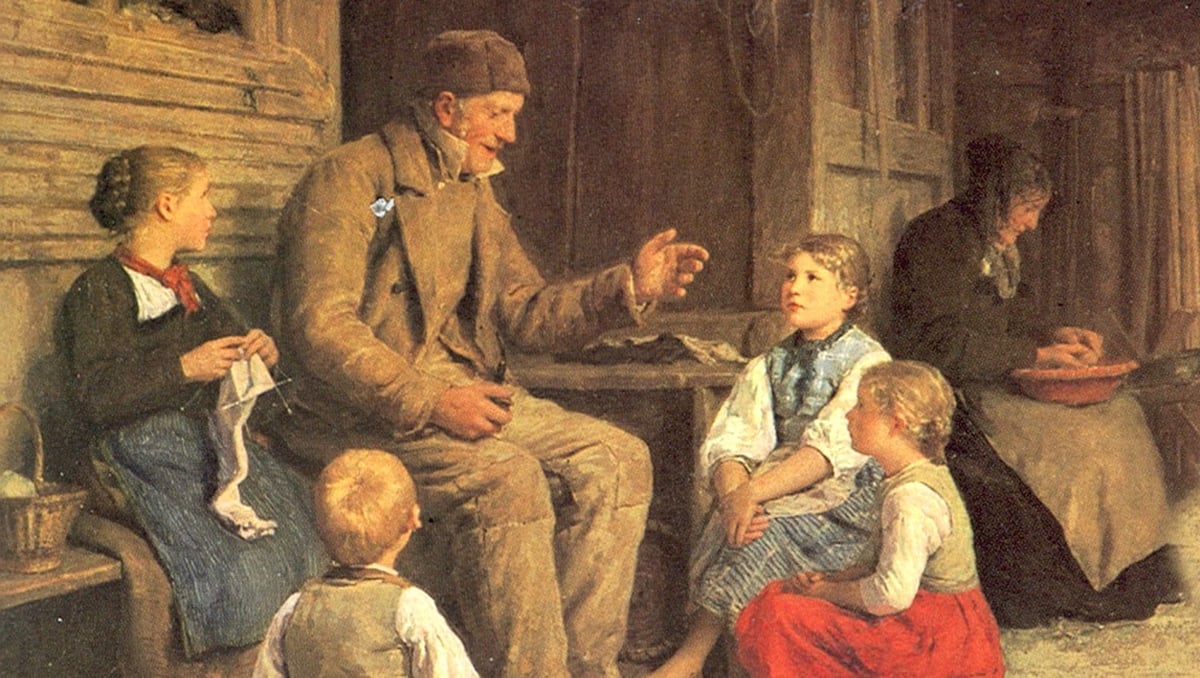
The seanchaí's performance context — the fireside gathering (*ceilidhe* or *cuaird*) at which stories were told — was a specific social institution of Irish rural culture that shaped the performance tradition in ways that distinguishes it from storytelling contexts organized around the stage or the page. The fireside gathering was intimate, participatory, and embedded in the daily social rhythms of rural community life: neighbors gathering at a particular house known for its good storytelling, settling around the fire with their pipes and their knitting, and listening to the seanchaí perform for an audience that knew the tradition well enough to evaluate the performance with the critical attention of connoisseurs.
This audience knowledge created a specific performance environment. The seanchaí was not performing for people who didn't know the stories; they were performing familiar stories for people who knew them and who were judging the performance's quality by standards that required both fidelity to the tradition and creative vitality in its presentation. The same story performed by two different seanchaí would be recognizably the same story — the same plot, the same characters, the same essential episodes — but different in the specific language, the pacing, the digressive commentary, the physical performance (gestures, voice modulation, facial expression, the use of the body to embody the narrative's different characters) through which the seanchaí transformed the known text into a live event.
The physical elements of seanchaí performance — described in detail by collectors who observed the tradition in its living form — were as important as the verbal content. The best seanchaí were described as using the full body to tell the story: sitting upright, maintaining strong eye contact with specific audience members at specific moments, modulating voice between the low, conspiratorial tone appropriate to supernatural episodes and the full voice appropriate to battle scenes, using hands to indicate direction, size, and action, and — crucially — using silence as an expressive instrument, the pauses between narrative elements serving as punctuation and as the specific quality of suspense that oral performance creates through timing in a way that written text cannot.
The seanchaí's relationship with the audience was reciprocal: the audience's attention, their interjections (short conventional responses that signal attention and appreciation, similar to the call-and-response conventions of some oral performance traditions), and their obvious emotional responses to specific moments in the narrative all fed back into the performance, adjusting its pace and emphasis in real time. A seanchaí performing to a cold or distracted audience produced a different performance than the same seanchaí before an engaged one — the tradition's vitality was maintained by this responsiveness, which ensured that the performance was always a genuine social event rather than a transmission from a storage medium.
The Brehon Law and the Lawyer-Storyteller
One of the most consequential and least appreciated aspects of the Irish seanchaí tradition is its integration with the **Brehon law** system — the indigenous Irish legal tradition that governed Irish society from the early centuries CE until its suppression by English colonial authority in the seventeenth century. The Brehon law system was, like the storytelling tradition itself, an oral legal system maintained by a professional class of hereditary specialists who combined legal knowledge with poetic and historical learning.
The **brehon** (judge, from Old Irish *brithem*) was a specialist legal practitioner, but the boundaries between the filí's knowledge and the brehon's knowledge were not sharp: both maintained overlapping knowledge of genealogy (essential for both legal standing and historical narrative), of historical precedent (essential for both legal argument and historical understanding), and of the narrative framework within which law and story were inseparable. Legal decisions in the Brehon system were not made by reference to written statutes but by reference to the trained memory of the brehon, who maintained the full body of legal precedent — the *bretha* (judgments) accumulated across centuries of legal practice — as a living oral archive.
The implications of an entirely oral legal system are significant and counterintuitive to minds trained in written legal culture. The advantages of an oral legal tradition include: the capacity to adapt to specific contextual circumstances in ways that rigid written law cannot (the brehon who knew the full spirit of the legal tradition could interpret it creatively in novel circumstances), the democratic accessibility of law to people who could hear and participate in its performance even without literacy, and the integration of legal knowledge with the broader cultural tradition — law as part of the community's living knowledge base rather than a specialized technical apparatus separated from ordinary cultural life.
The disadvantages — the vulnerability of oral law to the death of its practitioners, the difficulty of resolving disputes about what the law actually said when the legal expert memories disagreed — were managed through the institutional framework of the hereditary specialist class, whose training ensured continuity, and through the practice of committing important legal decisions to verse form, which made them more memorable and more resistant to casual alteration. The most important Brehon law texts that survive in written form — primarily preserved in Irish monastic manuscripts from the seventh to ninth centuries — are in verse or in elaborately styled prose that reflects the oral performance context from which the written texts emerged.
The English colonial suppression of Brehon law, completed by the early seventeenth century, was not simply the replacement of one legal system with another. It was the destruction of an entire epistemological framework — a way of knowing, recording, and applying social knowledge that had been maintained by a professional class for a millennium, integrated with the poetic and historical and genealogical knowledge that the same tradition maintained. The suppression of the brehon class removed from Irish society the institutional framework within which the oral legal tradition could maintain itself, contributing to the broader dismantling of Irish Gaelic civilization that the colonial period accomplished across multiple institutional domains simultaneously.
Colonization, Famine, and the Survival of Story
The seanchaí tradition survived the destruction of the Gaelic political and institutional order that had originally supported it — but it survived in transformed and diminished form. The professional hereditary class of filí, dependent on aristocratic patronage that the destruction of the Gaelic chieftainship system eliminated, largely disappeared as an institution by the mid-seventeenth century. What survived was the more distributed, informal tradition maintained in the Irish-speaking rural communities of the west and south — the tradition that Peig Sayers represented — where the seanchaí function was performed by community members who combined the storyteller role with ordinary farming and fishing lives rather than the professional specialization of the medieval practitioners.
The **Great Famine** of 1845–1852 was the most destructive single event in the history of the seanchaí tradition. The famine killed approximately one million people and caused the emigration of another million within a few years, with emigration continuing at high rates for a century thereafter. The regions most severely affected — the Irish-speaking west and southwest — were the primary reservoirs of the living seanchaí tradition, and the catastrophic population loss of those decades eliminated many of the tradition's most active practitioners and dispersed the communities within which the tradition was embedded. The oral tradition requires community to function — the fireside gathering cannot happen without neighbors to gather — and the communities that the famine and emigration destroyed took their traditions with them into the grave or into the diaspora.
What survived did so in the Irish-speaking communities (*Gaeltacht* areas) that maintained enough population continuity to sustain the tradition, and in the diaspora communities in America, Britain, and Australia where emigrants carried their stories and songs. The Irish diaspora tradition — particularly strong in the Irish-American communities of Boston, New York, and Chicago — maintained many elements of the seanchaí tradition in community gathering contexts that bore a functional resemblance to the fireside *ceilidhe* even in urban American settings: the famil