The Mask That Rises From the River: Guinea's Kakilambe and the Living Power of Sacred Performance
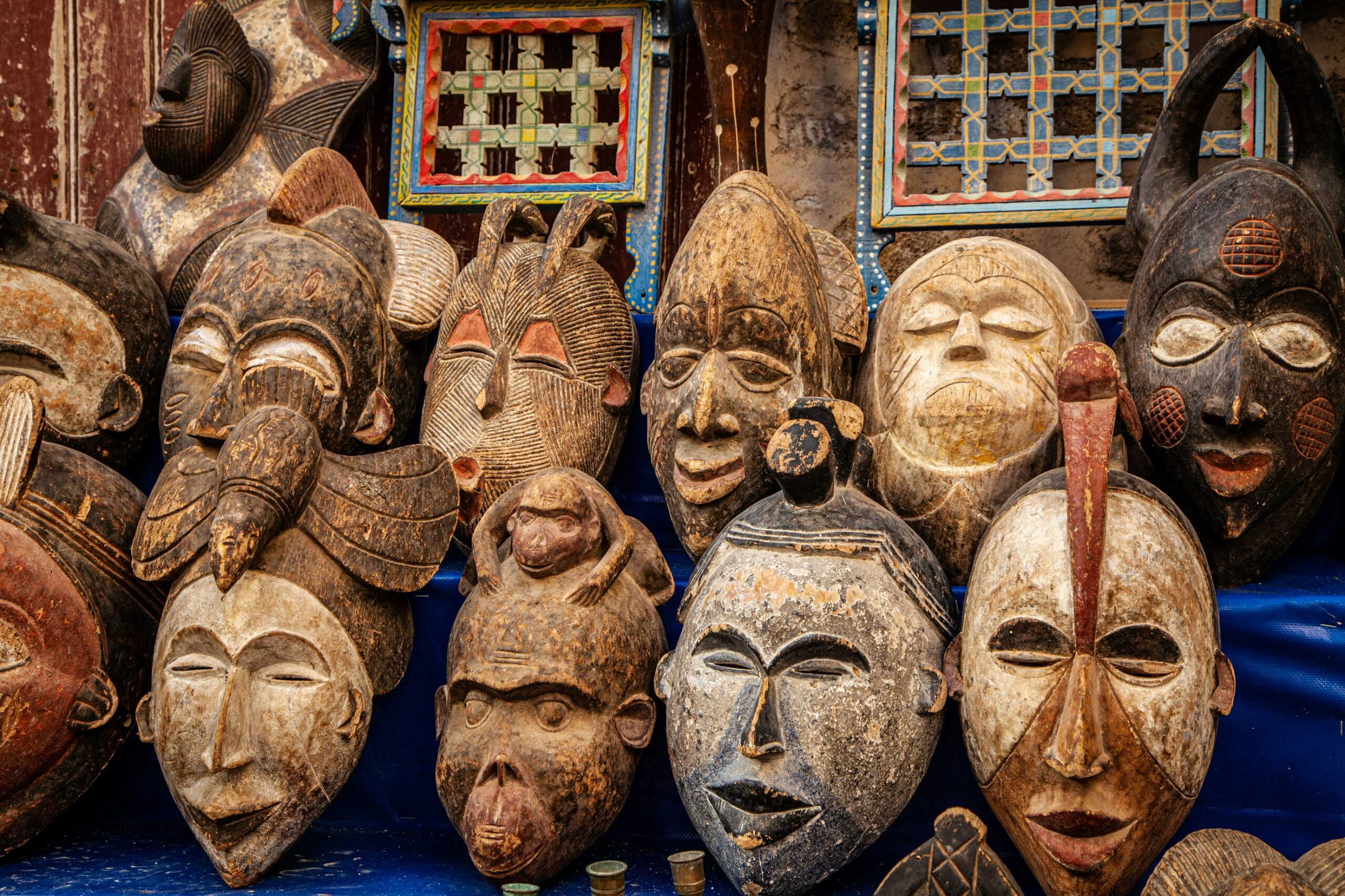
The Mask That Rises From the River: Guinea's Kakilambe and the Living Power of Sacred Performance
Somewhere in the estuaries and mangrove corridors of Guinea's Atlantic coast, in the villages that the Baga people have inhabited for centuries along the edge where the land becomes water and the water becomes uncertain, there is a mask that does not hang on a wall. It does not rest in a museum case or a private collection, though versions of its cousin masks have traveled to both. It waits — sometimes for years, sometimes for a generation's turning — in the custody of the men who know its protocols, attended by obligations that govern what can be said about it, who can approach it, what must be performed before it moves, and what the community owes it in exchange for what it gives.
When the **Kakilambe** finally appears — typically once in a seven-year cycle, at moments of collective significance determined by the community's religious leadership — it does not walk out from a storeroom. It rises. The ceremony's staging involves the mask's emergence from water or from the earth, the specific location varying by community tradition, in a movement that enacts the cosmological claim at the center of the Baga spiritual world: that the power which governs human life comes from beneath the visible surface of things, that it must be called up through the correct procedures by the people who hold that knowledge, and that when it arrives, the community must be prepared to receive its judgment, its healing, and its renewal.
What the Kakilambe offers the communities that maintain its tradition is not entertainment, not cultural spectacle, not the performance of identity for outside observers. It is governance: a form of social and spiritual ordering that integrates what Western institutional frameworks separate — law and religion, health and justice, individual and collective, the living and the ancestral dead.
The Baga People and the World the Mask Inhabits
The **Baga** are a coastal people of what is now the Republic of Guinea, concentrated in the Boké Prefecture along the Atlantic littoral and the river estuaries that cut through the mangrove forests of the Guinea coast. They speak Baga languages — a cluster of related tongues within the Atlantic branch of the Niger-Congo family — and have inhabited their current territory long enough that their relationship to the landscape is encoded in the ritual geography of their ceremonies: specific rivers, specific forest clearings, specific tidal zones are not neutral terrain but spiritually inhabited spaces whose custodianship falls to specific lineages and whose protocols govern how the Baga relate to the natural world they live within.
The Baga world is not secular in any functional sense. The distinction between the natural and the supernatural that structures so much of Western institutional thought simply does not operate as an organizing principle in the cosmological framework within which the Kakilambe tradition exists. The spirits that inhabit the rivers, forests, and estuaries of the Guinea coast — the *a-Mantsho-ño-Pön*, the *Nimba*, the *Kakilambe* and its associated powers — are not supernatural in the sense of being outside nature. They are the forces that constitute nature, that give the landscape its agency, that hold the covenants through which human communities are permitted to inhabit and use the land and water that sustains them.
This is the context without which the Kakilambe cannot be understood: a world in which the mask is not representing a spiritual power but is — during the period of its activation — that power's presence in the community. The distinction between symbol and referent that Western aesthetic theory assumes does not apply here. The mask is not about the spirit. During the ceremony, properly conducted, it is the spirit. This claim is not metaphor or folk psychology. It is the theological foundation on which the entire institution rests, and it determines everything about how the ceremony is structured, who may participate, and what it accomplishes.
The Mask's Anatomy: Reading the Kakilambe Form
The Kakilambe mask is not a face covering in the conventional masquerade sense. It is an architectural object — a construction of considerable scale that incorporates the masked performer within a larger structure that extends well above and around the human body inside it, transforming the performer not into a disguised person but into something categorically different: a moving presence that reads, at the distance from which most community members experience it, as inhuman in its scale and movement.
The basic form — which varies significantly between communities and across historical periods, the mask tradition having undergone considerable change across the nineteenth and twentieth centuries — typically involves a horizontal element at the performer's head level (a carved wooden board or panel, often elaborately decorated) from which vertical elements rise, sometimes to heights of several meters, incorporating plant materials, cloth, fiber, feathers, and other substances whose specific inclusion is governed by protocols known to the craftsmen and religious specialists who build and maintain the object. The performer inside the structure is entirely concealed; the costume extends from ground to considerable height, and the movement of the whole — the rising, the swaying, the turning — is produced by the performer's body but reads as the autonomous movement of the entity the mask represents.
The materials incorporated into the Kakilambe's construction are not chosen for visual effect alone. Each element carries meaning within the Baga symbolic vocabulary: specific plants are associated with specific spiritual powers or protective functions; specific colors encode cosmological relationships; the arrangement of elements in vertical space maps a cosmological order in which the mask's height itself communicates something about the power's relationship to the human scale below it. The mask looks down at the community it addresses from a height that is not architectural accident but theological statement: this is what it means to stand in the presence of a power that exceeds the human.
The Seven-Year Cycle: Why the Interval Matters
The Kakilambe's emergence on a seven-year cycle — the specific interval varying somewhat by community and by circumstance, with appearances possible at moments of crisis outside the regular schedule — is not arbitrary. The interval is long enough that most community members have experienced the previous appearance but are not so accustomed to the ceremony that its arrival fails to produce the specific quality of anticipation, preparation, and collective reorientation that the ceremony requires.
A generation of children grows up between appearances. The children who were small at the last ceremony are young adults at the next; the young adults of the last appearance are now among the elders who carry the ceremony's governance responsibilities. The seven-year interval is, among other things, a pedagogical structure: the ceremony educates each generation into the community's values, obligations, and cosmological framework at the specific life stage when that education is most formative, and it does so not through instruction but through experience — the direct encounter with a power that exceeds ordinary social life.
In the years between appearances, the Kakilambe is not absent from community life, but its presence is maintained through the obligations and prohibitions that structure the relationship between the community and the power it holds. The men who are custodians of the mask's physical form and ceremonial protocols carry ongoing responsibilities — to the mask's maintenance, to the observance of specific behavioral requirements, to the knowledge transmission that ensures the next ceremony can be conducted correctly. The interval is filled with invisible labor that makes the visible ceremony possible.
The timing of an appearance within the seven-year structure is not mechanically determined. The religious and political leadership of the community — the elders who hold the knowledge of Kakilambe's protocols — make a judgment about when the ceremony is needed, taking into account the community's current state: unresolved disputes that require the mask's judicial function, illnesses or misfortunes that suggest a disruption in the community's relationship to the powers it depends on, social tensions that ordinary governance mechanisms have been unable to resolve. The mask's appearance is, in this sense, a diagnosis as well as a treatment.
The Ceremony's Functions: Justice, Healing, and Renewal
What distinguishes the Kakilambe tradition from many West African masquerade traditions is the comprehensiveness of the functions it performs during its appearance. A single ceremony can encompass judicial proceedings, healing interventions, initiatory instruction, agricultural blessing, and communal reconciliation — not in sequence but simultaneously, the different functions overlapping in a ceremonial structure that Western institutional frameworks would distribute across courts, hospitals, schools, churches, and political assemblies.
**Justice** is among the most significant of the Kakilambe's functions. The mask's appearance creates conditions under which disputes that have resisted resolution through ordinary community mechanisms can be brought before a authority that both parties recognize as exceeding the human scale of the conflict. The power that emerges from the water or the earth to stand before the community is not a human mediator with human biases and human loyalties; it is the community's relationship to a force that both parties share, and the judgment delivered through it carries an authority that no purely human arbitration can command.
This judicial function is not simply theatrical. It produces real social outcomes: agreements brokered in the presence of the Kakilambe carry the weight of sacred obligation, violations of which are understood to have consequences in the spiritual domain that exceed the social. The community member who agrees to something before the mask and then violates the agreement is not merely breaking a social contract; they are breaking a covenant with the powers that govern their world, and the consequences of that breach are understood to extend to their family and their lineage.
**Healing** operates alongside justice in the ceremony's structure. Individuals presenting with conditions understood to have spiritual as well as physical dimensions — illnesses that have not responded to treatment, misfortunes that suggest a disruption in the individual's relationship to the powers around them, behavioral changes that community members read as symptoms of spiritual interference — can bring these conditions into the ceremony's space. The Kakilambe's judgment on such cases involves both the identification of the disruption's source and the prescription of the corrective actions required to restore the individual to health.
**Initiation** and generational transmission form the ceremony's educational function. The appearance of the Kakilambe is the occasion on which the coming generation encounters, in the most vivid possible context, the cosmological framework within which they will live their adult lives. The young men undergoing initiation during a Kakilambe ceremony are not watching a performance; they are being formed by an encounter that the tradition's practitioners describe as irreversible — something that changes the initiate's relationship to the world at a level that ordinary instruction cannot reach.
Colonial Disruption and the Masks That Disappeared
The Kakilambe tradition has not existed in isolation from history. The nineteenth and twentieth centuries subjected the Baga communities and their ceremonial traditions to a series of pressures — colonial administrative disruption, Islamic reformist movements, and post-independence nation-building policies — whose cumulative effect on Baga masquerade traditions was severe enough that scholars who began studying the tradition in the 1950s found it in a state of significant contraction compared to the accounts of earlier observers.
French colonial administration in Guinea had complex and inconsistent relationships to indigenous ceremonial practices. Some district administrators tolerated or ignored the masquerade traditions of the coastal peoples; others, seeing in the ceremonies a source of authority that competed with colonial administrative power, sought to restrict or eliminate them. The specific damage to Baga traditions came as much from the internal dynamics of Guinea's history as from direct colonial suppression: the expansion of Islamic reformist movements among the Baga in the mid-twentieth century produced a period in which significant numbers of Baga communities voluntarily abandoned their masquerade traditions, the masks either destroyed or surrendered to missionaries and administrators in demonstrations of conversion.
This period — the late 1950s and the years immediately surrounding Guinean independence in 1958 — saw the physical destruction or dispersal of large numbers of Baga sacred objects, including Kakilambe masks and the related **Nimba** — the iconic breast-form mask that became one of the most reproduced images in the Western art market's encounter with West African objects after Pablo Picasso's engagement with African formal vocabulary in the early twentieth century. The Nimba masks that entered Western collections during this period came, in many cases, from communities that had abandoned the traditions within which they had functioned — a fact that complicates both the art-historical account of Modernist primitivism and the heritage institution's claim to be preserving what local communities had discarded.
Sékou Touré's post-independence government (1958–1984), which pursued an aggressively nationalist cultural policy, had a paradoxical relationship to Baga traditions: on one hand, it promoted "authentic" African culture as the foundation of Guinean national identity; on the other hand, it was suspicious of the specifically local, ethnically particular authority that masquerade traditions represented. The result was inconsistent — some traditions received state support as cultural heritage; others were discouraged as potential foci of sub-national identity that competed with the national project.
Revival and the Question of What Returns
Beginning in the late 1980s and accelerating through the 1990s, scholars and community members documented what they described as a revival of Baga masquerade traditions — including the Kakilambe — in communities that had abandoned them during the mid-century disruptions. The revival is real and is now well documented; what requires careful attention is the question of what exactly has been revived and in what form.
The anthropologist Lamp, among others who worked with Baga communities during this period, noted that revived ceremonies were drawing on collective memory, on the knowledge of older practitioners who had maintained the tradition privately, and on community consultation processes that were themselves different from the transmission models of the pre-disruption tradition. The ceremonies that emerged from the revival were continuous with what had come before — recognizably Kakilambe ceremonies, functioning according to recognizable protocols — but they were also the product of reconstruction: community decisions about what to retain, what to modify, and how to reintegrate practices that had been interrupted for a generation.
This reconstruction dynamic is not unique to the Baga or to Guinea. It characterizes the contemporary situation of virtually every living ceremonial tradition that has undergone significant disruption in the twentieth century. What makes the Baga revival particularly instructive is its community-driven character: the decision to revive the Kakilambe tradition was made by the communities themselves, on the basis of their own assessment of what the tradition provided that its absence had cost them, and the process of revival has been conducted primarily through internal knowledge-holders rather than through external institutional frameworks.
The distinction matters for how we understand living traditional practices and the agencies that sustain or endanger them. The Kakilambe survived not because external institutions protected it but because the people within whose world it functioned retained — in memory, in private practice, in the knowledge held by aging custodians — enough of what the tradition was to reconstruct it when the conditions for revival arrived.
Gender, Secrecy, and the Boundaries of Knowledge
Like many West African masquerade traditions, the Kakilambe operates within a social structure that distributes participation and knowledge unequally by gender and by initiation status. The full ceremonial knowledge of the Kakilambe — the protocols that govern its construction, the invocations that activate its power, the procedures that govern its judicial functions — is held by initiated men, and its transmission is through male initiation sequences that formalize the passage from youth to adult membership in the community's governance structure.
Women's relationship to the Kakilambe is not exclusion in the simple sense — women are present at ceremonies, some women hold specific roles within the broader ceremonial structure, and the power that the mask represents is not understood as male in any straightforward way. But there are aspects of the knowledge system, and aspects of the ceremony itself, from which women are excluded, and the protocols governing this exclusion are maintained with the seriousness that any institution gives to the boundaries that structure its knowledge hierarchy.
The category of secrecy in the Kakilambe tradition — what can be known, who may know it, what obligations attach to that knowledge — is not primarily about information control in the bureaucratic sense. It is about the recognition that certain kinds of knowledge are dangerous: that knowing how to call up a power of this scale carries responsibilities that the knowledge system cannot distribute indiscriminately without compromising the power's integrity. The secrecy protects not the institution's authority (though it has that effect) but the knowledge's efficacy — the understanding that what the ceremony does requires the conditions of appropriate relationship, appropriate preparation, and appropriate transmission that the secrecy structures help maintain.
Outsiders — non-Baga observers, researchers, journalists, the present writer — encounter this secrecy as an epistemic boundary: there are things about the Kakilambe that cannot be known from outside, that the tradition has not placed in the public domain, and that responsible engagement with the tradition requires acknowledging rather than attempting to circumvent. The account available from outside the initiation structure is necessarily partial, and the partiality is not a defect in the scholarship but a feature of the tradition's own structure.
The Mask in the World: Art Markets, Heritage Institutions, and the Objects That Left
The Baga masquerade tradition — particularly the Nimba breast-form mask that is the Kakilambe's closest cousin in the broader family of Baga sacred objects — has occupied a significant position in the Western art market since the early twentieth century, when Picasso and Léger among others engaged with the formal vocabulary of West African sacred objects in ways that transformed Western art history and simultaneously transformed the Western demand for African objects.
The Nimba's formal qualities — the massive downward-arching nose, the corrugated neck, the breast forms that give the mask its feminine identity within the Baga system of spiritual powers — attracted Western collectors who were responding to formal properties abstracted from the ceremonial context that gave those properties their meaning. The result was a market in which Baga objects commanded prices in European and American auction rooms that were entirely incommensurable with the economic conditions of the communities from which those objects came, and in which the communities received nothing from transactions that were generating significant wealth elsewhere.
The colonial-period and mid-century disruptions that caused communities to surrender or abandon their sacred objects mean that a portion of what is now in Western museum collections and private hands left Guinea under conditions that would not today be considered consensual. The heritage repatriation conversations that have become prominent in global cultural policy over the past decade — centered most visibly on objects from West and Central Africa — are directly relevant to the Baga tradition, and Guinea's government has been involved in conversations with several European institutions about the conditions under which specific objects might be considered for return.
What repatriation would mean for the Kakilambe tradition specifically — whether the objects that left could be reintegrated into the ceremonial practice from which they came, whether that practice could receive them as the objects they once were rather than as the heritage objects they have become in their institutional travels — is a question that the communities themselves are best positioned to answer. The tradition has demonstrated its capacity to function after disruption without the return of the objects that left; it has also demonstrated that it retains the knowledge to receive them if they come back.
What the Rising Means
The Kakilambe rises from water or earth in the ceremony's central moment, and the specific choreography of that rising — the way the performers work together inside the structure to produce the emergent vertical movement that reads, from the watching community's perspective, as an autonomous appearance — is one of the most carefully maintained secrets of the tradition's technical knowledge. What it produces in those watching, practitioners and elders report consistently, is a quality of recognition: the feeling not of seeing something new but of re-encountering something whose presence was always there, beneath the visible surface of the community's daily life, waiting for the conditions under which it could be called up.
This phenomenology of the Kakilambe's appearance — the rising as recognition rather than revelation — maps the tradition's deepest philosophical claim: that the powers the community depends on are not external to it, not imported from a sacred realm that requires exceptional access, but immanent in the landscape and relationships that constitute the community's ordinary world, requiring only the correct conditions, the correct relationships, and the correct knowledge to become present.
The seven-year wait is not absence. It is the form that presence takes when the ceremony is not happening. The mask that waits in its custodians' care, attended by obligations and prohibitions that structure the community's behavior whether or not the ceremony is occurring, is continuously active in the life of the community — not visibly, not dramatically, but in the specific gravity that sacred objects give to the spaces and relationships that attend them.
When it rises, it rises into a community that has been prepared by the years of its waiting to receive it — a community that knows, because it has lived within the structure of obligations that the mask's custody creates, what it owes and what it can ask for. The ceremony is the visible peak of a relationship that is continuous, not episodic. The Kakilambe does not visit the Baga community from somewhere else. It surfaces from within it, from beneath it, from the water and the earth that are the landscape the community has lived within and been shaped by for as long as anyone's memory reaches.
The mask rises. The community gathers. Something that was always there becomes, for the duration of the ceremony, unmistakably present. And then it returns — not to absence, but to the depth from which it came, where it continues to hold what it has always held: the covenant between the Baga people and the powers that govern the world they inhabit, renewed in the ceremony's space and maintained, in the years between ceremonies, by the knowledge and the obligations of those who know how to call it up.