The King Who Pretends to Leave: The Moro Naba Ceremony and the Power of Mossi Ritual
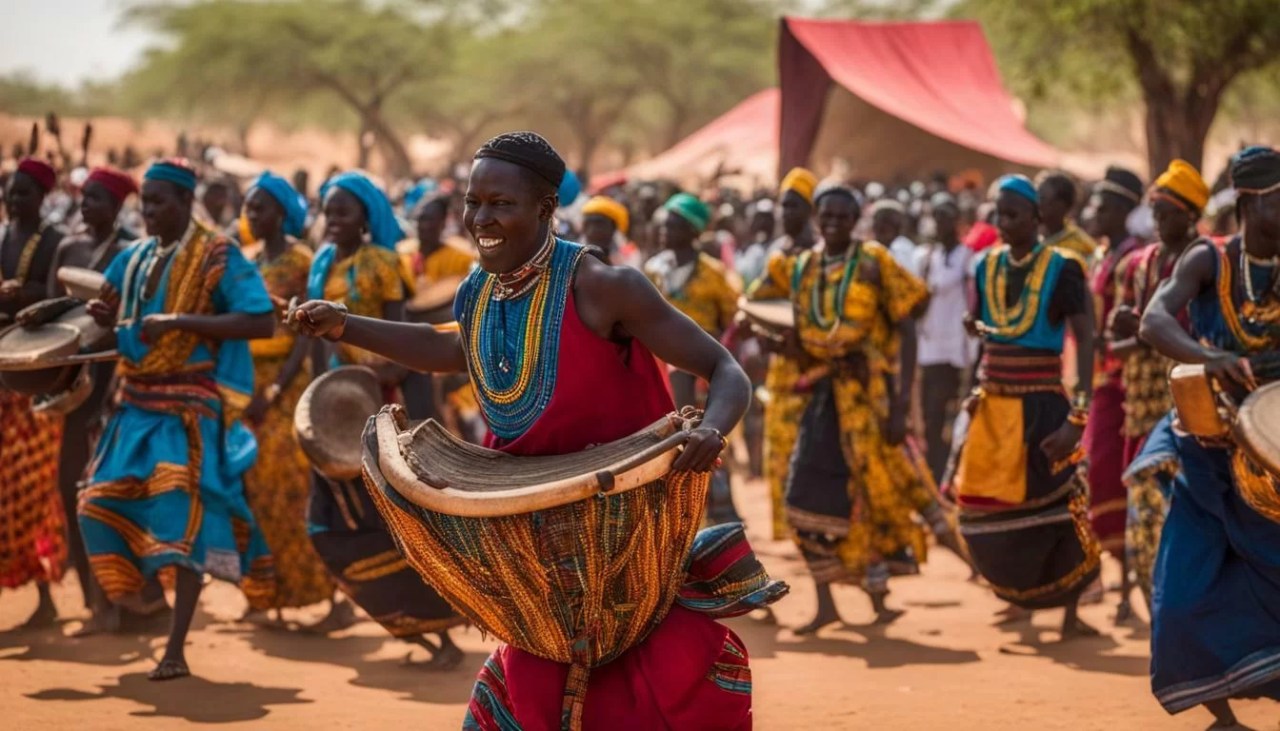
The King Who Pretends to Leave: The Moro Naba Ceremony and the Power of Mossi Ritual
At dawn every Friday, in the courtyard of the Moro Naba palace in Ouagadougou, the capital of Burkina Faso, a king prepares to abandon his people.
He emerges from the palace dressed in red — the color of war, of departure, of finality — mounted on a red horse, surrounded by the regalia of a sovereign in motion: the drums, the griots, the ministers of his court arranged in their ceremonial positions. His bearing is resolute. His direction is outward. The message communicated by every element of his presentation is that the Moro Naba — the emperor of the Mossi people, one of West Africa's most ancient and durable royal institutions — is leaving, and the reason for his departure is grave enough to override the claims of his kingship.
Then his ministers intervene. They approach in order of their rank and function, each pleading with the king to reconsider, each bringing forward the argument of their office — the kingdom needs you, the people need you, this is not the moment to go. The Naba Wemba, the minister who embodies the voice of the people, falls to his knees. The griots intensify their appeals. The red horse is stilled. The king, after the appropriate pause of a sovereign who considers and is moved, changes his white inner garments for white — the color of peace, of presence, of kingship exercised rather than abandoned — and returns inside.
The war he was preparing to fight ended somewhere in the seventeenth century. The ceremony reenacting it has occurred every Friday since, without interruption, across four centuries of change that included the French colonial conquest, independence, seven coups d'état, and the death of every individual who has played any of its roles. It is one of the longest continuously performed political rituals in the world, and it encodes within its thirty minutes of ceremonial action a complete philosophy of governance, consent, and the relationship between a sovereign and the people who make sovereignty possible.
The Mossi: A Kingdom That Lasted a Thousand Years
To understand the Moro Naba ceremony, it is necessary to understand something of the political achievement it represents and the civilization that produced it.
The **Mossi people** — today the largest ethnic group in Burkina Faso, comprising roughly half of the country's population of 22 million — formed one of the most durable state systems in West African history. The Mossi kingdoms, established sometime in the eleventh or twelfth century CE by warriors from the south who conquered and absorbed the populations of the central Voltaic plateau, maintained their political independence and territorial integrity for approximately 800 years — resisting the Songhai Empire's expansion in the fifteenth century, maintaining sovereignty through the height of the trans-Saharan trade era, and only finally succumbing to French colonial conquest in 1896 when the military technology gap between a European imperial army and a cavalry-based African kingdom became insurmountable.
This durability was not accidental. The Mossi political system combined the concentrated sacred authority of the *nakomsé* — the royal lineage that traced descent from the founding warrior-kings — with a sophisticated administrative structure that distributed governance across a hierarchy of chiefs (*naba*, singular and plural, meaning "chief" or "king" depending on context) arranged in ranked tiers from the village level to the paramount paramount. The **Moro Naba** — *moro* meaning "large" or "great" — is the paramount chief of the Mossi, based in Ouagadougou, which was and remains the Mossi political and ceremonial center.
The Mossi system's genius was its management of the relationship between sacred and administrative authority. The Moro Naba's power was simultaneously royal and spiritual: he embodied the connection between the living Mossi and their ancestors, between the kingdom's present and its founding narrative, in a way that made his authority not merely political but cosmological. He was the still point around which Mossi reality organized itself. But this concentrated sacred authority coexisted with a practical system of ministerial responsibility in which specific nobles held specific administrative functions — and in which the king's decisions were formally subject to the counsel of the court, whose members had not only the right but the obligation to represent the kingdom's interests to the sovereign.
The Friday ceremony dramatizes exactly this balance.
The Origin Story: What War the Ceremony Remembers
The ceremony's foundational narrative — preserved in oral tradition and transmitted by the griots whose hereditary function is to maintain the Mossi's historical memory — concerns an event from the reign of a Moro Naba who ruled sometime in the sixteenth or seventeenth century, the specific dating uncertain in the way that oral tradition's dating always is.
The king, according to the account, suffered the death of his most beloved wife — in some versions his principal wife, in others a favored consort whose loss was so devastating that it was interpreted not merely as personal grief but as an omen, a signal from the ancestral realm that something had gone fundamentally wrong in the relationship between the kingdom and its spiritual foundations. The Naba's response was to prepare to go to war — not against a political enemy but against the condition of his grief and his kingdom's disorder, war being the register in which a Mossi king expressed the highest intensity of response to a crisis that demanded his personal agency.
His ministers and people, faced with the prospect of their sovereign's departure into a war that could claim his life and leave the kingdom without its sacred center, intervened. They argued that the king belonged not to his grief but to his people — that the relationship between sovereign and kingdom was one of mutual obligation, in which the king's right to act on his personal imperatives was constrained by the kingdom's claim on his presence. The king, presented with this argument by the people who had the standing to make it, relented. He stayed.
Whether this specific event occurred as described, or whether the ceremony's origin was more gradual — an accumulation of ritual practice around the theme of sovereignty and consent rather than a single founding moment — is less important than what the narrative accomplishes. It explains and justifies a ceremony that reenacts, weekly, the most fundamental proposition of Mossi political philosophy: that the king's authority is real and absolute within its proper domain, but that the proper domain of kingship is defined by the kingdom's welfare, and that the king who abandons his kingdom — for whatever reason, however personally compelling — has failed the terms of his office.
The ceremony is therefore not merely commemorative. It is constitutional. It restates, every Friday, the terms of the social contract between sovereign and people that the Mossi political system is built on.
The Ceremony in Detail: A Thirty-Minute Lesson in Political Philosophy
The Moro Naba ceremony begins before dawn, when the palace's ceremonial drummers begin the rhythms that signal the day's ritual is being initiated. By the time the sun has cleared the horizon, the palace courtyard has filled with the actors whose roles are fixed by hereditary office: ministers, nobles, griots, cavalry, and the attendants whose specific functions — holding particular objects, standing at particular positions, speaking particular words at particular moments — are as precisely determined as any liturgical text.
The **Moro Naba** emerges from the palace's inner sanctum dressed in full red regalia. The color is not arbitrary: red in Mossi ceremonial language signals war, urgency, and departure — the register of the king who acts rather than waits. The horse he mounts is also red. The combination is a visual declaration that would be legible to every Mossi observer without any verbal explanation: the king is in war mode, and war mode means he may not stay.
Facing the king, the court is arranged in its functional hierarchy. The **Naba Wemba** — the minister whose title means literally "the chief of the white horse," whose role in the ceremony is to represent the collective voice of the Mossi people — takes his position at the front of the supplication. The white horse he leads is the counter-symbol to the Moro Naba's red: white is peace, white is presence, white is the king who governs rather than departs.
The supplication begins. Each minister in turn approaches the king and makes his argument for the king's return — using the specific words and gestures that his office prescribes, drawing on the specific authority of his ministerial function to make the case that belongs to his role. The griots' drums and voices accompany and intensify the appeals, their music not merely background but active persuasion, the sonic dimension of the argument being made.
The pause that follows the ministers' collective supplication is the ceremony's most important moment, and it is the moment most easily missed by observers focused on the visual spectacle. The king sits on his red horse in silence, receiving the arguments, weighing them against whatever imperative drove him to prepare for departure. The silence is not passive. It is deliberate — the held beat before resolution, the visible exercise of sovereign consideration that demonstrates the king is not simply going through motions but genuinely processing the claim being made on him.
Then the resolution: the Moro Naba dismounts from the red horse. His attendants help him change from the red outer robes to white. He mounts, or is assisted toward, the white horse — or in some versions of the ceremony, simply receives the white regalia and turns back toward the palace. The drums change their rhythm. The griots shift their tone. The ceremony has arrived at its conclusion, and the conclusion is always the same: the king stays. The kingdom continues. Sovereignty is exercised through presence rather than abandoned through departure.
The whole sequence lasts approximately thirty minutes. The palace then opens to visitors and petitioners for the rest of the morning, the Moro Naba receiving individuals and delegations in a more conventional audience format that follows the ceremony's constitutional preamble.
The Ministers and Their Meanings: A Court as Social Map
The specific ministers who participate in the Moro Naba ceremony are not ceremonial functionaries in the merely decorative sense. Each ministerial role corresponds to an actual administrative or social function within the Mossi political system, and the presence of each role in the ceremony encodes the Mossi understanding of what a complete political community consists of.
The **Naba Koom** — the "water chief" — represents the agricultural communities whose relationship to water determines their survival, and whose presence in the ceremony affirms that the king's authority extends to and must serve the farming populations who form the Mossi kingdom's economic base. The **Naba Tinga** — the "earth chief" — represents the *tengbiisi*, the autochthonous peoples who inhabited the Voltaic plateau before the Mossi conquest and whose relationship to the land predates and in some spiritual dimensions exceeds the nakomsé's political authority. The tension between the conquering Mossi royal lineage and the original inhabitants of the land they govern is a permanent feature of Mossi political philosophy, and its acknowledgment within the ceremony — the earth chief's presence among those who plead for the king's return — is a weekly reminder that legitimate sovereignty requires the consent of even those over whom it was imposed by force.
The griots — the **bendré**, the hereditary praise-singers and historians — are participants rather than observers. Their role in the ceremony is not merely to narrate or celebrate but to actively advocate: the griot's appeal to the king draws on his function as keeper of the royal genealogy and historical memory, making the argument that the king's departure would sever him from the chain of ancestors whose authority he inherits and whose legacy he is obligated to maintain. The griot who reminds the king of his predecessors' greatness is simultaneously honoring that greatness and weaponizing it as a claim on the present king's behavior.
This structure means that the ceremony's cast of characters is itself a diagram of Mossi society — its productive classes, its conquered peoples, its historical memory, its divine mandate — all assembled in the courtyard to make the collective argument that the king belongs to the community he leads, and that the community's claim on him supersedes whatever personal imperative drove him to prepare for departure.
Surviving Colonialism: The Ceremony Through the French Period
The French colonial conquest of 1896 — in which the Moro Naba Wobgho was defeated in battle, fled into exile in German Togo, and was replaced by a French-approved successor — presented the Moro Naba ceremony with its most serious modern challenge. The French colonial system had no particular philosophical problem with African royal institutions as long as those institutions could be made to serve colonial administrative purposes, and the Mossi chieftaincy system — with its highly organized hierarchy and its tradition of the paramount chief mediating between the population and external authority — was too useful to dismantle.
What the French required was that the Moro Naba's authority be refracted through the colonial administrative system rather than exercised independently of it. The Moro Naba who cooperated with this arrangement gained certain protections for his institution; the Moro Naba who resisted faced exactly what Wobgho had faced: exile and replacement. The ceremony continued through this period — its weekly enactment of Mossi political philosophy too embedded in the institution's identity to suppress without effectively ending the institution — but its meaning shifted in the colonial context. The king who reenacted his decision to stay was, in the colonial period, also enacting his decision to stay within a system that constrained his sovereignty in ways no amount of ceremonial authority could override.
Several Moro Nabas used what autonomy the system permitted to protect Mossi cultural institutions during the colonial period — the ceremony itself, the griot tradition, the system of lesser chiefs — with varying success. The French recognition that indirect rule through existing African political structures was administratively more efficient than direct European administration gave traditional authorities a survival mechanism that outright resistance would not have provided. The Moro Naba ceremony's survival through the colonial period is partly a product of this pragmatic accommodation and partly a testament to the ceremony's depth of cultural rootedness — it was simply too central to Mossi identity to eliminate without destroying the administrative cooperation the French depended on.
Independence, Coups, and the Ceremony's Endurance
Burkina Faso — known as Upper Volta until 1984, when Thomas Sankara renamed it in a gesture of revolutionary self-definition — has experienced seven successful coups d'état since independence in 1960, along with multiple attempted coups and years of political instability that have made governance continuity a rare commodity. Through all of it, the Moro Naba ceremony has continued.
This continuity is not merely institutional inertia. The ceremony has repeatedly demonstrated its political utility to the governments that have succeeded each other in Ouagadougou, regardless of their ideological character. Military governments, revolutionary governments, democratically elected governments — each has found it useful to maintain a working relationship with the Moro Naba, whose authority over the Mossi population (and whose symbolic authority over a much broader constituency for whom the Mossi kingdom represents pre-colonial African statehood) provides a form of political legitimacy that electoral mandates alone cannot fully supply.
The most dramatic test of this relationship came during Thomas Sankara's revolutionary government of 1983–1987 — a Marxist-influenced, pan-Africanist military administration that was in principle hostile to traditional and religious authority as retrograde obstacles to the revolutionary transformation of Burkinabé society. Sankara's government's relationship to the Moro Naba was tense, the two institutions representing different and in some ways contradictory sources of political legitimacy — the revolutionary state claiming authority from the people's transformation, the traditional kingdom claiming authority from ancestral continuity. Yet the ceremony was not banned. The Moro Naba institution survived the Sankara period — in part because Sankara himself understood that eliminating a thousand-year-old institution would cost more political capital than accommodating it.
After Sankara's assassination in 1987 and through the subsequent Compaoré government's 27 years in power, the Moro Naba's role evolved into something closer to active political mediation — the palace in Ouagadougou becoming a site where political crises were brought for traditional arbitration in a manner that formal government institutions were too compromised or too slow to provide. The Moro Naba Baongho, who held the position from 1957 to 2016, was perhaps the most politically significant figure in this mediating role, using the ceremony's weekly affirmation of his authority as the foundation for a practical political influence that extended well beyond what formal constitutional arrangements assigned to him.
The Living Court: What the Ceremony Produces Every Week
To watch the Moro Naba ceremony as a visitor is to encounter a disorienting temporal experience: the ceremony is simultaneously ancient and contemporary, its participants wearing regalia that encodes centuries of Mossi history while standing in a courtyard surrounded by a modern capital city in which mobile phones photograph the proceedings. The griots' praise-songs reference ancestors who died four centuries ago. The ministers hold titles whose administrative functions have been transformed beyond recognition by two centuries of colonial and post-colonial governance. The king who changes from red to white is a twenty-first century figure — educated, politically sophisticated, navigating a national and international context his predecessors could not have imagined — whose weekly ritual function requires him to inhabit a role whose script was written before the French arrived.
This is not contradiction. It is continuity, and the continuity is the ceremony's primary product. Every Friday, the Mossi political community — represented in the courtyard by the court, and in the broader population by the knowledge that the ceremony is occurring — is reminded that it has a history deeper than the nation-state that currently governs its territory, a political tradition more durable than any of the regimes that have succeeded each other since independence, and a form of sovereignty that exists in a register that electoral politics and military coups cannot fully occupy or eliminate.
The practical political effect of this reminder is not negligible. Burkina Faso's governments have consistently found it useful to have a Moro Naba who can deliver the cooperation of Mossi communities in a way that central government directives alone cannot achieve. The Moro Naba who arbitrates a land dispute between Mossi farmers is exercising a practical jurisdiction that the formal court system, with its case backlogs and its geographic limitations, often cannot deliver. The palace's mediation function — explicitly connected to the ceremony's weekly affirmation of the Naba's role as the one who stays, the one who is present, the one whose authority is grounded in continuity rather than contingent power — is not archaic custom preserved in amber. It is a working social institution meeting real community needs.
The Griots' Burden: Memory as Political Function
No account of the Moro Naba ceremony can be complete without sustained attention to the griots — the bendré of the Mossi tradition — whose role in the ceremony is both the most visually spectacular and the most philosophically important.
Griot traditions across West Africa share a common function: the hereditary preservation and transmission of historical, genealogical, and political memory in oral form, performed through song, narrative, and the musicianship that accompanies both. The griot is simultaneously praise-singer, historian, diplomat, and entertainer — a combination that has no equivalent in European cultural traditions because European cultures delegated these functions to separate institutions (church, archive, court, theater) rather than concentrating them in a hereditary performing class.
In the Moro Naba ceremony, the bendré perform a specific function that goes beyond general praise-singing. Their appeals to the king draw on the genealogical and historical knowledge they carry: they name the king's ancestors, recite their achievements, and invoke the accumulated weight of Mossi history as an argument for the present king's continuation. This is not flattery. It is a form of political theology — the claim that the present king's legitimacy is derived from and conditional on his relationship to that history, and that departure from the role that history has defined would constitute a betrayal not merely of the living community but of the dead who made the living community possible.
The griot who carries this knowledge is therefore not a performer hired for the occasion. He is a custodian of the memory that makes the ceremony possible, and his hereditary status — the knowledge is transmitted within griot families, not available to be learned from outside — is the guarantee of the transmission's authenticity. When the bendré sing the Moro Naba's genealogy in the Friday ceremony's dawn courtyard, they are not reciting a text that could be equally well read from a book. They are activating a living memory that their family has maintained precisely for this purpose, across precisely this many generations, in exactly this form.
What the Ceremony Teaches the Modern World
The Moro Naba ceremony has survived everything that should have ended it: military defeat, colonial suppression, revolutionary ideology, political instability, modernization, urbanization, and the radical transformation of the social context in which it was originally meaningful. Its survival is not nostalgia's victory. It is evidence that the ceremony continues to do something — to produce something — that the modern institutions surrounding it cannot fully replicate.
What it produces is a specific form of political accountability that democratic elections only partially capture and that military coups do not capture at all: the weekly, public, ceremonially enacted acknowledgment that sovereignty is conditional, that the king who abandons his people has failed the terms of his office, and that the community has both the right and the responsibility to call a departing sovereign back.
In a country that has experienced seven coups d'état and whose current government came to power by force, this proposition — reenacted every Friday in Ouagadougou in thirty minutes of costume and horsemanship and drumming — is not merely cultural heritage. It is a political claim. It insists, against the evidence of recent history, that authority properly understood is not what you seize but what you are given, and that what is given can be, must be, called back when the terms of its grant are violated.
The king changes from red to white. He dismounts from the war horse. He turns back toward the palace and the people who have asked him to stay.
He has been making this choice every Friday for four hundred years. In Burkina Faso, in the twenty-first century, the choice still needs to be made.