The Hunter and the Sky: Mongolia's Eagle Hunting and the Last Nomadic Partnership
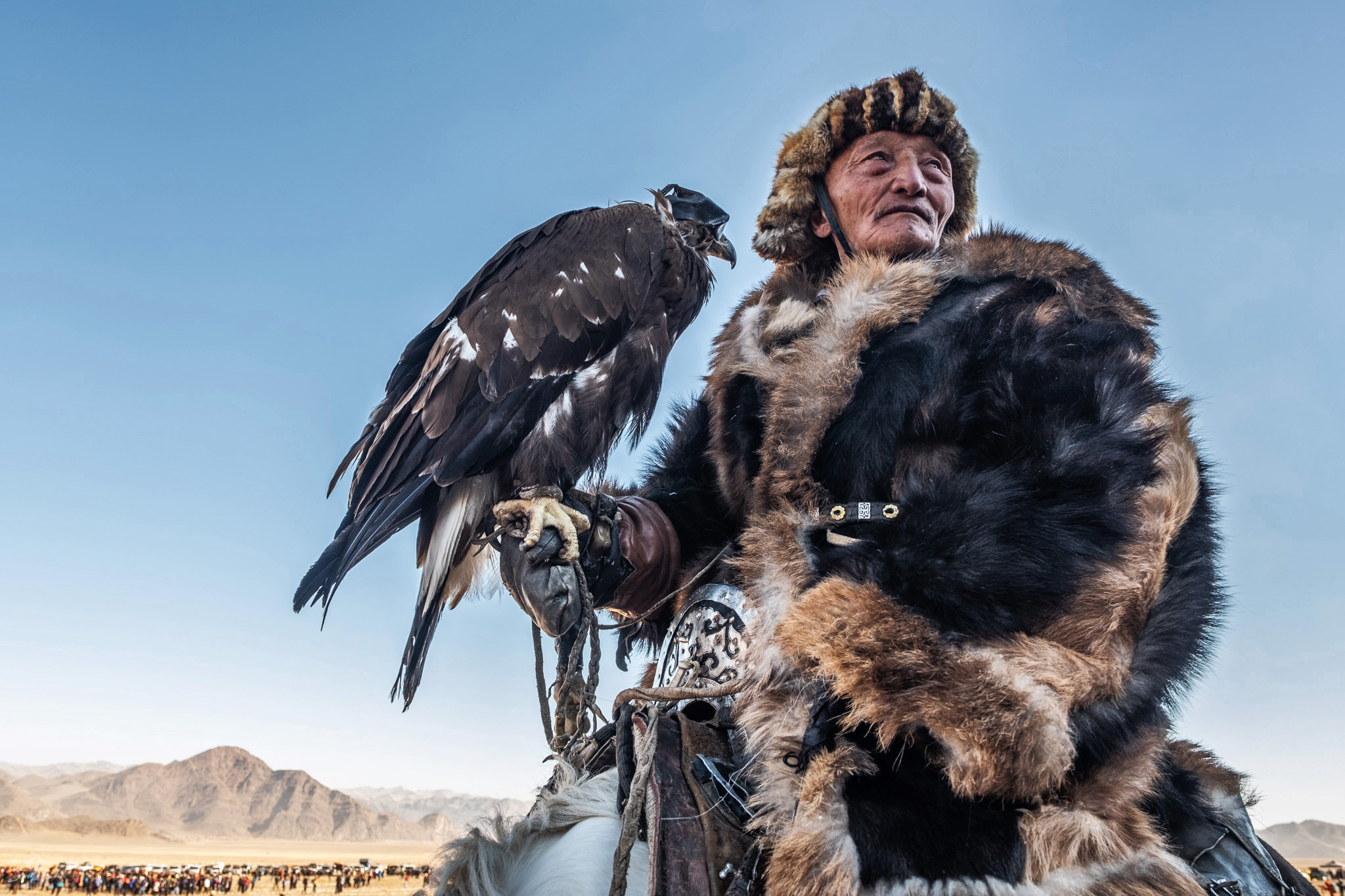
The Hunter and the Sky: Mongolia's Eagle Hunting and the Last Nomadic Partnership
There is a specific quality of silence in the Altai Mountains of western Mongolia in January that has almost no equivalent anywhere else on earth. At 2,000 meters elevation, in a landscape of granite peaks and snow-covered steppe where the temperature can reach -40°C and the nearest settlement is three hours by horse, the silence is not merely the absence of noise but the presence of something — a quality of absolute attention that the landscape seems to impose on everything within it. The sky is the color of hammered steel. The snow reflects it back without warmth.
Into this silence, a rider emerges on a stocky Mongolian horse — the breed that Genghis Khan's armies rode across half the known world, unchanged in eight centuries. On the rider's left arm, extended and braced against the forearm rest of the hunting perch, sits a golden eagle (*Aquila chrysaetos*) whose wingspan approaches 2.5 meters, whose talons can exert 400 pounds per square inch of pressure, and whose weight — approximately 6 to 7 kilograms — has been pressing against the same arm for three hours of riding without the rider's posture suggesting any strain. The eagle's eyes, which can resolve detail at four times the distance of human vision, are scanning the slope below for the flash of fox fur against snow.
The rider is a **burkitshi** — a Kazakh eagle hunter, practitioner of a tradition that is at least 4,000 years old and that the approximately 400 active practitioners remaining in western Mongolia's Bayan-Ölgii province represent in its most complete surviving form. The burkitshi and the eagle are a partnership so thoroughly developed that calling it a training relationship — the human trains the bird — misses the degree to which the bird also shapes the human, requiring patience, attentiveness, and a quality of inter-species sensitivity that the tradition's practitioners describe in terms more familiar from intimate human relationships than from animal handling.
The Kazakh Minority of Western Mongolia
Understanding eagle hunting in Mongolia requires understanding who the eagle hunters are, because they are not ethnically Mongolian. The burkitshi tradition belongs to the **Kazakhs** — a Turkic people whose homeland is present-day Kazakhstan but who have maintained communities in western Mongolia's Bayan-Ölgii province since the eighteenth and nineteenth centuries, when successive migrations brought Kazakh families across the Altai Mountains into what was then the Qing Empire's outer territory.
Approximately 90,000 Kazakhs live in Mongolia today, concentrated in Bayan-Ölgii, where they constitute approximately 88% of the provincial population. Their presence creates a cultural enclave within Mongolia that is distinct from the Mongolian majority culture in language (Kazakh, a Turkic language, rather than Mongolian), religion (predominantly Muslim rather than Buddhist), and specific cultural practices — eagle hunting primary among them. The burkitshi tradition did exist in Kazakhstan proper, and eagle hunting is practiced in Kazakhstan, Kyrgyzstan, and other Central Asian countries, but the Mongolian Kazakh community has maintained the most complete and traditional form of the practice, partly due to the geographic isolation of Bayan-Ölgii and partly due to the specific political history that preserved Mongolian Kazakh traditional culture more completely than the Soviet collectivization that disrupted Kazakh culture in Kazakhstan itself.
This cultural positioning means that eagle hunting in Mongolia is simultaneously a heritage practice of the Kazakh minority and a recognized element of Mongolian national cultural heritage — a duality that creates interesting tensions in how the practice is presented, funded, and protected. Mongolian cultural institutions have adopted the eagle hunter as an iconic image of national heritage (the burkitshi appears in Mongolian tourism materials and cultural representations with a frequency that somewhat belies the practice's specific Kazakh cultural ownership), while Kazakh cultural organizations in Bayan-Ölgii maintain the practice as specifically Kazakh heritage that happens to be located within Mongolian territory.
The Eagle: Choosing and Bonding
The golden eagle that a burkitshi hunts with is not purchased from a breeder or trapped as an adult. She — hunting eagles are almost always female, as female golden eagles are significantly larger and more powerful than males — is taken from the nest as a chick of approximately three to four weeks of age, before she has fully developed her flight feathers and, crucially, before her primary social bond has been established with her parents.
The selection of the nest eagle is the first exercise of the burkitshi's expertise. Nest location in steep Altai cliff faces requires intimate knowledge of the terrain and patient observation of adult eagle behavior over the preceding season. The young hunter who can identify an active nest, reach it safely, and select a chick of the right age and apparent health from a nest that may contain two or three chicks — taking only one, as the Kazakh tradition specifies, to allow the adults to raise their remaining offspring — is demonstrating both ecological knowledge and the specific boldness of cliff navigation that the tradition requires of its practitioners.
The chick is brought to the burkitshi's home and raised in close human contact from the earliest weeks of life. The process that follows is one of the most extended and demanding examples of inter-species bonding in any hunting tradition worldwide. For the first weeks, the chick is carried constantly — on the arm during the day, sleeping beside the family at night — until the bird recognizes the specific smell, sound, and weight of its human family as the primary context of safety and nourishment. The feeding — raw meat offered by hand, the handler speaking softly while feeding to establish the voice as a component of the safety association — is as much about relationship as nutrition.
The subsequent stages of training — hood training (acclimating the bird to the leather hood that controls sensory stimulation during transport), lure training (teaching the bird to fly to a swinging piece of fox or rabbit fur), and quarry introduction (first flights in the presence of live quarry) — build on this initial bond in a sequence that the experienced burkitshi calibrates to each specific bird's development pace. There is no standardized timeline. Some eagles are ready for their first hunt in one season; others require two. The burkitshi who rushes the process produces a bird that is neither effective as a hunting partner nor reliable in its behavior — and the behavioral reliability of a bird capable of exerting 400 pounds per square inch of pressure with its feet is not a trivial concern.
The Hunt: Horse, Eagle, and Snow
The actual eagle hunt — *burkitchilik av* in Kazakh — occurs in the winter months, typically November through February, when the foxes and rabbits that are the primary quarry are most visible against the snow and least able to evade pursuit in the open terrain where the eagle's advantages are greatest. The hunt requires the simultaneous management of a horse, an eagle, and the specific terrain and wind conditions of the Altai steppe — three complex dynamic systems whose interactions must be read and anticipated by the burkitshi in real time.
The hunting party — typically two or more burkitshi riding together, with additional riders who may drive quarry toward the eagle hunters — moves across the high steppe searching for quarry. When a fox or rabbit is spotted, the hunt sequence begins: the hunters position themselves to take advantage of wind and terrain, the hood is removed from the eagle, and the bird — whose attention has been arrested by the quarry's movement — is released. The release is the moment of the deepest inter-species negotiation in the entire practice: the burkitshi must read, from the eagle's body language (the set of the wings, the angle of the head, the grip of the talons on the perch), whether the bird is genuinely locked onto the quarry or distracted, and must time the release to the moment of maximum focus.
What follows is beyond the burkitshi's control. The eagle stoops toward the quarry at speeds exceeding 100 kilometers per hour, folding her wings into a partial stoop, adjusting her trajectory with micro-movements of her tail and wingtip feathers as the quarry changes direction. A fox, which can reach speeds of 45 kilometers per hour and changes direction rapidly, is a genuinely challenging quarry even for a trained eagle; the capture rate on fox hunts is not as high as the tradition's dramatic images suggest, and a hunt in which the fox escapes is a normal outcome that reflects the fox's competence as much as any failure of the eagle's. The successful capture — the eagle striking the fox with her feet and gripping until the quarry's spinal cord is severed by the talon pressure — happens quickly when it happens, and the burkitshi must then ride hard to reach the eagle before she has consumed more than the reward portion of the quarry that the tradition specifies.
The burkitshi's arrival at the capture site is itself a precise procedure. The approach is on horseback, at speed, reading the eagle's posture to assess whether she has secured the quarry or is still engaged. The hood is applied — quickly, calmly, without alarm — and the reward portion of meat is offered from the hand in the feeding gesture the bird has associated with safety and completion since chick stage. The interaction at the capture site is the most demanding test of the burkitshi-eagle relationship: the eagle is in the heightened state of a successful predatory act, and the quality of the bond determines whether the hunter is greeted as a trusted partner in the completion of the hunt or as an intrusion.
The Training of the Burkitshi: Knowledge Before the Eagle
What the global media attention to eagle hunting — particularly the intense photographic documentation of the Golden Eagle Festival in Ölgii, which has attracted wildlife photographers from around the world — consistently underrepresents is the depth of the knowledge system that the burkitshi must possess before they can work with an eagle effectively.
The burkitshi's ecological knowledge includes: the habitat preferences and behavioral patterns of fox, rabbit, and wolf (the Altai's three principal quarry species); the daily and seasonal movement patterns of golden eagles in the wild; the weather indicators that affect both flight conditions and quarry availability; the specific terrain features of the hunting territory — the passes, ridges, and wind channels — that determine how the eagle's flight performance will be affected at specific locations under specific wind conditions; and the vegetation and snow conditions that affect quarry visibility and escape options.
The burkitshi's raptor knowledge includes: the physiology of the golden eagle at each developmental stage; the behavioral indicators that distinguish a bird in hunting focus from a distracted or overstressed bird; the health assessment skills to evaluate feather condition, weight, foot health, and behavioral state; the training progression that moves a specific individual bird from chick to hunting partner at the pace appropriate to that bird's specific development; and the behavioral management skills that maintain the eagle's trust and motivation across a hunting season of many weeks.
The burkitshi's horsemanship — which must allow them to control the horse, carry the eagle, and manage their own position and balance simultaneously across rough mountain terrain at all gaits — is itself a body of skill that takes years to develop to the standard required for effective hunting.
The transmission of this knowledge is through apprenticeship within families: a son (and increasingly a daughter — the female burkitshi Aisholpan Nurgaiv, who became internationally known through the documentary *The Eagle Huntress* in 2016, represents a genuine but not unprecedented tradition of female practitioners) accompanies his or her father on hunts from early childhood, observing before participating, participating under guidance before practicing independently. The knowledge is not taught in sequences of explicit instruction; it is absorbed through the apprentice's developing attention to what the experienced hunter attends to — the bird's body language, the horse's response to terrain, the quality of light and wind on a specific afternoon that experienced hunters read as favorable or unfavorable without being able to fully articulate why.
The Eagle Festival: Spectacle and Substance
The **Golden Eagle Festival** (*Altai Nomadic Festival* in its current formalization) is held annually in Ölgii, the capital of Bayan-Ölgii province, in early October — before the hunting season proper begins. Founded in 1999 as a cultural preservation event organized by the Mongolian Eagle Hunters Association, it has grown into an internationally attended event that draws hundreds of foreign visitors, documentary filmmakers, and wildlife photographers whose presence has dramatically increased the economic profile of the burkitshi tradition and the visibility of Bayan-Ölgii as a tourism destination.
The festival competitions test the skills that the hunting tradition requires: speed of eagle recall to the hunter's arm from a fixed release point, quality of eagle landing on the arm in motion, accuracy of the hunter's positioning relative to a fox-fur lure dragged from horseback, and the overall presentation of the burkitshi-eagle partnership to the judges and audience. The competitions are evaluated by experienced burkitshi elders, and the winners receive prizes and community recognition that carry genuine prestige within the Kazakh community.
The festival's dual function — as a cultural preservation event for the Kazakh community and as a tourism spectacle for international visitors — creates tensions that the Mongolian Kazakh community navigates with varying degrees of comfort. The photographic demand is enormous: the image of a burkitshi on horseback releasing a golden eagle against an Altai mountain backdrop is one of the most visually spectacular images in adventure travel photography, and photographers fly from Europe, North America, and Asia specifically to capture it. The most experienced burkitshi, who can reliably produce the image under the right conditions, have developed relationships with specific photographers and tour operators that generate income significant enough to affect their economic calculus about whether to maintain the tradition.
This economic development is double-edged. The income from tourism and festival performance supports the continuity of a tradition that, without external economic interest, would face greater pressure from the economic logic of modernity — the calculation that the years required to develop burkitshi skills and the considerable ongoing costs of maintaining eagles might be better invested in other economic activities. But the transformation of the burkitshi into a cultural performer for international audiences changes the practice's social meaning in ways that some practitioners find uncomfortable: the hunt conducted for photographers is not the same event, socially or spiritually, as the winter hunt conducted for the community's food and fur production.
The Eagle's Retirement: The Closing of the Partnership
The relationship between a burkitshi and their eagle is not permanent. After approximately ten years of hunting — during which the eagle will typically have hunted through five to ten winters and taken hundreds of fox, rabbit, and occasionally wolf — the bird is ceremonially released back to the wild. The release is not abandonment: it occurs in the eagle's peak productive years (golden eagles can live to 30 or more in the wild), when the bird retains the strength and hunting capacity to survive and reproduce independently. The burkitshi's intention in releasing the bird at this stage is explicitly to return the eagle to the cycle of wild reproduction — to give back to the population of wild golden eagles the bird that was taken from a nest a decade earlier.
The ceremony of release is among the most emotionally significant events in the burkitshi's life. The hunter who has spent a decade in daily relationship with an eagle — who has read her moods, adapted to her specific behavioral patterns, learned her specific hunting style, and shared the physical intimacy of thousands of hours of contact on the arm — describes the release in terms that acknowledge genuine loss without sentimentality. The eagle that returns to the sky returns to what she is; the hunter who watches her go has fulfilled the tradition's obligation of reciprocity.
This reciprocity — the principle that what is taken from the wild must be returned to it — is the ethical core of the burkitshi tradition and distinguishes it clearly from the permanent captive-raptor practices of some other falconry traditions. The Kazakh eagle hunting tradition is not based on the domestication of an animal species; it is based on a temporary partnership with a wild animal who remains wild in her essential nature and who is returned to wildness when the partnership has served its purpose. The burkitshi does not own the eagle; they borrow her, provisionally and with the obligation of eventual return.
Nomadic Epistemology: Knowing the World by Moving Through It
Eagle hunting belongs to a broader epistemological tradition — a way of knowing the world — that is nomadic in its fundamental character and that the settled world consistently underestimates in its sophistication. The nomad's knowledge is not the encyclopedic knowledge of accumulated documents but the procedural knowledge of someone who has moved through a landscape at all seasons, in all weather, and at all stages of life, accumulating a relationship with the environment that cannot be replicated from a fixed position.
The burkitshi knows the Altai not as a map but as a body of experience: the specific way a particular pass channels wind in November, the ridge where foxes congregate after heavy snowfall, the water source that remains unfrozen slightly longer than the others, the cliff face where a