The House That Holds Everything: Inside Kiribati's Maneaba Culture
The House That Holds Everything: Inside Kiribati's Maneaba Culture
There is almost no high ground in Kiribati. The nation — a scatter of 33 coral atolls and reef islands stretched across 3.5 million square kilometers of the central Pacific Ocean — averages less than two meters above sea level across its entire territory. From the center of most islands, the ocean is visible in all directions simultaneously, a 360-degree horizon of water that makes the land feel less like solid ground than like a raft: enormous, stable enough, but unmistakably floating on something larger and less predictable than itself.
In this geography, where the usual vertical markers of civilization — hills, mountains, defensible high ground, visual anchoring points — are entirely absent, the people of Kiribati built their cultural center horizontally. The **maneaba** is a large, open-sided meeting house built on every inhabited island in the I-Kiribati world, its roof of woven pandanus thatch supported by wooden posts without walls, its floor covered in mats woven from pandanus leaves, its interior open to the sea breeze from every direction. It is the largest and most important structure in any I-Kiribati community, and it does the work that in other cultures is distributed across many specialized institutions: governance, justice, celebration, education, spiritual practice, hospitality, and the transmission of everything the community knows about who it is and where it came from.
The maneaba is not a building that contains culture. It is the structure through which culture is produced, maintained, and made legible to the people who share it. To understand Kiribati is to understand what happens inside that open roof. And to understand what is at stake as rising seas threaten these atolls is to understand what the world would lose if the maneaba's floor — two meters above the Pacific and falling — goes under.
An Architecture of Openness
The maneaba's design is the first thing that distinguishes it from the meeting houses of other cultures. There are no walls. The roof — traditionally woven from pandanus leaves in a complex overlapping pattern that sheds tropical rain with the efficiency of any modern material while breathing in the heat — extends outward beyond the supporting posts, creating a deep overhang that shades the interior from the direct equatorial sun while allowing air to move freely through the space. The floor is the reef, leveled and spread with mats. The interior is dim and cool in a climate where those qualities are precious.
This openness is architectural theology. The maneaba does not separate insiders from outsiders by physical enclosure. It defines its space by the roof above and the mats below, not by walls between. Anyone who enters and takes their appropriate seat — the seating arrangement is elaborately prescribed, as we will see — is inside the community for the duration of what is happening there. Anyone who approaches but remains outside the roofline is a visitor or an observer, present but not participating. The boundary is permeable and positional rather than physical and absolute.
Traditional maneaba construction was the collective labor of the entire community, and the construction process itself was a social and spiritual event. Specific clans (*utu*) held hereditary responsibilities for specific aspects of construction: some families were responsible for the main posts, others for the rafters, others for the weaving of the thatch panels. These responsibilities were not assigned by skill alone but by lineage — they had been held by the same families, passed from father to son and mother to daughter, across generations. The completion of a maneaba was the occasion for elaborate celebration and ceremony, because a new maneaba was not merely a building being opened; it was the community's re-assertion of its own existence and the formal activation of the social structure it would house.
The Seating Plan as Social Constitution
Inside the maneaba, where you sit is who you are. The interior is divided into named sections, each belonging to a specific clan or lineage group (*bwoti*), whose members occupy that section at every gathering. The seating arrangement is not chosen at each meeting; it is fixed, inherited, and as constitutionally significant as the floor plan of a parliament. A person entering the maneaba for the first time as an adult knows exactly where to sit because they have known since childhood which bwoti they belong to and where that bwoti's section is.
The bwoti system is the maneaba's primary social technology. Each bwoti carries specific rights, responsibilities, and roles within the maneaba's proceedings. Certain bwoti have the hereditary right to speak first on particular categories of issue. Others hold the right to formally conclude a discussion. Some bwoti are responsible for the preparation and distribution of food at gatherings; others for specific ceremonies; others for the mediation of disputes between other groups. The maneaba's governance function depends entirely on this distributed role structure — no single chief or authority holds the procedural power that the bwoti system distributes across the community's constituent groups.
The elder (*unimane*, literally "old man") who speaks for each bwoti is not elected but recognized — acknowledged by the community as the holder of the lineage's accumulated knowledge and authority through a process of observation and consensus that unfolds over a lifetime rather than in a single moment of formal selection. Age is necessary but not sufficient: an old man whose knowledge is thin, whose judgment has proven poor, or whose conduct has been inconsistent will not be accorded the respect that gives an unimane's words their weight. The authority is moral before it is procedural.
This diffusion of authority across multiple bwoti, each with its own role and its own respected elder, produces a governance system that is simultaneously conservative — decisions require broad consensus, radical change is structurally difficult — and resilient. There is no single point of failure. If one lineage's elder dies before a successor has consolidated authority, the maneaba's other bwoti continue their functions without disruption. The system was designed, implicitly, for conditions of precarity — the conditions of atoll life, where individual catastrophes are frequent and community survival depends on the structure's ability to absorb them.
Oral History as Civic Architecture
The maneaba is the library. There are no written archives in the traditional I-Kiribati knowledge system — or rather, there were none before colonial contact, and the transition to written record-keeping has been recent enough that the oral tradition remains the primary vehicle for the knowledge that actually governs community life. The histories, genealogies, navigation knowledge, fishing lore, land tenure records, and ceremonial protocols that the community needs to function are held in the memories of the elders who know them, transmitted through the formal and informal contexts that the maneaba provides.
This creates a form of collective knowledge architecture that literate cultures often struggle to comprehend. In a culture with written archives, knowledge is separated from the knower — stored in a form that survives the death of any individual and can be accessed by anyone who can read the appropriate code. In an oral culture, knowledge and knower are inseparable: the genealogy lives in the person who memorized it, the navigation route lives in the mind that learned to read the star paths and wave patterns, and when that person dies without successful transmission, the knowledge dies with them.
The maneaba addresses this vulnerability through structured redundancy. Important knowledge — the genealogies of major lineages, the ownership records of land tenure on islands where land is too scarce to leave ambiguous, the protocols for ceremonies that must be performed correctly to be valid — is held by multiple keepers simultaneously, so that the death of one does not terminate the line. The formal occasions of the maneaba — the meetings, the ceremonies, the storytelling sessions that are themselves a genre — provide regular occasions for knowledge to be performed publicly, in front of multiple witnesses who can confirm and remember what was said.
The genre of **te kaimatoa** — formal speeches delivered in the maneaba on significant occasions — is one of the primary vehicles for this knowledge transmission. Te kaimatoa is not casual speech. It is a formal art form with its own conventions: specific rhythms of delivery, formulaic openings and closings, allusions to historical events and genealogical connections that function as proof of the speaker's knowledge and right to speak on the matter at hand. A poorly delivered te kaimatoa — one that contains errors of genealogy, mispronounces important names, or uses inappropriate allusions — is not merely rhetorically weak. It is socially damaging, evidence that the speaker does not hold the knowledge that the maneaba's authority requires. The standard is maintained by an audience that knows what it is hearing.
Bino and the Dance Tradition
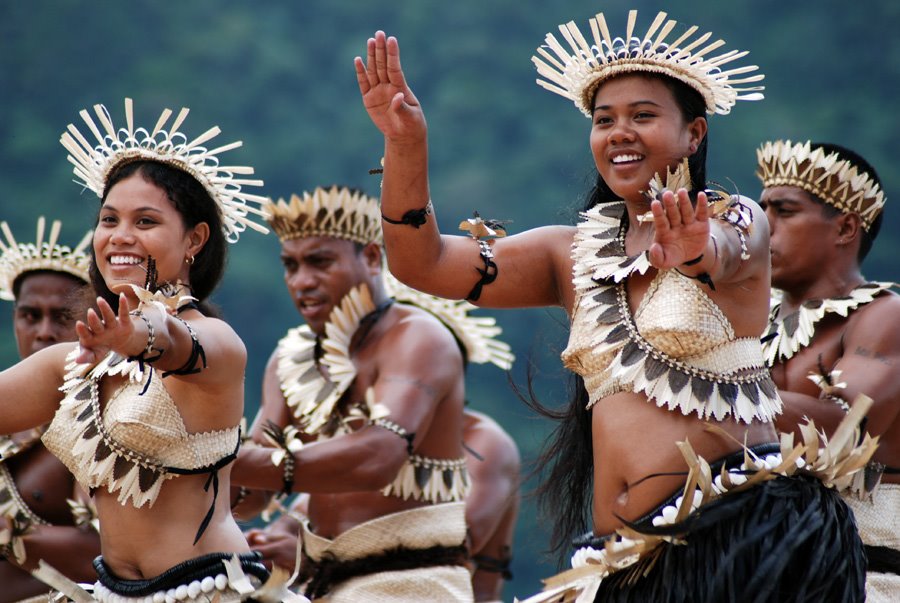
The maneaba is a performance space as much as a deliberative one, and the performance tradition it houses is among the Pacific's most sophisticated. **Bino** — traditional I-Kiribati dance — takes place in the maneaba, and the relationship between the dance and the space is not incidental. The open roof, the mat floor, the gathered community arranged in their bwoti positions around the performance space — these are the specific conditions for which bino was developed.
I-Kiribati dance is characterized by seated performance — dancers kneel or sit in formation — and by a precision of synchronized movement centered on the upper body, arms, and hands that can achieve effects of extraordinary collective complexity. The movement vocabulary of bino is codified and specific: each gesture has a meaning, each sequence tells a story or makes a statement, and the training required to perform bino at the level expected by a maneaba audience takes years. Children begin learning as young as five or six, absorbing the basic movement vocabulary through observation and imitation before being incorporated into junior performance groups.
The content of bino is not entertainment alone. Songs performed in the maneaba carry historical content — accounts of significant events, praises of specific lineages, records of navigational routes and fishing grounds that are encoded in poetic form for mnemonic purposes. A dance that celebrates a successful fishing expedition is also, in its lyrics and gesture sequence, recording the navigational knowledge that made the expedition possible. The aesthetic and the functional are not separated here; the beauty of the performance is the vehicle for its information content.
Contemporary bino has adapted to changing contexts — performed at public festivals, cultural events, and on the international stage where I-Kiribati communities in diaspora use it as a marker of identity — while maintaining its connection to the maneaba as its natural home. The most significant bino performances are still the ones that take place inside a maneaba, before an audience that can fully understand what is being said, by performers who have learned the tradition from elders who hold its full depth.
Land, Tenure, and the Maneaba as Courthouse
In a coral atoll nation where the total land area of Kiribati — across all its islands and atolls — is approximately 800 square kilometers, land is not merely valuable. It is existential. The relationship between a family and its land is the primary material basis of security and identity in I-Kiribati culture, and the system through which land tenure is determined, contested, recorded, and transmitted is administered through the maneaba.
Land disputes — among the most common and socially consequential conflicts in any I-Kiribati community — are adjudicated in the maneaba by the assembled unimane, drawing on the genealogical and historical knowledge that the elders hold. The process is not identical to Western legal proceedings, but it is equally formal and its outcomes are equally binding within the community's own governance framework. Evidence is presented in the form of genealogical testimony: who inherited the land from whom, tracing back through the lineage to the original allocation. Counter-claims are presented in the same form. The unimane who are not direct parties to the dispute draw on their own knowledge to evaluate the competing genealogical claims and reach a determination.
The authority of this determination rests on the same moral foundation as all maneaba authority: the accumulated recognition, over generations, that the elders who speak in the maneaba on these matters are the people whose knowledge and judgment deserve to govern. This is not a system that produces perfect outcomes — no human governance system does — but it is a system whose legitimacy within the community is profound and whose record of successfully managing the conflicts that inevitably arise in close-quartered atoll life over centuries suggests significant functional competence.
The arrival of colonial administration — first through the British Gilbert and Ellice Islands Colony and then through the arrangements accompanying Kiribati's independence in 1979 — introduced a parallel legal system that created tension with maneaba authority without fully displacing it. Contemporary Kiribati navigates a dual governance structure in which the national legal system and the maneaba authority coexist, sometimes complementarily and sometimes in friction, across all the islands of the republic.
Christianity and the Maneaba: Accommodation Without Erasure
Kiribati is overwhelmingly Christian — the country's population is distributed primarily among Catholic, Kiribati Protestant Church, and various smaller denomination communities, with Christianity having arrived through European missionaries beginning in the late nineteenth century. The encounter between missionary Christianity and maneaba culture produced a set of accommodations that are worth examining as a case study in cultural negotiation.
Early missionaries recognized that the maneaba was too central to I-Kiribati social life to confront directly. Attempts to eliminate it would have meant eliminating the primary institution of community governance, social organization, and cultural transmission — a project beyond any missionary organization's capacity to implement even if it had been desirable. Instead, Christianity was in significant ways incorporated *into* the maneaba framework: church meetings take place in the maneaba, biblical and theological knowledge has been transmitted through the same oral and performative channels that transmit traditional knowledge, and the figure of the Christian God has been integrated into the spiritual dimension of the maneaba in ways that do not require the abandonment of older forms of spiritual relationship.
The result is neither pure syncretism nor clean separation but something more like parallel tracks that the community navigates with contextual intelligence. The maneaba remains the space for I-Kiribati community governance and cultural practice; Christianity provides a religious framework that has been indigenized into the maneaba's social architecture rather than replacing it. Sunday services held in the maneaba are simultaneously Christian worship and I-Kiribati community gathering — the same space doing its usual work of holding the community together, with different content foregrounded at different moments.
The Climate Threat and the Question of What Survives
Kiribati's existential situation — rising sea levels driven by climate change threatening the habitability of atolls that average less than two meters above sea level — has made the country a synecdoche for climate vulnerability in global environmental discourse. The government of Kiribati purchased land in Fiji in 2014 as a contingency against the possibility of eventual uninhabitability, and subsequent administrations have continued to develop migration and adaptation strategies. The country's former president Anote Tong became one of the most effective advocates for climate action at international forums precisely because Kiribati's predicament was undeniable and legible: not a projection or a model but a present-tense emergency visible in king tides that now overtop the sea walls that were built, not long ago, high enough to prevent them.
What this situation means for maneaba culture is a question the I-Kiribati community is actively grappling with, and the answers are not simple. The maneaba is not a portable institution. It is embedded in specific land, specific communities, specific genealogical connections between families and the sections of the meeting house floor they have occupied for generations. The bwoti system depends on continuity of community — on the same families gathering in the same place, carrying the same knowledge, enacting the same roles, across generations. A community dispersed — to Fiji, to New Zealand, to Australia, to the growing I-Kiribati diaspora in other Pacific nations — is not the same community in the maneaba sense. The institution can be replicated structurally: a maneaba can be built anywhere wood and pandanus are available. What cannot be easily replicated is the accumulated social meaning that makes a specific maneaba the center of a specific community's world.
I-Kiribati communities in diaspora are already confronting this challenge. There are maneaba-like structures in New Zealand and Fiji where I-Kiribati communities gather to maintain cultural practice, and these gatherings are genuine — not performances for outside observers but actual community events with actual governance and cultural functions. But they are also attenuated: the genealogical connections to specific land are harder to maintain when the land is an ocean away and potentially disappearing beneath the sea. The oral knowledge that the maneaba transmits is also at risk of attenuation in diaspora conditions, where the linguistic and social contexts that make the knowledge meaningful are harder to sustain against the pressure of assimilation into host societies.
What the Maneaba Knows That Architecture Alone Cannot Hold
There is a concept in I-Kiribati cultural philosophy — te mauri, life and wellbeing in their fullest sense — that the maneaba is understood to protect and produce. Te mauri is not merely physical health or material security; it is the quality of being fully alive as an I-Kiribati person within an I-Kiribati community, in relationship with the land, the ocean, the ancestors, and the living members of the bwoti whose section of the maneaba floor is yours by birth. The maneaba is the primary institutional home of te mauri — the place where it is enacted, celebrated, defended, and transmitted.
This understanding helps explain why the maneaba is not easily replaceable by alternative institutional forms, even functional ones. The question of what Kiribati would need to preserve as sea levels rise is not only a logistical question about which buildings to replicate or which archives to digitize. It is a question about the conditions under which te mauri — a form of human flourishing specific to a specific culture in a specific place — can continue to exist. And the honest answer, one that I-Kiribati thinkers and cultural practitioners are working through with urgency and care, is that the conditions are both more portable than the land itself and more fragile than any structural replication of the maneaba can guarantee.
The open roof lets in the wind that has always blown across these atolls — the same wind that filled the sails of the canoes that first found these islands, navigated by people who read the stars and waves with a knowledge so precise they could find a coral atoll in three million square kilometers of open ocean. The mats on the floor are woven from the same pandanus that grows on land that may be underwater within a generation. The elders who sit in their bwoti sections hold knowledge that took centuries to accumulate and cannot be Googled or archived in any form that preserves its living quality.
All of this is two meters above the Pacific. The ocean, for the moment, is keeping its distance. But the people inside the maneaba know — because they are people who have always understood that they live at the mercy of something larger than themselves, and have organized a civilization around that understanding — that the distance is closing.
What they are doing about it, with the tools the maneaba has always provided — collective deliberation, distributed knowledge, the authority of accumulated wisdom, the social bonds that the mat floor and the open roof create between people who have sat together in the same positions since before anyone living can remember — is the last and most important story the maneaba has to tell.