The Gods Who Refused to Die: How Greek Mythology Still Shapes the Modern World
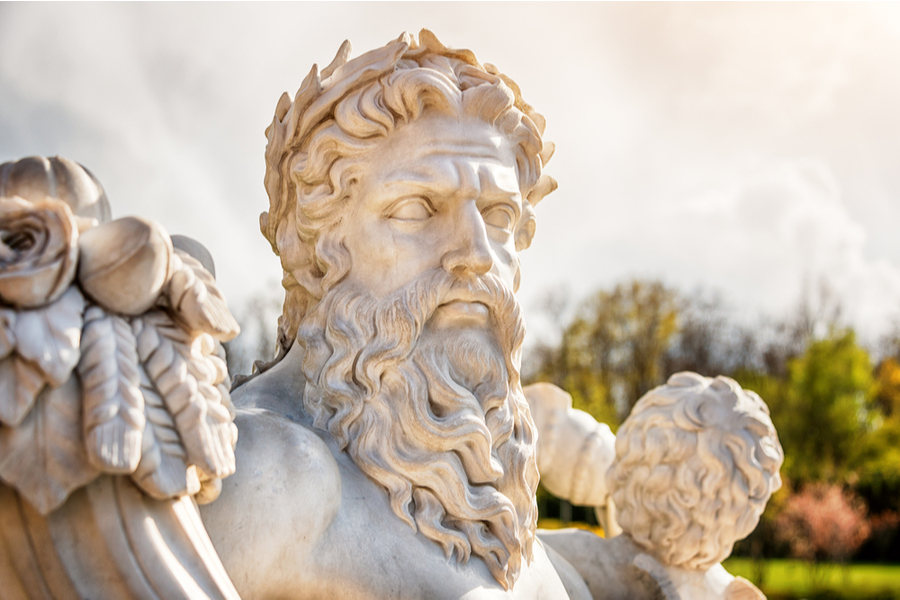
The Gods Who Refused to Die: How Greek Mythology Still Shapes the Modern World
On any given Tuesday, an ordinary English speaker will invoke the name of a Norse god (*Tuesday* derives from Tiw, the Germanic war deity), pass through the days named for Roman planetary deities (*Wednesday* through *Saturday*), and use the word *panic* — which comes from the Greek god Pan, the half-goat deity of wild places whose sudden appearance was believed to cause irrational terror in travelers crossing remote mountains. They will likely describe someone as *narcissistic*, referring to Narcissus, the beautiful youth who fell in love with his own reflection. They may mention the *Achilles heel* of a competitor's strategy. They may describe a difficult task as *Herculean*, a complex tangle of problems as *labyrinthine*, or an overwhelming abundance of options as *a Pandora's box*.
This is not the faded presence of a dead mythology. It is the active vocabulary of a living culture that has so thoroughly absorbed Greek mythological concepts that it can no longer think, in English or most European languages, without the Greek gods providing the conceptual architecture. The ancient Greeks stopped performing state sacrifices to Zeus sometime in the fourth or fifth century CE, when the Roman Empire's Christianization rendered the Olympian cult officially obsolete. The myths themselves did not stop. They went underground, into the educational curriculum, into the literary tradition, into the psychological vocabulary, into the names of celestial bodies and chemical elements and medical syndromes, and from there into every subsequent layer of Western civilization that inherited those educational and literary traditions.
The question worth asking is not whether Greek mythology has influenced the modern world — the evidence for that is so pervasive as to be almost invisible, like water to fish — but why. Why did these particular stories, told by a particular culture on a particular peninsula of the eastern Mediterranean roughly 2,500 to 3,000 years ago, achieve a cultural dominance that no subsequent mythology has matched? The answer is less obvious than it appears.
The Gods as Psychology: Before Freud, There Was Olympus
The most striking feature of the Greek divine pantheon, compared to the religious systems it encountered and displaced, is the insistent humanity of its gods. The Olympians are not morally superior beings who model proper behavior for humans. They are beings of enormous power with recognizably human flaws: Zeus is adulterous and capable of petulant vindictiveness. Hera is jealous and takes revenge on the innocent victims of her husband's infidelities. Achilles is courageous and compassionate but undone by wounded pride. Odysseus is brilliant and resourceful but capable of deliberate deception. Oedipus is wise and diligent and is destroyed by a fate he tried heroically to avoid.
This moral complexity was not a failure of theological sophistication. It was its most consequential innovation. A mythology in which the gods are perfect provides humans with role models but not with recognition — the gap between divine perfection and human fallibility is too vast to be psychologically useful. A mythology in which the most powerful beings in the universe struggle with jealousy, lust, wounded pride, and the gap between intention and consequence provides something different: a mirror. The Greek myths show people what they are, not what they should be, and the recognition this produces is the reason the stories have never stopped being told.
Sigmund Freud, constructing the vocabulary of psychoanalysis in the early twentieth century, reached for Greek myth at every decisive point. The **Oedipus complex** — the child's unconscious desire for the opposite-sex parent and rivalry with the same-sex parent — borrows its name and its emotional logic from the Sophocles tragedy that had been performed and read continuously since the fifth century BCE. The **Narcissistic personality** structure takes its name from Narcissus. The concept of **Eros** — libidinal life drive — is borrowed directly from the god of love. **Thanatos** — the death drive — from the god of peaceful death. **Psyche** — the word Freud used for the mind's totality — is a Greek word meaning "soul" that entered the psychological vocabulary through the myth of Eros and Psyche, the mortal girl who achieves immortality through love and divine trial.
Freud's borrowings from Greek mythology were not decorative. He was recognizing that the Greeks had already mapped the psychological territory that his clinical work was leading him through — that the myth of Narcissus had described narcissistic pathology with greater economy and emotional precision than any clinical case study, that the Oedipal dynamic had been worked through in five centuries of Greek drama before it acquired its clinical name. Carl Jung, developing his framework of archetypes and the collective unconscious, went further: his entire theoretical structure is built on the premise that Greek mythological figures — the Hero, the Shadow, the Anima, the Trickster — represent universal psychological patterns that appear across cultures because they correspond to structural features of the human psyche that Greek culture happened to name and dramatize with unusual clarity.
The Language of Science, Written in Greek
The decision by early modern scientists to name their discoveries using Greek (and Latin) vocabulary — rather than vernacular languages — was both practical and ideologically significant, and its consequences are visible in every scientific discipline today.
**Astronomy** is almost entirely Greek-named. The planets of the solar system carry the names of Olympian deities: Mercury, Venus, Mars, Jupiter, Saturn (Roman names for the Greek Hermes, Aphrodite, Ares, Zeus, Cronos), and the more recently discovered Uranus and Neptune. The moons of Jupiter are named for Zeus's lovers and offspring: Io, Europa, Ganymede, Callisto. Saturn's moons include Titan, Rhea, Tethys, Dione, Mimas — all figures from Greek Titan mythology. The asteroid belt contains thousands of objects named for minor Greek mythological figures. When the Voyager probes were sending back images of planetary moons in the 1970s and 1980s, the naming committees worked through the entirety of Greek mythology searching for unused names.
**Medicine** is structured almost entirely in Greek etymological vocabulary. *Cardiology* — the study of the heart (*kardia*). *Neurology* — the study of nerves (*neuron*). *Dermatology* — the study of skin (*derma*). *Ophthalmology* — the study of eyes (*ophthalmos*). *Psychiatry* — the healing of the soul (*psyche* + *iatros*, healer). The naming of medical conditions follows the same pattern: *narcissism* from Narcissus, *hypnosis* from Hypnos (god of sleep), *morphine* from Morpheus (god of dreams), *erotic* from Eros, *panic* from Pan, *lethargy* from Lethe (the river of forgetfulness in the underworld), *music* from the Muses, *odyssey* from Odysseus.
**Philosophy** — the word itself Greek (*philosophia*, love of wisdom) — carries the Greek intellectual tradition most directly, since Greek philosophers are not simply historical figures in the study of philosophy; they are its founding practitioners whose questions define the discipline's agenda: Plato's Theory of Forms, Aristotle's categories of causation, Socrates' dialectical method, the Stoics' ethics of rational acceptance, the Epicureans' philosophy of managed pleasure. The subsequent history of Western philosophy is, in significant measure, the history of responses to these founding positions — which is why Alfred North Whitehead's famous characterization of the European philosophical tradition as "a series of footnotes to Plato" is not entirely hyperbole.
**Mathematics** and **logic** bear the structural imprint of Greek thought most completely: Euclidean geometry (from Euclid of Alexandria, c. 300 BCE) organized the foundations of mathematical reasoning for two millennia. Pythagorean relationships in number theory were developed by the school of Pythagoras. Aristotelian syllogistic logic was the primary framework of formal reasoning until the development of modern mathematical logic in the nineteenth and twentieth centuries. The word *geometry* itself means "earth measurement" in Greek — a practical origin for what became the most abstract of mathematical disciplines.
The Olympian Stage: Greek Drama as the Invention of Western Theatre
The Western theatrical tradition begins in Athens in the fifth century BCE, at the festival of Dionysus, where playwrights competed annually to present trilogies of tragedies and a satyr play before audiences of thousands of citizens gathered in the outdoor theatre of Dionysus on the slopes of the Acropolis. The festival was a religious event — performances were offerings to Dionysus, god of wine, transformation, and theatrical ecstasy — and simultaneously a civic event: attendance was subsidized by the state for citizens who could not afford tickets, because the democratic city understood that its cultural health depended on its citizens sharing common dramatic experiences.
The five dramatists whose work survives — Aeschylus, Sophocles, Euripides, Aristophanes, and Menander — invented, between them, the structural and thematic conventions that the Western theatrical tradition has been working within and against ever since. Aeschylus introduced the second actor (drama had previously been a single actor in dialogue with a chorus), making genuine dramatic conflict possible. Sophocles added the third actor and reduced the chorus's role, shifting toward the character-driven drama that has dominated Western theatre since. Euripides introduced psychological realism and moral ambiguity in characterization — his Medea, who kills her children to punish her faithless husband, and his Hecuba, who is transformed by suffering into something that requires us to question what humanity means under extreme circumstances, are psychological portraits that feel contemporary in a way that most ancient literature does not.
The structural conventions of classical tragedy — the dramatic arc from equilibrium through conflict to catastrophe, the hamartia (fatal flaw) that drives the hero's downfall, the catharsis (emotional purgation) that Aristotle identified as tragedy's psychological function — are not ancient curiosities. They are the DNA of contemporary narrative in every medium: film, television, novel, and game. When a screenwriting manual instructs students in the three-act structure, it is transmitting conventions first articulated by Aristotle in the *Poetics*. When a blockbuster film builds toward a climactic confrontation between hero and antagonist in which the hero's greatest strength is also their greatest vulnerability, it is following a structural logic that Sophocles perfected in *Oedipus Rex*.
The Hero's Journey: A Greek Template for All Stories
In 1949, the mythologist Joseph Campbell published *The Hero with a Thousand Faces*, arguing that the myths of cultures worldwide — from Greek to Norse to Hindu to Native American — share a single underlying narrative structure that he called the **monomyth** or the Hero's Journey: a pattern in which a hero leaves the ordinary world in response to a call, undergoes trials in a realm of supernatural challenge, achieves a decisive victory, and returns transformed with a boon for their community.
Campbell's primary examples were drawn disproportionately from Greek mythology, and for good reason: the Greek heroic tradition — Heracles' twelve labors, Odysseus' ten-year return, Perseus' quest for Medusa's head, Jason's voyage for the Golden Fleece — provides the clearest and most fully developed examples of the monomythic pattern. The Greek hero narratives were not casual entertainment; they were sophisticated psychological maps of the initiation process — the transformation from one life stage to another through a structured ordeal — encoded in narrative form that could be transmitted and re-experienced across generations.
George Lucas explicitly credited Campbell's framework — and Greek mythology through Campbell — as the primary structural influence on the original Star Wars trilogy. The film's success in turn generated a generation of Hollywood storytellers who studied Campbell's framework and applied it to franchise storytelling. The contemporary blockbuster film's reliance on the Hero's Journey structure is therefore a direct descendant of Homeric epic, transmitted through twentieth-century mythological scholarship to twenty-first-century global cinema.
This transmission path illustrates something important about the mechanism by which Greek mythology has achieved its cultural dominance: it has not survived as a static body of stories that educated people reference. It has survived as a generative framework — a set of structural patterns and psychological archetypes that writers, filmmakers, and storytellers have found productive for creating new narratives. The Greek myths are not merely stories; they are a story-making technology, and the reason they keep getting retold is that they continue to generate fresh meanings when applied to new contexts.
The Philosophers and the Invention of Rational Inquiry
Greek mythology's relationship to Greek philosophy is more complex than it appears. The pre-Socratic philosophers of the sixth and fifth centuries BCE explicitly defined their project in opposition to mythological explanation: Thales of Miletus, traditionally considered the first Greek philosopher, proposed that all matter was composed of water — not because of any mythological precedent but as a rational hypothesis about natural substance. Anaximenes proposed air. Empedocles proposed four elements. Democritus proposed atoms. These were not religious proposals; they were what we would recognize as proto-scientific hypotheses, generated by the conviction that the natural world could be explained by natural principles rather than divine will.
This conviction — that rational inquiry could explain the world — is the most consequential legacy of ancient Greek thought, and it runs in a continuous, documentable line from Thales through the Hellenistic scientific tradition (Archimedes, Euclid, Eratosthenes, Hipparchus) through the Islamic scholars who preserved and extended Greek scientific texts through the European Renaissance and Scientific Revolution. The Scientific Revolution of the sixteenth and seventeenth centuries is, in this perspective, less a rupture with the past than a return to the Greek tradition of rational natural inquiry after a millennium in which theological frameworks had been more culturally dominant.
Yet Greek mythology was never simply the enemy that Greek philosophy overcame. Plato — the most influential of all Greek philosophers — wrote in the form of dialogues that often conclude with a *myth* (*mythos*) when rational argument has reached its limits: the Myth of Er at the end of the *Republic*, describing the afterlife; the Allegory of the Cave in Book VII, describing the nature of philosophical enlightenment; the Timaeus creation myth, describing the cosmos's divine construction. Plato used myth not as a retreat from reason but as a complement to it — a recognition that certain truths about the nature of reality, the soul, and the good are better approached through narrative than through argument, because they concern dimensions of experience that logical demonstration cannot fully reach.
This relationship between logos (rational argument) and mythos (narrative and myth) as complementary rather than opposed modes of understanding is one of Greek thought's most generative contributions to Western intellectual tradition, and it remains live in contemporary debates about the relationships between science, philosophy, religion, and literature.
Architectural DNA: The Greek Temple in the Modern City
Walk through the civic centers of Washington D.C., London, Paris, or Athens itself, and the built environment sends a consistent visual message: the columns, the pediments, the entablatures, the proportional systems that organize facade composition — these are Greek temple forms, adopted by Roman architects, revived by Renaissance architects studying Roman ruins, transmitted through Palladio and Vitruvius to the neoclassical movement of the eighteenth and nineteenth centuries, and deployed across the former colonial world as the architectural vocabulary of civic legitimacy and cultural aspiration.
The **Parthenon** — the temple to Athena on the Athenian Acropolis, completed in 432 BCE — is the most widely reproduced building in history. Exact replicas exist in Nashville, Tennessee (the Parthenon replica at Centennial Park, complete with a full-scale statue of Athena inside) and in Edinburgh, Scotland (the unfinished National Monument on Calton Hill, begun in 1822 and abandoned for lack of funds, known locally as "Scotland's Disgrace"). The Lincoln Memorial in Washington applies the Doric temple form to a civic shrine. The British Museum's main entrance facade is a Greek Revival portico. The New York Stock Exchange's facade is a Greek temple front with allegorical sculptures in the pediment.
The choice of Greek architectural forms for these institutions was not arbitrary eclecticism. It was a deliberate claim of cultural lineage: the democratic government, the public library, the museum, the court of law — these institutions were presented in Greek architectural dress because their founders understood them as continuations of the Greek project of rational civic organization. The **Doric column** that holds up a courthouse is arguing, in visual language, that justice here descends from the same tradition as justice in fifth-century Athens. The argument is historically contestable and ideologically charged — the buildings that deployed Greek architectural forms were not always built by or for all the people Greek democracy claimed to include — but the argument was being made, consciously, in stone.
The Living Mythology: Olympus in the Digital Age
Greek mythology's penetration of contemporary popular culture has, if anything, accelerated in the early twenty-first century, as the narrative hunger of global streaming platforms and gaming industries has found in the Greek tradition an inexhaustible story warehouse.
Rick Riordan's *Percy Jackson and the Olympians* series (2005–present) has introduced Greek mythology to tens of millions of youn