The Geometry of a Kingdom: Kuba Raffia Art and the Visual Intelligence of Central Africa
The Geometry of a Kingdom: Kuba Raffia Art and the Visual Intelligence of Central Africa
In 1907, Pablo Picasso visited the Trocadéro ethnographic museum in Paris and encountered African objects that produced in him what he would later describe as a revelation — a confrontation with formal possibilities he had not imagined, a visual intelligence that dissolved the assumptions he had carried into the building. The experience is most often discussed in relation to masks from the Fang and Kongo peoples. Less often mentioned, but documented in the accounts of contemporaneous artists and collectors moving through the same Parisian circles, is the Kuba cloth that was circulating in European collections by that period — woven raffia textiles from the Kuba Kingdom of central Africa whose geometric complexity was dense enough to stop trained eyes and hold them.
Whether Picasso saw Kuba cloth specifically is a matter of historical record that remains partially unresolved. What is not contested is that the formal vocabulary of Kuba textile design — its simultaneous use of multiple geometric systems within a single surface, its deliberate avoidance of bilateral symmetry in favor of more complex rotational and translational relationships, its apparent delight in visual problems that the eye must work to resolve — anticipates qualities that would define Cubism and the broader revolution in Western visual art in the early twentieth century. The Kuba were solving these formal problems in woven palm fiber before Cézanne had produced his first geometric analysis of a mountain.
This is not a claim that Kuba art caused Cubism. It is a claim about what Kuba art is: a tradition of visual problem-solving with geometric surfaces that represents one of the most sophisticated textile design systems ever developed anywhere, and that emerged entirely within the specific cultural, philosophical, and political context of a central African kingdom whose internal logic Western art history has spent a century failing to adequately describe.
The Kingdom That Design Built
The **Kuba Kingdom** — *Kuba* means "lightning" in the language of some neighboring peoples, though the Kuba call themselves *Bakuba* — was founded in the Kasai region of what is now the Democratic Republic of Congo, in the area between the Kasai and Sankuru rivers, sometime in the seventeenth century. Its founding is attributed in oral tradition to the culture hero **Shyaam aMbul aNgoong**, a figure who arrived from outside the existing chieftaincy structures, introduced a set of innovations that transformed the region's cultural and political organization, and established a royal lineage that would govern continuously for over four centuries.
What makes Shyaam's founding legend remarkable in the context of Kuba material culture is its specific content. Oral tradition credits him not primarily with military conquest or divine sanction but with the introduction of **new art forms** — new raffia weaving techniques, new embroidery patterns, new games (the board game *lele* is attributed to him), new forms of political ceremonial. The king as cultural innovator, the kingdom as a project of aesthetic development: this is an unusual founding narrative, and it accurately predicts the character of the civilization that developed from it. The Kuba Kingdom organized itself around the production of visual excellence in a way that had no precise parallel in the broader region.
The kingdom's **nyim** — the sacred king, whose person embodied the kingdom's spiritual and political integrity — was surrounded by a court culture of such elaborately developed aesthetic standards that foreign visitors from the eighteenth century onward consistently described Kuba royal compounds in terms of astonishment. The German ethnographer Leo Frobenius, arriving in the Kasai region in 1906, wrote of encountering a civilization of refinement and visual sophistication that contradicted every assumption he had arrived with. He described Kuba cloth, Kuba carved cups, Kuba masks, and Kuba architectural decoration as evidence of a civilization in full possession of its aesthetic intelligence — not a primitive precursor to something else but a developed tradition on its own terms.
Raffia and Its Possibilities
The material from which Kuba textiles are made is **raffia** — specifically, the leaf fibers of the raffia palm (*Raphia* species), which grows in the swampy forest margins of the Kasai basin with enough abundance to have served as the Kuba economy's primary luxury material. Raffia fiber is extracted from the young, unfurled fronds of the palm by a process of careful separation: the green outer skin is removed, the fiber beneath is dried, and the result is a creamy-white strand with a slight sheen and a texture that takes dyes and handles the mechanical stresses of weaving with sufficient flexibility to produce cloth of considerable delicacy.
The weaving itself is done on a simple hand loom that produces a base fabric of plain-weave raffia — a square-grid structure of warp and weft fibers whose regularity provides the foundation on which Kuba's complex geometric elaboration is built. Men do the weaving in Kuba tradition; the subsequent embroidery and surface elaboration — which transforms the woven base into the textile forms for which the tradition is known — is done by women, creating a gendered division of labor that distributes the tradition's technical knowledge across both halves of the society.
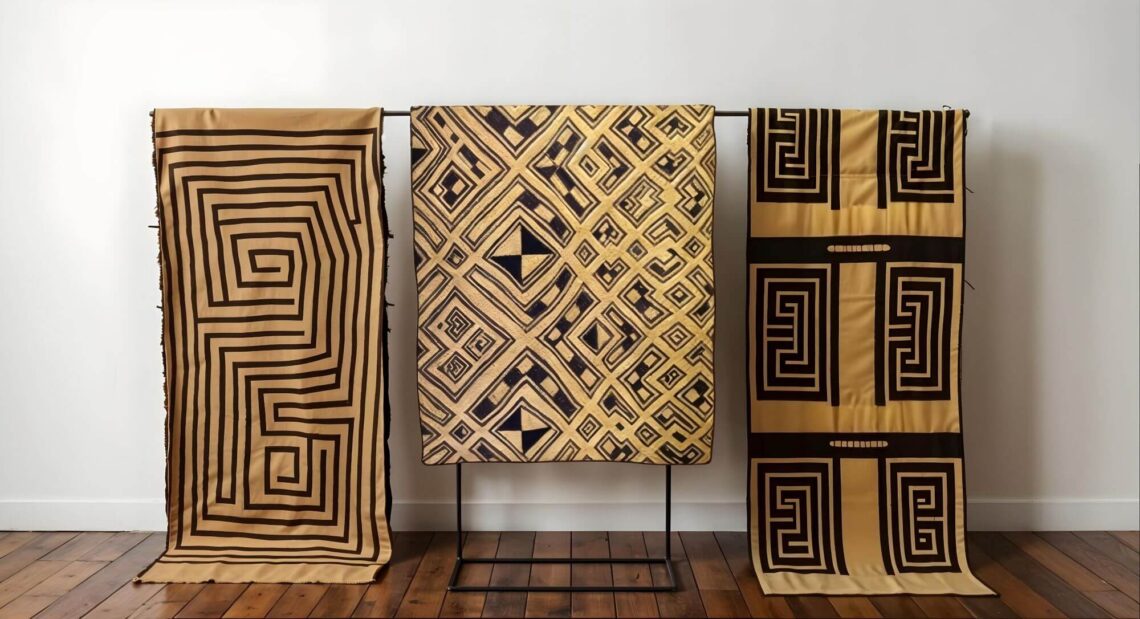
The surface elaboration takes several forms, each with its own technical demands and aesthetic character. The most internationally known Kuba textile type is the **cut-pile** technique — called *shoowa* — in which additional raffia strands are woven through the base cloth and then cut to produce a raised, velvet-like surface. The cut pile can be worked in patterns that exploit the contrast between the pile's soft texture and the flat base cloth visible between pile areas, or between differently colored areas of pile, to produce designs of extraordinary visual complexity. A shoowa cloth at full elaboration can contain hundreds of thousands of individual cut-pile insertions, each representing a specific patterning decision within an overall geometric scheme.
A second major surface technique is **embroidery** — the application of additional pattern elements to the woven base using drawn thread work or applied stitching that produces a flat, linear geometric design distinct from the three-dimensional quality of cut pile. Embroidered Kuba textiles have their own vocabulary of patterns and their own aesthetic logic, and the tradition contains numerous examples in which embroidery and cut-pile techniques are combined within a single cloth, the contrast between the two surface qualities becoming itself a design element.
The Pattern System: A Geometry Unparalleled
The design vocabulary of Kuba raffia textiles is the tradition's most intellectually remarkable feature and the aspect that stopped Parisian avant-garde artists in their tracks. It is not merely complex — many textile traditions produce surfaces of high visual complexity. What distinguishes Kuba pattern is the systematic way it generates and exploits formal relationships that Western aesthetic theory would not fully articulate until the twentieth century's development of symmetry analysis and information theory.
Kuba patterns are built from **geometric modules** — units that combine straight and diagonal lines, triangles, interlocking squares, and a distinctive curved element called the **mukenga** that appears across the tradition in multiple scales and orientations. These modules are combined according to rules that produce pattern fields with specific symmetry properties: some fields use pure translation (the module repeats without rotation or reflection); others use rotational symmetry (the module appears in 90- or 180-degree rotations); others use glide reflection (the module appears in a reflected and translated form). What is striking is the consistent Kuba preference for **asymmetric overall compositions** despite using highly structured modules: the pattern fields are not arranged to produce a balanced, centripetal design of the kind that European decorative tradition typically favored. Instead, the patterns run across the surface in a way that denies the eye a stable resting point, producing a restless, dynamic visual field that is still entirely orderly at the level of the individual module.
This quality — order at the local level, dynamic complexity at the global level — is what made Kuba cloth visually shocking to European eyes trained on decorative traditions that prioritized bilateral symmetry and clear focal points. The mathematical structure of Kuba pattern has been analyzed by crystallographers, who note that Kuba designers systematically explored all seventeen of the plane symmetry groups — the complete mathematical classification of ways that a pattern can repeat across a two-dimensional surface — several centuries before that classification was formally established by Western mathematics in the nineteenth century.
This is not coincidence, and it is not the result of abstract mathematical thinking applied to design. It is the result of a design tradition organized around the explicit value of **pattern innovation** — a cultural system in which inventing a new pattern was recognized as a significant achievement, in which the nyim himself was credited with specific pattern inventions that entered the tradition under his name, and in which the exhaustion of formal possibilities within any given pattern type was understood as the signal that new territory needed to be explored. The Kuba were not decorating cloth. They were conducting a centuries-long investigation of two-dimensional geometric possibility.
Royal Regalia and the Dressed Body as Political Statement
Kuba textiles are not only aesthetic objects. They are political ones, and the specific ways in which they were worn and displayed in the royal court encoded the kingdom's political structure with the same precision that the patterns encoded its geometric intelligence.
The **nyim's** ceremonial dress was the most elaborate material statement in the kingdom, requiring dozens of separate textile elements assembled into an ensemble that transformed the king's body into a living archive of the kingdom's visual tradition. The royal costume included skirts of cut-pile raffia in the most complex patterns available, layered in sequences that built visually from the waist downward; headdresses incorporating raffia, cowrie shells, and other prestige materials; and the specific combination of patterns that identified the wearer as the particular nyim and not merely as royalty in general. The dress was not chosen from a wardrobe in any casual sense. It was assembled according to protocols that had been developed and refined over generations of royal investiture, and its specific elements communicated information about the reign, the occasion, and the king's spiritual status to an audience that could read it.
The distribution of textile rights within the court extended this political function. Certain patterns were **reserved** for royal use — a system of design exclusivity that made unauthorized production of specific patterns a form of lèse-majesté. Other patterns were available to aristocratic families, others to free commoners, others in modified forms to people of lower social standing. The textile tradition was therefore also a social taxonomy: your dress declared your position within the kingdom's hierarchy with the same precision that the patterns declared their geometric relationships.
This system of textile rights created an economy of design that incentivized innovation in a specific direction. If a pattern became widespread, it became socially devalued — available to too many people to retain its exclusive prestige. The ongoing invention of new patterns was therefore driven not only by aesthetic aspiration but by the social logic of distinction: the court needed new patterns to maintain the visual distance between the royal elite and the broader population, and this need produced the centuries of formal innovation that resulted in the tradition's extraordinary range.
The Kuba Palm-Wine Cup and the Integrated Aesthetic
Raffia cloth is the most internationally recognized form of Kuba art, but it exists within a broader material culture of exceptional visual coherence. **Carved wooden cups** — typically used for palm wine consumption in ceremonial contexts — deploy the same geometric vocabulary as the textiles, translated into three-dimensional surface carving that demonstrates the tradition's pattern system operating across different materials and scales.
The Kuba cup is a form that Western collectors and museum curators have prized since the nineteenth century, and it appears in significant numbers in European and American museum collections — the British Museum, the Metropolitan Museum of Art, the Royal Museum for Central Africa in Tervuren each hold significant Kuba cup collections. What the cups reveal, when examined in relation to the textiles, is the degree to which Kuba geometric design is understood as a coherent system applicable to any surface rather than a technique specific to cloth. The same interlocking triangles, the same mukenga curves, the same asymmetric overall compositions that organize a shoowa cloth organize the carved surface of a palm-wine cup at a scale measured in centimeters rather than meters. The pattern thinks the same thoughts regardless of what it is covering.
This material coherence — the sense that Kuba visual culture is the expression of a single underlying geometric intelligence rather than a collection of separate craft traditions — is one of the most intellectually striking features of the tradition and one of the clearest signs that what is being transmitted is not just technique but a way of seeing. Kuba artisans are not applying patterns to surfaces. They are thinking in patterns, and the surfaces — cloth, wood, ivory, gourd — are the media through which that thinking becomes visible.
Picasso, the Primitivism Debate, and What Was Actually Stolen
The relationship between Kuba textile design and the development of Western modernism is a charged territory that the art historical establishment has approached with varying degrees of honesty. The 1984 exhibition at the Museum of Modern Art in New York, *"Primitivism" in 20th Century Art: Affinity of the Tribal and the Modern*, brought the formal relationships between African objects and Western modernist works into direct comparative display for the first time at institutional scale. It also generated the most sustained critique of the exhibition's conceptual framework: that "affinity" was a misleading term for what was in many cases direct formal borrowing, and that presenting the borrowing as spontaneous parallel development rather than influence erased the specific origins of ideas that Western modernism had absorbed and profited from without attribution.
The Kuba case is more complex than simple appropriation. The formal relationships between Kuba geometric design and the developments in Western abstract art in the early twentieth century are genuine, but the pathways of influence are difficult to trace with certainty. What can be said with confidence is that Kuba cloth was available in European collections before Cubism, that artists working toward geometric abstraction were in contact with those collections, and that the formal problems Kuba designers had been solving for centuries — how to organize a flat surface using geometric modules in non-symmetrical, visually dynamic relationships — were exactly the problems that Cubism and subsequent abstraction were attempting to solve by different means.
What is lost in the primitivism framework — in the formulation that African art provided "influence" on Western art — is the recognition that the Kuba tradition had already solved these problems, fully and at high sophistication, within its own internal logic and for its own purposes. The Western artists who encountered Kuba cloth and similar objects did not discover a primitive precursor to their own formal investigations. They encountered a completed solution to problems they were still working on. The direction of sophistication runs opposite to the conventional narrative.
Survival, Tourism, and the Contemporary Kuba Weaver
The Kuba Kingdom as a political structure persists in attenuated form — the current nyim maintains a ceremonial role in the Kasai region, and the royal court continues to function as a cultural institution even as its political sovereignty has been subsumed within the structures of the DRC state. The textile tradition survives alongside it, though in conditions that reflect the region's deep instability: the Kasai region has experienced repeated cycles of conflict and displacement, most recently the severe violence of 2016–2018 that killed thousands and displaced over a million people, severely disrupting the cultural transmission on which craft traditions depend.
Kuba cloth continues to be produced, but the market has shifted in ways that affect the tradition's character. **Tourist and export market production** — smaller pieces, simpler patterns, produced at higher speed for sale to foreign buyers — coexists with the deeper tradition of ceremonially significant cloth produced according to the full standards of the historical practice. The relationship between these two production modes is familiar from other craft traditions facing similar market pressures: the export market provides income that sustains weavers, but the formal shortcuts it incentivizes can gradually erode the complexity and skill that make the tradition distinctive.
**International museum interest** in Kuba textiles has produced some counter-pressures. The significant Kuba collections at Tervuren, the Smithsonian's National Museum of African Art, and other institutions have generated scholarly documentation of the tradition's historical range and technical standards, providing a baseline against which contemporary production can be evaluated and a resource for weavers seeking to work at the full complexity of the historical tradition. Several development and cultural preservation organizations have worked with Kuba weavers' cooperatives in the Kasai region to support training in the more complex techniques and to develop market connections that reward the higher skill levels rather than penalizing them with competitive disadvantage against simpler production.
The most important preservation work, however, is the least visible: the transmission that happens between experienced weavers and younger apprentices in households and workshops across the Kasai region, continuing the chain of knowledge that has been passing the geometric vocabulary of Kuba design from hand to hand for at least four centuries. This transmission has survived the disruptions of colonialism — which suppressed traditional political structures but could not eliminate household craft knowledge — and the various conflicts that have periodically torn through the region. It is more resilient than the political frameworks around it because it is more distributed: the knowledge lives in many hands, not in any single institution that can be destroyed.
What the Cloth Argues
There is a habit in the Western encounter with non-Western art — particularly African art — of stopping at aesthetic appreciation: the object is beautiful, the technique is skillful, the tradition is old. These things are true of Kuba raffia textiles, and they are insufficient. The cloth is making an argument.
The argument is about the nature of geometric possibility — about the ways that a finite set of simple elements can be combined according to systematic rules to generate complexity that exceeds what any individual designer could plan in advance. It is an argument that the Kuba tradition has been conducting for four hundred years, each generation adding to the vocabulary of discovered possibilities, each nyim credited with new patterns that expand what the tradition knows. It is an argument that Western mathematics formally completed in the nineteenth century without knowing the Kuba had already reached the same conclusions through cloth.
This is what Picasso and Matisse and the generation of European artists who encountered African objects at the Trocadéro were responding to, even if the institutional frameworks through which they processed the response — primitivism, influence, affinity — were inadequate to describe what was actually happening: an encounter between one sophisticated visual intelligence and another, on the neutral ground of geometric form, in which the African tradition had arrived first and stayed longer.
The mukenga curve continues to be worked into raffia fiber in the Kasai basin. The cut-pile velvet continues to accumulate its hundreds of thousands of individual insertions. The pattern that no one has discovered yet is waiting in the logical space between the patterns that exist, as it always has been, for the weaver patient and skilled enough to find it.
The investigation continues. It has not needed Western art history to validate it, and it does not now.