The Forest That Governs: Understanding the Poro Society of Guinea and Sierra Leone
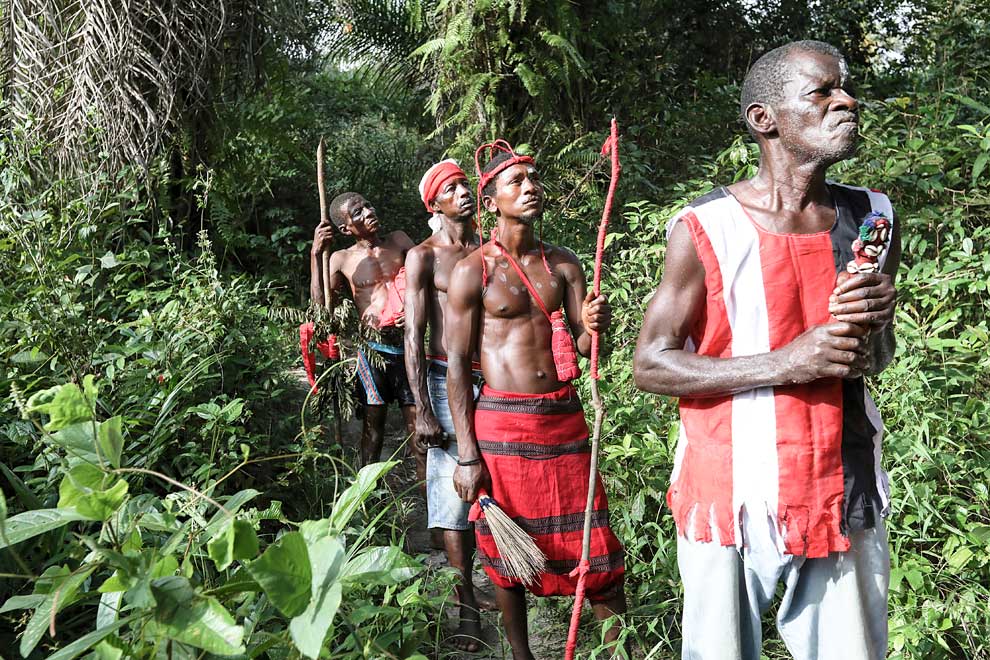
The Forest That Governs: Understanding the Poro Society of Guinea and Sierra Leone
There is a sound in certain forest communities of Guinea and Sierra Leone that has stopped conversations, emptied streets, and sent uninitiated women and children indoors for centuries. It is not a drum. It is not a horn. It is a low, resonant roaring — produced by a specialist instrument whose exact nature is known only to initiated members — that announces the presence of the Poro Spirit, the supernatural authority in whose name the society's most significant business is conducted. When that sound enters a village, the ordinary world pauses. The Poro is speaking.
For outsiders encountering the Poro Society through the filtered accounts of colonial administrators, missionary journals, or academic ethnographies, the institution tends to appear primarily as a secret society — a category that carries associations of mystery, perhaps danger, and cultural exoticism that flatten what is actually one of the most sophisticated governance and educational systems produced by any civilization anywhere. The Poro is secret in the specific sense that its inner knowledge is transmitted only to initiates and protected by obligations so serious that violation has historically carried the most severe consequences the society can impose. But secrecy is the method, not the substance. The substance is governance, education, law, and the reproduction of the social order across generations in conditions where alternative institutions — the state, the school, the court — either did not exist or could not be trusted.
Understanding the Poro means understanding what West African forest communities built when they built for themselves, over centuries, without external models.
Geography, People, and the Poro's Reach
The Poro Society is not a single organization with a central authority. It is a family of related institutions, sharing fundamental structures, ritual elements, and philosophical commitments, that operates across a broad geographic and ethnic range in the Upper Guinea Coast region of West Africa. Its presence has been documented among the **Mende**, **Temne**, **Limba**, **Kpelle**, **Loma**, **Gola**, **Bassa**, and numerous other peoples in what are now Sierra Leone, Guinea, Liberia, and Côte d'Ivoire, making it one of the most widely distributed traditional institutions in West Africa.
This distribution is not accidental. The Poro spread — through trade networks, through migration, through the deliberate extension of initiation relationships across ethnic boundaries — in part because it served functions that every community in the region needed: the education and transition of young men into adult social responsibility, the resolution of disputes through authority that transcended individual village leadership, and the maintenance of a social order sufficiently robust to survive the considerable pressures that the West African forest zone has imposed on its inhabitants: agricultural uncertainty, epidemic disease, intercommunal conflict, and the successive dislocations of the Atlantic slave trade and European colonialism.
The regional variation in Poro practice is significant. Among the **Mende** of Sierra Leone — the people among whom the Poro has been most extensively documented by researchers — the society's organizational structure, initiation procedures, and governance functions have been recorded in considerable detail, though always with the caveat that the knowledge transmitted to uninitiated outsiders is, by definition, the knowledge that the society judges appropriate for external circulation. Among the **Kpelle** of Guinea and Liberia, the Poro operates as a kind of parallel state — a governance system whose authority in specific domains exceeds that of any official political structure. These variations reflect local adaptation of a shared institutional framework rather than separate phenomena that happen to share a name.
The Bush School: Education as Transformation
The Poro's most widely known function — and the one most accessible to outside description — is the **bush school**: the period of initiation during which young men are removed from ordinary village life and taken into the forest for a period of education, ordeal, and transformation that marks their passage from boyhood to manhood.
The duration of bush school has varied historically and continues to vary by community: from a few weeks in contemporary, shortened versions to several years in the classical tradition. The longer periods — which could last three or more years in some Mende communities — reflect the depth of curriculum that the traditional Poro sought to transmit: not only the specific knowledge and skills of adult male life, but the ethical, social, and spiritual formation that would make the initiate a responsible member of his community for the rest of his life.
What happens during bush school is, by design and obligation, not fully available to outside description. What is known — from the accounts of initiates who have described what is permissible to describe, from ethnographic research conducted with community cooperation, and from the evidence of what initiated men demonstrate upon their return — includes several broadly documented elements:
**Survival and practical skills**: Knowledge of the forest environment — its useful plants, its dangers, its resources — transmitted through direct experience rather than abstract instruction. Farming, hunting, building, and craft techniques specific to the community's needs and context.
**Social and ethical formation**: The obligations of adult manhood within the community — responsibility toward family, toward neighbors, toward the community's collective wellbeing, and toward the Poro itself. The ethics of the initiated man are both broader and more demanding than those of the uninitiated youth; the initiation is understood to confer not just status but responsibility.
**Esoteric knowledge**: Knowledge of the Poro's own history, its spiritual dimensions, its songs, its languages, and the specific skills required of active Poro members in their governance and ceremonial functions. This knowledge is the most strictly protected and the least available to outside description.
**Physical transformation**: The initiation involves physical ordeals and, historically, forms of body modification that mark the initiate permanently as a Poro member. The specific marks vary by community and are themselves among the protected elements of the tradition. What the marks accomplish, in social terms, is to make membership visible — to create a permanent physical record of the transformation that bush school produced.
The young man who returns from bush school is understood, in the communities where the Poro operates, to be a different person — not merely an older version of the boy who entered. He has died, in the symbolic register of the initiation, and been reborn. The Poro spirit has consumed the boy and returned the man. This understanding is not metaphor in the casual sense; it is a theological claim about what the initiation accomplishes, and it carries the weight of that claim in how the returning initiate is received, welcomed, and subsequently treated by the community.
Governance: The Poro as Parallel State
The Poro's governance functions are, in many respects, its most consequential, and the ones that most directly explain both its historical political power and the repeated attempts by colonial and post-colonial states to suppress or control it.
In the classical operation of the Poro across Sierra Leone and Guinea, the society served as the primary institution for several governance functions that most modern states assign to the formal apparatus of courts, police, and regulatory agencies:
**Dispute resolution**: The Poro maintained jurisdiction over disputes between community members, particularly those involving serious offenses against communal norms. The society's courts operated according to their own jurisprudence, with their own procedures, and their judgments carried an authority rooted in the spiritual dimensions of Poro identity that secular dispute resolution mechanisms cannot replicate. A judgment issued by the Poro was, for initiated men, binding in a way that went beyond the external enforcement that state law relies on.
**Intervillage and interethnic coordination**: Because the Poro's initiation relationships extended across village and sometimes ethnic boundaries, the society provided a structure for coordination and communication between communities that political borders did not facilitate. Two communities whose chiefs were in dispute might nonetheless have Poro members on both sides who shared obligations of brotherhood — obligations that the society could activate to facilitate negotiation, establish truces, and create conditions for resolution that purely political means could not.
**Social control and norm enforcement**: The Poro maintained authority over a range of community behaviors, including economic practices (market regulation, the prohibition of certain transactions at certain times), sexual conduct, and the observance of community obligations. The threat of Poro sanction — which could include social exclusion, fines, and in extreme cases more severe consequences — functioned as a deterrent that supplemented and in some periods exceeded the deterrence available to formal political authority.
**Political legitimacy**: The relationship between Poro membership and political authority was close enough in many communities that leadership positions were effectively unavailable to non-members. Chiefs who were not Poro members lacked the legitimacy that Poro endorsement conferred; chiefs who fell into conflict with the Poro faced a source of counter-authority that their political position alone could not overcome.
The Poro Spirit and Its Masquerades
The theological center of the Poro — the element that transforms it from an educational and governance institution into something that also addresses the deepest dimensions of human existence — is the **Poro Spirit**: the supernatural being whose authority underlies the society's claims and whose presence is embodied in the masquerade traditions that are among the most visually and performatively complex in West Africa.
The masquerades of the Poro — performed by initiated members who wear elaborate costumes combining textiles, organic materials, and carved elements — are not decorative performances. They are the visible appearances of spiritual forces whose presence in the community carries consequences. The masquerade performer is not understood to be a man in a costume; he is, in the context of performance, an embodiment of the force the masquerade represents, and his treatment, behavior, and the conditions of his appearance reflect this.
The **Gbeni** masquerade among the Mende, and related forms across the Poro's geographic range, appear at specific moments in the community's social calendar — at initiations, at the resolution of serious disputes, at funerals of significant community members, and at moments of communal crisis. Their appearance both marks and constitutes these moments as significant: the presence of the spirit confirms the gravity of the occasion and invokes the authority that the society's governance functions rest upon.
The sound that announces the Poro Spirit's presence — the roaring that clears streets and sends the uninitiated indoors — is produced by instruments whose identity is among the Poro's most protected knowledge. For the uninitiated, this sound is the voice of the spirit itself.
The Sande Society: Complementary Power
The Poro does not operate in isolation. Across most of its range, the Poro's male institution exists alongside a complementary female institution — the **Sande Society** (also called **Bundo** in some communities) — that governs the initiation, education, and social life of women with a parallel structure and comparable authority. The Sande's masquerade tradition — the **Sowei** helmet mask, made of blackened wood and worn by senior Sande officials during initiations and other ceremonies — is one of the few cases in African art history of a masquerade tradition in which the performers are women, and the Sowei mask has become among the most recognized examples of West African sculptural form in international art collections.
The relationship between Poro and Sande is one of structured complementarity and mutual recognition: each society governs its own domain, acknowledges the other's authority in its domain, and the two together constitute the governance and educational system for the community as a whole. This gendered complementarity is one of the Poro-Sande system's most sophisticated features — a governance architecture in which authority is distributed by domain rather than concentrated in a single institution, and in which women's governance of women's affairs is not a concession but a structural feature of the original design.
Colonial Encounter: The Institutions That Were Feared
The British colonial administration of Sierra Leone and the French colonial administration of Guinea shared a consistent response to the Poro Society: anxiety verging on hostility, periodic attempts at suppression, and a persistent failure to achieve either. The anxiety was well-founded from the colonial perspective: the Poro represented a source of authority, coordination, and collective action that was entirely outside colonial control and that had demonstrated, across the nineteenth century, the capacity to organize significant resistance.
The **Hut Tax War** of 1898 in Sierra Leone — a widespread uprising against British colonial taxation and the imposition of a Protectorate that abolished traditional authority structures — had significant Poro involvement. The coordination between communities that the uprising required reflected the Poro's capacity for intervillage organization that no other institution in the region could match. The British response included not only military suppression but targeted action against Poro leadership, recognizing that the society was a structural enabler of resistance.
The missionary campaign against the Poro was even more sustained. Christian missionaries, operating from the doctrinal position that the society's spiritual dimensions were incompatible with Christianity and its initiation practices objectionable, lobbied colonial authorities for prohibition and conducted direct campaigns against participation. The society was formally banned in several colonial jurisdictions at various points — with the bans having the predictable effect of driving the practice underground without eliminating it.
The deeper colonial critique of the Poro — that it was a "secret society" whose opacity made it threatening to colonial order — reveals more about colonial epistemology than about the Poro itself. An institution whose governance authority rested on knowledge that colonizers could not access was, from the colonial administration's perspective, an institution that could not be controlled. The solution was not understanding; it was suppression.
Post-Colonial Poro: Persistence, Adaptation, and Tension
Independence did not resolve the Poro's ambiguous relationship with the state — it complicated it. The post-colonial governments of Sierra Leone and Guinea inherited colonial-era suspicion of secret societies alongside the political reality that Poro leadership in rural communities represented genuine authority that elected officials could not ignore. The result was a variable policy landscape: periods of attempted suppression, periods of accommodation, and periods of explicit political engagement in which politicians sought Poro endorsement as a form of rural legitimacy that state institutions could not independently confer.
Sierra Leone's civil war of 1991–2002 produced particularly complex interactions between the Poro and the warring factions. The Revolutionary United Front (RUF), which recruited heavily from youth populations — including young men who had been denied initiation by the war's disruption of normal social patterns — explicitly targeted Poro structures in some areas, destroying bush schools and killing senior Poro officials. The targeting reflected the RUF's opposition to traditional authority structures, but also the practical reality that Poro governance represented a form of community organization that could resist the RUF's recruitment and control strategies.
The post-war reconstruction period produced renewed engagement with the question of what role traditional institutions like the Poro should play in Sierra Leone's governance future. Truth and Reconciliation Commission testimony included accounts of Poro involvement in the conflict on multiple sides — evidence that, like any human institution, the Poro was neither uniformly protective nor uniformly beneficial in conditions of extreme social breakdown. The more honest post-war reckoning acknowledges both its genuine governance contributions and the ways in which its authority structures can be abused when the ethical commitments that constrain them break down.
What the Poro Knows That States Forget
The contemporary relevance of the Poro Society to governance theory and development practice is a question being worked through without consensus. The institution represents a form of social organization with specific, documented capacities: the transmission of practical and ethical knowledge across generations, the provision of community governance where state institutions are weak or absent, and the creation of cross-community solidarity networks whose durability has been demonstrated across several centuries of disruption.
These capacities are not automatically transferable to different contexts, and the Poro's governance functions have historically included elements — the exclusion of women from specific spheres of public life, the use of severe sanctions, the protection of elder male authority — that create real tensions with contemporary human rights frameworks. These tensions are being negotiated within Poro communities themselves: younger initiates, women community leaders, and Poro elders with different visions of the institution's future are participants in an ongoing internal conversation about what the society needs to be in conditions that differ from those in which its current form was developed.
What the Poro's history demonstrates, against the persistent development assumption that traditional institutions are obstacles to modernization that time will dissolve, is that community-embedded governance systems with deep roots in local epistemology and social practice are extraordinarily durable — more durable, across the specific history of Guinea and Sierra Leone, than the colonial and post-colonial state structures that have repeatedly attempted to supersede them.
This durability is not explained by resistance to change. The Poro has changed enormously across its history — adapting initiation periods, incorporating new knowledge, adjusting governance functions in response to state institutions that now operate alongside it. What has not changed is the underlying architecture: the commitment to knowledge transmission between generations, the claim of authority rooted in something beyond state power, and the understanding that the community's social reproduction requires an institution whose obligations are as serious as any it has ever been possible to create.
The Forest Endures
The Poro's initiates emerge from the forest changed. They carry marks that are permanently theirs, knowledge that is permanently theirs, obligations that will structure their relationships and decisions for the rest of their lives. They return to the same village they left, the same family, the same geography — and yet they are in a different relationship to all of it, because they have been through something that cannot be undone and that the community recognizes as having produced a different kind of person.
This is what the Poro, at its most fundamental, is about: the belief that persons can be made — deliberately, through structured experience, through the transmission of accumulated community knowledge, through ordeal and instruction and the cultivation of relationship — in ways that random experience cannot accomplish. The bush school is not an accident. It is a technology of human formation developed over centuries by communities that took the question of what kind of people they needed seriously enough to build an institution around the answer.
The forest that governs is also the forest that teaches, and the forest that transforms. That it has survived — colonial bans, civil war, missionary campaigns, the competing authority of modern states — is not evidence of backwardness or of simple resistance to change. It is evidence of something rarer: an institution that addresses needs deep enough, and addresses them well enough, that the communities it serves have decided, across many generations and many pressures, that they are not yet willing to do without it.
The roaring in the forest means the Poro is speaking. The village knows what to do. It has always known.