The Face Behind the Mask: What the Zaouli Dance of Ivory Coast Actually Reveals
The Face Behind the Mask: What the Zaouli Dance of Ivory Coast Actually Reveals
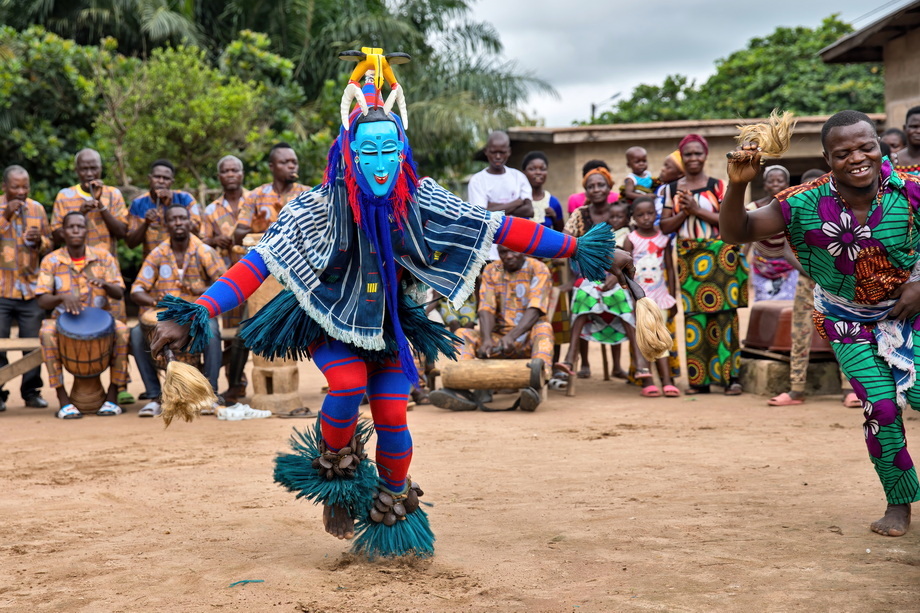
There is a moment in the Zaouli performance that experienced observers describe as a kind of optical impossibility: the masked dancer, wearing a towering construction of carved wood and fiber that extends a foot above the head, moving at a speed and with a precision that the weight of the mask should prohibit, executes a sequence of footwork so rapid and intricate that the feet appear to be improvising independently of the body above them — a blur of motion at the base of something that should be stationary. The mask does not bob or tilt. It rides above the storm of the feet with complete serenity, its painted face holding its expression of idealized beauty while the body beneath it does something close to the physically impossible.
This is the central paradox of the **Zaouli** — the masked dance tradition of the **Guro people** of central Ivory Coast, and one of the most recognized performance traditions in West African cultural life. The mask is a face of perfect stillness. The dance is controlled athletic intensity. The combination produces an effect that neither element could achieve alone, and that effect — the serene face of an ideal woman presiding over a display of human physical mastery — is the Zaouli's cultural argument, the statement it makes every time it appears about the relationship between beauty, power, community, and the forces that move through the world and through human beings when the conditions are right.
UNESCO recognized the Zaouli dance of the Guro communities in 2017, adding it to the Representative List of Intangible Cultural Heritage of Humanity. The recognition confirmed what the Guro people already knew: that what happens when the Zaouli dances is not entertainment. It is a form of knowledge made visible.
The Guro People and the World the Mask Comes From
The **Guro** (also spelled Gouro or Kweni) are a Mande-speaking people living primarily in the Bouaflé, Gagnoa, and Zuénoula regions of central Ivory Coast — the forest-savanna transition zone where the dense lowland forests of the south give way to the more open woodland and grassland of the interior. Their population numbers roughly 600,000, making them one of the significant ethnic groups of Ivory Coast without being among the largest. They have been farmers — yam, cassava, rice — and hunters, organized in village communities whose social structure is built around patrilineal descent and age-grade systems that assign roles and privileges to community members as they move through life's stages.
The Guro are known, within and beyond Ivory Coast, for producing some of the most sophisticated carved wooden objects in the West African artistic tradition. Their masks — not only the Zaouli but the full range of Guro masked traditions, including the **zamble** (crocodile spirit mask) and the **gu** (female beauty mask from which the Zaouli develops) — have been collected by European and American museums since the early twentieth century and occupy an honored position in the scholarly literature on African art. Western art markets have sometimes misread this as evidence that Guro masks are primarily aesthetic objects — things made to be contemplated. The Guro understanding is categorically different: the mask is a vehicle, not an object. Its aesthetic refinement is in service of what it carries, not an end in itself.
The social world from which the Zaouli emerges is one in which the visible and invisible are understood to interpenetrate continuously. The spirits of the forest and the bush — *min* — are real presences in Guro cosmology, capable of relationship with human communities and requiring careful management through appropriate ritual attention. Masked dances are among the primary technologies for this management: they create conditions under which the spirit associated with the mask can manifest in the human world, acting through the dancer's body, and can do the work — healing, protection, conflict resolution, communal regeneration — that the community requires of it.
The Legend of Djela Lou Zaouli: Beauty as Origin
The Zaouli's origin is told through a story that every Guro child grows up knowing, and that provides the mask's aesthetic and philosophical foundation simultaneously.
A man named **Djela** had a daughter of extraordinary beauty — so beautiful that the community understood her loveliness as something beyond the ordinary, a gift that carried both blessing and responsibility. The daughter's name was **Lou Zaouli**, and when she died young — before her beauty could fully flower into the life it deserved — her father's grief was of the kind that seeks form rather than consolation. He commissioned a mask-carver to make something that would hold her face — to capture the ideal of her beauty in wood so that it would not be lost with her body.
The mask was made. And when it was made, it moved.
The story encodes several of the Zaouli tradition's core principles. First: that the mask's face is not generic feminine beauty but a specific memorial — the idealization of an actual face, making every Zaouli performance simultaneously an aesthetic event and an act of remembrance. Second: that the mask's animating force — what makes it dance, what makes it more than a carved object — is love, specifically a father's love for a lost daughter, which is to say one of the most powerful of human emotional forces translated into spiritual energy. Third: that beauty, when it is real beauty and not merely decoration, has a life beyond the body that contained it; it can be held, transmitted, and made to move through the world in new forms.
This origin story is not simply legend. It is the Zaouli's operating instruction manual: the knowledge of where the mask comes from tells the community what to ask of it and what it is capable of doing.
The Mask Itself: Carving an Ideal
The Zaouli mask is among the most technically demanding objects in the West African carving tradition, and its requirements are specific enough that only a small number of carvers in any generation are considered qualified to make one. The face is that of a young woman — high forehead, half-closed eyes, a nose of precise proportion, and a mouth that is small and composed in an expression that Guro aesthetic vocabulary describes as *ideally beautiful* rather than merely pretty. The skin of the face is often painted in black, red ochre, white kaolin, or combinations of these, with geometric patterns that carry their own symbolic content — tribal markings, cosmological references, clan identifiers that a knowledgeable Guro viewer can read as additional layers of meaning beneath the face's surface.
The upper portion of the Zaouli mask is where its most distinctive visual character emerges: above the face rises a complex superstructure of carved geometric forms, often including interlocking circles, diagonal planes, and abstract shapes that have been interpreted variously as representing water, sky, and celestial bodies, as clan totems, and as purely formal elaborations on the face's geometry. This superstructure — which can add thirty centimeters or more to the mask's total height — is what gives the Zaouli its commanding visual presence from a distance, the elevated face presiding over the performance space with an authority that the carved expression reinforces without needing to assert.
The wood used for Zaouli masks is selected through protocols that are themselves part of the tradition: specific tree species whose spiritual properties are understood to be compatible with what the mask will carry, cut at specified times and in specified ways, prepared before carving through processes that involve the carver's own spiritual preparation as much as his technical skills. A Zaouli mask is not simply carved; it is made in conditions that allow the spiritual presence it will house to participate in its own construction. The carver's relationship to this process is understood as one of receptivity as much as skill — he is making a home for something, not simply producing an object, and the home must be appropriate to its resident.
The Dancer and the Dance: Training for Impossibility
The Zaouli dancer is male — the mask represents female ideal beauty and is danced by men, a common configuration in West African masked traditions that reflects a social logic in which the dangerous spiritual forces that masks engage are managed by those whose social role includes that management responsibility, rather than those whose social identity the mask represents. This is not paradox but complementarity: the female beauty of the mask and the male body of the dancer are two elements of a totality that neither could achieve alone.
Selection for Zaouli dancing begins in childhood. Boys who show the specific combination of physical aptitude, rhythmic intelligence, and what experienced community members recognize as the right kind of spiritual receptivity — a capacity to be moved by the music in ways that suggest genuine response rather than imitation — are identified and begin training. The training period is long, typically years, and it is structured by the dual demands of the tradition: the physical technique of the footwork on one hand, and the interior preparation that allows the dancer to receive and be animated by the spirit the mask carries on the other.
The footwork is the most immediately visible element of Zaouli performance and the one that produces the optical impossibility described at the opening. The Zaouli dancer performs a rapid, intricate sequence of steps that requires both balls of the feet to work independently at high speed, producing a continuous, flickering contact with the ground that looks, in its fastest passages, more like vibration than footwork. The steps are not improvised: they are a vocabulary, a set of forms that have been transmitted through the tradition and that the dancer learns with the same kind of embodied patience that any complex physical vocabulary requires. Within that vocabulary, however, there is real-time response — to the music's current phrase, to the moment's energy, to the presence or absence of the spiritual force that the mask is calling.
The music that accompanies the Zaouli is equally specific. Drummers — typically playing **djembe** and **talking drum** combinations — provide the rhythmic foundation, with the lead drummer and the lead dancer in a continuous responsive relationship: the drummer reads the dancer's current state and responds to it, the dancer reads the drum's current phrase and responds to that, the conversation between them producing what spectators experience as a unified event but what is actually a real-time negotiation between two forms of intelligence.
The Ceremony: When the Zaouli Appears
The Zaouli does not perform on demand. Its appearances are contextually specific, called for by the community's needs and organized through protocols that involve consultation with the mask's custodians, appropriate preparation, and the creation of conditions that allow the spirit to manifest productively.
The occasions for Zaouli performance fall into several categories. **Agricultural ceremonies** — marking the planting season, celebrating the harvest, petitioning for adequate rain and soil fertility — are among the most traditional contexts, connecting the mask's spiritual function to the community's material survival in the most direct possible way. **Healing ceremonies** in which the Zaouli is called to address illness or spiritual disturbance in a community member or household draw on the mask's capacity to intercede with forces that affect human health. **Community conflict resolution** — when disputes between families or villages have reached an impasse that human mediation has not resolved — is another function, with the Zaouli's appearance understood to create conditions in which the spirit's presence both clarifies the stakes and provides moral authority for the resolution.
Funerals are among the most significant Zaouli occasions, and in this context the tradition connects most visibly to its origin story: the mask that was made to hold the face of a dead woman is called to accompany the dead, to ease the transition between the living world and whatever follows it, to honor the deceased with the highest form of beauty and ceremony the community can offer. The Zaouli at a funeral is not entertainment or distraction from grief. It is grief given its most dignified form, the community saying to the dead and to each other: we know how to honor what was beautiful, and we will continue to know.
**Celebrations** — the arrival of important guests, the inauguration of a chief, the successful conclusion of a significant community project — also call the Zaouli, as manifestations of communal joy that deserve the mask's amplifying presence. In these contexts the dance's athleticism and the music's energy are most fully released, the performance building in intensity and speed as the spirit responds to the occasion's emotional charge.
The Zaouli and Other Masks: An Ecosystem of Spirits
The Zaouli does not operate in isolation. It belongs to an ecosystem of Guro masked traditions in which different masks address different spiritual functions, and in which the relationships between masks reflect the relationships between the various spirit forces that Guro cosmology recognizes.
The **zamble** — a mask representing a composite creature combining elements of the leopard, the crocodile, and the antelope — is the Zaouli's male counterpart and most important companion in the Guro masking tradition. Where the Zaouli represents female ideal beauty and the spiritual forces associated with it, the zamble represents masculine power, hunting prowess, and the forest's dangerous energies. The two masks often appear together at major ceremonies, the zamble preceding the Zaouli in the performance sequence and, in a sense, preparing the space for her appearance — clearing it of hostile forces, establishing the boundaries within which the Zaouli can operate safely.
The **gu** — the simpler female beauty mask from which the Zaouli developed, or which the Zaouli is understood as an elaboration of — represents an earlier stage of the tradition. The gu's face carries many of the same aesthetic features as the Zaouli's but without the elaborate superstructure, and its dance is less athletically demanding, performed at lower intensity. The relationship between gu and Zaouli in Guro masking practice is sometimes described as one of degree: the gu is female beauty, and the Zaouli is female beauty at its most complete, most spiritually charged, most demanding expression.
This ecosystem logic — in which different masks address different needs and appear in different contexts — reflects a sophisticated understanding of the variety of forces that affect community life and the variety of spiritual resources needed to engage them appropriately. The mask system is not redundant; each element has its specific function, and the whole is more capable than any single mask could be.
Artisans and Custodians: The Human Infrastructure of the Tradition
The Zaouli tradition requires not only dancers and musicians but a supporting human infrastructure of carvers, custodians, ritual specialists, and community elders whose roles maintain the tradition's integrity across generations.
The **carver** (*sculptor-féticheur* in the French-influenced vocabulary that Ivorian cultural documentation often uses) occupies the most specialized position: the man whose technical mastery and spiritual qualification combine to allow him to make masks that function as intended. The transmission of carving knowledge within the Guro tradition is genealogical in the broad sense — skills pass through family lines and through apprenticeship relationships that may or may not follow family boundaries. A young man apprenticed to a master carver is learning not only how to handle tools and wood but how to approach the work spiritually: the preparatory rituals, the relationship with the materials, the interior state that allows the carving to be more than skilled woodworking.
The **mask custodian** — the elder or family whose responsibility is the care and governance of a specific Zaouli mask — maintains the mask's physical condition and its spiritual health between performances. Masks require specific care: storage in conditions that prevent physical deterioration, periodic ritual attention to maintain the spiritual relationship between the mask and the force it houses, and governance of the decisions about when and in what context the mask is called to perform. The custodian's role is simultaneously material and spiritual, the hinge point between the object and the force, the person whose relationship to both makes the tradition function.
**Women** in the Guro tradition do not wear the Zaouli mask or dance it, but they are not absent from the tradition's life. Female community members participate in the ceremonies at which the Zaouli appears, contribute to the musical environment through singing, and exercise their own forms of governance over the aesthetic standards by which performances are evaluated. The women who watch a Zaouli performance and call out their approval or withhold it are not passive spectators; they are participants in the evaluative process that maintains the tradition's quality standards and that constitutes much of the social reinforcement through which the tradition reproduces itself.
UNESCO Recognition and the Pressures of the Present
The 2017 UNESCO inscription of the Zaouli dance of the Guro communities on the Intangible Cultural Heritage list represented both an achievement and a challenge. The achievement is real: international recognition of a tradition that academic and artistic communities had long acknowledged but that official heritage frameworks had not formally confirmed, with the practical consequences of increased documentation resources and international visibility. The challenge is equally real: the conditions that allow the tradition to function — the community structures, the spiritual framework, the transmission networks between generations — are under pressures that no UNESCO inscription resolves.
Ivory Coast's rapid urbanization has drawn significant portions of the Guro population from the rural village contexts where the Zaouli tradition has its natural habitat. Young Guro men growing up in Abidjan or Bouaflé have access to different economic opportunities and social worlds than their parents and grandparents, and the question of whether the tradition's demanding training requirements remain attractive in a context of expanded options is genuinely open. The carving tradition faces similar pressures: the years of apprenticeship required to develop the necessary skills compete with the accelerated timelines of formal education and urban employment.
The commercialization pressure is subtler but equally significant. International tourism and the art market have created demand for Zaouli performances outside their ceremonial contexts and for Zaouli-style masks produced for sale rather than ritual use. The response of Guro communities to this demand has been varied and carefully managed: some performances for external audiences have been permitted, in contexts where the distinction between demonstration and ceremony is clearly maintained; some carvers produce masks explicitly for the market, in forms that reference but do not replicate the specifications of ritual objects. These negotiations are ongoing and contested, reflecting the same tension that attends the commodification of any living sacred tradition.
What the Guro cultural custodians most consistently emphasize, in their engagement with both national and international heritage institutions, is the distinction between the object and the practice — the recognition that the Zaouli mask displayed in a museum, however beautiful, is not the Zaouli. The Zaouli is what happens when the mask moves, in the presence of the right music and the right community, under conditions that allow the spirit to be present. That event cannot be archived. It can only be transmitted, person to person, community to community, in the living practice that the tradition has sustained for generations and is working to sustain for the next ones.
What Moves Behind the Face
There is something the Zaouli tradition insists upon that Western aesthetic categories have difficulty accommodating: that the most beautiful face is not the face that is most perfectly still, but the face that moves most perfectly. The carved mask is beautiful in the way that a held breath is beautiful — complete, contained, holding something back. The dance is the release: the beauty in motion, the ideal animated by force, the serene face riding above a display of human capability that the serenity both presides over and paradoxically amplifies.
This is the Zaouli's argument, stated in the only language adequate to it: that beauty is not a quality possessed by an object but an event produced by a relationship — between the mask and the dancer, between the dancer and the music, between the performance and the community that called it, between the living and the dead, between the human world and the forces that move through it when the conditions are right. The mask is the invitation. The dance is the arrival.
In the villages of Bouaflé and Zuénoula, the carvers still work. The dancers still train. The drummers still know the rhythms that call what the mask carries. The girls who died too young are still remembered in the faces that their fathers' grief commissioned, still riding above the storm of the dancers' feet, still holding the community's ideal of beauty where the community can see it and be reminded of what they are capable of honoring.
The mask does not speak. But when it moves, the community hears everything it needs to know.