The Empire That Built the Sky: Inca Heritage and the Legacy That Outlasted Conquest
The Empire That Built the Sky: Inca Heritage and the Legacy That Outlasted Conquest
On a ridge between two mountain peaks in the Peruvian Andes, at an elevation of 2,430 meters above sea level, there is a city that should not exist. It should not exist because no wheeled vehicle ever carried materials to its site. It should not exist because no iron tool ever cut its stones. It should not exist because the mountain on which it was built is not a flat surface but a narrow saddle of rock and steep slope that required the complete transformation of a natural ridge into a flat, terraced, hydrologically managed urban platform before a single building could be raised. By every standard of what is feasible with pre-industrial technology, Machu Picchu should be a collection of modest structures at the valley floor.
Instead, it is a city of approximately 200 buildings, fitted with stone masonry so precise that a razor blade cannot penetrate the joints between blocks, served by a drainage system that has functioned without maintenance for five centuries, aligned to astronomical sightlines that track the solstices and the Pleiades, and built — entire — within perhaps a century of construction that began sometime around 1450 CE and was abandoned, still largely intact, less than a hundred years later when the Spanish conquest unraveled the civilization that built it.
Machu Picchu is the most famous artifact of Inca civilization, and it is, in at least one important sense, misleading. It suggests a culture whose legacy is spectacular ruins — stone cities in impossible places, photographed against clouds, admired from a distance. The actual legacy of the Inca Empire is different and more diffuse: it is in the languages spoken by ten million people across five countries, in the agricultural techniques that feed Andean communities today, in the spiritual practices that persisted through five centuries of colonial pressure, in the road system whose routes are still followed by modern highways, and in the living descendants of the Inca state — the Quechua-speaking communities of Peru, Bolivia, Ecuador, and Chile — who never fully stopped being what the empire made them.
Tawantinsuyu: The Four Quarters of the World
The Inca called their empire **Tawantinsuyu** — "the four quarters united" — a name that encoded both the geographic structure of the state and its cosmological ambition. The empire was divided into four *suyus* (quarters) radiating from Cusco, the capital city, which the Inca understood as the navel of the world (*qusqu* means "navel" in Quechua). At its maximum extent, between roughly 1438 and 1533 CE, Tawantinsuyu stretched from what is now southern Colombia to central Chile, encompassing the full length of the Andes and their Pacific coastal foothills — approximately 4,000 kilometers from north to south and containing an estimated 10 to 12 million people across hundreds of distinct ethnic groups, each with its own language, customs, and pre-Inca political structures.
This scale of political organization, achieved in less than a century of active imperial expansion by a state that had only begun consolidating power around 1400 CE, represents one of history's most rapid imperial constructions. The Inca did not simply conquer neighboring peoples; they absorbed them into a sophisticated administrative system whose mechanisms — the road network, the labor tax (*mit'a*), the redistribution economy, the state storehouse network, the system of appointed provincial governors (*tocricoc*) — allowed effective governance across an ecological range from Pacific desert to Amazonian cloud forest to high-altitude altiplano, all without the writing system, the iron metallurgy, or the wheeled transport that characterized contemporary civilizations elsewhere.
The speed of Inca expansion is typically dated from the reign of **Pachacuti Inca Yupanqui**, who took power around 1438 after repelling an invasion by the neighboring Chanka confederation and embarked on a program of military expansion and administrative reorganization that transformed a regional polity into a continental empire. Machu Picchu is widely believed to have been built as Pachacuti's royal estate — a country palace of extraordinary ambition, constructed at a site whose dual mountain setting (Huayna Picchu and Machu Picchu peaks) may have been selected for its astronomical and spiritual significance rather than its convenience.
Engineering Without Wheels: The Architecture of the Impossible
Inca architecture is the civilization's most immediately legible achievement to contemporary observers, and the one that has generated the most sustained attention from engineers, archaeologists, and historians of technology. What Inca builders accomplished in stone — without iron, without the wheel, without mortar, without written architectural plans — consistently exceeds what the available tools and technology would seem to permit.
The defining technique of Inca stonework is **ashlar masonry**: the cutting and fitting of stone blocks to such precise tolerances that no mortar is required to hold them in place. The joints between Inca stone blocks are not uniform; the stones are polygonal rather than rectangular, and each block is fitted to its specific neighbors through a process of iterative grinding and testing that consumed enormous amounts of skilled labor. The result is a wall that is both structurally superior to mortared construction — the fitted stones move slightly and resettle during earthquakes rather than cracking along rigid mortar lines — and visually extraordinary, the irregular polygon joints creating a surface texture that has no equal in any other stonebuilding tradition.
The logistics of Inca construction compound this achievement. The massive granite blocks of Sacsayhuamán — the fortress above Cusco whose largest stones weigh over 100 tons — were quarried from sites several kilometers distant and transported across steep Andean terrain without wheeled vehicles, using sledges, levers, ramps, and the coordinated labor of thousands of workers organized through the *mit'a* system. The engineering physics of these transport operations have been studied extensively, and while the specific techniques are not fully documented, experimental archaeology has confirmed that the moving of multi-ton stones over Andean terrain is feasible with human labor and simple mechanical advantage — just extremely demanding of time, organization, and manpower.
What this reveals about Inca civilization is less the absence of certain technologies and more the presence of an exceptional capacity for large-scale coordinated labor. The Inca state could mobilize tens of thousands of workers for construction projects because the *mit'a* labor tax — the obligation of each household to contribute labor to the state in lieu of tribute in goods — gave the empire a renewable workforce whose scale had no equivalent in contemporary civilizations. Tawantinsuyu was not built by slaves, as Herodotus imagined the Egyptian pyramids were built, but by taxpayers: people fulfilling an obligation that also entitled them to state provisioning — food, clothing, tools, and chicha (corn beer) — during their period of service.
The Quipu: Writing in Knots
Of all the apparent paradoxes of Inca civilization, none has generated more sustained scholarly debate than the absence of writing in a state of such administrative complexity. Tawantinsuyu managed population censuses, economic accounts, military logistics, historical records, and legal decisions across a continent-sized territory — and did all of this without any system of writing as the term is conventionally understood.
What the Inca had instead was the **quipu** (*khipu* in contemporary Quechua orthography): a device consisting of a main cord from which hang numerous subsidiary and tertiary cords, each knotted in patterns that encode numerical information through the type of knot, its position on the cord, and the cord's color. The quipu's numerical encoding system has been fully decoded: it uses a base-ten positional notation in which knot position encodes place value, allowing numbers up to the tens of thousands to be recorded on a single cord. Census data, agricultural inventories, tribute records, and military tallies were all maintained in quipu form and transmitted across the empire by the *chasqui* relay runners who are among the Inca administrative system's most remarkable features.
What has not been decoded — and what remains one of the most significant open questions in Andean archaeology — is whether quipus also encoded non-numerical information: narratives, historical accounts, poetry, administrative records in the linguistic rather than numerical sense. A subset of quipus examined by researchers including anthropologist Gary Urton and his collaborators display structural features that suggest they may encode syllabic or phonemic information rather than (or in addition to) numbers. The quipu's full communicative capacity remains unknown.
The **chasqui** system through which quipus and other messages traveled deserves attention in its own right. The Inca road network (*Qhapaq Ñan* — "Royal Road") extended approximately 40,000 kilometers through the Andes and coastal desert, connecting every significant population center in the empire through a system of paved road, suspension bridges (made from braided ichu grass, with spans reaching over 50 meters), and rest stations (*tambos*) spaced at regular intervals. The chasqui runners, stationed at posts along the road, ran relay segments of roughly 2.5 kilometers each, handing messages forward along the chain. A quipu could travel from Cusco to Quito — approximately 2,000 kilometers — in about five days. A fresh fish caught on the Pacific coast could reach the Inca emperor's table in Cusco in two days. This communication and transport speed was not exceeded in the Americas until the nineteenth century.
The Agricultural Genius of the Vertical World
The Inca Empire was built in one of the world's most challenging agricultural environments: the Andes present a vertical range of ecological zones — from sea-level desert through dry highland scrub to humid cloud forest to frozen altiplano — within horizontal distances of less than a hundred kilometers. No single crop grows across this entire range. No single agricultural technique is optimal across these conditions. The Inca response to this challenge produced an agricultural system of remarkable sophistication that is being studied today by scientists addressing climate change and food security.
**Andean terracing** (*andenes*) is the most visible element of this system: the conversion of steep mountain slopes into stepped horizontal platforms through the construction of retaining walls, infilling with carefully layered substrate (gravel for drainage, sand, topsoil), and the construction of irrigation channels to distribute water from mountain streams across the terrace surface. The Inca did not invent terracing — it predates them in the Andes by centuries — but they systematized and expanded it at a scale that transformed the productive capacity of Andean highland agriculture. Estimates of total terrace area in the pre-Columbian Andes range from 500,000 to 1,000,000 hectares, most of which was constructed or expanded during the Inca period.
The ecological logic of Andean terracing goes beyond slope management. The filled terrace platforms accumulate heat during the day and release it slowly at night, moderating the frost risk that makes high-altitude agriculture precarious — a passive thermal management system that operates without any external energy input. The layered substrate of a well-built andenes terrace drains freely, preventing the waterlogging that flat highland surfaces are prone to during the rainy season. And the alignment of terrace systems to mountain hydrology — tracking natural water flow rather than fighting it — creates irrigation networks of low maintenance and high reliability.
The **crop diversity** that Inca agriculture developed and maintained is among its most consequential legacies. The Andean agricultural tradition produced the world's most diverse potato collection — over 3,000 varieties of potato were cultivated in the Andes before European contact, compared to the handful that reached Europe and subsequently the world. Quinoa, kiwicha (amaranth), olluco, oca, and mashua are high-altitude crops developed in the Andean tradition that are now attracting significant attention from nutritionists and food security researchers for their cold tolerance, nutritional density, and drought resistance. The Inca practice of maintaining crop diversity across multiple ecological zones as insurance against localized crop failure was, in modern terminology, a sophisticated risk-management strategy embedded in agricultural practice.
The Spiritual World of the Inca: Cosmology and Ceremony
Inca religion was not a theology in the doctrinal sense — no creed, no canonical text, no single deity whose primacy organized all others. It was a cosmological system centered on the concept of **huaca**: the sacred power that inheres in certain places, objects, and beings, manifesting as a force that must be acknowledged, respected, and periodically renewed through ritual. Mountains (*apus*), springs, unusual rock formations, and places where significant events had occurred were huacas. The mummies of deceased Inca emperors — preserved and maintained as active participants in court life, with their own households, their own servants, their own property — were among the most powerful huacas in the empire.
The Inca solar religion — centered on **Inti**, the sun deity whose earthly representative was the Sapa Inca (emperor) — was the state religion imposed across the empire, but it overlaid rather than replaced the local religious traditions of conquered peoples, who were required to maintain their huacas while also acknowledging Inti's primacy. This religious pluralism was administratively practical — it reduced the social disruption of conquest — and it produced a spiritual landscape of extraordinary complexity, with thousands of recognized sacred sites distributed across the empire's territory.
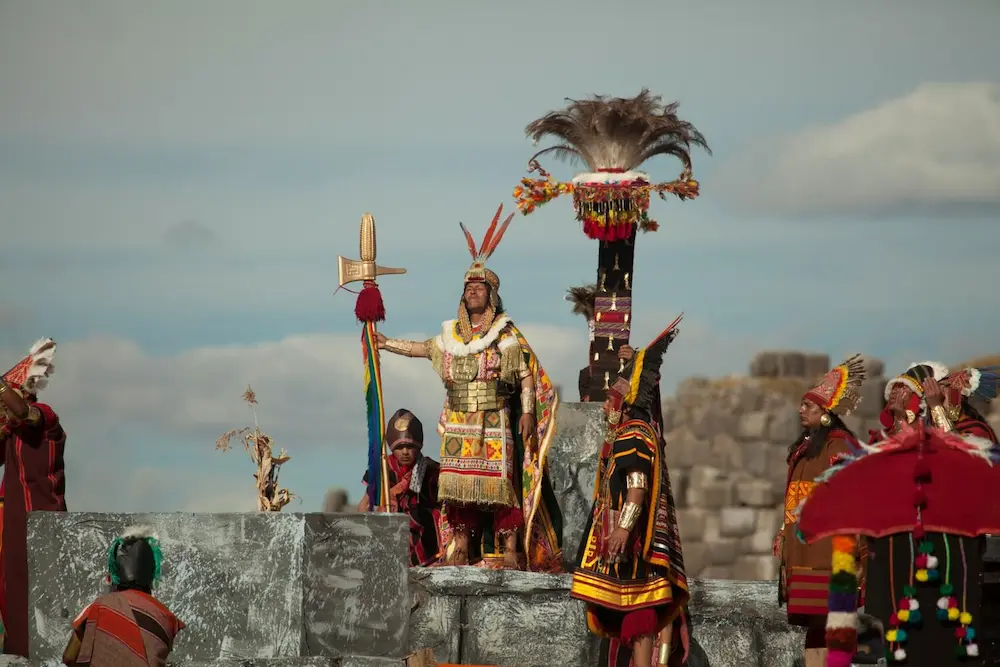
The **Inti Raymi** — Festival of the Sun, held at the winter solstice (June in the Southern Hemisphere) — was the Inca calendar's most important ceremony: a celebration of the sun's power at its annual nadir, a ritual entreaty for its return, and a spectacular public demonstration of the Inca state's relationship to the cosmic order. The ceremony at Cusco's Sacsayhuamán fortress drew participants from across the empire and lasted nine days. A contemporary revival of Inti Raymi has been performed in Cusco every June 24 since 1944, drawing thousands of visitors — a theatrical reconstruction rather than a living ritual continuation, but one that reflects genuine cultural investment in maintaining the ceremony's visibility.
The **ceque system** of Cusco — a network of 41 lines (*ceques*) radiating from the Coricancha (Temple of the Sun) at the city's center, along which were distributed 328 huacas used to organize the Inca ritual calendar — is one of the most sophisticated cosmological-geographic systems ever documented. Each ceque line was associated with a specific social group responsible for its maintenance and the performance of rituals at its huacas. The system simultaneously organized space, time, social obligation, and religious practice into a single integrated structure — the city itself functioning as a cosmological diagram whose maintenance was a civic responsibility.
The Spanish Conquest and What Was Destroyed — and What Was Not
In 1532, Francisco Pizarro arrived on the Peruvian coast with approximately 168 men, 62 horses, and several cannons, at the precise moment when the Inca Empire was emerging from a civil war between rival imperial claimants — Atahualpa and Huáscar — that had destabilized the state's administrative system. Within two years, the Inca emperor had been captured, held for ransom, ransomed with a room full of gold and two of silver (the largest ransom in history), and executed anyway. Within a decade, Cusco had fallen, the administrative system had collapsed, and the systematic destruction of Inca cultural infrastructure — the temples, the quipu archives, the religious institutions — was underway.
What the Spanish destroyed was vast and irreplaceable. The Coricancha — the Temple of the Sun in Cusco, its walls lined with gold panels, its garden containing life-sized figures of plants, animals, and humans cast in gold — was stripped and its gold melted. The quipu archives that maintained Inca historical and administrative records were burned or confiscated by priests who suspected them of containing pagan religious information. The mummy bundles of the Inca emperors — active participants in the political life of Cusco, consulted on matters of state — were destroyed as idols. The *acllahuasi* (houses of chosen women) who maintained religious practices, produced fine textiles, and brewed the chicha for state ceremonies were disbanded.
Yet the destruction, catastrophic as it was, was incomplete. Languages cannot be burned. Agricultural knowledge cannot be confiscated. The mountain spirits (*apus*) that the Inca venerated were embedded in the landscape itself, and no colonial decree could remove them. The **Quechua language** — the administrative lingua franca of Tawantinsuyu, spoken by perhaps half the empire's population — was not suppressed but expanded by Spanish missionaries who found it useful for evangelization, producing Quechua grammars and religious texts that inadvertently preserved and standardized the language. Today, Quechua is spoken by approximately 8 to 10 million people across Peru, Bolivia, Ecuador, Argentina, and Colombia, making it the most widely spoken indigenous language in the Americas.
Living Heritage: What the Inca Left in the Present
The most important argument against the framing of Inca civilization as "lost" is the fact that its descendants have never gone away. The Quechua-speaking communities of the Andes did not dissolve into the colonial order or the subsequent national orders that replaced it. They maintained their languages, their agricultural systems, their spiritual relationships with the landscape, and their social structures — adapting to successive waves of external pressure while preserving enough continuity to constitute genuine cultural transmission rather than mere historical memory.
**Reciprocal labor** (*ayni*) — the Andean principle of mutual assistance in which community