The Dance That Speaks to the Dead: Inside the Dogon Mask Ceremony of Mali
The Dance That Speaks to the Dead: Inside the Dogon Mask Ceremony of Mali
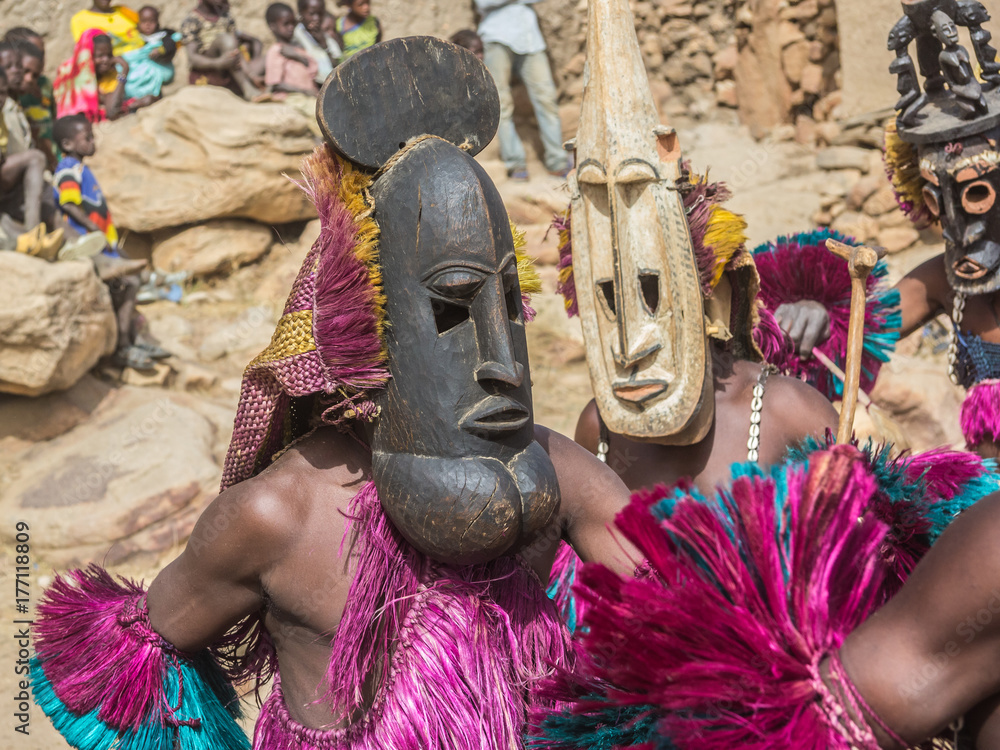
There is a moment in the Dogon *Dama* ceremony — the great funerary rite of the Dogon people of Mali's Bandiagara Escarpment — when the masks arrive at the edge of the village. They come from the bush, from the wild space beyond the boundaries of human habitation, and they come as entities rather than people: the men wearing them have ceased, for the duration of the ceremony, to be men. They are *imina* — spirits of the dead, or more precisely, the mediating presences through which the souls of the recently departed are guided from the village of the living into the country of the ancestors. The drums intensify. The crowd — the women and uninitiated, watching from a prescribed distance; the initiated men, closer, knowing what they know — falls into the particular collective state that the Dogon call the correct response to what is happening: alert, respectful, and fully aware that the boundary between worlds is, at this moment, genuinely thinner than usual.
To call the Dogon mask dance a "performance" is to use a word that imports assumptions that the ceremony systematically violates. Performance implies an audience distinct from participants, a separation between those doing and those watching, an aesthetic experience contained within the event's duration and released when it ends. The Dama is none of these things. It is a technical operation — as precise and consequential, in Dogon understanding, as surgery — in which the community collectively performs the work of releasing a soul from the world of the living so that it can join the community of the ancestors rather than remaining as a potentially dangerous ghost. The masks are the instruments through which this work is done. The dance is the mechanism. The aesthetic experience is inseparable from the theological operation: the beauty of what happens is evidence that the ceremony is functioning correctly.
The Bandiagara Escarpment: Geography as Theology
The Dogon have lived on and around the **Bandiagara Escarpment** — a sandstone cliff face approximately 150 kilometers long and up to 500 meters high in the Mopti region of central Mali — for at least six centuries, and possibly considerably longer. The escarpment's dramatic topography was almost certainly chosen for defensive reasons: the cliff faces provided natural protection against the slave-raiding and forced conversion campaigns that swept the West African savanna during the period of the great Sahelian empires and the subsequent expansion of Islam across the region. The Dogon, who practice a complex indigenous religion that has absorbed some Islamic surface features without transforming its fundamental character, retreated to the cliffs and maintained their cosmological and ceremonial traditions in relative isolation.
The landscape is not merely context for Dogon culture. It is constitutive of it. The cliff face, with its ancient granaries and dwellings of the **Tellem** — a people who inhabited the escarpment before the Dogon and who the Dogon regard as their spiritual predecessors — is where the dead are buried, in rock-cut tombs high on the cliff where only the initiated can reach them. The village, on the plateau or at the cliff's base, is the domain of the living. The bush — the uncleared land beyond the village boundary — is the domain of spirits and dangerous forces. The Dogon cosmological geography maps onto the physical landscape with the precision of a diagram: every social and spiritual category has its corresponding spatial zone, and the mask ceremony is, among other things, a regulated movement between these zones, bringing entities from the bush through the boundary into the village and guiding souls from the village boundary into the cliff where the ancestors rest.
The **Bandiagara Escarpment** was recognized as a UNESCO World Heritage Site in 1989 — one of the relatively few World Heritage sites inscribed for both its cultural and its natural significance, acknowledging that the Dogon cultural landscape and the physical landscape are inextricably connected. The inscribed site includes not just the archaeological remains of Tellem and Dogon habitation but the living villages where the ceremonies continue, making it simultaneously a heritage site and a functioning community — a classification that the site's managers and the Dogon communities themselves navigate with varying degrees of tension.
The Awa: The Society That Holds the Masks
Dogon mask culture is controlled by the **Awa** — a men's initiatory society whose membership is, in most Dogon communities, coextensive with initiated adult men. The Awa is not a voluntary association; it is the social institution through which Dogon men are constituted as full adult members of the community, equipped with the cosmological knowledge and ceremonial responsibilities that adult status carries. Initiation into the Awa is therefore not a choice but a developmental threshold — as structurally necessary as any other life transition.
The Awa's primary responsibilities are funerary: it is the Awa that performs the Dama ceremony, that maintains and brings out the masks, that controls the knowledge of mask construction and the ritual language associated with mask use. This knowledge — called **sigi so**, the "language of Sigi" — is a ceremonial register distinct from ordinary Dogon speech, used only in the context of mask ceremonies and transmitted only within the initiated community. It is not a secret in the sense of information deliberately concealed for competitive advantage; it is a specialized vocabulary that has no function outside its ceremonial context and that belongs, appropriately, to the people whose ceremonial responsibilities it serves.
The masks themselves are not permanently inhabited by spirits. Between ceremonies, they are stored in specific locations — mask sanctuaries in the cliff face, sometimes caves, sometimes dedicated structures — that are off-limits to the uninitiated. The care and maintenance of masks between ceremonies is the responsibility of specific lineages within the Awa, and the protocols for this maintenance — which materials can be used for repair, what can and cannot be touched, what ritual procedures precede handling — are as precisely specified as the ceremonial protocols for their use. A mask that is improperly maintained or incorrectly stored is not merely in poor condition; it is potentially dangerous, its spiritual charge not properly managed.
This is the aspect of Dogon mask culture that most fundamentally separates it from the category of "art" in which Western institutions have typically placed these objects. When Dogon masks entered European and American art markets in the late nineteenth and early twentieth centuries — through colonial acquisition, missionary confiscation, and commercial sale by individuals who may or may not have had the social authority to make such transactions — they left behind not just a cultural context but a set of ongoing responsibilities. A mask in a museum vitrine is, in Dogon understanding, a mask whose spiritual charge is unmanaged, potentially to the danger of whoever is in proximity to it, and certainly to the disruption of the ceremonial system from which it was removed.
The Dama: A Ceremony of Release
The **Dama** is the Dogon community's central funerary ceremony, held not immediately after a death but in a period — sometimes years — following it, when the family has accumulated the resources (primarily livestock for sacrifice and millet beer for distribution) and organized the community participation that the ceremony requires. The interval between death and Dama is the period during which the soul of the deceased is understood to remain in an intermediate state — present in the household, capable of causing both benefit and harm, not yet fully integrated into the community of ancestors. The Dama's function is to complete this transition.
In the days before the Dama begins, the community assembles. Relatives come from neighboring villages. The family of the deceased prepares the sacrificial animals and the millet beer whose distribution will be one of the ceremony's central social acts. The Awa prepares the masks — repairing any damage, refreshing pigments, rehearsing the dances that each mask requires, because different masks have different movement vocabularies and the execution of these correctly is a matter of ceremonial competence rather than personal expression.
The ceremony unfolds over multiple days, each with its prescribed sequence of events. The masks appear on the rooftop of the deceased's home, on the central plaza of the village, and at the site of the family's togu na — the men's meeting shelter whose low roof, permitting only seated posture, symbolizes the equality of those who deliberate beneath it. At each location, the masks perform in a specific sequence that follows the Dogon cosmological narrative: the creation of the world, the arrival of humanity, the establishment of the social order, and the correct relationship between the living and the dead that the Dama is enacting.
The dancers wearing the masks are invisible. This is not metaphor. The Awa's initiation teaches that when a man puts on a mask correctly, with the correct ritual preparation and in the correct ceremonial context, the man inside the mask ceases, for those purposes, to exist. The entity moving through the village is not a man in a mask. It is the spiritual presence that the mask embodies and channels. The women and uninitiated who watch the Dama from the prescribed distance are not watching men they know wearing wooden constructions. They are engaging with presences from the other side of the living-dead boundary, and their behavioral response — the specific forms of acknowledgment, respect, and avoidance that the ceremony requires — is engagement with those presences, not with the wood and fiber that makes them visible.
The Masks: A Vocabulary of the Cosmos
Dogon mask culture includes over seventy distinct mask types, each with its own cosmological significance, its own movement vocabulary in the dance, and its own position in the ceremonial sequence. Among the most significant:
The **kanaga** mask is the most widely recognized outside Dogon culture and the most complex in its symbolic content. Surmounting the face mask is a double-barred cross structure — two horizontal bars connected by vertical elements — that encodes the Dogon account of creation: the upper bar represents the sky world, the lower represents the earth, and the connecting structure represents the link between them, the axis along which creation descended from the divine to the material. The kanaga dancer's movements replicate this cosmology in motion: at the ceremony's critical moments, the dancer leans forward and sweeps the cross structure toward the earth, touching the ground with the mask's upper element, and then swings back upward — a gesture that enacts the connection of sky and earth, reiterating the structure of creation in the body's movement through space.
The **sirige** — the mask most immediately recognizable by its sheer scale — consists of a face mask surmounted by a plank that can reach four to six meters in height, carved with geometric patterns and painted in red, white, and black. The sirige appears only in the most significant Dama ceremonies and in the **Sigi** — the multi-generational ceremony that occurs every sixty years and represents the most complete expression of Dogon ceremonial culture. The dancer who wears the sirige moves the towering plank with controlled sweeps and oscillations that require extraordinary physical strength and balance, the plank's movement describing arcs through the air that other masks' shorter superstructures cannot achieve. The visual effect of the sirige in motion — the plank sweeping through space in gestures that reference the path of the ancestral ark in Dogon cosmological narrative — is among the most dramatic available in West African ceremonial culture.
The **satimbe** mask represents the primordial woman who, in Dogon mythology, discovered the masks and possessed them before the men took control of the institution. The mask is worn only by men, as all Dogon masks are, and its female subject matter is not ironic; it commemorates a mythological event that the ceremony's entire gender structure both acknowledges and reverses. The satimbe's presence in the Dama is a structural reminder that the ceremony's current form is historically contingent — that there was a time before the Awa's control, and that the institution's authority rests on a founding appropriation that the mythological tradition does not conceal.
Animal masks — the **buffalo**, the **antelope**, the **lion**, the **monkey** — represent the non-human species whose cooperation with the human community is part of the cosmic compact that the Dama reaffirms. Their presence in the ceremony is not decorative but functional: each species has a specific relationship to the Dogon cosmological order, and the mask-dancer embodying that species is activating and reaffirming that relationship as part of the ceremony's work of maintaining the correct order of things.
The Sigi: A Ceremony That Spans Generations
Beyond the Dama — which occurs whenever a sufficient accumulation of deaths in a community demands it — stands the **Sigi**, the great ceremonial cycle that unfolds across all Dogon communities over a period of seven years, moving from village to village in a prescribed geographic sequence, occurring once every sixty years. The last Sigi cycle ran from 1967 to 1973; the next is due to begin around 2027.
The Sigi's sixty-year periodicity has generated considerable scholarly attention, most of it focused on the question of whether this period corresponds to any astronomical cycle. The ethnographer Marcel Griaule, whose extended fieldwork with the Dogon in the 1930s and 1940s produced the foundational Western documentation of Dogon cosmology, reported that his Dogon informants — particularly the elder Ogotemmêli, whose extended conversations with Griaule are published in the book *Dieu d'Eau* (God of Water, 1948) — described detailed knowledge of the star Sirius's invisible companion star, later confirmed by Western astronomy as Sirius B, a white dwarf whose 50-year orbital period approximates the Sigi's sixty-year cycle.
The Sirius question has been one of the most contested in twentieth-century anthropology, with strong advocates for both the authenticity of Dogon astronomical knowledge and skeptics who argue that Griaule's methodology imported the knowledge he reported finding. The debate remains unresolved, and its resolution matters less for understanding the Sigi than the terms of the debate reveal: the investment that both sides made in whether the Dogon "really" knew something that Western science confirmed later reflects a particular set of assumptions about what constitutes legitimate knowledge, and those assumptions are worth examining.
What is not contested is the Sigi's ceremonial function and scale. It is the occasion on which a new generation of Dogon men is collectively initiated into the Awa, on which the authority of the masks is renewed, on which the great sirige masks are made new, and on which the entire community's relationship to its cosmological tradition is reaffirmed across the seven years of its unfolding. The Sigi is not an event. It is an era — a period in which the ordinary rhythm of life is inflected by the ceremony's demands, in which the movement of the ceremony from village to village creates a living map of Dogon communal identity, and in which the knowledge transmitted is understood to sustain the correct relationship between the living, the dead, and the divine for the following sixty years.
Marcel Griaule and the Complications of Documentation
No discussion of Dogon culture in the twenty-first century can avoid engaging with the figure of **Marcel Griaule** — the French ethnographer whose fieldwork in the 1930s, 1940s, and early 1950s produced the richest documentary record of Dogon cosmology available in Western scholarship, and whose methods and conclusions have been the subject of sustained and sometimes fierce critical examination.
Griaule's approach to Dogon culture was unusual for its era: he sought not the surface observation of behavior and material culture that characterized most colonial-period anthropology but the deep cosmological knowledge held by initiated elders. The account of Dogon cosmology he published — particularly in collaboration with Germaine Dieterlen — is extraordinarily detailed: a complete creation narrative, an account of the divine beings (*Nommo*) whose sacrifice established the world's current order, a specification of the symbolic meanings encoded in material culture from architecture to agricultural practice to the orientation of bodies in burial.
The criticism of Griaule's work — formulated most rigorously by Walter van Beek, whose own fieldwork with the Dogon in the 1990s found informants largely unfamiliar with the cosmological system Griaule had documented — raises genuine methodological questions. Did Griaule's sustained questioning of specific, unusually knowledgeable informants produce an account of the esoteric knowledge held by a small initiated elite? Or did the dynamic between the French researcher and his Dogon collaborators produce something more collaborative — a cosmological synthesis shaped in part by the questions asked, the framework imposed, and the desire of informants to satisfy the researcher's evident enthusiasm?
What van Beek's work did confirm, despite its challenges to specific claims in Griaule's account, is the vitality of Dogon ceremonial life: the masks, the Dama, the Awa, the structure of initiatory knowledge — these were present and functioning in the communities he studied. The cosmological framework may be more varied and locally specific than Griaule's account suggested. The ceremonial practice is real.
Security, Tourism, and the Ceremony's Future
The Bandiagara Escarpment region has faced severe security challenges since approximately 2015, as the jihadist insurgency that began in northern Mali spread southward and armed groups moved into the Mopti region where the Dogon heartland is located. The violence has included attacks on Dogon villages specifically, motivated by the communities' refusal to abandon their traditional religious practices and inter-community tensions that the insurgency has both exploited and intensified.
The consequences for Dogon ceremonial life have been severe. Tourism — which had brought international visitors to witness mask dances in controlled, community-managed contexts since the 1990s, and which had provided economic revenue that supported ceremonial maintenance — effectively ceased after 2015 as the region was placed on travel warning lists by most Western governments. Communities that had managed the tourism relationship with considerable sophistication, controlling what was photographed, which ceremonies were accessible to outsiders, and how visitor revenue was distributed, lost this income source entirely.
Despite these pressures, accounts from researchers and journalists who have maintained contact with Dogon communities report that the Dama ceremony continues to be performed, that the Awa's initiatory structure remains intact, and that the knowledge transmission that the ceremony depends on has not been interrupted. The tradition's survival under these conditions reflects the Dogon community's understanding that the ceremony is not optional, that the proper guidance of the dead into the ancestral community is a responsibility that cannot be suspended because the political situation is difficult.
What the Masks Carry
A Dogon mask, when it appears in the Dama, is carrying several things simultaneously: the spiritual presence it embodies and channels; the specific cosmological argument that its form makes visible; the physical skill of the dancer who wears it; the accumulated knowledge of generations of Awa members who have performed this ceremony before; and the community's collective investment in the transition being accomplished. It is carrying the dead person whose soul is being guided, and the grief of the people who loved them, and the structure of a cosmology that insists that death is not an ending but a transition between communities that remain in relationship.
None of this is accessible to a viewer who encounters a Dogon mask in a museum vitrine, separated from its context by thousands of kilometers and whatever transactions brought it there. The object in the case is the same wood and fiber and pigment as the object in the Dama, but it is doing nothing. It has been stilled. The knowledge that animated it — the dance, the song, the relationship with the deceased, the ceremonial sequence, the community gathered around it, the drums — is not in the object. It was never in the object. It was between the object and everything else.
This is the argument that Dogon communities make, with increasing directness, about the repatriation of masks held in European and American collections: not that the objects have spiritual value that Western institutions must be made to respect, but that the objects are incomplete — that they are fragments of a ceremonial system from which they were removed, and that their return to the community that can complete them would restore something that their current housing cannot provide.
The masks at Bandiagara are incomplete too — they will be complete again only when the drums begin and the dancers come from the bush, and the boundary between the living and the dead thins, and the work of release begins. The Dogon have been doing this work for centuries, under conditions that have included empires, slave raids, colonial administration, independence, drought, and armed insurgency. They are doing it still.
The dead require it. The living perform it. The masks move between.