The Currency That Remembers: Shell Money and the Living Economy of the Solomon Islands
The Currency That Remembers: Shell Money and the Living Economy of the Solomon Islands
The Langalanga Lagoon on the western coast of Malaita — the most densely populated island in the Solomon Islands chain — is where some of the Pacific's most skilled shell-money makers live on artificial islands they built themselves, centuries ago, from coral and stone piled onto the reef. The islands were constructed to escape the headhunting raids that plagued the mainland; the shell-money craft that developed on them became their economic survival strategy and eventually their most significant cultural export. Today, Langalanga shell-money makers are the primary producers of the most valued and widely circulated shell currency in the Solomon Islands — and they have been, without interruption, for over a thousand years.
This continuity is not ceremonial. Shell money in the Solomon Islands — called **rongo** on Malaita, **tafuliae** in other contexts, **bakia** in parts of the Western Solomons — is not a museum artifact hauled out for cultural festivals and then returned to storage. It circulates. It is used to negotiate bride prices, to compensate for injuries and deaths, to settle land disputes, to pay for traditional medical treatment, to mark the transition points of a life — birth, initiation, marriage, death — with a weight of meaning that the Solomon Island dollar, introduced in 1977, has never approached. Shell money does things that cash cannot do, and the distinction between what it does and what cash does tells you something essential about two entirely different theories of what an economy is for.
The Making: Craft as Social Investment
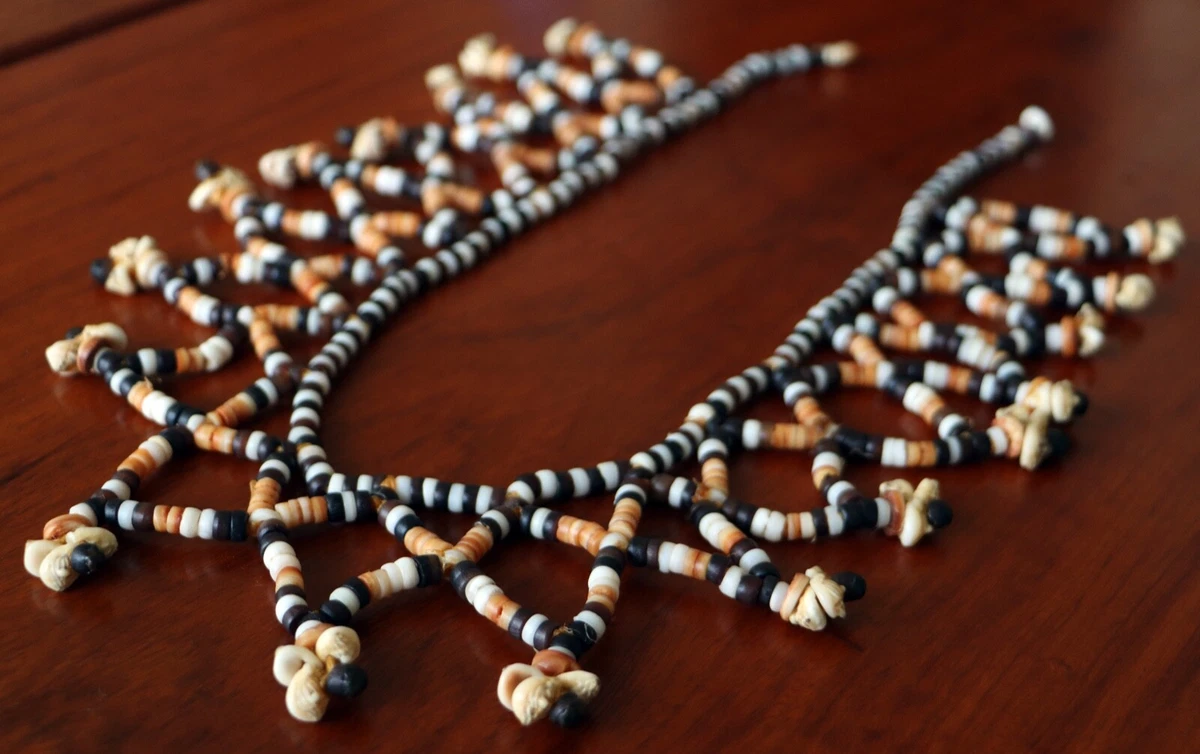
The production of shell money is a technical accomplishment of considerable difficulty, executed with hand tools, and its difficulty is not incidental to its value — it is the value's foundation. The most widely produced shell currency in Malaita uses three species of shell: the orange-red **chama** shell (*Chama pacifica*), which produces the most prized red discs; the white **trochus** (*Trochus niloticus*); and the black-banded **nassarius** shell for darker varieties. The production process begins with breaking the shell into rough pieces, then grinding each piece against a stone abrader — often coral — through stages of progressively finer grit until a disc of approximately five to eight millimeters diameter and one to two millimeters thickness emerges. Each disc is then drilled through the center using a hand-held iron or steel drill (historically, bone or shell drill bits were used) and strung in sequences of graduated color and size onto fiber cord.
The time investment is substantial. A single experienced maker can produce between 50 and 100 finished discs per day under good conditions — which means that a single strand of ten strings of 200 discs each (a common unit of tafuliae) represents weeks of a skilled person's work. The most valued strands — those where disc color, size, and texture are precisely graded from one end to the other, where the red achieves a specific depth that only the best chama specimens provide, where the drilling is perfectly centered in each disc — represent an aesthetic discrimination that takes years of practice to develop and that experienced recipients evaluate in seconds, running a strand through their fingers and knowing immediately whether what they hold is excellent or merely adequate.
This evaluation capacity is itself a form of cultural knowledge. The ability to assess shell money quality — to feel the difference between a strand produced carelessly and one produced with mastery — is distributed among community members who use it in the exchange contexts where that assessment matters. A bride price negotiation in which shell money is offered involves multiple parties who can all read the quality of what is presented, and who will register their assessments through the acceptance or rejection of specific strands, through negotiation over their equivalences, through the reputation that attaches to the family that offers excellent shell money and the diminished standing that attaches to the family that offers poor work dressed up as adequate.
Rongo, Tafuliae, and the Regional Currency Map
The Solomon Islands archipelago spans nearly 1,500 kilometers of the southwestern Pacific and contains over 70 language groups — a linguistic diversity comparable to that of Papua New Guinea, and one that reflects the islands' long history of relatively autonomous cultural development within a framework of inter-island trade and exchange. Shell money exists in multiple forms across this geography, and the relationships between these forms are themselves culturally significant.
**Tafuliae** — the stranded shell money most associated with Malaita and the Langalanga Lagoon producers — is the most widely recognized form and the one most frequently cited in anthropological literature. Tafuliae is measured in strings (*fatho*, approximately the span of an outstretched arm) and in bundles of strings, with the color grading of the discs determining the strand's value: red-dominant strands command the highest prices, white the lowest, with combinations and gradations producing intermediate values that experienced dealers assess holistically.
**Rongo** — a term used specifically on Malaita — refers to the same stranded shell currency but within the specific social and ceremonial context of Malaitan kastom (customary law and practice). The rongo is not simply a denomination of tafuliae; it is tafuliae embedded in the specific relational obligations and exchange protocols that Malaitan social organization has developed around it. The distinction between tafuliae as material object and rongo as social institution parallels the distinction between a dollar bill as a piece of paper and a dollar as a claim within a particular legal and social system — the material is the same; the institutional context is everything.
**Bakia** — the conus shell rings of the Western Solomons and parts of the Guadalcanal area — is a different form entirely: large rings cut from the spire of the conus shell, worn as jewelry and used in exchange, with their own value hierarchy based on size, thickness, and the particular species of conus they derive from. Bakia and tafuliae circulate in overlapping geographic areas and are sometimes exchanged against each other at locally established rates, creating an inter-currency market that operates through the knowledge of traders and exchange specialists rather than any formal institutional mechanism.
This regional currency map is not static. The relative prestige and purchasing power of different shell money forms has shifted over time in response to changes in production technology, migration patterns, and the specific social functions each currency serves. The introduction of steel drilling tools in the nineteenth century accelerated production significantly, affecting the scarcity that had previously structured value — a shift that Langalanga producers managed by emphasizing quality differentiation over mere quantity, maintaining value through craft discrimination rather than material rarity.
The Ceremonial Economy: What Shell Money Actually Buys
To describe shell money as a currency is accurate but insufficient, because the exchange systems within which it operates follow rules fundamentally different from those governing cash transactions in market economies. The most useful distinction is between **commodity exchange** — in which equivalent values are traded between strangers or near-strangers, completing the relationship rather than extending it — and **gift exchange** — in which the transfer of value creates ongoing relationships of obligation and reciprocity between parties whose connection the exchange is designed to sustain and deepen.
Shell money in the Solomon Islands operates primarily in the gift-exchange register, even when its transactions have the outward appearance of commercial bargaining. The most significant exchange contexts make this visible.
**Bride price** (*faanoa* on Malaita) is the most economically substantial regular use of shell money, and its logic is frequently misunderstood by outside observers who read it as a commercial transaction — the purchase of a wife — rather than what it actually is: a mechanism for creating, formalizing, and sustaining relationships between two kin groups that the marriage has joined. The shell money given by the groom's family to the bride's family is not payment for the bride. It is the material form of a relational commitment — the groom's family's acknowledgment of what it is receiving (a person, her labor, her children, her network of kin connections), and the bride's family's basis for ongoing claims on the new household. A bride price that has been paid creates obligations that run in both directions and that persist for decades, being recalled at funerals, land negotiations, and other moments where the relationship between the two kin groups becomes salient.
**Compensation payments** — *bata* — are the second major exchange context, and the one most directly tied to the political function of shell money as a conflict-resolution mechanism. When a death, injury, or serious offense occurs between members of different kin groups, the state's legal apparatus — courts, police, incarceration — is often inadequate to the relational damage that requires repair. A court verdict does not heal the relationship between two communities. A compensation payment, negotiated through customary law protocols that all parties understand and accept, can. The shell money transferred in a compensation payment is not a fine. It is a statement of sorrow, acknowledgment of responsibility, and commitment to restored relationship — with the material weight of the transfer providing a physical correlate for the relational gravity of what is being attempted.
The capacity of shell money to accomplish what cash cannot in these contexts is not mystical. It is structural: shell money carries the history of its production and previous exchanges in ways that cash does not. A specific strand of tafuliae that was part of a bride price two generations ago and that now appears in a compensation payment carries that history with it — the parties who know that history will read the strand differently than they read an anonymous quantity of currency. This mnemonic capacity of shell money — its ability to encode and transmit social history — is one of its most important functional properties and one that purely abstract currency systems cannot replicate.
The Kastom Economy: Shell Money and the Limits of Development Economics
The Solomon Islands is classified by the World Bank as a lower-middle-income country, with significant dependence on subsistence agriculture, artisanal fishing, and commodity exports (timber, fish, palm oil). Standard development economics frames the country's path to improved welfare in terms of market integration, formal-sector employment, and the expansion of monetary exchange into areas currently dominated by subsistence and customary activity.
This framework has a specific blind spot: it cannot see what the **kastom economy** — the parallel economic system organized around customary obligation, ceremonial exchange, and shell money — actually does for the people who participate in it, because it measures economic activity in ways that make the kastom economy invisible. A bride price negotiation involving thousands of shell money discs, sustaining relationships between two kin groups, creating ongoing obligations and entitlements, distributing resources across an extended network of contributors who will each benefit from future exchanges — none of this appears in GDP figures, tax records, or formal employment statistics. It is economically invisible to the development framework. It is not economically invisible to the people doing it.
Research by anthropologists including David Akin and Jonathan Friedman on Malaitan exchange systems has documented the kastom economy's scale and complexity in terms that contest the development economics dismissal. The shell money system functions as a form of social insurance — obligations created in one exchange are called upon in future difficulties, so that the network of exchange relationships a person maintains is also a network of potential support in crisis. It functions as a land tenure system — in a country where formal land titling covers only a fraction of land actually in use, customary land rights are established and maintained through the exchange protocols that shell money underpins. It functions as a legal system — compensation payments settle disputes that formal courts cannot access or would resolve inadequately. And it functions as a savings and investment system — shell money accumulated through productive exchange activity represents a store of value that can be deployed in future exchange obligations, functioning as capital in the sociological sense even when it is invisible to conventional economic accounting.
The development economist who argues that shell money should be replaced by cash — that the resources currently flowing through the kastom economy would be more efficiently allocated by market mechanisms — is making an argument that requires assuming away the specific things the kastom economy does. Markets are efficient at coordinating commodity exchange between parties who have no ongoing relationship. They are poor at creating and sustaining the social relationships that determine whether communities can survive bad years, resolve internal conflicts, and maintain the trust structures that make cooperative activity possible. The kastom economy, with shell money as its primary instrument, does those things. Replacing it with cash does not accomplish the same ends by more efficient means. It eliminates ends that cash cannot serve.
Tensions at the Interface: When Two Economies Meet
The coexistence of the kastom economy and the cash economy in the Solomon Islands is not peaceful. It is negotiated continuously, producing specific tensions that shape individual lives and community decisions in ways that neither economic system, taken alone, would predict.
The most immediate tension is temporal and financial. Kastom obligations — a bride price contribution, a funeral payment, a compensation component — arrive on schedules determined by social events rather than income cycles. A man working for wages in Honiara's formal sector may receive a contribution demand from his home community at a moment when his cash savings are depleted. Conversely, a period of successful shell-money accumulation does not translate into capacity to pay the cash-denominated costs — school fees, medical treatment, transport — that formal-sector participation requires. The person who is simultaneously embedded in both economies faces constant conversion problems, and the conversion rate between shell money and cash is not fixed, not transparent, and not controllable by any individual participant.
Young people navigating this interface face particularly acute versions of the tension. Education and formal employment require sustained commitment to a cash economy and a temporal logic — school calendars, wage schedules, career trajectories — that conflicts with the obligations of kastom participation. A young man who leaves his village for Honiara to pursue formal education and employment is not simply gaining opportunities; he is partially withdrawing from the exchange networks that his family's social standing depends on, and that withdrawal has costs that his cash income may or may not compensate. Communities that have lost significant proportions of their young adults to urban employment report declining capacity to fulfill kastom obligations, with consequences for the relational fabric that the exchange system maintains.
This tension has generated adaptation rather than simply dissolution. Remittances — cash sent by urban relatives to rural communities — are sometimes converted into shell money contributions when kastom obligations arise, with community members who maintain expertise in the conversion making that service available. Shell money itself has been adapted at the margins: some forms are increasingly produced for sale to tourists and collectors, creating a cash income stream for Langalanga producers while maintaining production skills that kastom exchange requires. The boundary between authentic kastom use and commercial production is managed by community protocols that attempt to distinguish the two, with varying success.
Climate, Conflict, and the Political Resilience of Shell Money
The Solomon Islands experienced a period of intense inter-communal conflict between 1998 and 2003 — the period Islanders call simply "the Tensions" — in which ethnic conflict between Malaitans and Guadalcanalese produced significant violence, displacement, and economic disruption. The conflict was partly about land access, partly about the political and economic advantages that Malaitan migration to Guadalcanal had produced, and partly about the deeper question of what kind of polity the Solomon Islands would be: whether formal state institutions or kastom structures would be primary.
The resolution of the Tensions — which involved Australian-led regional intervention in 2003 — required both formal and informal mechanisms, and the informal mechanisms were often more effective at the community level than the formal ones. Shell money compensation payments were part of the reconciliation process at the community level, following kastom protocols that gave the settlement a legitimacy and finality in customary law that court proceedings could not provide. Communities that had been in violent conflict with each other used shell money to rebuild the exchange relationships that violence had severed — because rebuilding those relationships was what reconciliation actually required, and because the kastom economy had the instruments that the formal legal system lacked.
This political function of shell money — its capacity to restore relationships and create binding commitments in contexts where state authority is limited or contested — is particularly relevant to the Pacific's current climate situation. The Solomon Islands faces significant climate vulnerability: rising sea levels, intensifying cyclones, and changing rainfall patterns are already displacing communities and creating resource pressures that have historically generated conflict. The capacity of customary exchange systems to manage conflict, redistribute resources, and maintain social solidarity may be among the most important resources available for communities navigating climate-induced stress. It is a resource that no development framework that treats the kastom economy as a pre-modern residue to be replaced by markets has any mechanism to strengthen.
Who Makes the Money Now: Gender, Craft, and Continuity
Shell money production in the Langalanga Lagoon has historically involved both men and women, with a gendered division of labor in which women perform the grinding and stringing while men handle the diving and collection of raw shells. Contemporary production reflects both the continuation of this division and its increasing modification: urbanization has drawn men away from communities, and women producers have taken on fuller production roles in response, with some female producers now handling the complete production process.
The transmission of production knowledge faces the same pressure as every specialized craft in a world where formal education and urban employment compete with apprenticeship at the family workshop. Young women who spend significant years in Honiara for education or employment may return to their communities with less production skill than their grandmothers developed, and the community's capacity to produce the quality of shell money that kastom exchange requires is affected by the aggregate of such individual decisions.
This is not simply a craft heritage problem. It is an economic infrastructure problem: the shell money system depends on a production base that can supply the exchange system's demands, and a production base that contracts or deskills cannot maintain the supply. Communities that have thought carefully about this have developed responses — mentorship programs within the Langalanga communities, cultural exchange visits that bring young people into extended contact with master producers, and deliberate documentation of production techniques — that reflect an understanding that the craft's continuity is the system's continuity.
What Money Remembers
The fundamental difference between shell money and cash is what each is designed to forget. Cash is designed to forget its history: the serial number on a banknote tells you nothing about who held it before you, what exchanges it passed through, what relationships it was part of. This amnesia is a feature, not a bug — it makes cash maximally liquid, maximally convertible, maximally useful for commodity exchange between strangers. The stranger you hand cash to asks no questions about where the cash came from; the cash's history is irrelevant to its value.
Shell money remembers. A specific strand of tafuliae from the Langalanga Lagoon carries in it the hands of the woman who ground its discs, the decisions she made about which specimens to include and which to reject, the exchanges it has passed through and the obligations it has created and discharged. Experienced handlers read some of this history in the strand itself — in the quality of the grinding, the color depth of the red discs, the fineness of the cord. Older strands whose provenance is known carry their history explicitly, in the accounts of the people who know where they have been.
This mnemonic capacity is what makes shell money a social technology rather than simply an economic one. A social system that needs to create and maintain relationships across time and between groups requires a medium of exchange that carries the memory of those relationships — that makes the history of exchange visible in the object of exchange itself. Cash, which is designed to erase that history, is the wrong tool for this work. Shell money, which is designed to carry it, is the right one.
The Langalanga Lagoon producers grinding discs on their artificial islands in Malaita's western waters are not preserving a relic. They are maintaining an infrastructure — the material foundation of a social system that has been managing relationships, resolving conflicts, and distributing resources in one of the Pacific's most complex inter-island environments for over a thousand years. The discs they produce today will carry new history — new bride prices, new compensation payments, new funerals and births and reconciliations — forward into the next generation of a system that has consistently demonstrated its capacity to adapt without losing the core of what it does.
What it does is remember. In an economy of memory, the shell is not a substitute for something better. It is the thing itself.