The Cows Come Home: Switzerland's Alpabzug and the Living Ritual of Alpine Life
The Cows Come Home: Switzerland's Alpabzug and the Living Ritual of Alpine Life
In the third week of September, something that has been happening in the Swiss Alps for at least a thousand years happens again: the cows come down from the mountains. The descent — called the **Alpabzug** in German-speaking Switzerland (or *désalpe* in the French-speaking regions, *dèsalp* in Romansh) — is technically a migration, the seasonal movement of livestock from the high summer pastures (*Alp* or *Alm*) back to the valley farms where they will spend the winter. It is practically a migration, involving hundreds of cattle, dozens of herdsmen, and the orchestration of multiple farms' animals across routes that traverse passes at 2,000 meters or more. And it is simultaneously a ceremony — one of the most visually spectacular and culturally dense seasonal rituals in European agricultural life.
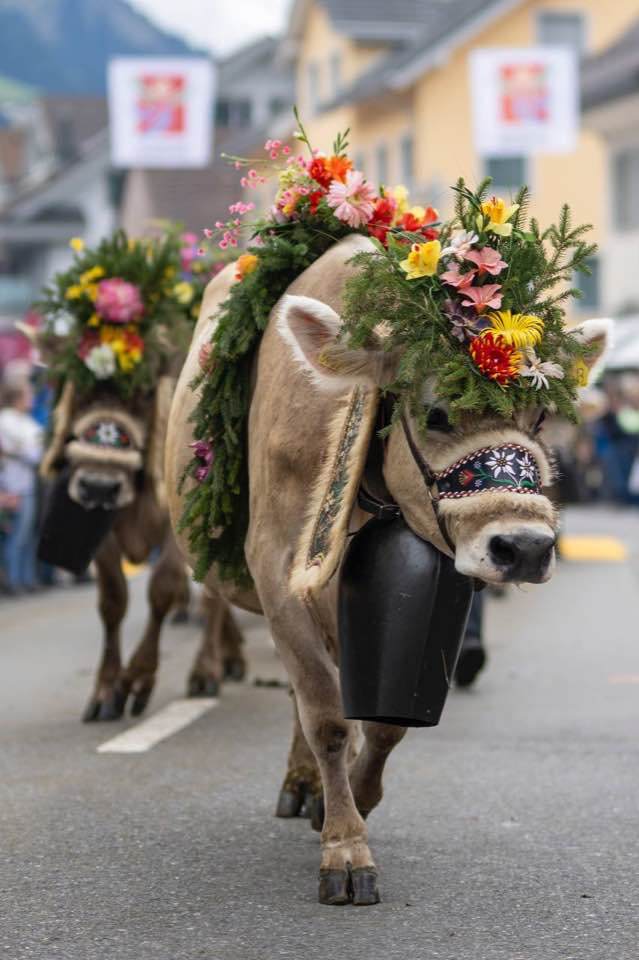
The cows that descend in the Alpabzug are not ordinary-looking cows. The lead cow of the herd wears a **Kopfschmuck** — a flower headdress that can stand 80 centimeters above her head, constructed from flowers (real and artificial), ribbons, mirrors, religious images, small figures, and the enormous ceremonial cowbell (*Treichel*) whose bass resonance can be heard for kilometers across the Alpine valleys. The headdress represents weeks of craft work by the herd's owner or the alp workers who tended the cattle over summer. It represents the health and productivity of the herd across the season — only a herd that spent the summer well, without serious illness or accident, earns the full ceremonial treatment. And it represents something harder to quantify but no less real: the pride of a farming tradition that has maintained its continuity across a millennium of political change, economic transformation, and the near-constant pressure of modernity to replace what works with what is newer.
The Alpabzug is Switzerland's most visible expression of a farming culture — **Alpine transhumance** — that shaped the Swiss landscape, economy, and national character in ways that the country's banking and watchmaking reputation has somewhat obscured. Understanding what the descending cows mean requires understanding what they did all summer, and why the mountains that hosted them are among the most intensively managed natural environments in the world.
Transhumance: The Vertical Migration That Made Switzerland
Alpine transhumance — the seasonal movement of livestock between valley winter quarters and high mountain summer pastures — is among the most ancient and most ecologically sophisticated agricultural systems in the world. It is practiced, in various forms, across every major mountain system in Europe (the Alps, the Pyrenees, the Apennines, the Carpathians), and its origins predate written history by millennia: pollen analysis from Alpine peat bogs has documented the presence of grazing livestock at high elevation during the summer months going back approximately 7,000 years.
The ecological logic of Alpine transhumance is elegant. The high Alpine pastures (*Alpen*) receive reliable summer precipitation and experience mild temperatures that produce the rapid grass growth of a short but intense growing season. They cannot be used in winter — snow cover makes them inaccessible and the vegetation disappears — but during the summer months, typically mid-June to mid-September, they produce a significant quantity of high-quality forage that would otherwise go ungrazed. The valley pastures and meadows, meanwhile, are allowed to rest and produce the hay crop that will feed livestock through the winter months. The rotation — summer in the high pastures, winter in the valley — optimizes the use of both ecosystems while preventing the overgrazing of either.
This rotational system has been in continuous practice in the Swiss Alps for long enough that the landscape it has produced is itself a cultural artifact. The **Bergwiese** (mountain meadow) of the Swiss Alps — the flower-rich grasslands photographed on chocolate boxes and tourism posters — is not a natural ecosystem in any simple sense. It is a managed one, produced by centuries of mowing, grazing, and the selective pressure of pastoral use that favors the flowering forbs and grasses that dominate these communities over the shrubs and forest that would otherwise reclaim the pasture. The Alpine meadow biodiversity that ecologists find so remarkable — up to 50 plant species per square meter in the best examples — is a product of the agricultural management that has maintained these meadows in an early successional state for centuries.
The cows that graze these meadows are not incidental to the landscape. They are the landscape's primary managers: their grazing prevents the encroachment of shrub species, their hooves maintain soil structure in ways that support the specific plant communities of the Alpine meadow, and the minerals in their dung are recycled into the pasture's nutrient cycle. A Swiss Alpine meadow without grazing cows is an Alpine meadow in the early stages of becoming an Alpine shrubland, and within decades it becomes a young forest. The Alpabzug — the ceremony of return — is therefore not simply the return of cows to their owners. It is the return of the agents who maintained the mountain landscape in the form that both the cows and the humans who own them require.
The Summer on the Alp: Three Months Above the World
To understand the Alpabzug, you must understand the Alpaufzug — the ascending journey that begins it — and the summer season on the high pastures that the Alpabzug concludes.
The **Alpaufzug** (alp ascent) occurs in mid-June, when the high pastures have shed enough snow and produced enough grass to support grazing. The ascent is itself a ceremony: the lead cow decorated with flowers and bell, the herd moving in convoy through village streets that come out to watch, the herdsmen carrying their equipment and the particular collective pride of a farming community dispatching its animals to the summer grounds. The ascent ceremony is the mirror image of the descent — the same visual elements, the same community participation, the same mixture of practical agricultural occasion and cultural ritual — and the two ceremonies frame a summer season whose character is unlike any other period in the Alpine farming year.
The summer on the high Alp is a world apart from the valley farm. The **Senner** or **Senn** (male alpine herdsman) and **Sennerin** (female) who tend the cattle through the summer months live in the **Alphütte** (alp hut) — typically a stone structure with minimal amenities, located at 1,500 to 2,500 meters elevation, accessible only on foot or by the unpaved track that serves the summer operation. Their work consists of moving the herd across the pasture as grass availability dictates, milking the cows twice daily, processing the milk into cheese and butter in the small dairy facility that most Alphütten include, and maintaining the pasture infrastructure — fences, water troughs, drainage channels — that makes efficient summer grazing possible.
The **Alpine cheese** produced in these summer huts — **Gruyère**, **Appenzeller**, **Raclette**, **Sbrinz** — represents the most economically significant transformation that the summer transhumance produces, and it is a direct product of the specific quality of the Alpine summer milk. Cows grazing on high Alpine meadows — eating a diverse botanical mixture that includes dozens of flowering plant species rather than the monoculture grass silage of intensive lowland dairy — produce milk with measurably different fatty acid profiles, higher concentrations of conjugated linoleic acid, and flavor compounds derived from the aromatic plants in the Alpine botanical mixture. The cheese made from this milk is quantifiably different from cheese made from lowland milk, and the **AOC (Appellation d'Origine Contrôlée)** designations that protect Swiss mountain cheeses specify not only production methods but the specific geographic range within which the milk must originate — the legal protection of a centuries-old understanding that place produces flavor.
The Bell: Sound as Cultural Identity
The cowbell (*Glocke* or *Treichel* in the ceremonial size) is the most acoustically distinctive element of the Alpabzug and one of the most culturally loaded objects in Swiss material culture. Swiss cowbells range from the small functional bells of everyday herd management — whose sound helps the herdsman locate animals in forested or fog-bound terrain — to the enormous ceremonial *Treicheln* worn by lead cows in the Alpabzug procession, which can weigh more than 10 kilograms and produce a deep, resonant sound whose specific harmonic character is immediately recognizable as Alpine.
The functional logic of cowbells predates the ceremonial use by centuries. In mountain terrain where visibility is limited by topography, vegetation, and weather, tracking a herd by sound rather than sight is the only reliable method of locating dispersed animals. The sound of cowbells moving through mountain landscape — the complex, overlapping harmonics of multiple bells of different sizes in a grazing herd — constitutes a specific auditory information system that experienced herdsmen can read with remarkable specificity: the pattern and rhythm of bell movement encodes information about whether the herd is grazing, moving, or resting, and irregular bell patterns signal disturbance.
The traditional Swiss cowbell manufacturers — primarily concentrated in the Saanen and Bern Oberland regions — produce bells by hand-forging sheet metal into the characteristic trapezoidal form and then tuning the completed bell by shaping the metal to produce the specific harmonic balance that gives each size of bell its characteristic sound. The craft requires both metalworking expertise and musical sensitivity: a well-made Swiss cowbell produces not a single tone but a complex harmonic cluster that changes character as the bell swings, and the best bells are those whose harmonic structure is most complex and most pleasing within the conventions of the tradition.
The large ceremonial *Treicheln* used in the Alpabzug are often heirloom objects — passed within families across generations, bearing the patina of decades of seasonal use, their specific harmonic character as familiar to the farm family as the sound of a specific person's voice. The bell worn by the lead cow in one family's Alpabzug procession may be the same bell that led the procession when the current farmer's grandparents were young, carrying in its worn metal the accumulated history of the farm's alpine seasons.
The Flower Headdress: A Season Reviewed
The **Kopfschmuck** (head decoration) worn by the lead cow in the Alpabzug procession is not a fixed design applied uniformly across all herds. It is a specific statement about the specific herd's specific summer — an assessment, made in flowers and ribbons and decorative elements, of how the season went.
A herd that completed the summer without serious illness or mortality wears the full ceremonial headdress: elaborate flower arrangements, the large ceremonial bell, mirrored elements, and the specific decorative motifs that the farm family has maintained as their tradition. A herd that suffered losses — a cow died, a calf was born dead, serious illness affected multiple animals — traditionally wears a modified or reduced headdress, sometimes with black ribbons replacing the bright colors, marking the season's difficulties in a public visual code that the community can read.
This communicative function of the headdress reflects the broader social transparency of traditional Alpine farming communities, in which the agricultural fortunes of individual farms were visible to and of genuine concern to the entire community. Neighboring farms whose summer pastures overlap, whose livestock graze adjacent territory, whose families have been intermarried for generations — these communities have a direct stake in each other's agricultural outcomes, and the Alpabzug's visual language makes those outcomes publicly legible without requiring explicit verbal communication. The decorated herd announces its own story.
The craft of headdress construction is a traditional skill maintained primarily by the women of farming families and by the Sennerin who spend the summer with the herd. The most elaborate headdresses involve weeks of preparation — sourcing specific flowers (edelweiss, alpine roses, and gentian are traditional favorites, supplemented by cultivated flowers whose colors and durability suit the design), constructing the armature that supports the arrangement above the cow's head, and assembling the complete decoration in a way that will survive the several-hour descent from the high pasture without losing its structural integrity.
The construction of a fine Kopfschmuck has become, in contemporary Swiss Alpine communities, a recognized craft skill that is taught at agricultural schools and demonstrated at competitions where the best headdresses from multiple farms are evaluated by experienced judges. The competition element — like the camel beauty contests of the UAE or the decorated float competitions of other harvest festival traditions worldwide — serves the social function of maintaining quality standards in the craft while providing a communal occasion for the display and evaluation of skill that the community's aesthetic tradition has accumulated.
Regional Variation: The Alps Are Not One Place
Switzerland's geographic and linguistic diversity — the country is divided among four language communities (German, French, Italian, and Romansh), nineteen major regional cultures, and an enormous range of Alpine topography — means that the Alpabzug tradition has distinct regional forms whose differences reflect the specific agricultural, social, and cultural conditions of each major Alpine region.
In **Appenzell** — the small, culturally conservative canton in northeastern Switzerland known for its direct democracy and strongly maintained folk traditions — the Alpabzug is perhaps the most elaborately ceremonial in Switzerland, with multiple herds descending on the same day and the local community turning out in traditional dress (*Tracht*) to receive the animals. The Appenzell Alpabzug has become something of a tourism event without losing its genuine agricultural character — the community participates because it is their tradition, not because visitors have arrived, though visitors are welcome to observe.
In **Graubünden** (Romansh: Grischun) — Switzerland's largest canton and its most linguistically diverse, where Romansh-speaking communities maintain a cultural distinctiveness that sets them apart from German and Italian Switzerland — the Alpabzug takes forms shaped by the specific agricultural geography of the region's high, relatively inaccessible valleys. The Romansh word *dèsalp* carries the same meaning but a slightly different cultural register: the Romansh-speaking farming communities of the Engadine and surrounding valleys have maintained their alpine traditions within a language community that has itself fought for survival against the dominance of German, making the tradition a carrier of linguistic as well as agricultural identity.
In the **Bernese Oberland** and **Valais** regions — the central Alpine zones that contain Switzerland's highest peaks and its most dramatic agricultural landscapes — the Alpabzug routes traverse terrain so demanding that the procession itself is a physical achievement. Some descents involve crossing passes at 2,500 meters, managing cattle through narrow rocky paths above sheer drops, and timing the movement to clear the high terrain before afternoon weather — the Alpine thunderstorms that can develop rapidly in the high mountains during September — makes the descent dangerous. The physical challenge of the descent in these regions gives the Alpabzug a character of genuine hardship navigated and completed that the more accessible descents of lower terrain do not quite share.
The Senn and Sennerin: Alpine Subculture
The alpine summer created, over centuries, a specific human subculture: the men and women who spent the summer on the high Alp, isolated from valley community life, responsible for the herd and the dairy operation, developing over generations a specific body of knowledge, specific social norms, and a specific relationship to mountain landscape that valley dwellers, even those in neighboring farms, did not share.
The **Sennerin** — the female alpine dairyworker — occupies a specific and somewhat paradoxical position in Swiss Alpine cultural history. The alpine summer placed women in a position of considerable autonomy and responsibility that the valley farm's more gender-divided social structure did not: managing the dairy operation, making decisions about herd movement, maintaining the hut and equipment, and developing expertise in alpine ecology that was recognized and valued by the farming community. The Sennerin's traditional figure in Swiss folk culture carries both the romance of mountain freedom and the reality of a demanding, isolated working environment.
The **Alphorn** — the instrument most associated internationally with Swiss Alpine culture — originated in the communication needs of the alpine summer. The alphorn's extraordinary length (traditional instruments are three to four meters long and produce a fundamental tone in the very low bass range) projects sound across the characteristic distances of Alpine terrain, and its use for signaling between distant pastures, for calling the herd, and for communicating between separated members of the alpine workforce reflects the practical acoustic requirements of a landscape where human voices cannot carry reliably across the distances that herd management requires.
The tradition of alpine music — the **Kuhreigen** (cow reigen, traditional alpine melodies associated with summoning the herd), the **Jodel** (yodeling, whose technical demands and characteristic sound reflect the acoustic properties of Alpine terrain), and the alphorn repertoire — developed specifically in the context of the alpine summer and carries the emotional register of that specific environment: the loneliness, the freedom, the specific quality of mountain light, the particular character of distance that open alpine landscape produces.
The Alpabzug Today: A Living Traditio