The Country That Kept Its Wine Underground: Moldova's Cellar Heritage and the Politics of Survival
The Country That Kept Its Wine Underground: Moldova's Cellar Heritage and the Politics of Survival
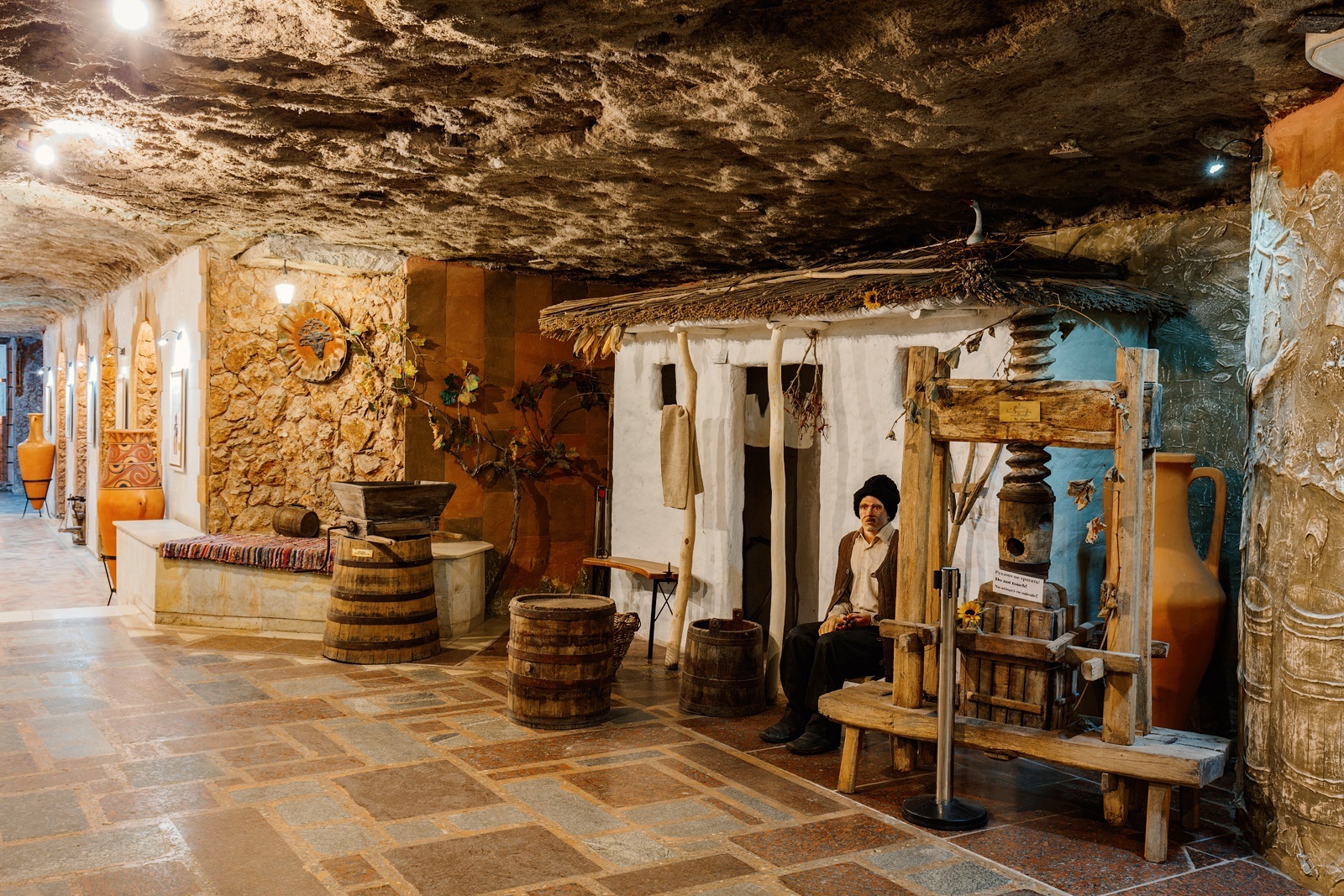
Beneath the limestone hills northeast of Chișinău, the capital of Moldova, there is a city. It has streets — named for the wines stored along them: Cabernet Street, Chardonnay Street, Pinot Street — and those streets are wide enough for a car to drive through, which visitors to Cricova frequently do, touring the cellar complex behind the wheel of their rental vehicle like a surreal underground road trip through the world's most unusual municipal planning decision. The city has a population of zero permanent human residents and approximately 1.25 million bottles of wine.
Cricova is one of Moldova's great underground wine cellars, carved from the limestone that was quarried here in the fifteenth century to build Chișinău, leaving behind a network of galleries and chambers extending approximately 120 kilometers beneath the earth. Mileștii Mici, the other great Moldovan underground complex south of the capital, runs for approximately 200 kilometers and holds approximately 1.5 million bottles — enough to hold the Guinness World Record for the largest wine collection in the world. Between the two complexes, and the dozens of smaller underground facilities scattered across the country, Moldova maintains underground approximately 10 million liters of wine in various stages of aging — a quantity that seems implausible for a country smaller than Belgium with a GDP smaller than many mid-sized American cities.
The question of why Moldova — one of Europe's smallest and poorest countries, without a coastline, without major natural resources in the conventional sense, perpetually contested between larger powers and perpetually uncertain about which power will define its future — maintains this extraordinary underground wine archive requires understanding not just the country's geography and climate but its history: specifically, the relationship between winemaking and survival in a civilization that has spent most of its recorded history being someone else's territory, and that has stored its most valuable things underground because underground was the only place they might be safe.
Five Thousand Years in the Vineyard
Moldova's winemaking tradition is among the oldest in the world — archaeological evidence from sites in the Carpathian-Pontic region (the area that now includes Moldova and neighboring Ukraine) documents grape cultivation and wine production going back approximately 5,000 years, predating written history in the region and connecting contemporary Moldovan winemaking to the very earliest European viticulture.
This deep antiquity is not simply a tourism talking point. It reflects a genuine ecological reality: the territory of modern Moldova, situated between the Prut and Dniester rivers in the southeastern slopes of the Carpathian foothills, is among the most favorable natural environments for viticulture in the entire Eurasian wine-growing belt. The combination of a continental climate moderated by the Black Sea's influence (approximately 400 kilometers to the southeast), well-drained soils ranging from clay-limestone to black earth (*chernozem*), and 300 or more days of annual sunshine produces growing conditions that viticulturalists compare favorably to Burgundy and Bordeaux — with the critical difference that Moldova's vines are substantially cheaper to farm and its wines substantially cheaper to buy, which has historically been either a disadvantage (when competing for market position with established French and Italian appellations) or an advantage (when competing for the cost-conscious segments of the global wine market that Moldova has primarily served).
The indigenous Moldovan grape varieties — **Fetească Albă** ("white maiden"), **Fetească Neagră** ("black maiden"), **Fetească Regală** ("royal maiden"), **Rară Neagră**, and the Cypriot-origin **Viorica** — represent a viticultural heritage of considerable genetic diversity that predates the introduction of the French international varieties (*vinifera* varieties including Cabernet Sauvignon, Merlot, Chardonnay, and Sauvignon Blanc) that dominate Moldovan commercial production. The indigenous varieties encode in their genetic diversity the accumulated selection of five millennia of Moldovan viticulture: grapes adapted to the specific soil, climate, and disease-pressure conditions of this specific landscape in ways that imported varieties cannot replicate. The current movement among Moldovan winemakers toward the indigenous varieties — driven by the premium natural wine market's appetite for distinctive, place-expressive wines — is, in a genuine sense, a return to the archive.
The Limestone Gift: How the Cellars Came to Be
The specific material that makes Moldova's great underground wine complexes possible is limestone — the soft, easily quarried, temperature-stable rock that underlies much of central Moldova and that was the primary building material of early Chișinău. The limestone quarrying that built the capital created the underground galleries that would eventually hold the wine. The relationship is symbiotic in a way that speaks to the particular character of Moldovan resourcefulness: the quarrying operation produced both the building material above ground and the storage space below it, and the subsequent generation recognized that what had been left behind — the cool, constant-temperature, humidity-stable underground space — was the ideal environment for long-term wine storage.
Wine stored underground in limestone galleries maintains a constant temperature of approximately 12°C (54°F) throughout the year, regardless of the extreme seasonal temperature variation above ground — Moldova's summers can exceed 35°C, its winters can drop below -20°C. This thermal stability is the single most important environmental condition for long-term wine aging, more important than any other single factor in determining whether a wine held for decades develops the complexity and integration that makes extended aging worthwhile. The natural thermal stability of the Moldovan limestone cellars provides, without any artificial climate control, the conditions that the world's most prestigious wine cellars — in Burgundy, in Champagne, in Bordeaux — achieve through expensive engineering.
The humidity in the limestone galleries is equally stable — approximately 95-97% relative humidity, the ideal range for maintaining cork seals without excessive moisture that would damage labels and wooden cases. The darkness is absolute — no ultraviolet light that would degrade wine compounds over time. And the size of the galleries — carved to the dimensions required for horse-drawn carts moving construction limestone, which turns out to be exactly the size required for motor vehicles moving wine pallets — makes the logistics of managing a collection of millions of bottles practical in a way that cramped conventional cellars are not.
The Cricova and Mileștii Mici complexes were both developed in their current wine-storage form during the Soviet period, when the Moldovan Soviet Socialist Republic's wine industry was organized into large state enterprises that needed facilities scaled for industrial production and storage. The scale of the facilities reflects Soviet production ambitions; the quality of what those facilities now contain reflects the specific decisions made within and around the Soviet system by the people who actually understood wine.
The Soviet Chapter: Mass Production and Hidden Quality
The Soviet period (1940-1991, with the interruption of 1941-1944) is the most complicated chapter in Moldovan wine history, and the one whose consequences most directly explain the current character of the great underground cellars.
The Soviet wine industry in Moldova was organized around the same principles that Soviet agriculture applied to everything: scale, standardization, and the subordination of quality to quantity. Moldova was designated the primary wine-producing republic of the Soviet Union, and its wine industry was systematically scaled to supply the enormous demand of the Soviet population for cheap table wine. At its peak, Moldovan Soviet wine production reached approximately 12-14 million hectoliters per year — more than France's total annual production — and the wine was produced in quantities that required the industrialization of every aspect of viticulture and winemaking: mechanized harvesting, stainless steel fermentation tanks replacing oak barrels, early bottling to maximize throughput, and blending across vineyards and varieties to achieve consistency at the expense of specificity.
The industrial wine system produced wine that was, at its best, adequate and at its worst, actively unpleasant, and it destroyed much of the accumulated traditional knowledge of Moldovan winemaking in the process — the specific vineyard management practices, the indigenous variety cultivation, the small-scale fermentation and extended aging techniques that had produced the quality wines for which Moldovan territory was historically known.
But something else was happening within and alongside the industrial system. The great underground cellars — Cricova most significantly — were being used by the Soviet system for the production and storage of not only mass-market table wine but of sparkling wine (*Izabella*, the Soviet sparkling wine that was a luxury item in the Soviet consumer economy) and of limited quantities of genuinely high-quality still wines that were produced through traditional methods and aged for years or decades in the underground galleries. These high-quality wines were not for the Soviet mass market; they were for the Soviet elite.
The **Cricova collection** that survived the Soviet period includes bottles from decades of high-quality production that were stored in the cellars specifically for the use of Soviet leadership. The story that Hermann Göring's wine collection, looted from France during the Second World War, ended up in Cricova's cellars is widely told and partially documented — though the full extent and current location of any such collection within the Cricova complex is a matter of ongoing historical investigation. What is documented is that Soviet-era Cricova maintained a collection of international wines alongside its own production, including wines from the French estates that Soviet trade relationships occasionally made available, stored in dedicated sections of the underground complex.
Yuri Gagarin, the Soviet cosmonaut who became the first human in space in 1961, visited Cricova and was reportedly so enchanted by the underground complex that he missed his evening flight back to Moscow — a story that Cricova's marketing has embraced with understandable enthusiasm, and that reflects the complex's reputation even within the Soviet period as something genuinely unusual within the Soviet landscape of cultural institutions.
Gorbachev's War and What Survived It
The most catastrophic episode in recent Moldovan wine history is Mikhail Gorbachev's anti-alcohol campaign of 1985-1988 — the most aggressive state prohibition measure attempted in any major country since American Prohibition, and the most destructive event in the history of Soviet wine production.
The campaign — launched with genuine public health intentions but implemented with the blunt force of Soviet administrative action — ordered the reduction of Soviet alcohol production by two-thirds and the physical destruction of vineyards across the Soviet Union's wine-producing regions. In Moldova, the campaign resulted in the destruction of approximately one-third of the republic's vineyards — approximately 80,000 to 100,000 hectares of established vines, some of them decades old, uprooted by government order. The specific loss of old vines — vines that had been producing wine for thirty, forty, or fifty years, whose root systems had reached deep into the soil and whose canopies had developed the complexity of mature plants — represented a viticultural heritage loss that took decades to begin recovering.
The anti-alcohol campaign's administrators did not, however, have perfect control over everything that happened in the underground cellars. The wines already in storage in Cricova and Mileștii Mici were protected from the campaign's destruction orders partly by bureaucratic inertia, partly by the difficulty of accessing and inventorying the full underground collections, and partly — if the accounts of people who worked in the industry during this period are to be believed — by the active efforts of individuals within the wine enterprise who understood what was being asked to be destroyed and found ways to delay, obscure, and protect their most significant holdings.
The bottles that survived Gorbachev's campaign represent, therefore, a specific kind of survival: the survival of things hidden and preserved specifically because the people who held them understood that the authority ordering their destruction was temporary and would pass, while the wine, if protected, would remain. This is the same logic that underlies the great underground cellars' entire function in Moldovan cultural history — the wine stored underground is wine protected from the volatility of the political world above it.
The Russian Embargo and the Turn Toward Europe
In 2006, Russia — Moldova's primary export market, which had been absorbing approximately 80% of Moldovan wine exports — announced a total ban on Moldovan wine imports, citing food safety concerns. The ban was widely understood as a political instrument rather than a genuine food safety measure: it came at a moment of specific tension between Russia and Moldova over Moldova's orientation toward the European Union, and it followed a similar Russian wine ban against Georgia, which had also been moving toward a closer European relationship.
The Russian embargo was economically devastating for Moldovan wine producers who had structured their entire production for the Russian market — cheap, high-volume table wine in formats and styles suited to Russian consumer preferences. The short-term consequence was severe: unsold wine, closed or near-closed wineries, lost export revenue that had been a primary source of income for the many Moldovan families dependent on the wine industry.
The medium-term consequence was transformative. The closure of the Russian market forced Moldovan wine producers — for the first time in their modern commercial history — to compete in the European and global premium wine market rather than the Soviet and post-Soviet mass market. This forced competition required a total rethinking of production: shifting from high-volume table wine to lower-volume premium wine, developing the specific quality controls and wine-style profiles that European and North American consumers expected, and building the marketing and distribution relationships with Western importers that the Russian market had never required.
The producers who navigated this transformation most successfully discovered something that the Soviet mass-production period had obscured: that the best Moldovan wines — the single-vineyard, indigenous-variety, small-production wines made from the old vine plots that survived the Soviet period and Gorbachev's campaign — were genuinely competitive with European premium wines at their price points, and that the specific character of Moldovan terroir produced wines with a distinctiveness that the globally homogenized premium wine market increasingly valued.
The Russian embargo that was intended to punish Moldova's European orientation inadvertently accelerated the transformation of Moldovan winemaking into the kind of quality-oriented, terroir-expressive industry that could actually compete in the European market. The wine that Russia tried to shut out found new markets in France, Germany, the United Kingdom, and the United States — and found there audiences who had never tried Moldovan wine and discovered it to be considerably more interesting than their assumptions about former Soviet wine production had led them to expect.
The Small Winemakers: The Counter-Archive
Against the backdrop of the enormous underground collections of Cricova and Mileștii Mici — the industrial-scale heritage — a parallel development in Moldovan wine culture represents an equally significant story: the emergence of small, artisanal, quality-focused wineries that have developed since independence and particularly since the mid-2000s, when the Russian embargo forced the reconsideration of Moldovan wine's identity.
These small producers — wineries like **Château Vartely**, **Purcari** (whose history predates Moldovan independence by nearly two centuries, founded in 1827 and producing wines that were historically served to the Russian Imperial court and to Queen Victoria), **Crama Ceptura**, and dozens of smaller operations — represent a return to the pre-Soviet model of wine production: specific vineyards, traditional varieties, careful fermentation, and extended aging that produces wines with the place-specific character that the industrial system deliberately erased.
The natural wine movement has found an unexpected ally in Moldovan winemaking: the combination of ancient indigenous varieties, old-vine material that survived Soviet clearance, organic viticulture methods that were standard before the Soviet industrialization introduced agro-chemicals, and limestone and clay soils that produce wines with the mineral character that natural wine enthusiasts prize has made Moldova one of the more quietly exciting locations in the contemporary natural wine world. Small Moldovan producers who grow Fetească Neagră on old vines in clay-limestone soils and ferment with wild yeasts without additives are producing wines that compare favorably, in specific terms of place-expression and vitality, to wines from the most prestigious natural wine producers of the Loire Valley and Burgundy — and at a fraction of the price.
Wine Tourism Underground: The Experience of the Cellar
The visitor experience of the great Moldovan underground cellars is, by any measure, extraordinary — and the specific quality of the experience is difficult to capture in description for the simple reason that descending into 200 kilometers of underground gallery requires physical presence to appreciate at the appropriate scale.
Cricova's visitor program involves an underground tour in electric vehicles through the named wine streets, stopping at the tasting hall and various cellar sections for wine sampling and explanation of the collection's history. The experience of moving through the underground city — the cool air, the stone-carved walls, the long perspective of the gallery ceiling receding ahead, the sense of descending into something permanent and serious — is nothing like visiting a conventional winery above ground. It is closer to the experience of visiting an underground archive or library: the sense of being in the presence of things that have been deliberately protected from the world above, preserved specifically because the world above could not be trusted to preserve them.
Mileștii Mici offers a similar experience at larger scale — the 200-kilometer extent of the galleries cannot be covered in a single visit, and the visitor experience is necessarily selective. The oldest bottles in the Mileștii Mici collection date to the 1960s, and the specific sections of the gallery where these are stored have an atmosphere of accumulated time that is hard to replicate in any newer wine environment. The bottles, in their specific shapes and labels and the slightly dusty condition of things that have been in one place for decades, are the most concentrated physical record available of Moldovan winemaking across the Soviet period and into independence.
What Moldova Is Saying
Moldova is a country of approximately 2.6 million people, approximately 400,000 of whom live outside the country as labor migrants. It is, by most economic measures, Europe's poorest country. It has spent the past three decades navigating a position between the Russian influence sphere that its Soviet history connected it to and the European integration that its geography and cultural heritage pull it toward. In 2022, Moldova applied for EU membership, and its candidacy has been actively advanced in the context of the broader European security disruptions of that year.
In this context, the underground wine cellars are not merely a tourist attraction or an agricultural asset. They are a statement about what Moldova is and what it intends to continue being: a civilization with a five-thousand-year relationship to a specific piece of land, expressed most completely in the cultivation of vines and the making of wine; a country that has survived every empire and every prohibition and every embargo by keeping its most valuable things underground, where the political volatility of the surface world cannot reach them; and a people who have learned, from five millennia of necessity, that the most durable investment is the one stored in darkness, at stable temperature, under the limestone hills, waiting for the conditions on the surface to be right for its emergence.
The wine will outlast the embargoes. The cellars will outlast the regimes. The vines, if tended, will outlast everyone currently arguing about what Moldova should be.
In the meantime, the temperature underground is a steady 12°C, the humidity is maintained, the darkness is absolute, and in a gallery whose walls were carved from limestone that was used to build a city six hundred years ago, a bottle from 1968 is slowly becoming something that the 1968 winemaker who made it could not have fully anticipated: a document of persistence, a record of survival, and a message from a civilization that chose, when the world above was uncertain, to put its faith underground.