The Art of Tribal Face Painting in Papua New Guinea Culture
A Thousand Faces, A Thousand Nations: The Living Art of Papua New Guinea
There is no country on earth quite like Papua New Guinea in one specific and staggering respect: it contains, within its borders, approximately 850 distinct languages — roughly twelve percent of all languages spoken on the planet — belonging to communities so geographically isolated by its mountainous terrain that neighboring valleys sometimes developed entirely separate vocabularies, separate cosmologies, and separate visual languages over thousands of years of parallel existence. When the first European explorers reached the Highlands in the 1930s, they encountered communities that had never seen a wheel, a metal tool, or a person from outside their immediate region — and who had, in that isolation, developed artistic traditions of extraordinary complexity and sophistication.
The face was their canvas. It still is.
To call Papua New Guinea's tribal face painting "art" is accurate but insufficient. It is a writing system, a legal document, a religious text, a military insignia, and a personal biography, all compressed into patterns of clay and charcoal and plant pigment applied to skin. Understanding what you are looking at when you see a painted face in the Highlands requires understanding that the face has been turned into a text — and that you are, almost certainly, illiterate in it.
The Isolation That Made Everything
Papua New Guinea's extraordinary cultural diversity is a direct product of its geography. The island of New Guinea — shared between Papua New Guinea to the east and the Indonesian province of Papua to the west — is the world's second-largest island, and its interior is dominated by the Highlands: a spine of mountain ranges rising to over 4,500 meters, cut by deep river gorges, blanketed in cloud forest, and for most of human history effectively impassable in any lateral direction. Communities settled into valleys and stayed there. Over millennia, they differentiated — linguistically, culturally, spiritually, artistically — into the 800-plus distinct peoples that the country contains today.
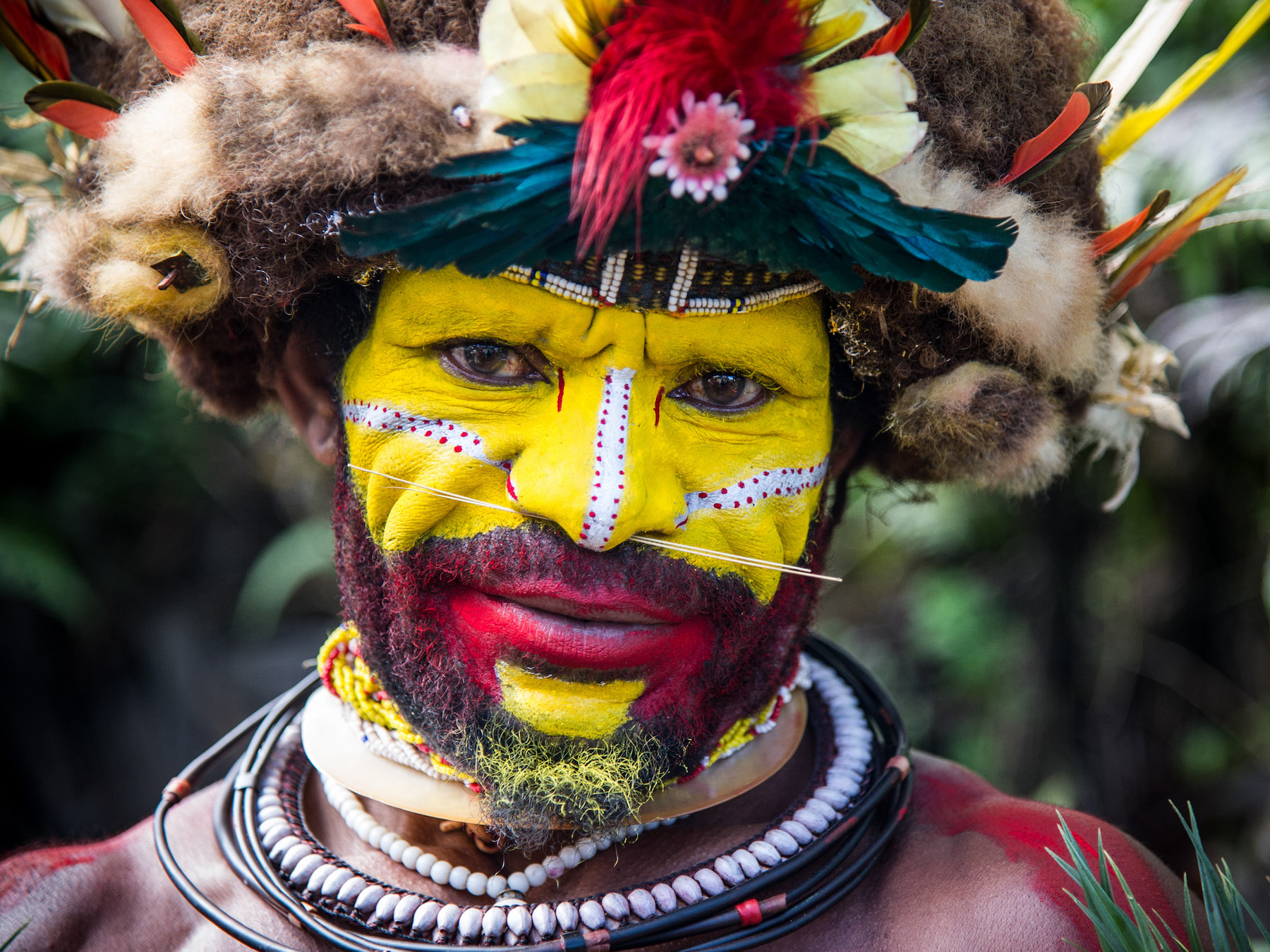
This is why there is no single tradition of face painting in Papua New Guinea. There are hundreds. The Huli Wigmen of the Southern Highlands paint their faces in brilliant yellow, red, and black, designs that frame eyes rendered enormous by the contrast of the surrounding color, producing faces of almost theatrical intensity. The Asaro Mudmen, from the Eastern Highlands, cover their entire heads in gray clay masks with elongated features, said to commemorate an origin story in which their ancestors rose from a river as spirits to frighten away enemies. The Sepik River communities of the north produce designs of geometric precision that echo the carvings on their haus tambaran — spirit houses — connecting the face to an entire architectural and spiritual vocabulary. Each tradition is a world unto itself.
The mistake that outside observers consistently make is to treat these as variations on a single practice. They are not. They are as distinct from one another as, say, Chinese calligraphy is from the Cyrillic alphabet — both are writing systems, both involve applying marks to a surface with skill and intention, but the similarities end there.
What the Paint Is Made Of and Why It Matters
The materials of traditional face painting are not chosen for convenience. They are chosen for meaning, and the sourcing of them is itself a practice embedded in relationships — to the land, to specific places, to the plants and minerals that those places produce.
The red ochre that appears in face painting traditions across the Highlands is iron oxide, found in specific clay deposits that are often owned, in the sense that particular communities have rights to harvest from them, and that carry their own histories and sometimes their own spiritual associations. The red it produces is not simply a color; it carries connotations of blood, vitality, and in some traditions, the realm of the living as opposed to the realm of the dead. To paint a face red is to make a statement about the living body's power.
Charcoal — typically made from specific burned woods rather than any available fuel — produces the deep blacks used for outlining, contouring, and creating the high-contrast effects that make painted faces visible at distance during ceremony. In the strong equatorial sunlight of the Highlands at a Sing-Sing gathering, a face painted in primary colors with black outlines reads from fifty meters away with the clarity of a heraldic shield. This is functional design: the face must communicate its message to anyone in the gathering who can read it, across the distance of a ceremonial ground.
White, produced from clay or lime, signals different things in different traditions but frequently connects to ancestors and to the spiritual world — in some communities, the faces of the newly dead are painted white before burial, and the same white appears on ceremonial faces as a way of inhabiting or invoking the ancestral realm. The boundaries between the colors of the living and the colors of the dead are permeable and intentional in ways that make the colors themselves carriers of theological meaning.
What is almost universally true across Papua New Guinea's face painting traditions is that the materials must come from the right place, prepared in the right way, by the right people. Substituting synthetic paint for ochre is not merely a practical shortcut; it is, in the context of the tradition, a category error — like writing a legal document in crayon and expecting it to be enforceable.
The Sing-Sing: Where the Faces Gather
The Sing-Sing is the event that most outsiders associate with Papua New Guinea face painting, and it is both a genuine cultural practice and a more complicated institution than it appears. The most famous, the Mount Hagen Cultural Show, has been held annually since 1964 in the Western Highlands Province, bringing together communities from across the region for a gathering that combines competitive display, inter-community diplomacy, and the deliberate assertion of cultural identity before an audience that now includes significant numbers of international tourists and photographers.
At a Sing-Sing, each group — a wantok group, meaning a community connected by shared language and kinship — presents itself as a unit, in matching or coordinated face paint, costume, and movement. The presentation is competitive in the way that a medieval tournament was competitive: partly about winning, but more fundamentally about demonstrating that your community has the resources, the knowledge, the social organization, and the spiritual authority to mount a performance of this quality. The face paint is part of that demonstration. To arrive at a Sing-Sing with faces poorly painted — designs executed without skill, colors improperly sourced, patterns that do not correctly represent your community's tradition — is a form of public embarrassment with real social consequences.
The Goroka Show, held in the Eastern Highlands, is older still, dating to 1957, and has been described by photographers and anthropologists as one of the most visually overwhelming events on earth: hundreds of groups in simultaneous procession, each face a distinct statement, the accumulated effect a kind of overwhelming visual polyphony in which every element is individually meaningful and the totality is beyond any single person's ability to fully read.
Reading a Face
Within a specific tradition — take the Huli of the Southern Highlands as an example — the information encoded in face paint is considerable. The Huli are famous for their elaborate wig men tradition, in which initiated men grow their hair for years specifically to have it cut and formed into a ceremonial wig decorated with feathers and flowers. The face paint worn with these wigs follows rules that vary by the specific ceremony, the status of the wearer, and the narrative the performance is meant to convey.
Yellow, for the Huli, is associated with the sun and with a quality of brightness or revealed truth. Red connotes blood, strength, and the warrior tradition. Black connects to the spiritual realm and to power that operates outside normal social boundaries. The specific patterns in which these colors are arranged — whether the face is bisected vertically, whether the nose is outlined in black, whether the eyes are surrounded by yellow circles or by red crescents — encode information that Huli viewers can read as fluently as a literate person reads text.
What is being communicated is not merely identity — though identity is part of it — but position within a system: age group, ceremonial status, specific role in the event being performed, the particular ancestors or spirits being invoked or honored, and sometimes specific achievements or obligations. A young man performing his first major ceremony will wear different designs from an elder who has performed it many times. A warrior face is differently constructed from a healer's face. The paint is a costume in the deepest sense: not a disguise, but a truthful statement about who the wearer is within the community's understanding of who a person can be.
The Pressure of the Present
Papua New Guinea gained independence from Australia in 1975, and the decades since have brought the pressures that independence brought to most post-colonial states: migration from rural areas to urban centers, the spread of Christianity (which has in some communities actively discouraged traditional ceremonial practice as incompatible with Christian belief), the intrusion of mobile phones and social media into communities that were isolated as recently as a generation ago, and the complex economics of tourism.
The tourism dimension is particularly double-edged. The revenue that the Sing-Sing festivals generate — from entry fees, from photography, from the hospitality industry that has grown around them — provides economic support to communities that need it and creates an incentive to maintain and perform traditional practices. It also creates incentives to perform for the camera rather than for the community, to simplify designs for visual impact rather than semantic precision, and to treat the ceremony as a product rather than a living practice.
The communities most vulnerable to this transformation are those closest to the major urban centers — Port Moresby, Lae, Mount Hagen — where the tourism economy is most developed and the traditional social structures that governed who could paint what, and when, and why, have been most eroded by migration and modernity. In the more remote valleys of the Highlands and the Sepik basin, where access is still difficult and tourism is minimal, the practices remain more fully embedded in their original context — practiced because they are necessary, not because they are photographable.
Several universities, including the University of Papua New Guinea, and international ethnographic institutions have ongoing documentation projects — recording designs, collecting oral histories about their meanings, creating archives that communities can access to reconstruct traditions that might otherwise be lost to inter-generational discontinuity. These projects are valuable, but they face the fundamental limitation of all archival work: a tradition documented in a database is not a living tradition. It is a specimen.
The Face as Archive
What makes Papua New Guinea's face painting traditions remarkable is not their visual spectacle — though that is real, and the photographs of painted faces from the Highlands are among the most arresting images in the ethnographic archive. What is remarkable is the information density: the fact that a practice requiring no writing, no printing press, no digital infrastructure has managed to transmit detailed, community-specific knowledge across generations in a medium that washes off with rain.
The transmission happens because the knowledge is not stored in the paint. It is stored in the people. The master painters of a community know not only how to execute the designs but why each element is placed where it is, what it refers to, what would happen — spiritually, socially — if it were changed. That knowledge passes from teacher to student in the practice of making, not in any document. Every time a young person sits before an elder who paints their face for a ceremony and watches and asks questions and eventually learns to do it themselves, the tradition survives.
This is both the strength and the vulnerability of oral and embodied cultural transmission. It requires living people in continuous relationship with one another, practicing together, not merely celebrating what was once practiced. The face paint washes off. The community that knows what it means must not.
Papua New Guinea has roughly 850 languages, hundreds of distinct face painting traditions, and — despite every pressure of the modern world — communities still painting their faces for reasons that have nothing to do with tourism, with documentation, or with global fascination. They are painting their faces because their ancestors painted theirs, because the spirits recognize the patterns, because the community sees itself reflected in the designs, because the ceremony demands it and the ceremony is not over.
The canvas washes away. The art continues.