Stone, Sky, and Eternity: What the Pyramids of Egypt Were Actually Built to Do
Stone, Sky, and Eternity: What the Pyramids of Egypt Were Actually Built to Do
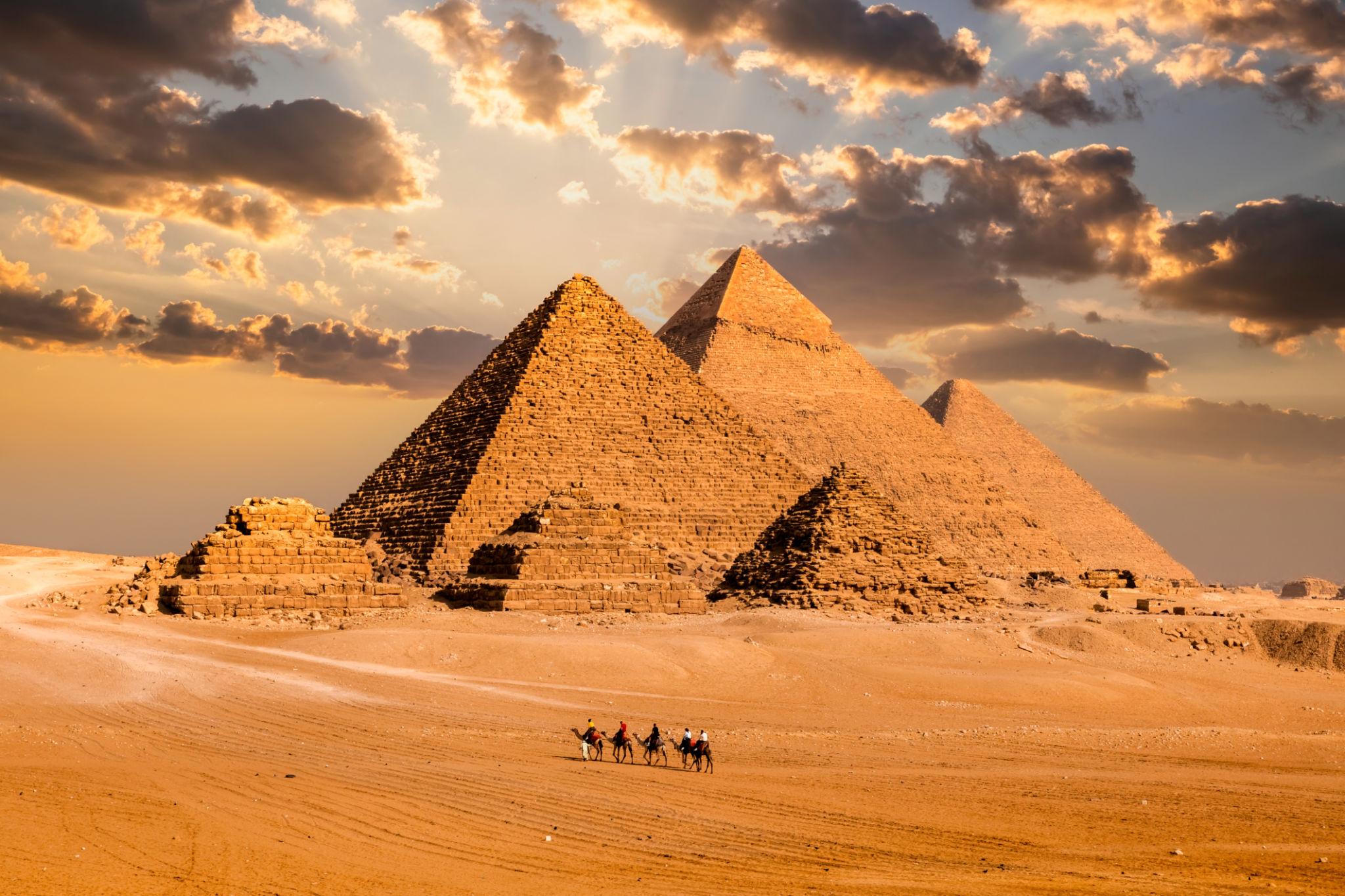
Stand at the base of the Great Pyramid of Khufu at Giza, close enough to touch the lowest course of limestone blocks, and the scale becomes briefly incomprehensible. The blocks at your feet are taller than you are. The pyramid rises above you at an angle so steep and so regular that it seems less like something built and more like something that emerged from the desert, a feature of the landscape that has always been there. This is, in a sense, what its builders intended: not a building in the ordinary sense, not a structure that provides interior space for human use, but a mountain — artificial, precisely shaped, and designed to exist at the intersection of the terrestrial and the divine for longer than any other human construction.
The Great Pyramid has stood for approximately 4,500 years. For 3,800 of those years it was the tallest structure on earth. It contains approximately 2.3 million stone blocks averaging 2.5 tons each, fitted together with a precision — the base level of the four sides varies by less than 2.1 centimeters across 230 meters of length — that modern construction engineers regard with something between admiration and disbelief. It was built without iron tools, without the wheel in any applied mechanical sense, without computers or precision surveying instruments as we would recognize them, and without the slave labor that popular culture has assigned to it. What it was built with — and what it was built for — is a story that four thousand years of scholarship has been progressively unraveling, and that remains in important respects open.
The Civilization That Could Do This
The Egyptian pyramids were not built by an isolated genius or a tyrannical singularity. They were built by a civilization — the Old Kingdom of ancient Egypt, roughly 2686 to 2181 BCE — that had been developing its political, theological, and technical capacities for several centuries before the first pyramid was attempted. Understanding the pyramids requires understanding the civilization that produced them, which means understanding something that modern minds find genuinely difficult: a society in which the boundaries between political authority, religious cosmology, and the practical organization of human labor were not merely blurred but did not exist as separate categories.
The pharaoh in Old Kingdom Egypt was not a king in the sense of a powerful human ruler with divine sanction. The pharaoh was a god — specifically, the living embodiment of Horus, the falcon deity of kingship, who became Osiris at death and whose resurrection guaranteed the annual Nile flood that made Egyptian agriculture possible and Egyptian civilization viable. This was not metaphor or political propaganda, though it was both of those things too. It was the operational cosmological framework through which the Egyptian state organized its relationship to the universe. The pharaoh's proper burial — with the correct spells, the correct material provisions, the correct architectural setting — was not simply a political concern. It was a cosmic necessity. If the pharaoh did not successfully transition to the divine realm after death, the Nile might not flood. The crops might fail. The world might not maintain its order against the chaos that perpetually threatened it.
The pyramid is the architectural expression of this cosmological necessity. It is not a tomb in the sense of a place where a body is hidden and preserved. It is a machine for transformation — a precisely shaped conduit between the earthly and the divine, designed to facilitate the pharaoh's resurrection and his ongoing relationship with the living world from the eternal realm he had entered.
Imhotep and the First Pyramid: The Invention of Monumental Stone
The history of Egyptian pyramid-building begins not at Giza but at Saqqara, the necropolis of the ancient capital of Memphis, where around 2650 BCE the architect Imhotep designed for Pharaoh Djoser the first monumental stone structure in human history: the **Step Pyramid**, a six-tiered structure of diminishing rectangular stages rising to approximately 62 meters above the desert floor.
Imhotep's achievement was not simply the construction of a large stone building — though that was an unprecedented technical accomplishment, requiring the development of new quarrying and transport methods and the organization of a workforce and supply chain at a scale Egypt had not previously attempted. His more radical innovation was the conceptual move from mudbrick to stone, and from flat-topped mastaba tomb (the rectangular mudbrick structures in which Egyptian nobles had been buried for centuries) to a stepped form that physically ascended toward the sky.
The theological logic of the step form was explicit: the staircase connected the dead pharaoh's underground burial chamber to the sky realm, providing a literal path of ascent toward the divine. The surrounding complex — walls, courtyards, chapels, a running track for the pharaoh's eternal jubilee (*sed*) festival — was designed not for the living but for the dead king's eternal use, a miniature royal city in stone that would function forever without physical inhabitants because its inhabitants were spirits.
Imhotep was deified after his death — one of very few non-royal Egyptians to receive this honor — and was worshipped for centuries as a patron of medicine and wisdom. His achievement at Saqqara was not just architectural; it was the demonstration that human ingenuity, applied to the problem of mortality, could produce something that outlasted both its maker and the civilization that commissioned it.
From Steps to True Pyramid: The Sneferu Experiments
The transition from step pyramid to the true pyramid — the smooth-sided triangular form that has defined "pyramid" in every language since — was not inevitable, and it was not achieved in a single stroke. It was the result of a series of experiments, at least two of which went dramatically wrong, conducted during the reign of Pharaoh Sneferu (approximately 2613 to 2589 BCE), Khufu's father and the most prolific pyramid-builder in Egyptian history.
Sneferu built at least three pyramids — possibly four — including the **Bent Pyramid** at Dahshur, whose lower half rises at a steep angle of 54 degrees and whose upper half, after an apparent recognition midway through construction that the lower angle would produce an unstable structure, abruptly changes to 43 degrees, producing the distinctive silhouette that gives it its name. The Bent Pyramid appears to have been a failure — not catastrophically, but sufficiently that Sneferu built a second pyramid at Dahshur, the **Red Pyramid**, at the gentler 43-degree angle throughout, which produced the first successfully completed true pyramid in Egyptian history.
The engineering significance of these experiments is considerable. The Egyptians were not following a received tradition when they built the first true pyramids. They were solving, in real time and at enormous scale, a set of structural engineering problems — optimal angle for stability, internal stress distribution, foundation requirements — that had no precedent. The Bent Pyramid's mid-construction angle correction suggests that Egyptian engineers detected structural problems through observation of actual deformation in the building and responded with a practical adjustment. This is empirical engineering — learning from failure and adapting — conducted in stone at the cost of enormous labor and resources, on the principle that the knowledge gained would enable the next attempt to succeed.
It did. The Red Pyramid's successful completion gave Khufu's architects the structural knowledge base to attempt, at Giza, the largest pyramid ever built.
Giza: The Mathematics of the Absolute
The **Great Pyramid of Khufu** at Giza is, by most measurements, the most precisely constructed large structure in human history. Its base is aligned to true north with an error of less than one-fifteenth of a degree — more precisely than the Paris Meridian, which was established with far more advanced instruments some 4,500 years later. The base's four sides vary in length by less than 7.9 centimeters across an average side length of 230.4 meters. The four corner angles vary from true right angles by an average of 0.05 degrees. These tolerances, achieved across a 5-hectare footprint in the middle of a desert, represent a degree of precision that the construction industry continues to study.
How this precision was achieved without GPS, theodolites, or steel measuring instruments is a subject of ongoing investigation. The tools available to Khufu's engineers included: straight wooden rods, set squares, plumb bobs and levels, sighting instruments using the stars, and — most importantly — sophisticated mathematical knowledge encoded in practical methods. Egyptian mathematics as preserved in the Rhind Mathematical Papyrus and other documents demonstrates command of geometry, ratio calculation, and the practical arithmetic of large-scale construction. The pyramid's slope angle — approximately 51.8 degrees — corresponds to a seked ratio (the Egyptian measure of slope, expressed as horizontal displacement per vertical unit) of 5.5 palms per cubit, a ratio that appears in mathematical texts as a standard construction proportion.
The **Giza complex** encompasses two further major pyramids — those of Khufu's son Khafre and grandson Menkaure — along with the Great Sphinx, multiple smaller queen's pyramids, workers' villages, boat pits, causeways, and valley temples, all integrated into a single planned necropolis that was developed over approximately a century. The site's overall layout has been analyzed for astronomical alignments: the three main pyramids of Giza are positioned to replicate the three stars of Orion's Belt as they appeared in the Egyptian sky around 10,500 BCE, a hypothesis proposed by Robert Bauval that remains debated but has contributed to the recognition that the Giza complex was designed with astronomical intent that went beyond the simple cardinal alignments of individual structures.
The Workers: The Real Builders of Eternity
The most consequential revision to popular pyramid mythology of the past four decades is the archaeological demolition of the slave labor theory. The claim that the pyramids were built by slaves — a narrative originating with Herodotus in the fifth century BCE, propagated by biblical conflation with the Book of Exodus, and perpetuated in film and popular culture ever since — has been definitively contradicted by physical evidence.
In 1990, a tomb complex near Giza was accidentally discovered that proved to belong to the pyramid builders. Subsequent excavations by Zahi Hawass and Mark Lehner revealed a permanent town of considerable size — bakeries, breweries, fish-processing facilities, copper tool workshops, administrative buildings, and burial grounds — that housed the workers who built Khufu's pyramid. The burials are especially informative: the workers were interred with care, in mudbrick tombs with grave goods and inscriptions that identify them as proud participants in a great royal project. The skeletons show evidence of significant physical strain — arthritis, healed fractures, worn joints consistent with heavy labor — but also evidence of medical care: bones show healed fractures with signs of setting, and at least one skeleton shows evidence of a successful amputation surgery. These were not slaves abandoned to their fate. They were workers whose bodies were treated as worth maintaining.
The administrative records found at Giza — particularly the Diary of Merer, discovered in 2013 at the port of Wadi al-Jarf and dating to the reign of Khufu, the earliest papyrus documents yet found in Egypt — provide direct evidence of the logistics of pyramid construction. The diary, written by a middle official named Merer who supervised a team of approximately 40 men, records the transport of limestone from the Tura quarry across the Nile to Giza, detailing quantities, travel times, and the provisioning of the team with food and equipment supplied by the state. The system it describes is not slave labor but organized labor: workers on rotating assignment from communities across Egypt, fed, housed, equipped, and compensated by the state in exchange for labor service as a form of taxation.
Current estimates suggest a peak workforce of 20,000 to 30,000 organized workers at Giza, with a permanent skilled core of perhaps 5,000 and a rotating pool of several times that number engaged in quarrying, transport, and basic construction tasks. The organization required to manage this workforce — the supply chains for food, water, copper tools, ropes, and timber; the scheduling of rotating teams; the quality control that produced the pyramid's extraordinary precision — was itself among the most sophisticated administrative achievements of the ancient world.
The Great Sphinx: Monument and Mystery
The **Great Sphinx of Giza** — the leonine figure with a human head that guards the eastern approach to the Giza plateau — is among the most studied and most debated monuments in Egyptology, generating controversy on questions ranging from its date of construction to the identity of the face it bears to the meaning of its specific siting and orientation.
The mainstream scholarly consensus dates the Sphinx to the reign of Khafre, approximately 2530 BCE, based primarily on its position adjacent to Khafre's causeway and valley temple and on stylistic analysis of the head's facial features, which bear resemblance to statues of Khafre. The Sphinx's body was carved directly from the bedrock of the Giza plateau — a single piece of living rock shaped into a crouching lion approximately 73 meters long and 20 meters tall, making it the largest surviving monolithic sculpture in the world.
The Sphinx's orientation is significant: it faces east, toward the rising sun, and its siting positions it to witness the sun rise directly between the Khafre and Khufu pyramids as seen from its perspective on the equinoxes. In the Egyptian theological tradition, the lion was associated with the horizon deity Hor-em-akhet (Horus-of-the-Horizon, rendered in Greek as Harmachis) — the solar force that rises from and descends into the horizon in the daily cycle of creation and regeneration. The Sphinx may have been understood not as a portrait statue of Khafre but as an embodiment of this solar force, a permanent guardian of the horizon whose leonine body referenced the power of the sun and whose human face referenced the divine aspect of the king who erected it.
The question of water erosion on the Sphinx's body — argued by geologist Robert Schoch to indicate that the Sphinx was exposed to significant rainfall erosion consistent with a date considerably earlier than the Old Kingdom — remains one of Egyptology's most active controversies. Mainstream Egyptologists counter that the erosion patterns can be explained by other mechanisms and that no corroborating archaeological evidence supports a pre-dynastic construction date. The debate is unresolved.
The Pyramid Texts: Speaking to the Dead Sky
The interior of the Great Pyramid of Khufu is, famously, almost entirely blank — the granite-lined King's Chamber and the lower chambers are undecorated stone, their walls uncarved and unpainted. This absence of inscription has contributed to the persistent public confusion about what pyramids are, since the lavishly decorated tombs of the Valley of the Kings — a thousand years younger than Giza — are what most people visualize when they think of Egyptian royal burial.
The transition to inscribed pyramid chambers began with Pharaoh Unas of the Fifth Dynasty, around 2350 BCE, whose pyramid at Saqqara contains the first appearance of what scholars call the **Pyramid Texts**: the oldest surviving corpus of religious literature in the world, a collection of spells, hymns, and ritual instructions carved into the limestone walls of the burial chamber and antechambers in vertical columns of hieroglyphs, designed to facilitate the dead king's resurrection and his passage through the dangers of the Duat (underworld) to his place among the imperishable stars.
The Pyramid Texts' content reveals the theological framework that the pyramid itself embodied. The dead king is addressed as Osiris — god of the dead and of resurrection — and instructed through a series of spells that protect him from malevolent forces, provide him with provisions, open the gates of the sky, and ultimately unite him with Re, the sun deity, whose daily circuit from east to west and back through the Duat was the template for the royal soul's journey. The pyramid's point, in this theology, is the place where the dead king's soul exits the earthly realm and enters the stellar one — specifically, where it joins the circumpolar stars, which never set below the Egyptian horizon and were therefore understood as "the imperishable ones," the permanently living dead.
The northern shaft in the King's Chamber of the Great Pyramid is precisely aligned, at its angle of inclination, to have pointed toward the circumpolar star Thuban (the pole star of 2500 BCE) at the time of construction. The dead king, lying in his sarcophagus, was aligned with the chamber's south shaft, which at the same period pointed toward the star Alnitak in Orion's Belt — identified by Egyptians as the belt of Osiris. Whether these alignments were deliberate remains debated, but the astronomical precision of the overall complex makes astronomical intentionality the more economical explanation.
After the Pyramids: A Tradition That Transformed Itself
The Old Kingdom pyramid-building tradition did not simply end. It transformed. The enormous resource demands of royal pyramid construction — which had consumed a significant proportion of the Egyptian state's surplus production for over a century — became unsustainable as the Old Kingdom's central authority weakened in the late third millennium BCE. After the Old Kingdom's collapse around 2181 BCE and the intermediate period that followed, the Middle Kingdom pharaohs who reunified Egypt built pyramids that were smaller in scale, using mudbrick cores faced with limestone, reflecting both reduced resources and a modified theology of royal burial.
The New Kingdom (approximately 1550 to 1070 BCE) — the era of Tutankhamun, Ramesses II, and the great temple complexes of Karnak and Luxor