Famadihana: Inside Madagascar's Ritual of Dancing with the Dead
Famadihana: Inside Madagascar's Ritual of Dancing with the Dead
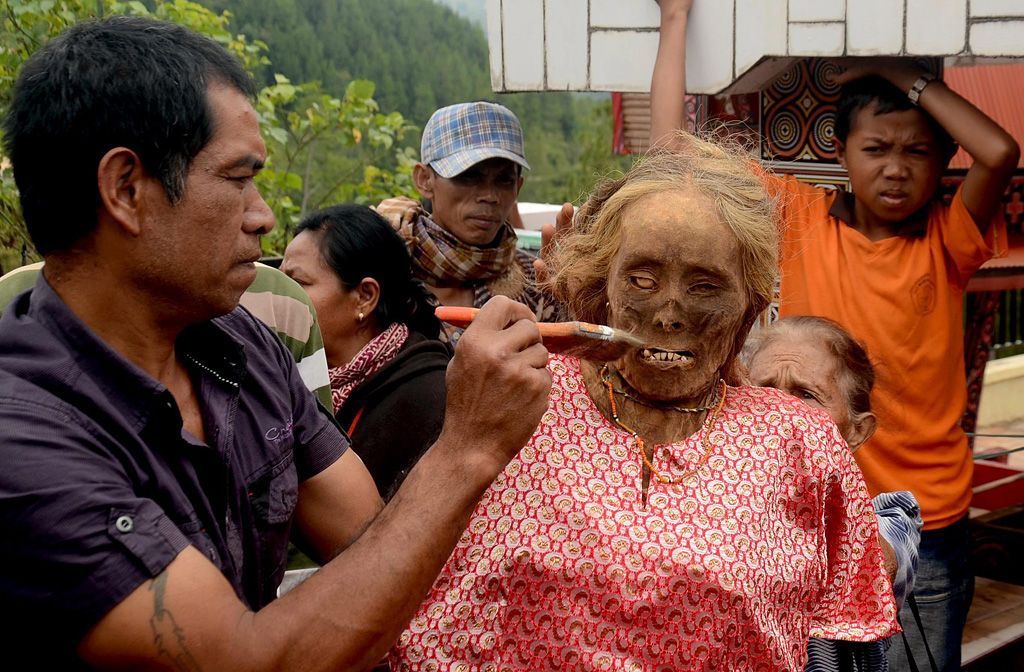
In the central highlands of Madagascar, a family gathers outside a whitewashed tomb built into a hillside. A brass band plays. Someone has brought rum. Children run between the legs of aunts and uncles who haven't seen each other in years. Then the tomb is opened, and a wrapped bundle — the remains of a great-grandmother, dead for decades — is lifted into the sunlight and carried, shoulder-high, into a wave of dancing relatives
This is Famadihana, literally "the turning of the bones." To an outsider, the scene reads as unthinkable: exhuming the dead, unwrapping them, rewrapping them in new silk shrouds, and parading them through a crowd of celebrating descendants. But among the Merina and Betsileo peoples of Madagascar's central highlands, Famadihana is not a violation of death. It's a rejection of the idea that death is final at all.
A Different Timeline for the Dead
Western funerary logic treats burial as an endpoint — the body goes into the ground, and that, more or less, is that. Malagasy highland cosmology works on a longer and more patient clock. Death, in this framework, is a process rather than an event. The newly deceased are considered dangerous, unstable, still tethered to the world of the living, prone to bringing misfortune if not properly managed. It can take years — sometimes a generation — for a body to complete its transition into razana, a revered ancestor who has fully joined the collective dead and taken up a protective, almost divine role in the life of the family.
Famadihana is one of the primary rituals that moves a person along this timeline. Every five to seven years, a family will return to the ancestral tomb, remove the wrapped remains of relatives, and literally handle them — rewrapping the bones in fresh lamba mena, the red silk shrouds traditionally reserved for the dead, before returning them to the tomb, often in a different position or location within it. The dancing that accompanies this — set to hired brass bands playing everything from traditional highland music to, increasingly, contemporary pop — isn't disrespect. It's an invitation for the ancestor to enjoy one last, tangible encounter with the family before being resettled.
The Architecture of Memory
To understand why this ritual makes sense on its own terms, it helps to look at where it happens. Merina and Betsileo tombs are not modest headstones in a distant cemetery. They are substantial, expensive structures — stone or concrete buildings, sometimes multi-chambered, built directly into hillsides near the family's ancestral village, or tanindrazana ("land of the ancestors"). Highland families will often invest more in a tomb than in the house they live in. A Malagasy proverb captures the priority directly: the house is for the living, but the tomb is for eternity.
This is not incidental architecture. It reflects a worldview in which land, lineage, and the dead are inseparable. Owning ancestral land isn't primarily about farming rights — it's about having somewhere to put your dead, and by extension, somewhere your descendants will keep returning to perform Famadihana for you. Families who have moved to Antananarivo or emigrated abroad will still travel back to the highlands for these ceremonies, sometimes at considerable expense, because failing to do so risks severing the relationship between the living branch of the family and its ancestral root.
Why the Bones Are Turned
The mechanics of the ceremony reveal its underlying logic. A Famadihana typically begins with formal permission — the family consults an ombiasy, a traditional astrologer-diviner, to determine an auspicious date, almost always during the dry winter months between June and September, when the ground is firm and the harvest is in. Word spreads through the extended family and village; a Famadihana can draw hundreds of guests, and hosting one is a significant financial undertaking involving new shrouds, a hired band, and enough food and rum to feed everyone who comes.
On the day itself, the tomb is opened and the wrapped bodies are brought out one at a time. Each is unwrapped from its old shroud — which has often decayed after years underground — and the remains, by this point mostly skeletal, are rewrapped in a new lamba mena. Family members will sometimes speak to the deceased directly during this process, updating them on family news: a birth, a marriage, a grandchild's success in school. The rewrapped bundle is then carried above the heads of dancing relatives, circling the tomb multiple times — traditionally an odd number of circuits — before being laid back to rest.
What looks like chaos is carefully structured. The order in which relatives are exhumed, the direction of the dancing, the placement of each body within the tomb — all of it follows customary rules specific to each family and region. This is not improvised revelry. It's a liturgy.
The Colonial Collision
Famadihana's history carries a real tension worth sitting with. When French colonial administrators and Christian missionaries arrived in Madagascar in the 19th century, they viewed the practice with a mixture of horror and fascination, and pushed hard against it — missionaries in particular saw it as incompatible with Christian teaching on death and resurrection. Yet the ritual didn't disappear. Instead, something more interesting happened: it absorbed Christianity rather than being erased by it. and enough food and rum to feed everyone who comes.
On the day itself, the tomb is opened and the wrapped bodies are brought out one at a time. Each is unwrapped from its old shroud — which has often decayed after years underground — and the remains, by this point mostly skeletal, are rewrapped in a new lamba mena. Family members will sometimes speak to the deceased directly during this process, updating them on family news: a birth, a marriage, a grandchild's success in school. The rewrapped bundle is then carried above the heads of dancing relatives, circling the tomb multiple times — traditionally an odd number of circuits — before being laid back to rest.
What looks like chaos is carefully structured. The order in which relatives are exhumed, the direction of the dancing, the placement of each body within the tomb — all of it follows customary rules specific to each family and region. This is not improvised revelry. It's a liturgy.
The Colonial Collision
Famadihana's history carries a real tension worth sitting with. When French colonial administrators and Christian missionaries arrived in Madagascar in the 19th century, they viewed the practice with a mixture of horror and fascination, and pushed hard against it — missionaries in particular saw it as incompatible with Christian teaching on death and resurrection. Yet the ritual didn't disappear. Instead, something more interesting happened: it absorbed Christianity rather than being erased by it.
Today, the overwhelming majority of highland Malagasy identify as Christian, and many of the same families who attend Sunday Mass will, a few years later, unwrap their grandmother's bones and dance with her through the village. Priests sometimes participate in or bless Famadihana ceremonies outright. This isn't hypocrisy or incomplete conversion — it's a genuine synthesis, one where ancestor veneration and Christian faith are understood as operating on different, non-competing registers. The razana watch over the family's daily fortunes; God and the church handle the soul's ultimate fate. Anthropologists studying religious syncretism elsewhere in the world rarely find as clean and durable a fusion as Madagascar's highlands have managed to sustain for over a century.
The Economics of Honoring the Dead
There's a practical dimension to Famadihana that's easy to miss amid the spectacle: it is expensive, and increasingly so. A single ceremony — silk shrouds for multiple family members, a band, food and drink for hundreds of guests — can cost the equivalent of several months' income for a rural highland family. Families sometimes take out loans or sell livestock specifically to fund a Famadihana. This has made the practice a genuine flashpoint in contemporary Madagascar, where roughly three-quarters of the population lives below the poverty line.
Some younger, urbanized Malagasy — and some evangelical Christian denominations that have grown rapidly in recent decades — have begun questioning whether the expense is sustainable or theologically necessary, and Famadihana ceremonies are reportedly becoming less frequent in and around the capital. Conversely, in more rural highland communities, the ritual remains a non-negotiable social obligation, one that reinforces status, maintains land claims, and — perhaps most importantly — pulls scattered family networks back together on a fixed, recurring schedule. In a country where economic pressure has pushed increasing numbers of people toward cities or abroad, Famadihana functions as something close to a mandatory family reunion, with the ancestor as the honored guest who makes attendance non-negotiable.
A Health Question the Ritual Has Had to Confront
Famadihana has faced a more recent and more serious challenge than economics or theology: plague. Madagascar is one of the few places on Earth where bubonic and pneumonic plague still occur in regular outbreaks, and in 2013, Malagasy and international public health researchers identified direct handling of infected remains during Famadihana ceremonies as a contributing factor in disease transmission. The finding put health officials in a genuinely difficult position — Famadihana is not a fringe practice easily legislated away; it is a core expression of highland Malagasy identity, kinship obligation, and religious life.
The government's response has been notable for what it didn't do: rather than attempting an outright ban, which would likely have failed and provoked backlash, Madagascar's health ministry has run public education campaigns encouraging safer handling practices and discouraging exhumation of bodies that died from plague-like symptoms, while otherwise leaving the ritual intact. It's a case study in the limits of top-down public health intervention when it collides with practices this deeply woven into social and spiritual life — you cannot regulate away a ritual that defines how a society understands death itself.
What Famadihana Actually Argues
Strip away the specifics — the highland geography, the lamba mena, the brass bands — and Famadihana is making a claim that most cultures have, in one form or another, made at some point: that the dead are not gone, merely relocated, and that the relationship between the living and the dead is ongoing, maintained, and reciprocal rather than severed. Where Western mourning practices tend to emphasize letting go, moving on, achieving closure, Famadihana insists on the opposite — periodic, physical, joyful re-engagement.
This is worth taking seriously rather than filing under "fascinating cultural practice." Grief researchers have increasingly moved away from the old "stages of grief" model toward frameworks that emphasize continuing bonds — the idea that healthy grieving doesn't require severing a relationship with the deceased but rather transforming it. Highland Malagasy families arrived at a structural, communal, ritualized version of this idea generations before it became a subject of Western psychological research. The bones are turned not because the family has failed to accept death, but because they've built an entire social architecture around accepting it on their own terms: slowly, physically, and together.
That's the real content behind the ceremony's more sensational surface. Famadihana isn't a curiosity about what people do with corpses. It's a working answer to a question every culture has to solve somehow — what obligation, if any, do the living owe the dead — and Madagascar's highlands have answered it by refusing to let the relationship end at the grave.
.