Bark That Becomes Memory: The Tapa Culture of Niue and What It Holds
Bark That Becomes Memory: The Tapa Culture of Niue and What It Holds
The island of Niue rises from the South Pacific like a fortress — a raised coral limestone plateau with no harbour, no reef lagoon, no gentle beach approach. The ocean meets the island in cliffs, chasms, and surge pools carved by millennia of wave action into rock so ancient and specific to this place that nowhere else on earth has quite the same geology. Niue is one island, not an archipelago. One main settlement, Alofi. A population, at last count, of approximately 1,600 people — which makes it the smallest self-governing nation associated with the United Nations, smaller than many village communes, smaller than the catchment population of most secondary schools.
And yet Niue has a tapa tradition.
Not a reconstructed one, not a heritage-tourism performance, not something retrieved from museum archives and taught to schoolchildren as a cultural lesson. A living tradition, practiced by women who learned it from their mothers, whose mothers learned it from theirs, across a chain of transmission that extends back to the Polynesian navigators who settled this isolated limestone platform somewhere between 900 and 1000 CE and brought with them, among everything else they carried across open ocean, the knowledge of how to beat the inner bark of certain trees into a cloth that would carry the marks of their civilization.
That cloth — called **hiapo** in Niuean — is the subject of this article. But hiapo is never only what it is literally. In Niue, as in every Pacific culture that has maintained its bark cloth tradition, the cloth is also a record, a ceremony, an identity document, and increasingly, a declaration of survival. To understand Niuean hiapo is to understand something essential about what a culture does when everything — geography, history, emigration, modernity — conspires to make it disappear.
The Making: Bark, Stone, and Time
Hiapo is made from the inner bark of the paper mulberry tree (*Broussonetia papyrifera*), called *hiapo* in Niuean — the tree lending its name to the cloth produced from it, a conflation that signals how completely the material and the practice are identified with each other. Paper mulberry was brought to the Pacific by Austronesian settlers as a canoe plant — one of the small number of cultivated species transported deliberately on voyaging canoes because they were too valuable to leave behind. Its presence across the Pacific from Taiwan to Hawaii maps the routes of Polynesian expansion as reliably as any linguistic or genetic evidence.
The production process begins with the harvesting of young shoots, typically one to two years old, whose inner bark is most workable. The outer bark is carefully stripped away, and the inner bark — pale, fibrous, flexible — is soaked in water to soften it. Then comes the beating.
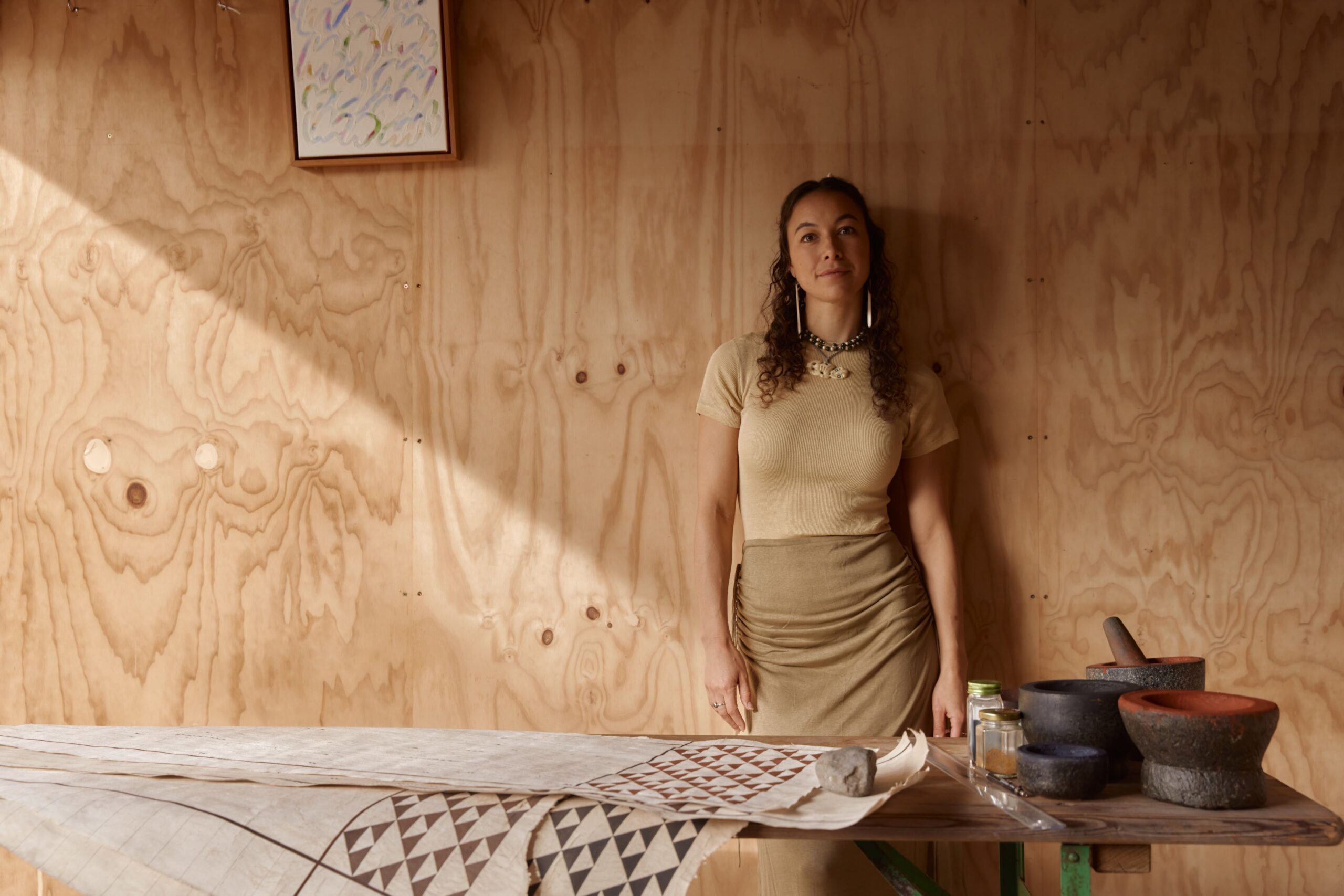
The wet bark is laid on a hard flat surface — traditionally a smooth log or stone anvil — and struck repeatedly with a wooden beater (*ike*) whose face is grooved in parallel lines. The beating does two things simultaneously: it thins and spreads the bark by breaking down the fiber structure, and the grooved beater leaves a texture in the surface that affects how the cloth receives pigment later. Strips of beaten bark can be felted together by overlapping their edges and beating them wet — the fibers interlock as they are struck, bonding without adhesive into a seamless sheet that can be as large as the maker's ambition and the available materials allow.
What emerges from this process is something that is not quite fabric and not quite paper — stiffer than woven cloth, more flexible than paper, with a surface that takes pigment with the specific quality of absorption that synthetic materials cannot replicate. The finished hiapo has a warmth to it, a presence, that reflects both the organic material and the human labor compressed into its surface. Every blow of the beater is still in the cloth. You can feel it.
The Patterns: A Visual Language Centuries in the Making
Niuean hiapo is distinguished from the tapa traditions of neighboring Pacific cultures — Tongan *ngatu*, Fijian *masi*, Samoan *siapo* — by its specific pattern vocabulary, a system of geometric designs that carry cultural meaning with a precision that only those initiated into the tradition fully read but that communicates cultural identity even to those who cannot decode specific motifs.
The dominant design principle in traditional hiapo is geometric repetition: angular forms — squares, triangles, stepped patterns, interlocking lines — arranged in grids that tile across the cloth's surface with a mathematical regularity that reflects both aesthetic preference and the technical constraints of the instruments used to apply them. Designs are applied using hand-stamping with carved stamps (*kupeti*), freehand painting with brushes made from pandanus root fibers, or stenciling through cut templates — each method producing a different quality of line and a different relationship between the maker's hand and the pattern's regularity.
The pigments are traditionally plant-derived: the black-brown used most frequently in Niuean hiapo comes from the candlenut (*Aleurites moluccana*) — its soot collected from burning and mixed with a binding agent — or from mangrove bark tannins. The application of these pigments to the absorbent hiapo surface produces the deep, warm tones that characterize traditional pieces: not the flat, graphic black of synthetic dye but something that varies in density across the surface, darker where the pigment pooled slightly, lighter where the brush moved faster, the variations producing a visual depth that even high-resolution photographs fail to fully convey.
The patterns themselves are not merely decorative. Specific motifs carry genealogical associations — design elements that appear in a family's hiapo across generations communicate kinship affiliations to those who know how to read them. The composition of a ceremonial hiapo — which motifs appear, how they are arranged, what border designs frame the central field — can function as a readable statement about the maker's family, her village affiliations, and the occasion for which the cloth was made. This readable dimension of hiapo design is one of the elements most at risk of being lost as the tradition contracts: the vocabulary survives in the cloth, but the fluency to read it depends on a community of practice that has been severely stressed by the forces reshaping Niue's population.
The Ceremony: When Hiapo Is Given and Why
Hiapo's significance in Niuean life has never been primarily aesthetic. It is a ceremonial object — produced for specific occasions, given at specific moments, received with a seriousness that reflects the labor and identity it contains.
The occasions that call for hiapo are the life transitions that every human culture marks with special ceremony: birth, coming of age, marriage, death. A newborn wrapped in hiapo is being welcomed into the community with the community's most carefully made gift — not the warmth of synthetic fabric, which any shop provides, but the warmth of a specific woman's labor over weeks or months, embedded in a material that carries the family's visual language. A coffin covered with hiapo at a Niuean funeral is being sent with the community's deepest honor: the finest thing the family can make, given irreversibly.
The **gift** dimension of hiapo is structurally important. Tapa cloth across the Pacific has functioned within gift economies as a primary vehicle for the transfer of social obligations — hiapo given at a wedding creates a debt that the recipient family will repay in kind at the next appropriate occasion, sustaining a web of mutual obligation that constitutes community cohesion as much as any formal institution. The size, quality, and number of hiapo pieces given at a ceremony is legible to everyone present as a statement about the giving family's social standing, their investment in the relationship being marked, and their mastery of the tradition that produces the gift's value.
This ceremonial economy gives hiapo a function that purely commercial craft production cannot replicate. A hiapo purchased from a craft market and displayed on a wall is beautiful. A hiapo given at a funeral — made by the deceased's daughter over three months in the evenings after her children slept, beating bark that came from the family's own trees, painting patterns that her mother taught her — is something categorically different. The distinction is not sentimental. It is structural: the ceremonially gifted hiapo carries social meaning that the purchased one cannot, because social meaning of this kind is produced by the specific relationships and labor that precede and surround the object, not by the object's physical properties alone.
The Diaspora Problem: When the Community Leaves
Niue faces a demographic situation that has no precise parallel among the world's self-governing states: its diaspora substantially outnumbers its resident population. Approximately 20,000 people of Niuean descent live in New Zealand — primarily in Auckland — compared to the roughly 1,600 who remain on the island. This emigration has been ongoing since the mid-twentieth century, accelerated by the devastation of Cyclone Heta in 2004, which destroyed much of Alofi and pushed a further wave of residents toward New Zealand.
For a tapa tradition that depends on living community practice — on the transmission of making skills from experienced to novice practitioners, on the ceremonial occasions that give hiapo its meaning, on the trees that require cultivation and the specific landscape knowledge that sustainable harvesting requires — this demographic reality is a structural challenge of the first order. You cannot beat bark without bark. You cannot maintain a pattern vocabulary without a community of practitioners large enough to hold and transmit it. You cannot sustain the ceremonial occasions that give the cloth its meaning without the community that the ceremonies exist to bind together.
And yet: the Auckland Niuean community has not abandoned hiapo. It has relocated it. Auckland has significant Niuean cultural organizations — churches that function as cultural centers, community groups that organize around the maintenance of Niuean identity in diaspora conditions — and within these organizations, hiapo making is practiced, taught, and exchanged in forms adapted to the diaspora context. Paper mulberry cannot be grown in Auckland's climate, but bark can be obtained from Niue through family networks, ordered through cultural organizations, or in some cases sourced from Pacific communities in warmer parts of New Zealand. The making happens in community halls and living rooms rather than on Niue's coral limestone landscape, but it happens.
The diaspora hiapo is a different object in some respects — made in different physical conditions, for ceremonies that occur in New Zealand context, sometimes adapted in design to reflect the maker's experience of living between two cultures — but it is continuous with the island tradition in the ways that matter most: the skills are transmitted between generations, the ceremonial occasions that require hiapo are maintained in diaspora form, and the identity that the cloth carries — Niuean, specific, irreducibly this — is preserved.
Hiapo and the School: Transmission Under Pressure
On Niue itself, the continuation of hiapo practice depends significantly on what happens in its schools. The island's school system — which serves a student population small enough that the entire secondary school could fit in a single lecture hall at most universities — has maintained arts and cultural education that includes hiapo making, at least periodically, as part of the curriculum.
The school-based transmission of hiapo is qualitatively different from the household-based transmission that historically sustained it, and experienced practitioners are clear about the difference. Learning hiapo from a grandmother in the context of making a specific piece for a specific occasion — the wedding of a cousin, the funeral of a neighbor — embeds the skill in meaning from the start. The learner understands immediately what the cloth is for and what it must accomplish, and this understanding shapes the quality of attention she brings to the technical instruction.
Learning hiapo in a school context, with standardized materials and assessment criteria and forty-five-minute periods, produces a different relationship — more technical, less ceremonially embedded, the skill separated from the meaning-structure that gave it its urgency. This is not an argument against school-based transmission; in conditions where household transmission has become unreliable, school-based transmission is better than none, and several women now recognized as skilled hiapo practitioners trace their initial exposure to the tradition to school-based programs. But it is an argument for ensuring that school-based programs are supplemented by ceremonial contexts in which the cloth's full function is experienced, not just its production techniques.
The Niue Arts Council and various community organizations have worked to create these contexts — workshops that connect making to occasion, exhibitions that include ceremonial explanation, community events that create the demand for hiapo that keeps its production socially justified. The effectiveness of these interventions is difficult to quantify but directionally positive: hiapo is still being made on Niue, still being given at ceremonies, still being taught to young women by practitioners who themselves learned from their mothers.
The Collections Problem: When the Cloth Lives Abroad
A significant proportion of the finest historical Niuean hiapo — pieces made in the nineteenth and early twentieth centuries before the tradition's contraction, representing the tradition at a level of elaboration and skill that current production only partially approaches — is held not in Niue but in museum collections in New Zealand, the United Kingdom, Germany, and the United States. These pieces arrived in collections through the usual routes of colonial-era collection: missionary acquisition, trader purchase, ethnographic expedition gathering, gifts by colonial administrators.
The collections are, in a narrow sense, protected: climate-controlled, catalogued, physically preserved in conditions that the objects' long-term survival requires. But they are simultaneously inaccessible to the community that produced them. A Niuean woman learning to make hiapo cannot travel to the British Museum to study the finest historical examples of her tradition. A practitioner trying to recover a specific pattern vocabulary can access photographs in academic publications, but photographs of tapa cloth — flat images of objects whose meaning is partly tactile, partly contextual — are a pale substitute for the objects themselves.
Several New Zealand museums with Niuean hiapo collections have made genuine efforts to address this through community engagement programs — inviting Niuean community members to work with the collections, creating digitized access to high-resolution images, organizing loans to Niuean community exhibitions. These are meaningful steps. They are not equivalent to the objects being where the community that made them can fully use them.
The question of where historical tapa collections belong — whether the preservation argument for keeping them in major institutional collections outweighs the cultural revitalization argument for returning them to their communities of origin — is one of the central debates in Pacific museum practice, and Niuean hiapo sits directly in its middle. The debate is not easily resolved, and this article does not attempt to resolve it. But it is worth noting that the finest historical examples of a tradition are not merely beautiful objects for the communities that produced them. They are pedagogical resources, design references, and evidence of what the tradition is capable of at its most developed — evidence that matters enormously when you are trying to sustain a practice under conditions that did not produce those finest examples.
What the Coral Rock Keeps
Niue's geology — that raised limestone plateau, those sea-carved chasms — is oddly apt as a metaphor for what the island's tapa tradition has demonstrated over the past century. Limestone is not the most fertile ground. It does not produce the lush agricultural abundance of volcanic island soils. What it produces instead is specificity: the plants that grow in limestone conditions are adapted to those conditions in ways that make them distinct from their relatives growing in richer soils, and the communities that have learned to live on limestone have developed specific knowledges and relationships with their particular landscape that no amount of general agricultural knowledge transfers.
Niuean hiapo is like this. It is not the largest tapa tradition in the Pacific — Tonga's *ngatu* is produced in greater volume, Fiji's *masi* has more international recognition, Samoa's *siapo* has a larger community of practitioners. What Niuean hiapo has is its own specificity: a pattern vocabulary, a design philosophy, a ceremonial context, and a community of practitioners — scattered between a tiny island and a diaspora — who have kept these specific things alive precisely because they are specific. Not generic Pacific tapa. Niuean hiapo. This family's patterns. This woman's hands.
The women who beat bark on a coral limestone island in the middle of the South Pacific — who soak the inner bark of paper mulberry trees their grandmothers planted, beat it on stones their grandmothers used, paint patterns their grandmothers taught them, and give the finished cloth at the ceremonies their grandmothers would recognize — are doing something that looks, from a distance, like cultural conservation. From close up, it looks different. It looks like the most ordinary thing: a woman making something her family needs, in the way she was taught, for the reason it has always been made.
The cloth holds what it always held: the specific knowledge of specific hands, the specific patterns of a specific people, the evidence that someone was here on this limestone fortress in the Pacific, and that they made something beautiful, and that they gave it away at the moments that mattered, and that the giving created the web of obligation and love and memory that is, in the end, what a community is made of.
Beat the bark. Wet it. Lay it on the stone. Strike it until it spreads.
The island is small. The tradition is older than the island's name. It continues.