After the Heat Breaks: What Senegal's Takussan Gatherings Reveal About Community, Time, and Joy
After the Heat Breaks: What Senegal's Takussan Gatherings Reveal About Community, Time, and Joy
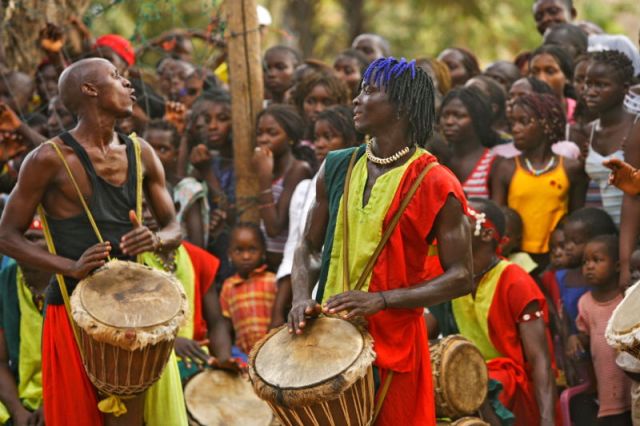
The chairs come out first. Someone drags a plastic stool through a compound gate; another person brings a low wooden bench from just inside a doorway, setting it at the angle that experience has established as best for catching the evening air. A third person has already started the charcoal, and the small metal teapot — the *canari* — sits on a brazier no bigger than a cooking pot's base, the first round of *attaya* beginning its slow transformation toward the dense, sweet, intensely bitter tea that is the evening's formal medium. By the time the sun has dropped enough to turn the street's dust gold, eight or ten people have assembled where twenty minutes ago there was only a wall and a pavement.
Nothing was planned. No invitations were issued. This is **takussan** — the traditional Senegalese evening gathering, a social institution so embedded in the rhythm of daily life that its occurrence requires no more organization than the sunset that triggers it. The word itself carries multiple meanings in Wolof: the evening itself, the cooling after the day's heat, and the specific social practice of gathering in that cooling to talk, drink tea, and simply be present together. That a single word covers all three meanings is itself informative: in Senegalese cultural logic, the evening, the temperature drop, and the gathering are not three separate phenomena. They are one.
The Architecture of the Everyday
To understand takussan, it is necessary to first understand the spatial organization of Senegalese domestic and neighborhood life — because takussan happens in a specific geography that has been shaped, over generations, to accommodate it.
The **compound** (*keur* in Wolof) is the basic unit of Senegalese domestic organization: a walled enclosure housing an extended family, with multiple sleeping rooms arranged around a shared courtyard that functions as the household's actual living space. Cooking, socializing, childcare, and small commerce all happen in the courtyard, not inside the rooms. The rooms are for sleeping and storage; life is lived in common outdoor space. This architectural logic produces a social orientation toward shared space that has no real equivalent in the privatized domestic architecture of Western cities, where the interior of the home is the primary social space and the exterior is transit.
The street in front of the compound is the compound's social extension — the threshold zone where household space meets neighborhood space, where the family's social life flows outward to meet the neighbors' social lives flowing outward from their own compounds. Takussan happens in this threshold zone. The chairs that come out at dusk are placed neither fully inside the compound nor fully in the street: they occupy the margin, and that marginal position is the point. The gathering is simultaneously household and neighborhood, private and public, intimate and open.
This spatial logic means that takussan is structurally inclusive in a way that most Western social events are not. The gathering has no entry requirement, no invitation list, no minimum consumption. A neighbor passing by who pauses is already inside the event; someone sitting on the steps of a nearby compound who joins in a comment is a participant. Children who have been told to sleep but find reasons to linger at the edge are absorbed into the periphery. The gathering's boundary is entirely social rather than physical — you are in it when you are oriented toward it, and you leave it simply by turning away.
Attaya: The Tea That Structures Time
The three rounds of **attaya** — the Senegalese tea ceremony adapted from the Maghrebi tradition of *atay*, the sweet mint tea that traveled south with trans-Saharan trade routes — are the temporal skeleton around which takussan organizes itself. Each round takes roughly thirty to forty-five minutes to prepare, which means a full attaya ceremony occupies nearly two hours from first glass to last. This is not incidental. It is functional: the tea creates a pace.
The preparation of attaya is not background activity. It is the gathering's anchor and its ongoing dramatic focus. The **tea maker** (*garçon du thé*, though women prepare it too) handles the process with an attention that can look, to an outside observer, almost theatrical: the first steep of green Chinese gunpowder tea — *Gunpowder* brand, the specific import that Senegalese tea culture has made its own — poured back and forth between the small pot and a glass to aerate and cool, the process repeated multiple times to build the foam that is a mark of quality preparation. The first round (*premier verre*) is intensely bitter, with little sugar — *amer comme la mort*, bitter as death. The second round adds more sugar and sometimes mint — *doux comme la vie*, sweet as life. The third and final round is sweet enough to qualify as dessert — *sucré comme l'amour*, sweet as love. This progression from bitter to sweet is explicitly acknowledged in the saying, and it maps the evening's own emotional arc: the initial settling in, the conversation's deepening, and the final warmth before dispersal.
The tea maker's skill is evaluated with the same seriousness that a cook's skill is evaluated. The foam must reach a certain depth. The temperature of each round must be managed carefully — the second steep of the same leaves produces a different extraction than the first, requiring adjustment. A takussan regular who is also a skilled tea maker carries real social prestige in the gathering, and the role tends to settle on specific individuals who have demonstrated both the patience and the technical mastery the ceremony demands. The preparation is itself a form of hospitality: to make the tea well for the people gathered is to honor them, and the care invested in the process communicates something about the host's relationship to the guests that words alone could not convey.
Teranga and the Ethics of Presence
The concept most essential to understanding takussan — and Senegalese social life more broadly — is **teranga**: the Wolof word for hospitality, generosity, and the particular quality of welcome that makes a stranger feel received. Teranga is so central to Senegalese cultural identity that it functions as a near-synonym for the country itself — Senegal is sometimes called *le pays de la teranga*, the land of welcome — and it is not an abstract value but a behavioral practice with specific manifestations.
At takussan, teranga operates through a set of behaviors so normalized they are largely invisible to participants and entirely legible to any Senegalese observer. The tea is shared equally regardless of the drinker's social position — the glass of attaya makes no distinction between the compound owner and the passing neighbor who stopped because he smelled the charcoal. If food appears — and it may, a bowl of fruit, a plate of *thiakry* (millet couscous with sweet fermented milk), whatever the household has — it is offered outward before anyone eats, the gesture of offering preceding any consumption. A newcomer who arrives midway through the gathering is greeted by the assembly before the existing conversation resumes — not cursorily, but with the full attention of those present, who briefly set aside what they were discussing to acknowledge the arrival. The acknowledgment is not a formality. It is a statement: *you are here, we see you, you are part of this now*.
This ethics of presence has practical consequences for what takussan enables socially. The gathering is not organized around an agenda, a task, or a purpose that participants are present to achieve. It is organized around being present together — and this orientation allows things to happen that agenda-driven social interactions preclude. Problems surface sideways, in the middle of a conversation about something else. Information moves laterally through the network of people assembled, connecting those who needed to know to what they needed to know without any formal mechanism for the connection. Conflict that might harden if addressed directly dissolves in the gradual softening of shared tea and shared evening. A Senegalese anthropologist describing takussan to a Western academic audience might reach for the phrase "community maintenance" — and the phrase would be accurate, though it would leave out the flavor.
The Griot's Evening: Oral Tradition at the Gathering
Not every takussan includes a **griot** (*gewel* in Wolof) — the hereditary caste of oral historians, praise singers, and musical performers whose function in West African societies is to maintain the genealogical and historical memory of the community and to perform it on occasions that require it. But the griot's influence on the form and texture of takussan conversation is pervasive even in absentia, because the communicative norms of the gathering — the value placed on narrative over argument, on indirection over confrontation, on the story as the vehicle for truth — reflect a broader Wolof oral tradition in which the griot is the specialist and the rest of the community are participants.
When a griot is present at a takussan — more common in rural settings, in the *ceddo* aristocratic families whose griots have served them for generations, and at larger gatherings associated with ceremonies — the evening's conversational quality shifts perceptibly. The griot's speech is a different register: more formal, more allusive, deploying proverbs (*xam-xam*) whose meaning is apparent to those who know the tradition and partially opaque to those who don't. A skilled griot can praise the host, trace the host's lineage, embed the current moment in a historical narrative that connects it to ancestors whose deeds the griot's own lineage has preserved, and do all of this while the tea steeps and the neighbors listen — producing an experience of temporal depth in which the evening gathering becomes briefly continuous with centuries of gathered evenings that preceded it.
The proverb tradition that griots formalize is also the everyday currency of takussan speech. Wolof is a language extraordinarily rich in proverbs — *liggéeyam noppi du nelaw*, "work that is finished does not sleep," carries a judgment about the importance of following through; *ku am sa xol, amul dëkk*, "whoever has their heart has no homeland," speaks to the primacy of internal belonging over geographical attachment — and these sayings circulate through takussan conversations as both wisdom and wit, deployed at the right moment to crystallize something the conversation had been circling, to end a debate without declaring a winner, to honor a truth that direct statement would somehow diminish.
Gender, Generation, and the Gathering's Social Map
The composition and spatial arrangement of a takussan gathering encodes the social structure of the community with a precision that a sociologist would find instructive. In traditional settings, men and women often occupy different sections of the gathering space — not through rigid exclusion but through a social gravity that reflects the different domains of daily life and conversation that men and women inhabit. Women's takussan conversations tend toward the household economy, children's welfare, neighborhood relationships, and the dense social intelligence that managing compound life requires; men's conversations range across work, politics, religion, and the extended networks of obligation and alliance that male social life in Senegal navigates.
Yet this separation is more permeable in practice than it appears in description. Women's voices cross from their section of the gathering to the men's when a topic requires their knowledge — and women's knowledge of certain domains, particularly anything concerning family and neighborhood relationships, is recognized as primary and deferred to. Men contribute to conversations framed as women's when invited. Children move freely between both sections until sleep or an adult directive removes them. Older women, particularly grandmothers whose social authority in the extended family is significant, may occupy positions in the gathering that bridge both zones.
The intergenerational dimension of takussan is one of its most socially significant features and one most vulnerable to contemporary disruption. The gathering is a natural transmission mechanism for knowledge, values, and social norms — not through formal instruction but through the absorption of what is said and how it is said over hundreds of evenings across childhood and adolescence. A child who grows up at the edges of takussan, listening while appearing not to, learns how disputes are navigated in their community, what qualities are praised in people who are praised, what behaviors are marked by the slight tonal shift that indicates disapproval without stating it directly. This is not education in any formal sense. It is something more fundamental: the child learning what it means to be a member of this specific community in this specific place at this specific time.
Takussan in the City: Dakar's Adaptation
Dakar — the West African megalopolis of approximately four million people, densely urban, cosmopolitan, connected to global media and economic flows in ways that would have been unrecognizable to the generation that built the neighborhoods now being gentrified — has not abandoned takussan. It has adapted it, in the way that living practices always adapt to new conditions without losing the core of what they are.
In the dense, mixed neighborhoods of the Médina, Parcelles Assainies, and Grand Yoff, takussan continues in modified form: the chairs still come out, the charcoal still lights, the attaya still takes its unhurried two hours. But the composition of the gathering reflects Dakar's density and diversity — neighbors from different ethnic groups and regional backgrounds share a courtyard's evening, the Wolof proverbs mixing with Pulaar expressions and the French that has become the language of urban professional life, producing a conversational register that is distinctly Dakarois, neither purely traditional nor purely globalized.
The smartphone has entered the gathering without ending it. A takussan circle in Parcelles Assainies in 2026 will include people checking phones between exchanges, music coming from someone's Bluetooth speaker rather than from a live instrument, perhaps a video call pulled into the circle so a family member in Europe can participate in the conversation for a few minutes. These are accommodations, not replacements. The fundamental social form — people gathered in shared outdoor space at dusk, drinking tea together, talking without urgency — persists beneath the new technologies, because it is meeting needs that the technologies do not meet: the need for physical co-presence, for the specific warmth of a shared evening, for the slow-building conversational knowledge of neighbors whose lives overlap daily.
What Dakar's urban takussan cannot fully replicate is the intergenerational depth of the village gathering — the grandmother who has been sitting in this same spot for forty years, the griot lineage whose presence transforms an evening into a moment of historical continuity. Urban mobility breaks lineages; people move to the city, neighborhoods change, the person sitting next to you at takussan may have been there only three years and is building the relationships that the village gathering has held for generations. The city's version of the practice is younger, more provisional, more consciously constructed. Which is not to say it is weaker — conscious construction of community can be more intentional and more resilient than inherited community under certain pressures. It is to say it is different.
What Takussan Is Protecting
The threat to takussan is not dramatic. It is gradual, structural, and familiar to anyone who has watched any traditional social practice meet the specific pressures of contemporary economic life: the elongation of the working day, the privatization of leisure into screen-based individual entertainment, the replacement of outdoor shared space by indoor private space, and the acceleration of social life that makes the tea ceremony's two-hour unhurried pace feel like an unaffordable luxury rather than the social infrastructure it actually is.
Senegalese urbanists and social commentators have been documenting the gradual thinning of takussan in neighborhoods where the economic pressure is most intense — where people work two jobs, where the commute is long, where the television or the phone offers an alternative to going outside that is easier than going outside. The practice persists, but its frequency in some urban contexts has diminished from nightly to weekly or occasional. The chairs that once came out every evening come out on Fridays, on holidays, at weddings and naming ceremonies. The daily social infrastructure becomes an occasional special event, which is precisely the transformation that social practices lose the most in.
What is lost when takussan thins is not easy to quantify, which is part of why it is undervalued in policy conversations about urban development and social welfare. What is lost is the ambient awareness of neighbors that daily gathering produces — the knowledge that someone is unwell before it becomes an emergency, the conflict resolution that happens informally before it requires official intervention, the loneliness prevention that is so effective precisely because it operates before loneliness has been named or recognized. Takussan is social infrastructure in the literal sense: it maintains the conditions for community to function, and its absence creates costs that appear elsewhere in the social accounting without ever being traced back to the missing evening gathering.
The Unhurried Revolution
There is a concept that economists and psychologists have begun exploring under various labels — "slow time," "temporal commons," "the pace of belonging" — that Senegalese social tradition has been practicing in the form of takussan for centuries. The idea is that community requires time that is not productive in the economic sense: time that is shared, unstructured, and oriented toward presence rather than output. This time is not wasted. It is the substrate in which trust, solidarity, and mutual knowledge grow — the social capital that makes everything else the community needs to do possible.
The two hours of attaya, the unhurried conversation, the evening that begins with the heat breaking and ends when it is simply time to sleep — this is not inefficiency. It is the most efficient possible use of time for a specific and irreplaceable social function: the maintenance of the relational fabric that makes community possible. The chairs that come out at dusk are not furniture. They are a daily reaffirmation that the people in this compound, on this street, in this neighborhood, belong to each other in a way that the morning's economic transactions and the afternoon's private concerns cannot sever.
The tea finishes its third round. Someone says it's time, and the others agree without urgency. The chairs go in. The street returns to itself. Tomorrow evening, the charcoal will light again, and the chairs will come out, and whoever needs to be there will find themselves there — drawn by something that has no name more precise than the name it has always had: the evening gathering, the cooling, the conversation, the belonging. Takussan.