8,000 Years Underground: How Georgia's Qvevri Winemaking Is Rewriting Wine History
8,000 Years Underground: How Georgia's Qvevri Winemaking Is Rewriting Wine History
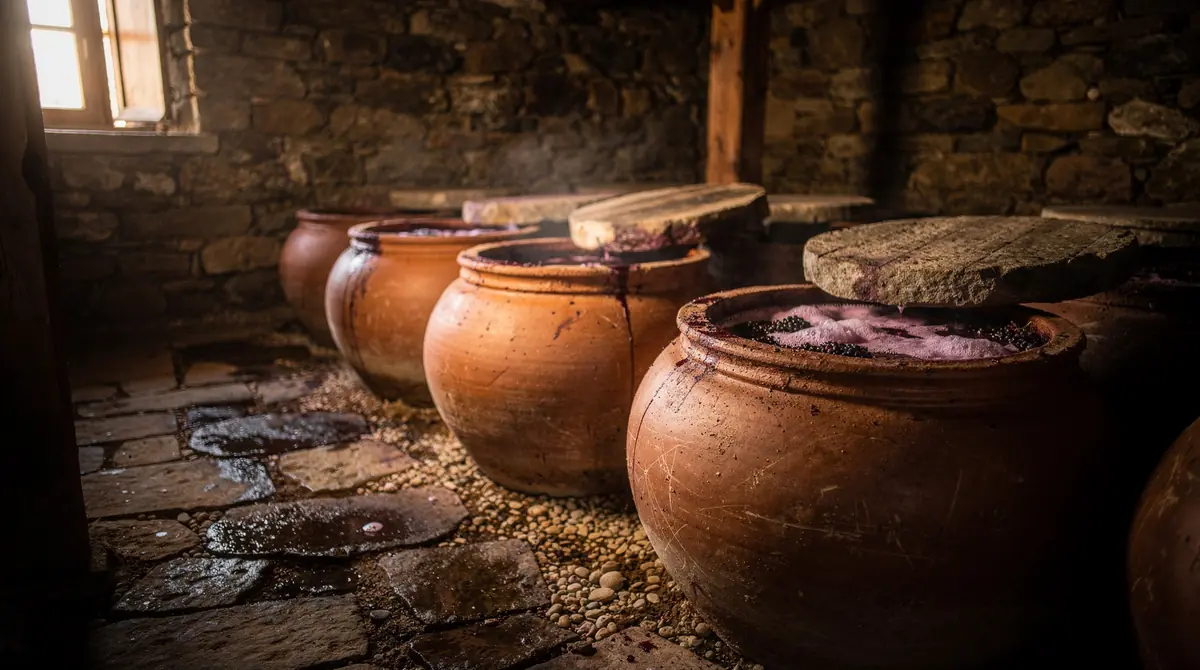
In the village of Signagi in the Alazani Valley, a winemaker named Ramaz Nikoladze leads a visitor down a short flight of stone steps into a room below the family home. The room is cool and dark. Its earthen floor holds twenty ceramic vessels embedded to their shoulders in the ground, their interiors lined with beeswax, their mouths sealed with stone lids. Each vessel — a **qvevri** — holds between 200 and 2,000 liters of fermenting or aging wine. The family's harvest of Rkatsiteli grapes went in ten months ago, skins and stems included, and has been fermenting and clarifying slowly in the oxygen-limited environment below the soil's surface. When Nikoladze lifts a lid and draws a sample with a long-handled ladle, what comes out is not white wine and not red wine but something the wine world has been struggling to adequately categorize for twenty years: deep amber, tannic, complex, carrying the fingerprint of the grape's phenolic compounds in a concentration that no conventional white wine fermentation produces.
This is Georgian wine in its most ancient and most specific form. Not a style choice, not a natural wine experiment, not a trend borrowed from the avant-garde of the European wine world. This is the way wine was made at the moment humanity invented it — and in a narrow mountain nation at the crossroads of Europe and Asia, it never stopped.
The Archaeological Case for Georgia as Wine's Birthplace
The claim that Georgia is the birthplace of wine is not Georgian nationalism. It is archaeology.
In 2017, a research team led by Patrick McGovern of the University of Pennsylvania Museum — the world's leading biomolecular archaeologist of ancient beverages — published findings from two Neolithic villages in the Kvemo Kartli region of Georgia: Gadachrili Gora and Shulaveris Gora. Chemical analysis of ceramic jar fragments from these sites, dated to approximately 6000 BCE, revealed the presence of tartaric acid, malic acid, citric acid, and succinic acid — the precise chemical signature of *Vitis vinifera* grape wine — making them the oldest evidence of grape wine production yet discovered, by approximately 600 years. The villages predate the previously oldest evidence, found in the Zagros Mountains of Iran, and they predate the emergence of Egyptian viticulture by roughly 3,500 years.
The vessels found at these sites are not identical to the qvevri used in Georgia today, but they are recognizably ancestral to them: large ceramic jars, used for fermentation and storage, buried in or near dwelling spaces to maintain stable temperatures. The ceramic tradition that those Neolithic villagers established has continued, with modification and refinement, for eight thousand years — an unbroken chain of practice that no other winemaking tradition on earth can claim with equivalent archaeological support.
Georgia's **Vitis vinifera sylvestris** — the wild grape from which all domesticated wine grapes descend — still grows in the Caucasus forests. Genetic studies of domesticated grape varieties worldwide have consistently found that the closest wild relatives of domesticated *Vitis vinifera* are the wild grapes of the South Caucasus. The mountain forests of Georgia are, in the most literal genetic sense, the origin of every wine grape variety currently grown in France, Italy, Spain, Argentina, California, and anywhere else that wine is made from *Vitis vinifera*. When a French vigneron presses Chardonnay grapes in Burgundy, the grape's most distant ancestor grew wild in what is now Georgia.
This is not a footnote to wine history. It is the founding chapter, and understanding it reframes everything that follows.
The Vessel: What a Qvevri Actually Is
The **qvevri** (also spelled *kvevri*) is a ceramic vessel, egg-shaped or amphora-shaped, made from local clay by craftsmen who have inherited the techniques of their trade through family lineages traceable for generations. The vessel's interior is lined with beeswax applied while the clay is still warm — a process that seals the vessel's microscopic pores against bacterial contamination while allowing a degree of microoxidation through the vessel wall that is critical to the wine's development. The shape — tapering to a point at the bottom — means that grape solids (*lees*) settle in a compact cone, separated from the clarifying wine above, producing natural clarification without filtration.
The manufacturing process is demanding enough that skilled qvevri craftsmen — **qvevrisamqurofeli** — are a scarce and increasingly recognized cultural resource. A large qvevri, holding 2,000 liters or more, is built up from coils of clay worked by hand, dried slowly, then fired at temperatures between 900 and 1,200 degrees Celsius. The firing produces the vessel's final porosity — controlled by the clay composition and the firing temperature to produce the specific microoxidative conditions the winemaker wants. A poorly made qvevri cracks under thermal stress or allows too much oxygen exchange; a well-made one can last for centuries. Qvevri from the nineteenth century are still in use in Georgian family cellars, their beeswax lining renewed periodically, their clay undamaged by the cyclical filling and emptying that constitute a century of winemaking.
UNESCO recognized the **art of making and playing the chonguri** and, more relevantly here, the **traditional Georgian qvevri wine-making method** on its Intangible Cultural Heritage list in 2013 — one of the earlier inscriptions related to food and drink, reflecting the method's singularity and its living status as an active rather than merely historical practice.
The inscription matters beyond its prestige because it formally established that the qvevri method is not merely an interesting artifact of ancient technique but a living cultural practice with active practitioners, ongoing transmission, and genuine contemporary vitality. By 2013, that vitality was already accelerating — but the reasons for it require understanding what qvevri winemaking actually produces that conventional modern winemaking does not.
Skin-Contact Fermentation: The Chemistry of Amber Wine
Modern white wine is made by pressing grapes, separating the juice from the skins immediately, and fermenting the juice alone. The skins, seeds, and stems — collectively the grape's **pomace** — are discarded or composted. This practice, which became standard across European winemaking from the eighteenth century onward, produces the pale, low-tannin, high-acidity white wines that dominate global wine consumption.
Georgian qvevri winemaking — specifically the Kakhetian method practiced in the country's most celebrated wine region — does the opposite. Grapes are crushed and transferred to the qvevri complete: juice, skins, seeds, and often stems together. This mixture — *chacha* plus must — ferments together for anywhere from six weeks to six months, with the skins remaining in contact with the fermenting juice throughout. The result is a white wine that has extracted from the skins everything that skin-contact produces: **phenolic compounds** (tannins, anthocyanins, and flavonoids), **color compounds** that shift the wine from yellow-green to deep amber-gold, and a textural density that tannin extraction adds to a wine that would otherwise be entirely defined by its acidity and aromatics.
The wine that results from this process is categorically different from conventional white wine in ways that extend beyond color. It ages differently — the phenolic compounds that conventional whites lack are precisely the compounds that protect red wine from premature oxidation and allow it to develop in the bottle over decades. Skin-contact Georgian whites from quality producers have documented aging potential that exceeds most conventional white wines: bottles from the early 2000s have been opened at tastings in Tbilisi and London and found to be evolving beautifully rather than fading.
The **tannin** in a skin-contact Georgian white — the same compound responsible for the drying sensation of strong tea and red wine — is something that the contemporary wine world, trained on tannin-free whites, initially found disorienting. The first Western wine writers to encounter serious qvevri wines in the 1990s and early 2000s often described them as flawed, assuming that the tannin was evidence of winemaking error. The reassessment that followed — driven partly by a deepening understanding of natural winemaking across Europe, partly by the growing authority of Georgian wine producers in international markets — required acknowledging that the expectation of tannin-free whites was itself a historically recent and geographically limited convention, not a universal standard against which all white wines should be measured.
Rkatsiteli and Saperavi: The Ancient Grapes
Georgia has approximately 525 identified indigenous grape varieties — a genetic diversity so extraordinary that the country's vineyards function as a living ark of *Vitis vinifera* biodiversity that has no parallel anywhere in the world of comparable scale. For context, France — which is considered extraordinarily rich in grape diversity — has approximately 200 recognized varieties. Georgia's 525 represent thousands of years of cultivation, selection, and preservation of genetic lines that would otherwise have been lost to the commercial monoculture that has simplified viticulture across most of the world.
**Rkatsiteli** — Georgia's most widely planted white variety and one of the world's oldest continuously cultivated wine grapes, with genetic evidence of cultivation dating to at least the first millennium BCE — is the primary grape of the Kakheti region's amber wine tradition. In conventional white wine style, it produces a crisp, moderately aromatic wine with apple and quince notes and firm acidity. In the qvevri, with extended skin contact, it becomes something more architecturally complex: the quince aromatics deepen toward dried apricot and walnut, the acidity is framed by tannin that gives the wine structure that conventional Rkatsiteli lacks, and the color ranges from pale amber to deep burnished gold depending on skin contact duration.
**Saperavi** — Georgia's most celebrated red variety, whose name means "dye" or "paint" in Georgian, reflecting its unusually dark skin — is one of only a handful of grape varieties worldwide that is both deeply pigmented in the skin and in the flesh, meaning that Saperavi wine is colored throughout rather than merely on the surface. In the qvevri, Saperavi ferments to wines of extraordinary depth and longevity — dark, tannic, high in anthocyanins, capable of aging for decades with the qvevri method's natural stabilization. Saperavi's genetic lineage is ancient: DNA analysis has confirmed it as one of the progenitor varieties of the Caucasian domestication event, placing it among the oldest cultivated wine grapes on earth.
The Cellar as Sacred Space: Wine in Georgian Culture
The Georgian word for a wine cellar is **marani**, and it carries cultural weight that the English equivalent does not. A marani is not simply a storage space. In traditional Georgian rural culture, it is the home's most important room — more carefully constructed than the sleeping quarters, maintained with more consistent attention than any other part of the property, and treated with a reverence that reflects the cultural position of wine in Georgian life.
Wine in Georgia is inseparable from **supra** — the Georgian feast, organized around a table of extraordinary abundance presided over by the **tamada**, the toastmaster, whose role is to lead the table through a sequence of toasts that constitute a liturgy of connection: to God, to Georgia, to peace, to the guests, to ancestors, to the land. A Georgian supra without wine is not a supra. The wine poured in the horn-shaped drinking vessel (*kantsi* or *wineskin*) and passed around the table is not merely alcohol; it is the medium through which the community's bonds are renewed and the occasion's significance is acknowledged.
This sacralization of wine has deep historical roots. The Georgian Orthodox Church — which has been the country's primary religious institution since the fourth century CE — incorporated wine into its central theology in ways that go beyond the Eucharistic use shared with other Christian traditions. The Georgian tradition holds that the Virgin Mary chose Georgia as her earthly lot, and that the grape vine itself — **vazi** — is a sacred plant whose cultivation is a form of stewardship of something divinely given. The cross of St. Nino, who brought Christianity to Georgia in 334 CE, is traditionally depicted as made from grapevines bound with the saint's own hair — a visual representation of the faith's arrival bound to the vine that had already been central to Georgian life for thousands of years before Christianity reached the Caucasus.
The Soviet Interruption and the Qvevri's Near Death
The Soviet period came close to ending the qvevri tradition entirely, and understanding the recovery requires understanding how complete the near-extinction was.
Soviet agricultural policy collectivized Georgian viticulture into large-scale operations that prioritized volume over quality and standardization over diversity. The family-scale qvevri cellars that had sustained Georgia's winemaking tradition were replaced by industrial facilities producing blended, mass-market wine for Soviet consumption. Qvevri production — which required specialized craftsmen, family-scale operations, and the patience of slow fermentation and aging — was incompatible with the industrial model. The number of practicing qvevri craftsmen declined precipitously; the number of family cellars still using qvevri by the 1980s had contracted to a fraction of the pre-Soviet baseline.
The varieties contracted as well. Soviet viticulture favored high-yield varieties over the complex, lower-yielding indigenous grapes that Georgian winemaking had developed over millennia. Large tracts of ancient variety vineyards were replanted with more productive but less interesting cultivars. The genetic diversity that Georgian viticulture represented was actively reduced in the name of agricultural rationalization.
What survived the Soviet period survived in the margins — in family cellars in rural Kakheti and Kartli where the practice continued quietly outside the official system, in the knowledge of elderly craftsmen who had not passed their skills to the next generation because the next generation had no economic reason to receive them, and in the genetic bank of the wild and semi-wild vines that persisted in Georgian forests and hedgerows despite the replanting pressure.
The recovery that began after Georgian independence in 1991 was therefore not a simple revival of an interrupted practice. It was a reconstruction effort — gathering surviving knowledge from elderly practitioners, locating remaining craftsmen, tracing the genetic lines of ancient varieties through the country's botanical and agricultural institutes, and rebuilding the economic structure of family-scale winemaking that the Soviet system had dismantled. The recovery was not inevitable. It required specific individuals making specific decisions at a moment when the alternative — accepting the industrial wine model and abandoning the qvevri tradition as economically unviable — was a genuine possibility.
The Amber Wine Renaissance: How Georgia Reached the World
The international discovery of Georgian qvevri wine happened through a specific channel at a specific moment: the natural wine movement in Europe, and particularly in Italy, in the late 1990s and early 2000s.
Italian winemakers associated with the emerging natural wine movement — producers in Friuli-Venezia Giulia like **Josko Gravner** and **Stanko Radikon** who were already experimenting with extended skin contact on white grapes — encountered Georgian amber wines through cultural exchange, traveled to Georgia, and returned with a vocabulary for what they were finding in their own extended maceration experiments. Gravner, in particular, traveled to Georgia in 2000, returned with qvevri, and began fermenting his Ribolla Gialla in Georgia's ancient vessels — producing wines that were initially controversial in Italy but that created an international audience for skin-contact whites that had not previously existed.
This triangular exchange — Georgia's ancient practice reaching Italian iconoclasts who were already moving in a compatible direction, who then communicated the results to a wine press newly interested in alternatives to the conventions of industrial winemaking — produced the amber wine movement. By the 2010s, natural wine bars in London, Copenhagen, New York, and Tokyo were stocking Georgian qvevri wines alongside the Gravners and Radikons and the growing cohort of European natural producers working with extended skin contact. The wines were strange by the standards of the mainstream market — amber-colored, tannic, oxidative in ways that conventional white wine avoids, requiring a palate adjustment that some consumers found challenging and others found revelatory.
Georgian producers who had been maintaining the tradition through the difficult post-Soviet years found themselves, somewhat suddenly, with an international audience whose wine education had prepared it to value exactly what qvevri winemaking produces. Producers like **Pheasant's Tears**, **Iago's Wine**, **Alaverdi Monastery**, and **Ramaz Nikoladze** began appearing on wine lists in cities they had never visited, their labels carrying an explanation of the qvevri method that doubled as cultural documentation of a tradition the wine world was discovering for the first time.
The Monastery Cellar: Alaverdi's Unbroken Thread
Among the qvevri cellars currently producing wine in Georgia, one carries a particular authority: the **Alaverdi Monastery** cellar in Kakheti, which has been producing wine continuously — or as close to continuously as Georgian history, which includes multiple invasions and periods of destruction, allowed — since the eleventh century. The monastery's current winemaking operation, revived and developed in recent decades by Bishop David Machavariani, uses qvevri buried in the original medieval cellar, processes grapes from vineyards attached to the monastery using traditional methods, and produces wines under the guidance of a monastic tradition that treats viticulture as spiritual practice rather than merely agricultural production.
The Alaverdi example illuminates something about qvevri winemaking's persistence that purely economic analysis misses: the tradition survived in part because institutions — the Orthodox Church primarily — maintained it not as a commercial activity but as a form of sacred continuity. A monastery that produces wine for the Eucharist, for the supra of religious feast days, and for the maintenance of a tradition understood as divinely sanctioned has different incentive structures than a commercial producer responding to market signals. The monastery's wine doesn't need to satisfy a market trend. It needs to satisfy an obligation that transcends market cycles.
This is why the monastery cellar is both a heritage site and a functioning winery — not a museum reproduction of ancient practice but an active production facility making wines that are served, exported, and consumed in 2026 using methods established before the Norman Conquest of England.
What the Qvevri Proves About Wine's Future
The contemporary wine world is navigating a genuine crisis of direction. Climate change is altering the conditions that made European wine's canonical regions canonical — warmer temperatures advancing harvests, reducing acidity, changing the character of varieties that were selected for specific historical climate conditions. The monoculture viticulture that industrial wine production established is proving ecologically fragile in ways that were not apparent when the industrial model was being built. And the consumer market, particularly younger consumers, is demonstrating increasing interest in wine that tastes of a specific place and person rather than a category standard.
Georgia's qvevri tradition offers a response to all three challenges that is not theoretical. Eight thousand years of continuous practice in the South Caucasus represents a portfolio of varieties selected for the specific conditions of that landscape, techniques developed to work with those varieties in those conditions without chemical intervention, and a relationship to terroir — the French wine world's concept of place-expression — that predates the French wine world by several thousand years.
The 525 Georgian varieties represent a genetic library of adaptive solutions to viticultural challenges — drought resistance, cold hardiness, disease resistance — that the monoculture systems of industrial viticulture have discarded and may urgently need to recover. The qvevri method's natural stabilization — the combination of lees contact, phenolic preservation, and controlled oxidation that keeps qvevri wines stable without sulfur addition or filtration — offers a model for low-intervention winemaking that works not because it rejects science but because it has been refined over long enough a time scale that it represents accumulated empirical knowledge more extensive than any controlled trial.
None of this makes the qvevri a simple answer to complex modern problems. Georgia's wine industry has its own challenges — inconsistent quality, infrastructure limitations, the difficulty of scaling artisanal methods for larger markets, the tension between the qvevri tradition's cultural depth and the simplified brand narratives that international marketing requires. But the tradition's survival across eight thousand years of continuous use, through invasions and occupations and Soviet collectivization and the disruptions of the post-Soviet transition, suggests a resilience that is worth understanding rather than merely admiring.
The Harvest and the Toast
Back in the Alazani Valley, the harvest has begun. Families and neighbors gather in the vineyard in the specific way that the rtveli — the Georgian harvest — has always been organized: collectively, the work made communal by necessity and tradition simultaneously, songs sung between the vine rows that have been sung at harvest time for generations, the cut clusters passed hand to hand into the baskets that will go to the qvevri cellar.
The grapes go in whole. The lid comes down. The earth receives the vessel back to the temperature it has maintained through the summer, the autumn, the winter, the spring. Ten months from now, someone will lift that lid and draw a sample, and what comes out will carry — in its amber color, its tannin, its specific fragrance of the variety and the vintage and the family that made it — the signature of something old enough that its beginning is beyond the reach of historical memory, present enough that it is happening right now, and durable enough that there is every reason to expect it will be happening eight thousand years hence.
Wine is the oldest form of agriculture that is also art. And the oldest form of that art is still being practiced, underground, in the country that invented it. The Georgian word for making a toast is gaumarjos — "to victory." It is raised at every supra, in every season, over every qvevri wine poured into every horn. To victory over time, which the wine in the glass has already achieved. To victory over forgetting, which the tradition refuses.
Gaumarjos.